A bearish engulfing in an uptrend shows that sellers interrupted upward movement, but it does not prove that trend control has shifted. The useful test comes after the candle: price either stays below the engulfing range, stays unresolved around it, or reclaims the range while higher lows remain intact.
Key Points
- A bearish engulfing in an uptrend shows that sellers interrupted upward movement.
- The reading is stronger near resistance, after a stretched advance, or after failed upside continuation.
- Follow-through, a lower high, or a break of higher-low structure makes the bearish reading more meaningful.
- The warning weakens if price reclaims the engulfing candle range or continues to make higher lows.
- Candle structure matters most when the next response supports the same message.
What a Bearish Engulfing Means in an Uptrend
A bearish engulfing candle forms when a bearish real body covers the prior bullish real body. Inside an uptrend, that structure does not erase the trend by itself. It shows that sellers were strong enough to overwhelm the previous candle’s body, but the surrounding trend still decides whether that pressure becomes a reversal attempt or only a temporary interruption.
The important question is not whether the candle looks bearish in isolation. The better question is whether the market starts accepting lower prices after the candle forms. If price holds below the engulfing range, forms a lower high, and pressures the nearest swing low, the warning becomes more serious. If price absorbs the selling, reclaims the range, and keeps higher lows intact, the candle becomes a failed bearish attempt inside an active trend.
When the Uptrend Starts Losing Body Acceptance
An uptrend is built from upward progress, higher lows, and repeated acceptance at higher prices. A bearish engulfing candle can challenge that structure, but one candle does not prove that buyers have lost control. The warning becomes more serious when price fails to recover the engulfed body area or starts breaking the higher-low structure that previously supported the move.
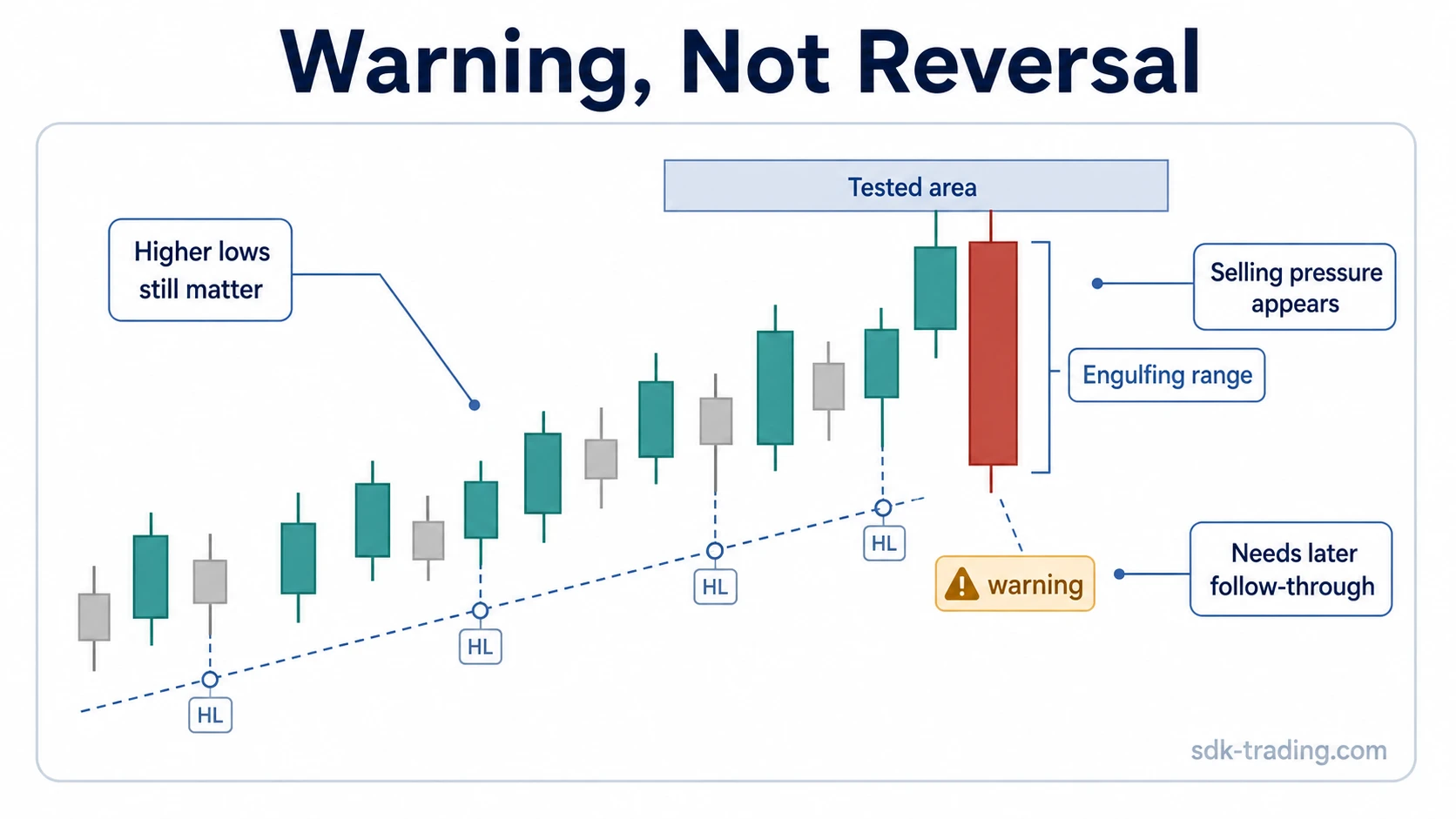
Location decides how much weight the candle deserves; follow-through decides whether the warning survives. A candle that engulfs after a stretched move into resistance carries more weight than the same candle in the middle of a controlled trend leg. Even then, sellers still need to keep price below the tested area before the bearish interpretation becomes stronger.
Common mistake: treating the engulfing candle as if the uptrend has already ended. A stronger reading waits for later behavior: failed reclaim, lower high, break of higher-low structure, or continued acceptance below the candle range.
What Changes the Reading in an Uptrend
| Later behavior | Structure read | Why it matters |
|---|---|---|
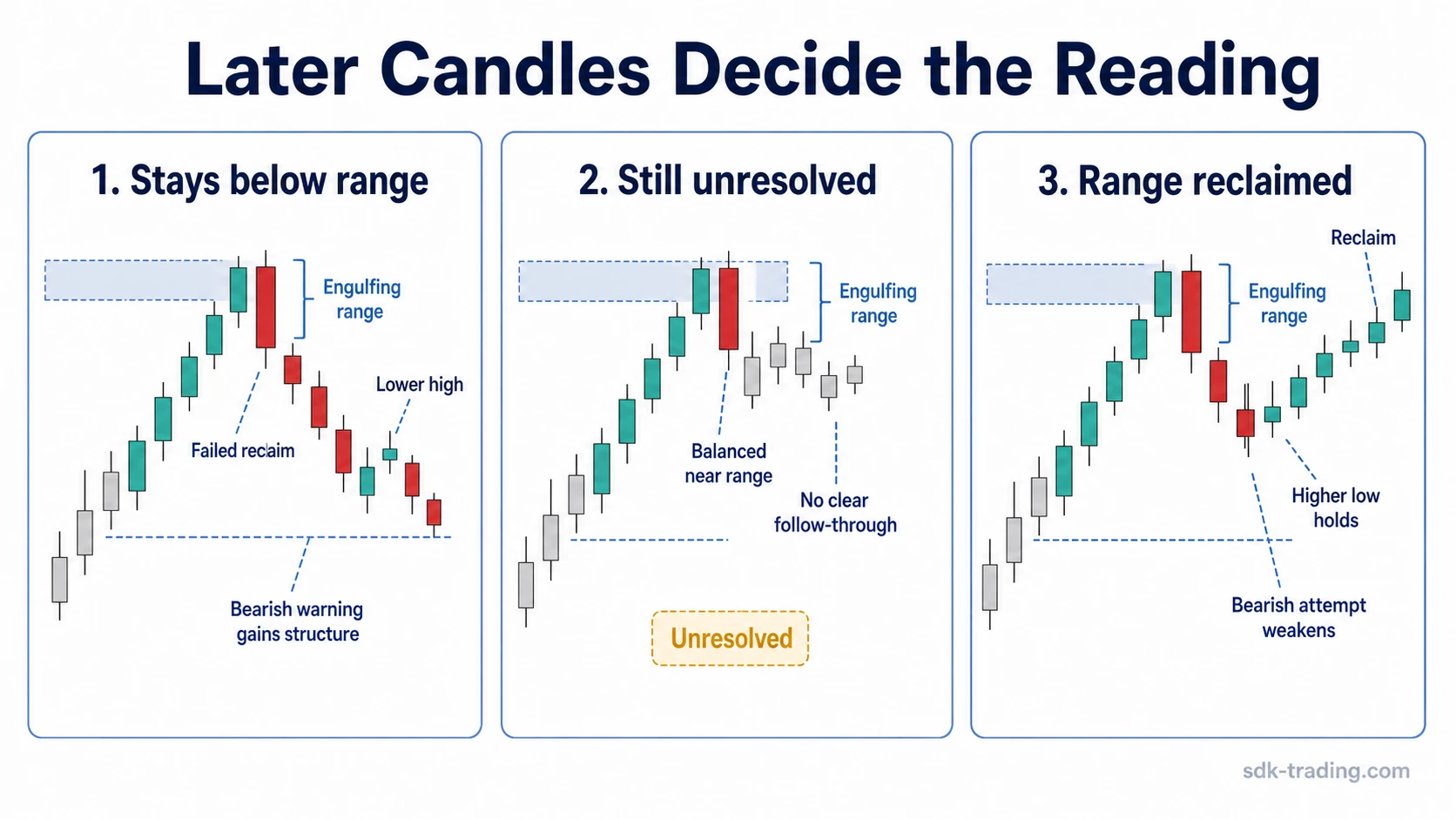
| Price stays below the engulfing range, forms a lower high, and breaks a prior higher low. | The bearish case is moving from candle pressure into trend-structure damage. | Sellers are no longer only reacting at the high; they are beginning to affect the trend sequence. |
| Price holds near the candle range without clean follow-through in either direction. | The candle remains unresolved because neither side has gained acceptance. | The candle shows pressure, but the market has not chosen between rejection and continuation. |
| Price reclaims the engulfing range, preserves higher lows, or pushes to a new high. | The bearish attempt has weakened because buyers have reclaimed the range. | The uptrend structure remains active because sellers did not gain acceptance below the candle range. |
Bearish Engulfing in an Uptrend Example
Price advances through several higher highs and higher lows, then reaches a prior supply area. A bearish engulfing candle forms after the latest upward push and closes below the prior bullish real body. The first reaction is a warning because sellers have interrupted the advance.
If the next recovery attempt stalls below the engulfing candle range and price starts pressing the most recent higher low, sellers are affecting more than one candle. The focus shifts from the engulfing shape to whether buyers can regain the range.
The bearish attempt can fail if buyers reclaim the engulfing range, hold the next pullback above the prior swing low, and then push above the engulfing candle high. In that sequence, selling pressure appeared, but it did not change the higher-low structure.
How It Differs From Nearby Two-Candle Patterns
A bearish harami pattern is usually a contained structure: the second candle sits inside the prior candle’s range and reflects compression or hesitation. A bearish engulfing candle is more forceful because the second candle expands around the prior bullish body.
A dark cloud cover pattern also appears after upward movement, but it does not fully engulf the prior real body. It closes into the prior bullish body and signals pressure through penetration rather than full body coverage.
The practical distinction is pressure versus acceptance. Bearish engulfing, bearish harami, and dark cloud cover can all warn that upside momentum is weakening, but none confirms a reversal unless later candles support the same direction.
When the Bearish Reading Weakens
The bearish reading weakens when price refuses to stay below the engulfing range. A quick reclaim shows that sellers created pressure but did not gain acceptance. If higher lows remain intact, the uptrend has not yet lost its main structure.
The reading also weakens when the candle forms in the middle of a trend leg rather than near a meaningful tested area. Without resistance, exhaustion, failed continuation, or later downside pressure, the candle may reflect temporary profit-taking rather than a durable shift in control.
FAQ
When does a bearish engulfing in an uptrend matter more?
It matters more when the engulfing candle appears near resistance, after a stretched advance, or before later candles fail to reclaim the engulfing range and damage the higher-low structure.
What confirms a bearish engulfing in an uptrend?
Confirmation becomes stronger when later candles fail to reclaim the engulfing range, form a lower high, or break the prior higher low. Those conditions show that selling pressure is affecting structure rather than appearing for only one candle.
Can an uptrend continue after a bearish engulfing candle?
Yes. The uptrend can continue if buyers reclaim the engulfing range, hold higher lows, and push to a new high. In that case, the bearish candle becomes a failed interruption rather than a confirmed reversal.
Does location change a bearish engulfing reading in an uptrend?
Yes. The same candle carries more weight near resistance, after a stretched advance, or after failed upside continuation. In the middle of a controlled trend leg, it usually needs clearer follow-through before the bearish reading gains strength.
How is bearish engulfing different from dark cloud cover?
Bearish engulfing covers the prior bullish real body, while dark cloud cover closes into the prior bullish body without fully engulfing it. Both need later confirmation before the bearish reading becomes stronger.