Continuation Chart Patterns

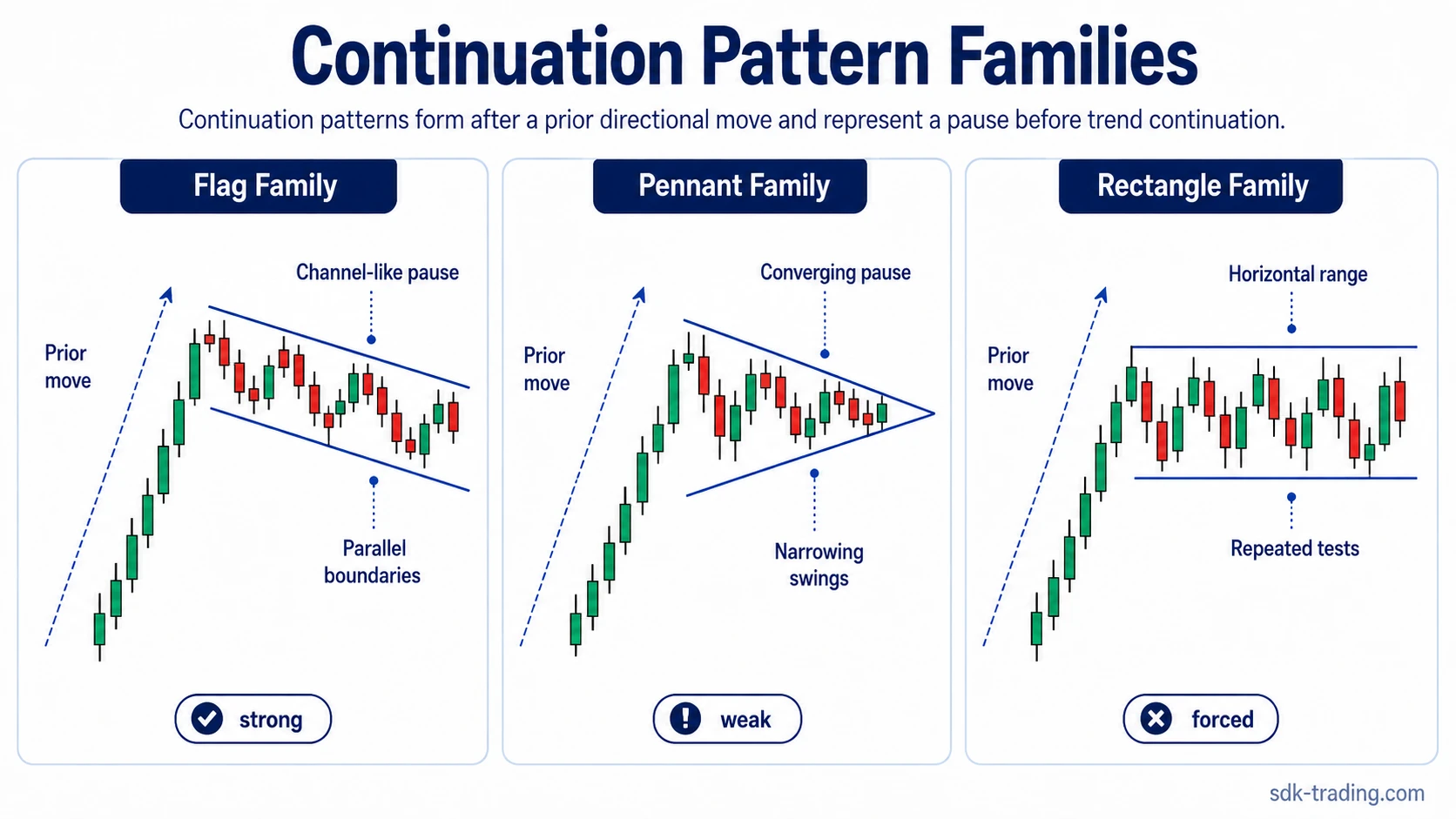
Continuation chart patterns are trading chart structures where price pauses after an existing move and may continue if the pause holds its structure. The pattern name matters less than the behavior inside the pause: a channel-like pullback points toward flag logic, narrowing compression points toward pennant logic, and horizontal containment points toward rectangle logic.

A useful continuation reading starts with contrast. The prior move should be clear enough to give the pause directional context, while the pause should be smaller, more contained, or more compressed than the move that came before it. If the pause erases the impulse, ignores its own boundaries, or fails to attract follow-through in the trend direction, the continuation label becomes weaker.

Definition: A continuation chart pattern is a temporary consolidation after an existing directional move where the market has not yet shown enough evidence to treat the prior trend as finished.

Key Points

  • Continuation chart patterns begin with a prior directional move followed by a pause.
  • Pause shape separates the main families: channel-like, converging, or horizontal.
  • Boundary quality and swing depth help separate clean readings from weak or forced labels.
  • Specific pattern names are safer to use after the structure is classified first.

What Are Continuation Chart Patterns?

Continuation chart patterns form when price stops advancing or declining in a straight line and begins to consolidate within the context of an existing move. The pause can slope against the move, compress into a smaller range, or move sideways while buyers and sellers test the same area repeatedly.

The important point is conditional. A continuation pattern does not prove that the trend will resume. It only shows that the market is pausing in a way that may still fit the prior direction if later price behavior supports that interpretation.

The prior impulse gives the pattern its context. Without a visible move before the pause, the same candles may look like ordinary sideways movement rather than a continuation structure.

How Continuation Pattern Families Differ

Continuation-pattern families are separated by the shape of the pause. A channel-like pause has different information than a narrowing pause, and both differ from a horizontal containment range.

Pause structure Common family Main reading question Interpretation risk
Small pullback contained by roughly parallel boundaries Flag family Is the pause orderly relative to the prior impulse? A deep or messy pullback can erase the continuation context.
Compact swings that narrow toward a point Pennant family Is volatility compressing without losing the prior directional context? Loose or oversized compression can become a forced label.
Repeated tests inside horizontal upper and lower boundaries Rectangle family Are both sides of the range being respected? A range can remain unresolved if neither side gains acceptance.
Broader narrowing or expanding geometry Triangle or wedge-related structures Is the shape still part of continuation logic, or has it become a separate pattern family? Overfitting geometry can blur the difference between continuation, reversal, and indecision.
Continuation chart pattern families grouped by flag, pennant, and rectangle pause structures after a prior move
Continuation pattern families differ by pause shape, boundary behavior, and reading quality.

Continuation Pattern Classification Map

The fastest way to classify a continuation pattern is to start with the structure, not the name. Each label becomes more useful when it is tied to the actual pause shape, boundary behavior, and amount of directional context still visible on the chart.

Structure you see Likely pattern family What to check Related pattern concept
Price advances, then pulls back in a smaller channel-like pause Bullish flag structure Impulse contrast, parallel boundaries, and whether the pause stays controlled bull flag structure
Price declines, then pauses in an upward or sideways channel-like correction Bearish flag structure Whether the correction remains smaller than the prior decline bear flag structure
The pause is a compact channel rather than a broad sideways range Flag family Boundary respect, corrective depth, and whether reactions repeat on both sides flag pattern structure
Swings narrow quickly after the prior move Pennant family Converging boundaries, shrinking swings, and whether compression stays compact pennant compression
A bullish impulse is followed by compact converging compression Bullish pennant Whether the compression is small enough to preserve the prior bullish context bullish pennant structure
Price moves sideways between repeated horizontal tests Rectangle family Whether upper and lower boundaries are repeatedly respected before acceptance changes rectangle continuation range

How to Identify a Continuation Pattern

A continuation reading begins with the move before the pause. The impulse should be visible enough that the pause can be judged against it. A small, controlled pause after a clear move is easier to classify than a pause after a weak or unclear move.

Next comes the shape of the consolidation. Parallel boundaries suggest flag-family logic, converging boundaries suggest pennant-family logic, and repeated horizontal tests suggest rectangle-family logic. The more a label depends on redrawing boundaries after the fact, the weaker the structure becomes.

Later behavior matters because the pause alone is incomplete. A continuation interpretation becomes more defensible when price behavior supports acceptance in the prior trend direction. The interpretation weakens when the market returns into the pause quickly, breaks the structure without acceptance, or turns the consolidation into a wider unresolved range.

Clean, Weak, and Forced Continuation Readings

Not every pause deserves a continuation-pattern label. A better reading separates clean structure from weak structure before giving the pattern a name.

Reading quality What it looks like Why it matters
Clean reading Clear prior impulse, compact pause, respected boundaries, repeated reactions The structure is readable before the label is applied.
Weak reading Deeper or choppier pause, mixed boundary reactions, unclear compression The continuation idea may still exist, but the evidence is less clean.
Forced reading Boundaries are drawn after the fact, the impulse is mostly erased, or the range keeps expanding The pattern name starts doing more work than the chart structure.

Reading note: A clean pattern label should come from visible structure. If the label only works after ignoring messy swings, failed boundary reactions, or a missing prior impulse, the continuation reading is less reliable as an interpretation.

Simple Continuation Chart Pattern Example

Price advances strongly into a prior resistance area and then begins to pause. If the pause stays compact and forms a small downward or sideways channel, the structure is closer to flag-family logic. If the swings narrow quickly into a compact point, the structure is closer to pennant-family logic.

The same pause becomes harder to classify if it grows deeper, breaks both sides repeatedly, or turns into a broad horizontal range. At that point, the stronger question is not which label sounds best, but whether the prior impulse still has enough influence over the structure. If movement outside the pause is quickly rejected and price returns into the structure, the reading should stay unresolved rather than being treated as confirmed continuation.

Common Mistakes With Continuation Patterns

A common mistake is calling every pause after a move a continuation pattern. A pause is only useful when its structure can be compared with the prior move and with later acceptance or rejection.

Common mistake: Treating the first break from a pause as proof of continuation. A break can start the next question, but it does not remove the need to judge acceptance, failure, and the quality of the structure that came before it.

  • Ignoring the prior impulse and naming a sideways range as a continuation pattern too early.
  • Using a flag or pennant label when the correction is too deep or too disorderly.
  • Drawing boundaries that fit only after several failed attempts.
  • Reading a rectangle as continuation when both sides of the range remain unresolved.
  • Using the pattern name as a substitute for context, structure, and later behavior.

Related Continuation Pattern Concepts

Channel-like continuation pauses usually lead into flag-family concepts. A bullish channel-like pause belongs closer to bull flag logic, while a bearish continuation pause belongs closer to bear flag logic.

Compact converging structures lead into pennant concepts. A bullish pennant keeps the focus on narrowing compression after an upward impulse, while the broader pennant concept separates compression quality from direction.

Horizontal containment leads into rectangle concepts. A rectangle continuation range depends on repeated tests of both sides of the range before the market shows whether acceptance is developing outside it.

FAQ

What are the main types of continuation chart patterns?

The main continuation chart pattern families include flags, pennants, rectangles, and some triangle or wedge-related structures. The cleaner classification starts with the shape of the pause: channel-like, converging, or horizontal.

Are continuation chart patterns reliable by themselves?

Not by itself. A continuation-pattern reading depends on the prior move, the quality of the pause, boundary behavior, and later acceptance or failure.

How is a flag different from a pennant?

A flag usually has a small channel-like pause with roughly parallel boundaries. A pennant usually has compact converging boundaries where the swings narrow after the prior move.

When does a continuation pattern become a forced reading?

A continuation pattern becomes forced when the label depends on redrawn boundaries, a weak prior impulse, an overdeep correction, or structure that no longer respects its own pause.