A bullish pennant is a continuation-context chart pattern that can form after a prior upward impulse, followed by a compact converging consolidation. The label is stronger when the structure has meaningful upper and lower boundaries and the later movement beyond the upper boundary is accepted, not only briefly pierced.
A small triangle after a rise is not automatically a bullish pennant. Loose sideways movement, unclear boundaries, or a wick-only push above the structure can make the reading weak. The pattern is best treated as a classification of price structure, not as a prediction that continuation must follow.
Definition: A bullish pennant is a bullish continuation chart pattern defined by a prior upward impulse, a short converging consolidation, and accepted movement beyond the upper boundary of that consolidation.
Key Points
- A bullish pennant needs a prior upward impulse before the consolidation begins.
- The consolidation should be compact and converging, with both upper and lower boundaries carrying meaning.
- A wick above the upper boundary is weaker than price holding outside the prior compression.
- The reading weakens when the structure becomes loose, returns quickly into the range, or fails through the lower boundary.
- A bullish pennant is related to the broader pennant family, but it is the upward-pressure variant after a prior advance.
What Is a Bullish Pennant?
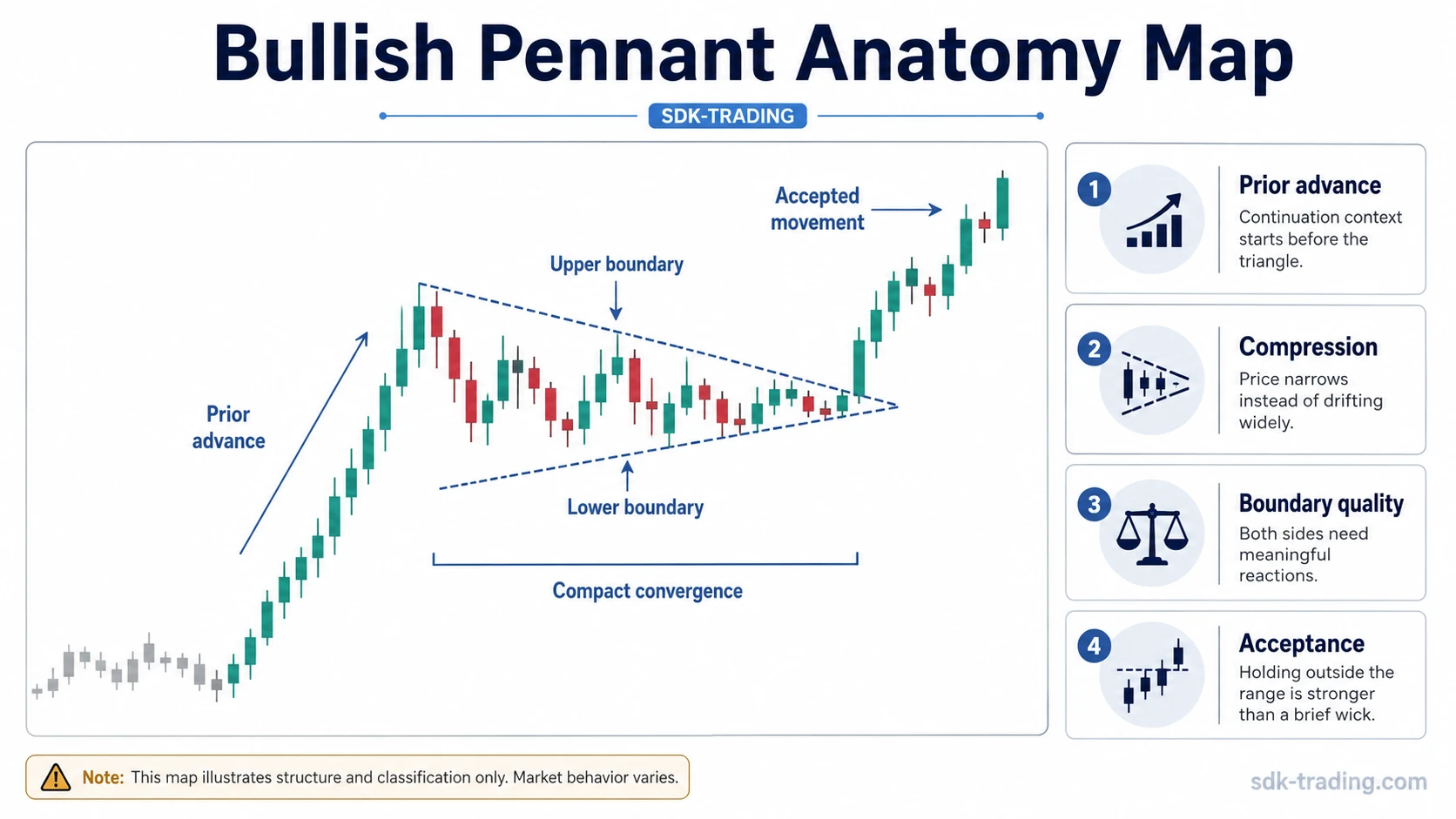
A bullish pennant is a compact continuation pattern that appears after price has already advanced. The first part is the upward impulse. The second part is a narrowing pause where price compresses between falling resistance and rising support. The final structural test is whether movement beyond the upper boundary is accepted rather than immediately rejected.
The pattern is called bullish because it forms after an upward move and tests whether buyers can maintain pressure after a pause. That does not make every bullish-looking triangle valid. The shape has to be connected to the prior impulse, and the consolidation has to behave like compression rather than random chop.
Classification boundary: A bullish pennant reading becomes more defensible when the prior advance, compact convergence, boundary quality, and upper-side follow-through align. If one of those pieces is missing, the label should stay tentative.
What a Bullish Pennant Is Often Mistaken For
The most common mistake is treating any small triangle after price rises as a bullish pennant. A true reading needs more than shape similarity. The earlier move should be strong enough to create a clear flagpole, and the consolidation should narrow in a way that shows compression rather than directionless movement.
A bull flag is also different. A bull flag usually has a more channel-like or parallel pullback structure, while a bullish pennant contracts into a smaller converging range. A broad triangle without a clear prior impulse may still be a triangle, but the bullish pennant label is weaker if the structure is not tied to an earlier upward drive.
A wick above the upper boundary can start the question, but it does not settle the classification. If price immediately closes back inside the consolidation or returns into the range on the next movement, the breach is weak evidence. Accepted movement is stronger when price remains outside the prior compression instead of immediately falling back into it.
Bullish Pennant Anatomy
The anatomy of a bullish pennant is easiest to read as a sequence of structural conditions. Each condition narrows the interpretation. The pattern does not begin with the triangle. It begins with the prior advance that gives the consolidation its continuation context.
| Part of the structure | What to observe | Why it affects the reading |
|---|---|---|
| Prior upward impulse | Price advances clearly before the consolidation forms. | Without the prior impulse, the structure is not a bullish continuation pennant. |
| Compact consolidation | Price pauses in a smaller range instead of drifting widely. | Compactness helps separate compression from ordinary sideways chop. |
| Converging boundaries | The upper boundary slopes down or flattens while the lower boundary rises. | Convergence gives the pattern its pennant structure. |
| Volume or participation | Participation often contracts during the pause and is watched again near the boundary test. | Volume can support the reading, but it does not validate the pattern by itself. |
| Upper-boundary acceptance | Price moves beyond the upper boundary and does not quickly fall back into the structure. | Movement that does not quickly return into the prior range is stronger evidence than a wick-only breach. |
How to Identify a Bullish Pennant
Identification starts with the prior move. If the market has not advanced first, the structure may be a different triangle or consolidation. The next step is to inspect the pause: a bullish pennant should compress into a small, converging range rather than expand into loose volatility.
Boundary quality matters. The upper and lower sides should be meaningful enough that multiple reactions can be compared. A single line drawn through one wick is weak evidence. The structure becomes easier to classify when both boundaries contain price for a short compression phase and the later boundary test is visible.
- Look for a clear upward impulse before the consolidation.
- Check whether the pause is compact relative to the prior move.
- Compare both boundaries, not only the upper breakout area.
- Separate a wick-only breach from accepted movement outside the structure.
- Treat volume as supporting context, not as a mechanical rule.
- Downgrade the reading if the range becomes loose, overlapping, or directionless.
Limitation: A bullish pennant can look clean while it is forming and still fail if price cannot hold beyond the upper boundary. The useful question is not whether the shape resembles a pennant, but whether the structure behaves like controlled compression followed by accepted release.
Clean, Weak, and Invalid Bullish Pennant Readings
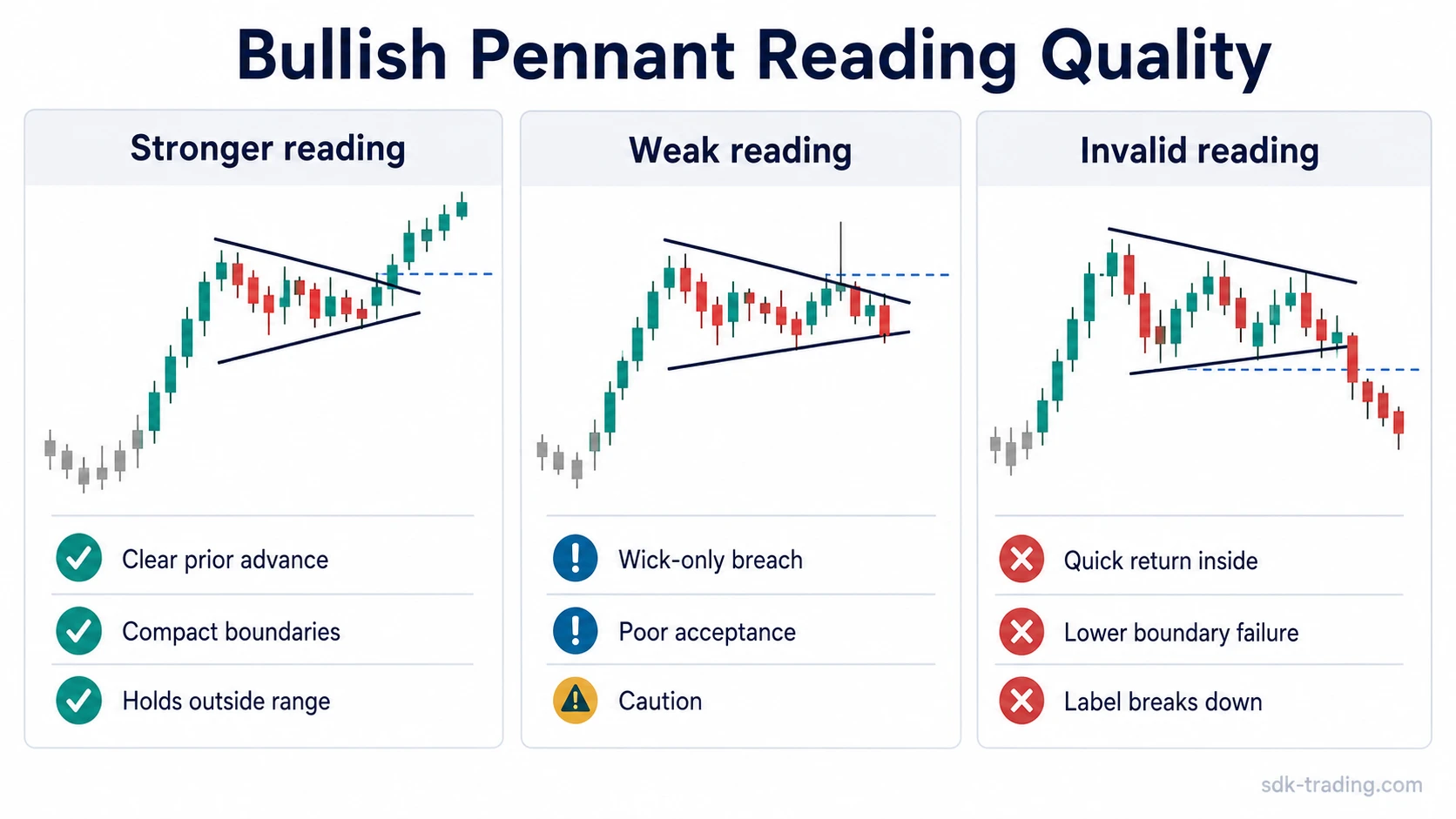
The same visual idea can produce different classification quality. A clean reading has alignment between impulse, compression, boundaries, and price holding outside the prior compression. A weak reading has partial evidence. An invalid reading loses the structural conditions that made the bullish pennant label reasonable.
| Reading quality | Typical structure | Diagnostic interpretation |
|---|---|---|
| Clean bullish pennant | Clear prior advance, compact converging pause, meaningful boundaries, and accepted movement above the upper boundary. | The bullish pennant classification is more defensible because the structure and boundary behavior align. |
| Weak bullish pennant | Prior advance is visible, but the consolidation is loose, boundaries are poorly defined, or the upper breach is only a wick. | The pattern may still be considered, but the evidence is incomplete and the label should remain cautious. |
| Invalid bullish pennant | No meaningful prior impulse, no real convergence, quick return into the range, or failure through the lower boundary. | The structure no longer supports the bullish pennant label, even if part of the chart still resembles a small triangle. |
Example: Wick-Only Breach vs Accepted Movement: Price advances sharply, then compresses into a small converging range. The upper boundary is tested, but the first push above it leaves only a wick and closes back inside the structure. That keeps the reading weak. The classification becomes more defensible only if later movement holds beyond the upper boundary and the prior compression does not immediately fail.
Bullish Pennant vs Pennant, Bearish Pennant, and Bull Flag
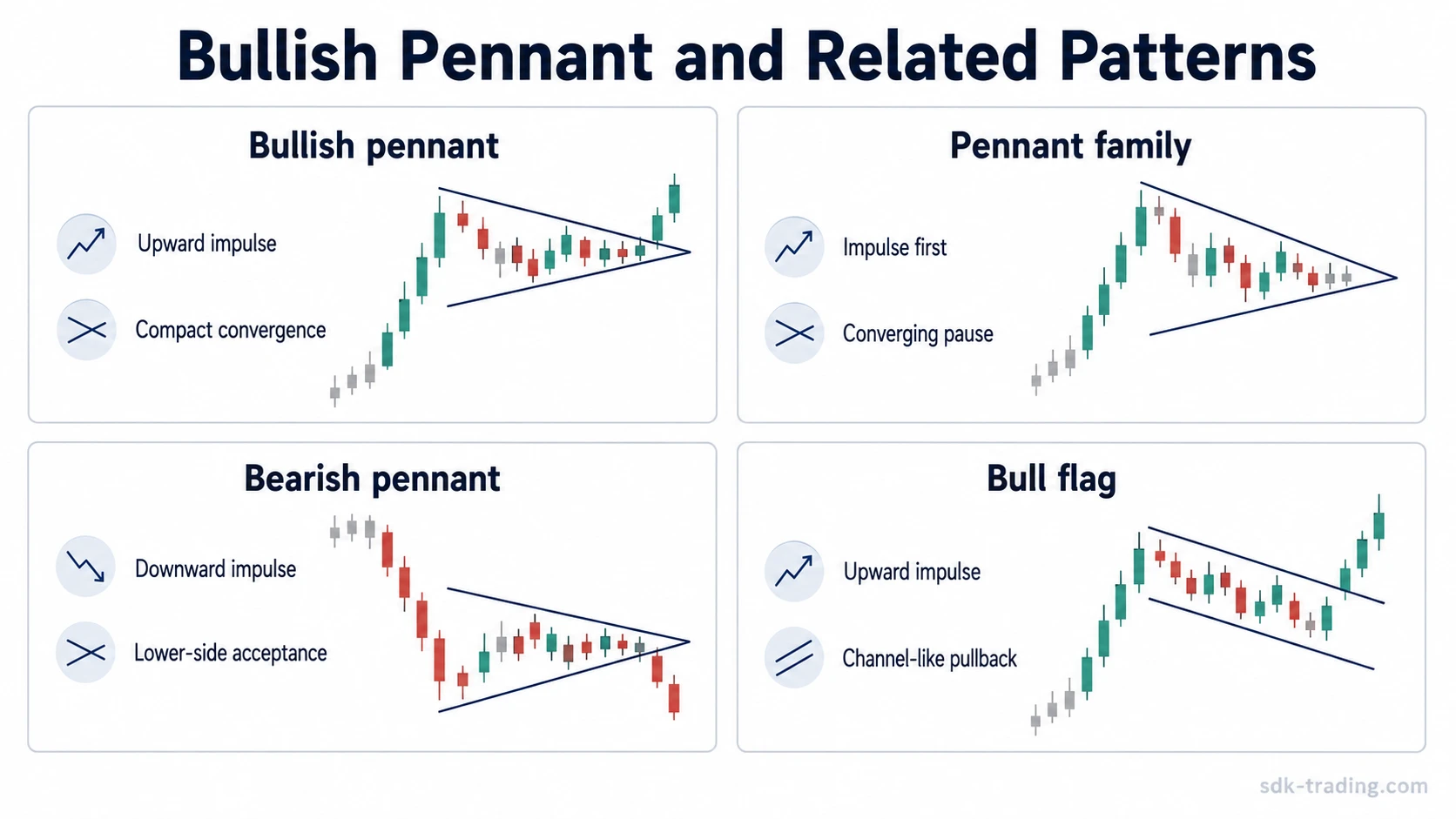
A pennant is the broader chart-pattern structure: a prior impulse followed by a compact converging consolidation. A bullish pennant is the version that forms after a prior upward impulse and tests upper-side continuation pressure.
A bearish pennant is the directional counterpart. It appears after a prior decline and tests whether lower-side pressure is accepted after a compact pause.
A bull flag is close enough to create confusion, but the shape is different. A bull flag is usually read through a more parallel or channel-like pullback, while a bullish pennant narrows into a compact triangle-like compression. The distinction is structural, not only directional.
| Concept | Core structure | Main distinction |
|---|---|---|
| Bullish pennant | Upward impulse, compact converging pause, upper-boundary acceptance. | Bullish directional variant after a prior advance. |
| Pennant | Impulse plus compact convergence. | Broader family that can include bullish or bearish direction. |
| Bearish pennant | Downward impulse, compact converging pause, lower-boundary acceptance. | Directional counterpart after a prior decline. |
| Bull flag | Upward impulse plus more channel-like consolidation. | Usually less triangular and less convergent than a pennant. |
Common Mistakes With Bullish Pennants
One mistake is forcing the label onto any bullish-looking consolidation. A valid reading needs the prior upward impulse and the compact converging pause. Without those conditions, the structure may still be useful to observe, but the bullish pennant label is less precise.
Another mistake is treating the first boundary breach as enough. A wick above the upper boundary can appear during a failed test. If price quickly returns into the prior consolidation, the evidence points more toward rejection than accepted movement.
Volume can also be misread. Traders often watch for quieter participation during the pause and renewed activity near the boundary test, but volume does not turn a poor structure into a clean pattern. It is a supporting clue, not a substitute for impulse, compression, and boundary behavior.
Measured-move formulas can create false precision when used as certainty claims. A bullish pennant describes structure and classification quality. It does not guarantee distance, duration, or outcome.
FAQ
What is a bullish pennant?
A bullish pennant is a continuation-context chart pattern that forms after a prior upward impulse, then compresses into a compact converging consolidation before testing movement beyond the upper boundary.
How do you identify a bullish pennant?
Identify the prior upward impulse first, then check whether the consolidation is compact, converging, and bounded by meaningful upper and lower sides. A stronger reading also needs accepted movement beyond the upper boundary rather than only a wick.
What makes a bullish pennant weak?
A bullish pennant reading is weak when the consolidation is loose, the boundaries are poorly defined, the breach is wick-only, volume does not support the structure, or price quickly returns into the prior range.
What invalidates a bullish pennant reading?
The reading fails when the structure loses its continuation conditions, such as no clear prior impulse, no real convergence, quick return into the consolidation, or failure through the lower boundary.
Is a bullish pennant the same as a bull flag?
No. Both can appear after an upward impulse, but a bullish pennant narrows into a compact converging structure, while a bull flag usually has a more parallel or channel-like pullback.