A bearish pennant is a trading chart pattern that appears after downside pressure, when price compresses into a small converging range instead of continuing lower in a straight line.
The bearish label is better supported when price later holds beyond the lower boundary. A brief probe below the line, forced boundaries, or a quick reclaim of the consolidation makes the structure less reliable as a bearish-pennant reading.
Definition: A bearish pennant is a continuation chart pattern built from a prior downward impulse, a short narrowing consolidation, and a bearish-side resolution through the lower side of that consolidation.
Key Points
- A bearish pennant starts with downside pressure before the small converging range appears.
- The consolidation should look compressed and controlled, not like loose sideways chop with forced trendlines.
- A clean reading needs bearish-side acceptance beyond the former lower boundary, not only a single wick through the line.
- Immediate reclaim of the prior consolidation weakens or invalidates the bearish-pennant label.
What Is a Bearish Pennant?
A bearish pennant is the bearish variant of a pennant pattern. It usually appears after a sharp downward move, then forms a compact triangular pause as selling pressure slows temporarily and price compresses between converging boundaries.
The pattern label describes structure, not a guaranteed outcome. The visible question is whether the pause remains a bearish continuation structure or turns into ordinary consolidation, failed breakdown, or unrelated chop.
Cleaner bearish-pennant readings often combine three elements: a clear prior decline, a small tightening consolidation, and behavior that holds beyond the lower side of the pattern.
Bearish Pennant Structure and Anatomy
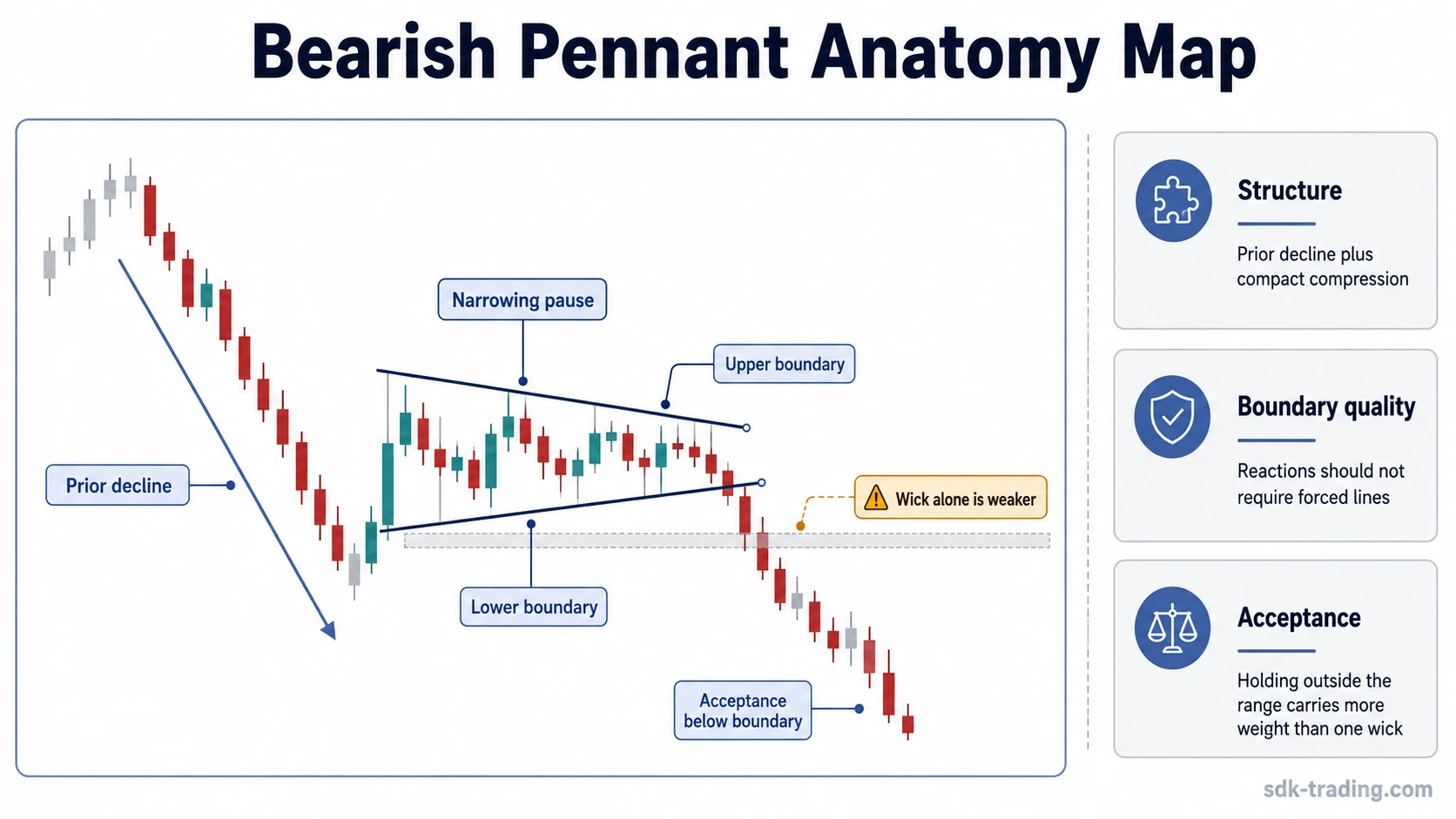
A bearish pennant has two main parts: the prior downward impulse and the compressed pause that follows it. The prior impulse gives the pattern its bearish context. The pennant itself is the smaller narrowing range that forms after that move.
| Component | What to Look For | Why It Matters |
|---|---|---|
| Prior downward impulse | A clear bearish move before the consolidation begins. | Without downside pressure first, the structure is not a bearish pennant. |
| Small converging range | Price compresses between a descending or flat upper boundary and a rising or flat lower boundary. | The narrowing range separates a pennant from broad sideways movement. |
| Boundary quality | The boundaries connect meaningful reactions without constant redrawing. | Forced lines often turn random chop into a false pattern label. |
| Bearish-side acceptance | Price moves beyond the lower boundary and does not immediately reclaim the prior range. | Acceptance gives the lower-boundary break more weight than a wick-only breach. |
A boundary test is cleaner when the move remains outside the former compression and the old lower side acts as a meaningful reference area. If price moves straight back into the prior range, the pattern depends too much on a single line touch.
Volume can add context, especially if activity contracts during compression and expands during resolution, but volume should not override poor structure. A loose pattern does not become clean only because volume changes.
How to Identify a Bearish Pennant
Identification starts with the sequence, not with the triangle alone. A small triangle that appears without prior downside pressure may be a different type of consolidation.
Identification sequence: first, check whether a clear decline came before the pause. Next, check whether the pause is compact and narrowing. Then check whether the lower boundary is breached with acceptance rather than only touched or briefly pierced.
| Question | Cleaner Answer | Weaker Answer |
|---|---|---|
| Was there downside pressure first? | Yes, a distinct bearish impulse came before the range. | No, the range appeared without a clear bearish lead-in. |
| Is the consolidation compact? | Price tightens into a small range with visible compression. | The range is wide, loose, or repeatedly adjusted to fit the idea. |
| Do the boundaries make sense? | They connect repeated reactions without obvious forcing. | The lines depend on isolated wicks or selective anchor points. |
| What happens near the lower boundary? | Price accepts beyond it and the prior range is not quickly reclaimed. | Price only wicks below it or returns straight back inside the structure. |
What a Bearish Pennant Is Not
A bearish pennant is not every small triangle that appears after a decline. The structure needs a clear lead-in, a compressed pause, and a defensible bearish-side resolution.
It is also not the same as random sideways chop. If price movement is loose, overlapping, and difficult to frame without repeatedly changing the lines, the pattern label is probably being forced.
A one-candle probe below the lower boundary is not enough by itself. A wick through the line can start the question, but the interpretation depends on whether price remains accepted beyond the former boundary or quickly returns into the consolidation.
Clean, Weak, and Invalid Bearish Pennant Readings
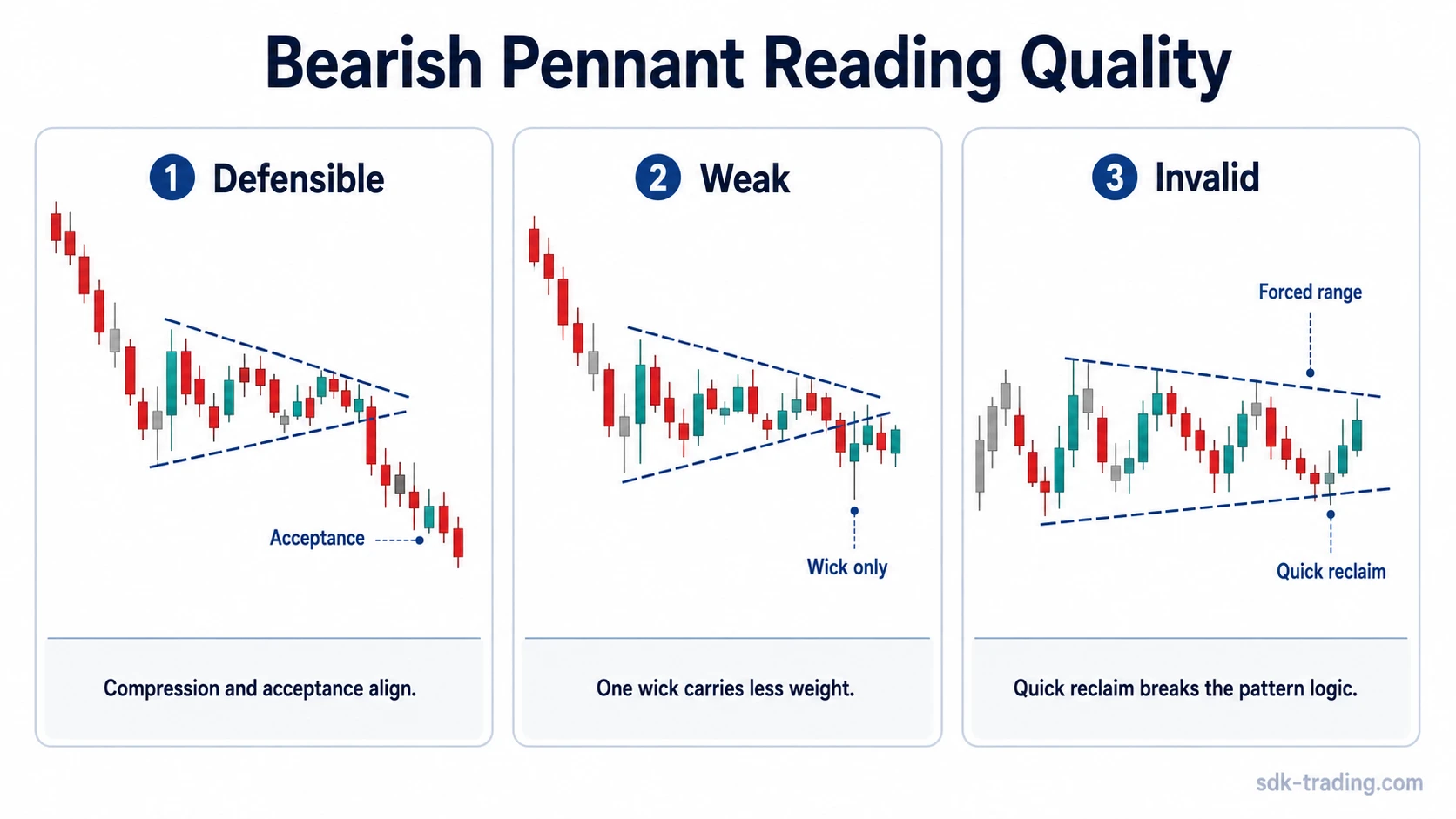
The useful diagnostic split is not simply “pattern present” or “pattern absent.” A bearish pennant can be clean, weak, or invalid depending on the quality of the impulse, compression, boundary behavior, and later acceptance.
| Reading Quality | Structure | Boundary Behavior | Classification Result |
|---|---|---|---|
| Clean | Clear prior decline followed by compact narrowing consolidation. | Lower boundary breaks and price remains accepted beyond the former range. | The bearish-pennant reading is structurally defensible. |
| Weak | Prior decline exists, but the consolidation is loose, uneven, or based on thin contact points. | Price briefly pierces the lower boundary but does not show sustained behavior beyond it. | The pattern remains tentative and depends too much on a single boundary touch. |
| Invalid | The prior impulse is unclear, the range is forced, or movement no longer respects the pennant structure. | Price reclaims the consolidation or moves in a way that breaks the pattern logic. | The bearish-pennant label loses structural support. |
Limitation: The lower-boundary move needs acceptance, not just a wick. A brief break can be noise, especially when the next candles return into the prior compression.
Bearish Pennant vs Bullish Pennant and Pennant
A bearish pennant and a bullish pennant share the same compressed pennant shape, but the prior impulse and directional context differ. The bearish version follows downside pressure, while the bullish version follows upside pressure.
A pennant describes the broader pattern family. The bearish version is the downside continuation variant, so its classification depends on the earlier decline and the way price behaves around the lower boundary.
Short Bearish Pennant Example in Context
Price declines sharply, then pauses in a smaller range where each reaction becomes narrower. The upper and lower boundaries can be drawn without forcing the lines, and the range does not drift into broad sideways chop.
If price moves below the lower boundary and continues to hold outside the former range, the bearish-pennant reading is cleaner. If the move only leaves a lower wick and price quickly returns into the consolidation, the structure becomes weaker or invalid.
If the recovery back inside the range stalls near the former lower boundary, the structure remains unresolved rather than cleanly restored. That distinction keeps the focus on classification quality instead of turning the pattern into a trade instruction.
Common Mistakes and Limitations
The first common mistake is ignoring the prior move. A pennant shape without earlier downside pressure may still be a triangle or consolidation, but it does not carry the same bearish-pennant structure.
The second mistake is forcing the boundaries. If the pattern only works after excluding inconvenient candles or redrawing the lines several times, the chart is probably not showing clean compression.
The third mistake is treating a wick as acceptance. A brief move through the lower boundary has less diagnostic value when price immediately reclaims the prior range.
The fourth mistake is turning the label into a prediction. A bearish pennant describes a chart structure and a possible continuation reading; it does not guarantee continuation and does not replace broader analysis.
FAQ
What does a bearish pennant mean?
A bearish pennant means price declined first, then compressed into a small converging range. The bearish reading becomes stronger when price later accepts below the lower boundary.
How do you identify a bearish pennant?
Look for a prior downward impulse, a compact narrowing consolidation, defensible boundary reactions, and bearish-side acceptance beyond the lower boundary.
Can a bearish pennant fail?
Yes. The reading weakens when the structure is forced, the range becomes loose chop, or price breaks below the lower boundary and quickly reclaims the prior consolidation.
Is volume required for a bearish pennant?
Volume can add context, but it should not override structure. A poor pattern does not become clean only because volume changes during the consolidation or boundary move.