Continuation chart patterns are trading structures where price pauses after a prior directional move and may later continue in the same direction. The useful job is classification: deciding whether the pause looks more like a flag, pennant, rectangle, measured move, or another continuation structure before comparing the specific pattern reading.
Definition: A continuation chart pattern is a pause within an existing trend structure. It does not prove that the trend will continue; it gives a chart-reading framework for comparing the shape of the pause, the quality of the boundaries, and the behavior that follows.
Pattern names are useful only when they separate different structures. A tight sloping pause, a compact converging pause, a sideways range, and a two-leg measured rhythm can all appear after a strong move, but they are not the same reading.
Quick Classification Filter
- Start with the prior directional move, then judge the pause structure.
- Use the pattern name to classify shape, not to create a trade instruction.
- Compare flag, pennant, rectangle, and measured-move readings before choosing the specific structure.
- Treat poor boundary quality, loss of compression, and fast rejection as reasons to question the continuation reading.
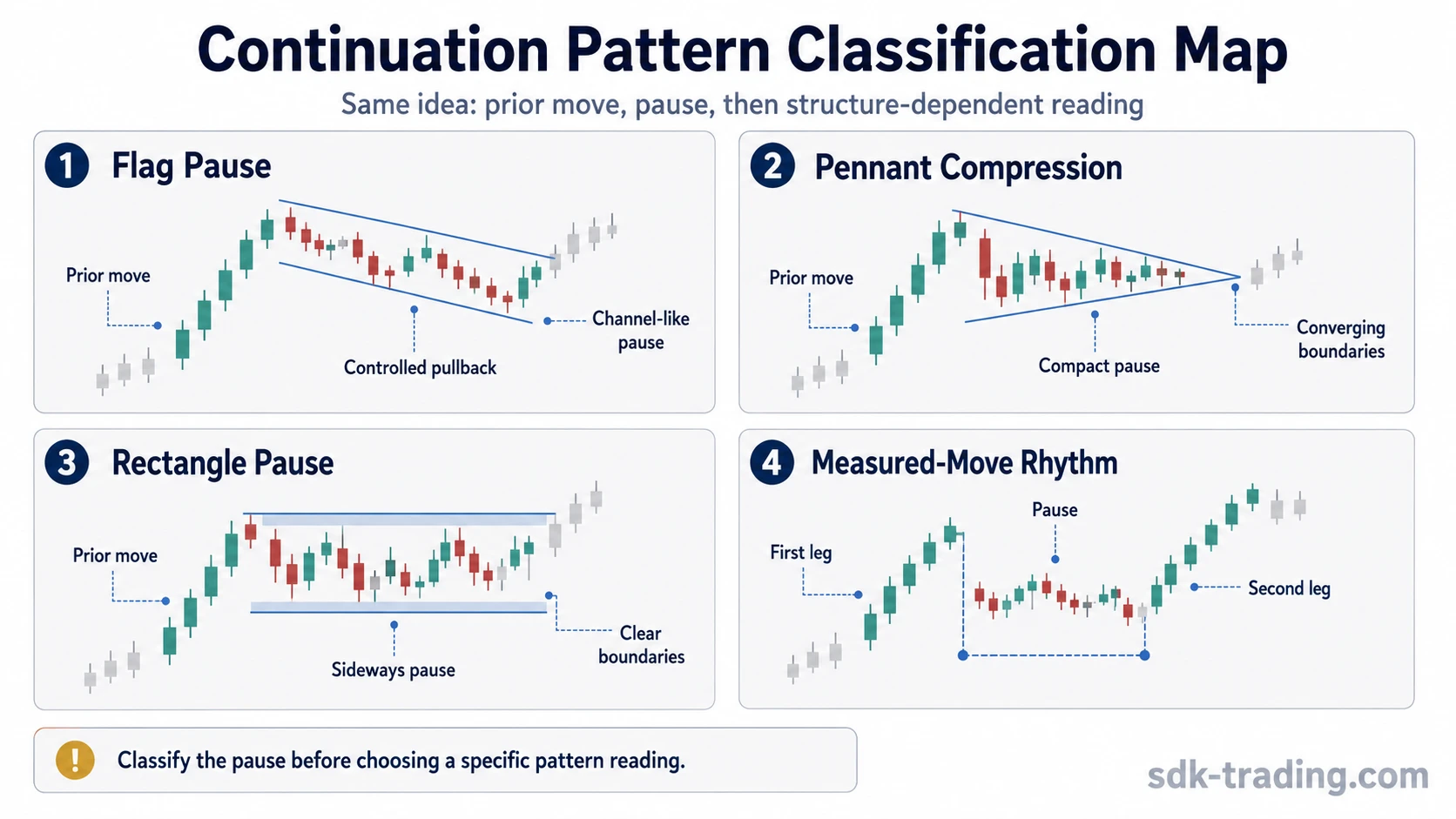
How Continuation Patterns Are Grouped
Continuation structures can be grouped by the way price pauses. The same broad idea can look different depending on whether the pause is sloping, compact, horizontal, or part of a larger two-leg rhythm.
| Structure type | What the pause looks like | Common pattern names | What to check next |
|---|---|---|---|
| Flag family | A short, usually sloping pause after a sharp move. | Flag pattern, bull flag, bear flag | Whether the pullback is controlled or too deep for a clean continuation reading. |
| Pennant family | A compact converging pause after a strong directional move. | Pennant, bullish pennant, bearish pennant | Whether the pause is tight enough to read as compression rather than a loose triangle-like drift. |
| Sideways continuation | A horizontal pause between relatively stable upper and lower boundaries. | Rectangle | Whether the structure is a defined rectangle or a broader range with less precise boundaries. |
| Measured rhythm | A move, pause, and second leg that can be compared structurally. | Measured move up, measured move down | Whether the second leg belongs to a continuation rhythm or a separate swing structure. |
| Related continuation families | Other chart-pattern families can also pause inside trends, but they may have separate classification rules. | Triangles, wedges, channels, cup-and-handle structures | Check whether the structure belongs to a neighboring chart-pattern family before forcing it into the core continuation groups. |
Core Continuation Pattern Groups
Each group below points to a more specific continuation structure. Use the shape and direction of the pause to choose the closest match.
| Group | Pattern | Best fit | Boundary to watch |
|---|---|---|---|
| Flag family | flag pattern | A short channel-like pause after a strong prior movement. | The pause should remain orderly enough to read as controlled correction, not a broad reversal attempt. |
| Flag family | bull flag | A bullish continuation reading after an upward impulse and controlled pullback. | A deep or disorderly pullback weakens the flag classification. |
| Flag family | bear flag | A bearish continuation reading after a downward impulse and controlled rebound. | A strong recovery that accepts higher prices can challenge the bearish continuation read. |
| Pennant family | pennant | A compact converging pause after a directional move. | If the structure becomes wide, slow, or poorly bounded, the pennant label becomes less useful. |
| Pennant family | bullish pennant | A compact bullish continuation pause after an upward impulse. | The reading depends on compression quality, not on the name alone. |
| Pennant family | bearish pennant | A compact bearish continuation pause after a downward impulse. | Loss of compression or acceptance against the prior direction can move the structure away from a bearish pennant reading. |
| Measured move family | measured move up | An upward continuation rhythm where the second leg is compared with the earlier movement. | The rhythm should be read as structure, not as a guaranteed projection. |
| Measured move family | measured move down | A downward continuation rhythm where the second leg is compared with the earlier movement. | The reading weakens if the pause turns into acceptance against the prior direction. |
| Sideways continuation | rectangle | A horizontal consolidation with clearer upper and lower boundaries. | Messy boundaries can make the structure closer to a range than a clean rectangle. |
Continuation vs Reversal Readings
A continuation reading starts with the idea that the market is pausing after a prior directional move. A reversal reading starts to become more relevant when the pause accepts price action against that prior direction, breaks the structure of the move, or repeatedly fails to regain the continuation area.
The first pause is not enough by itself. The distinction depends on whether later behavior supports controlled consolidation or shows that control has shifted away from the prior trend.
Useful boundary: continuation patterns classify a pause inside a trend; reversal patterns question whether the prior trend is losing control. A structure can begin as a possible continuation and later fail if price behavior no longer supports that reading.
Flag, Pennant, Rectangle, or Measured Move?
After a strong directional move, the first decision is not whether the pattern is bullish or bearish. The first decision is structural: what kind of pause is forming?
| Observation | Closer continuation reading | Common confusion |
|---|---|---|
| The pause slopes against the prior move in a short channel-like form. | Flag family | A loose pullback may be mistaken for a clean flag. |
| The pause compresses into a compact converging structure. | Pennant family | A broad triangle-like pause may be called a pennant too early. |
| The pause moves sideways between horizontal boundaries. | Rectangle family | A normal range may be forced into a rectangle label. |
| The structure forms a move, pause, and second leg rhythm. | Measured move family | A projected rhythm may be treated too mechanically. |
Flag and pennant labels can overlap when a pause is short and compact. The distinction between a bull flag vs pennant reading depends mainly on whether the pause looks channel-like or converging.
Horizontal pauses need a separate check. A rectangle vs range distinction matters when the boundaries are too loose to support a precise rectangle classification.
When a Continuation Reading Is Weak
A continuation label becomes weaker when the pause loses compression, absorbs too much of the prior move, or fails to regain the side that should support continuation. The problem is not the pattern name by itself; the problem is that the behavior no longer supports a clean pause-after-impulse reading.
Common mistake: naming the structure before judging reading quality. A chart can resemble a continuation pattern but still fail as a useful classification if boundary quality is poor, the pullback distorts the prior movement, or the next attempt cannot hold the continuation side of the structure.
Reliability language should stay conditional. A specific bull flag reliability question belongs in a narrower reliability reading, not in a broad classification table.
Simple Continuation Pattern Example in Context
Price moves strongly in one direction, then pauses near the middle of the prior move rather than immediately reversing it. If the pause is short and channel-like, the flag family is the first comparison. If it compresses into a tight converging shape, the pennant family becomes more relevant. If it holds between two clear horizontal boundaries, the rectangle reading may fit better.
The same pause becomes less convincing as a continuation reading if it expands, loses boundary quality, or starts accepting price action against the prior move. The pattern name should follow the structure; it should not force the interpretation.
FAQ
What are continuation chart patterns?
Continuation chart patterns are structures where price pauses after a prior directional move and may later continue in the same direction. They are used to classify the pause, not to guarantee the next move.
Which continuation pattern families are usually compared first?
Continuation-pattern families often compared first include flags, pennants, rectangles, and measured moves. The useful classification depends on the shape of the pause and the quality of the surrounding price behavior.
How are continuation patterns different from reversal patterns?
A continuation pattern reads the pause as part of the existing trend structure. A reversal reading becomes more relevant when price behavior shows acceptance against the prior direction or repeated failure to regain the continuation area.
Can a continuation pattern fail?
Yes. A continuation reading can fail when the pause becomes poorly structured, loses compression, accepts price action against the prior direction, or challenges the prior trend structure.