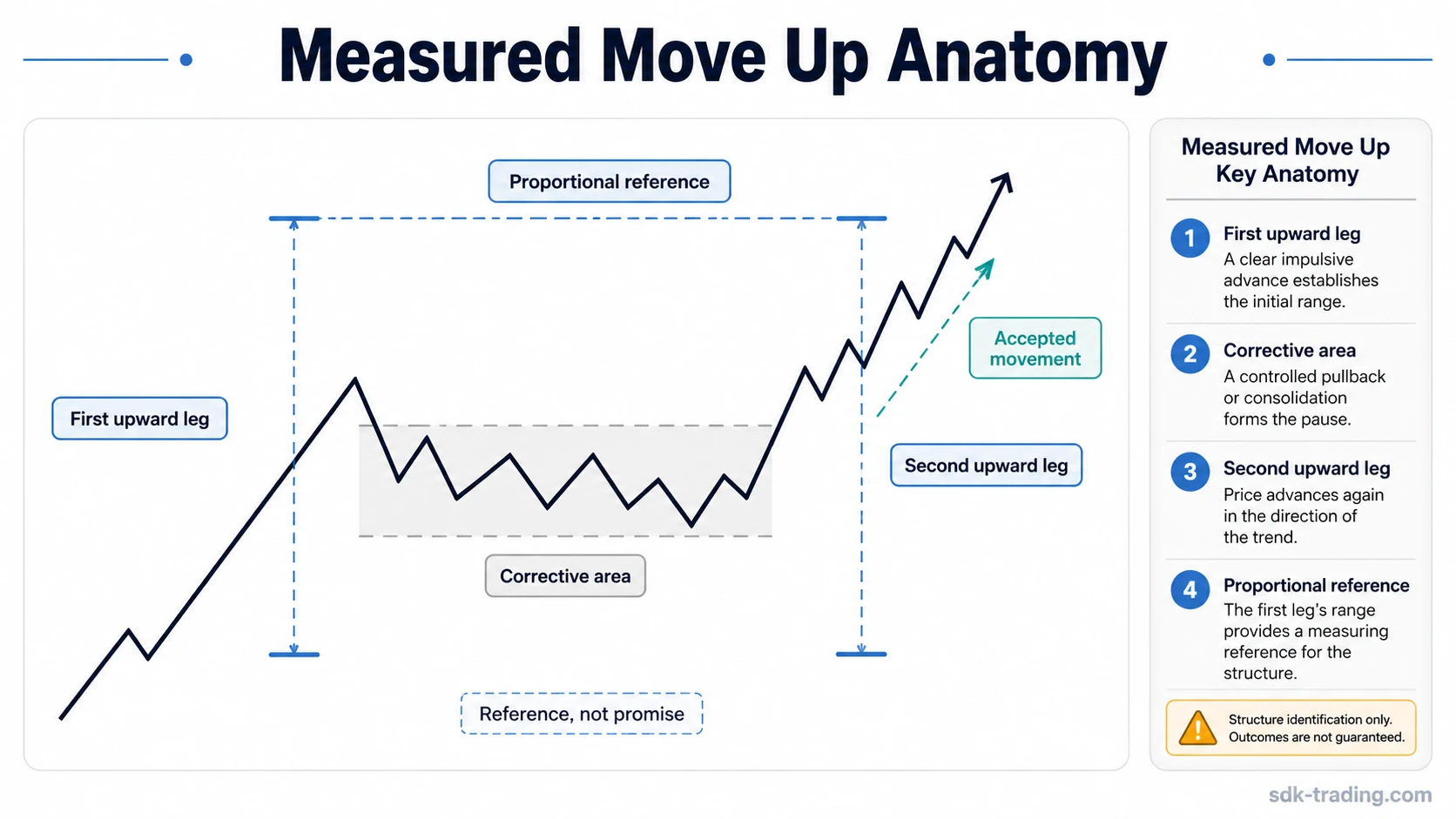
A measured move up is not just two rallies separated by a pullback. In technical chart analysis, it is a bullish structure where a first upward leg, a corrective phase, and a later upward leg show enough proportional rhythm to be read as one related movement.
Definition: A measured move up is a chart pattern built from a first upward price leg, a correction or consolidation, and a second upward price leg that develops from that correction. The first leg gives a structural reference, but it does not prove that the second leg must match it exactly.
The useful idea is proportionality, not certainty. The first leg helps frame the scale and rhythm of the structure. The correction then shows whether the market is pausing in a controlled way or losing the shape that made the label defensible.
Key Points
- A measured move up uses three parts: first upward leg, correction, and second upward leg.
- The two upward legs do not need to be identical; proportionality is a structural reference, not a promise.
- A cleaner structure has a controlled correction and a second leg that remains accepted beyond the corrective area.
- The label loses strength when price returns into overlap, the correction expands too deeply, or the second leg fails to preserve the rhythm.
What Is a Measured Move Up?
A measured move up is a bullish chart structure that compares a prior upward movement with a later upward movement after a pause. The pattern is usually read as a two-leg advance separated by a correction, but the correction is not a minor detail. It is the part that separates a structured continuation from a loose sequence of unrelated swings.
The common misunderstanding is treating the first leg as a fixed forecast. A cleaner interpretation treats the first leg as a scale reference, then checks whether the correction and second leg still support the same structure.
Common misunderstanding: A measured move up is not confirmed by the visual similarity of two rallies alone. The correction between them must remain coherent, and the later upward leg must show acceptance rather than a brief push that quickly returns into the prior overlap.
How a Measured Move Up Forms
The structure usually begins with a clear upward leg. That first movement creates the reference. It should be distinct enough to separate from ordinary noise, but it does not need to be vertical or unusually large.
The middle phase is a correction, consolidation, or pause. This area matters because it shows whether the market is absorbing the prior advance in a controlled way. A tight or orderly correction keeps the measured-move idea intact. A deep, expanding, or disorderly correction can change the label into something else.
The second upward leg tests the structure. A cleaner reading appears when price leaves the corrective area and remains above it. A brief move above the correction is weaker when it behaves like a wick-only test and then returns into the old overlap.
| Part of the structure | What to observe | Why it matters |
|---|---|---|
| First upward leg | A distinct advance with enough range to act as a reference | Creates the scale for judging later proportionality |
| Correction or consolidation | A pause that does not fully erase the prior structure | Shows whether the advance is being digested or structurally lost |
| Second upward leg | Renewed upward movement away from the corrective area | Tests whether the market is extending the earlier rhythm |
How to Identify a Measured Move Up
Identification starts with structure, not with a drawn projection line. The first upward leg should be visible enough to serve as a reference, the correction should remain contained enough to preserve the relationship, and the later upward movement should show more than a brief probe above the corrective area.
A stronger measured move up usually has four observable features:
- Clear first leg: the initial advance stands out from nearby price noise.
- Controlled correction: the pause does not fully destroy the prior upward structure.
- Renewed displacement: the second upward movement leaves the correction with visible directional pressure.
- Acceptance beyond the pause: price does not immediately fall back into the corrective overlap after testing higher ground.
Measurement note: The first leg can be used as a proportional reference. It should not be treated as a guarantee that the later leg will travel the same distance or finish at a precise projected point.
Clean, Weak, and Invalid Measured Move Up Readings
The same broad shape can produce very different readings. The distinction depends on impulse quality, correction behavior, price acceptance beyond the corrective area, and whether the second leg preserves a visible relationship to the first leg.
| Reading quality | Typical structure | Interpretation |
|---|---|---|
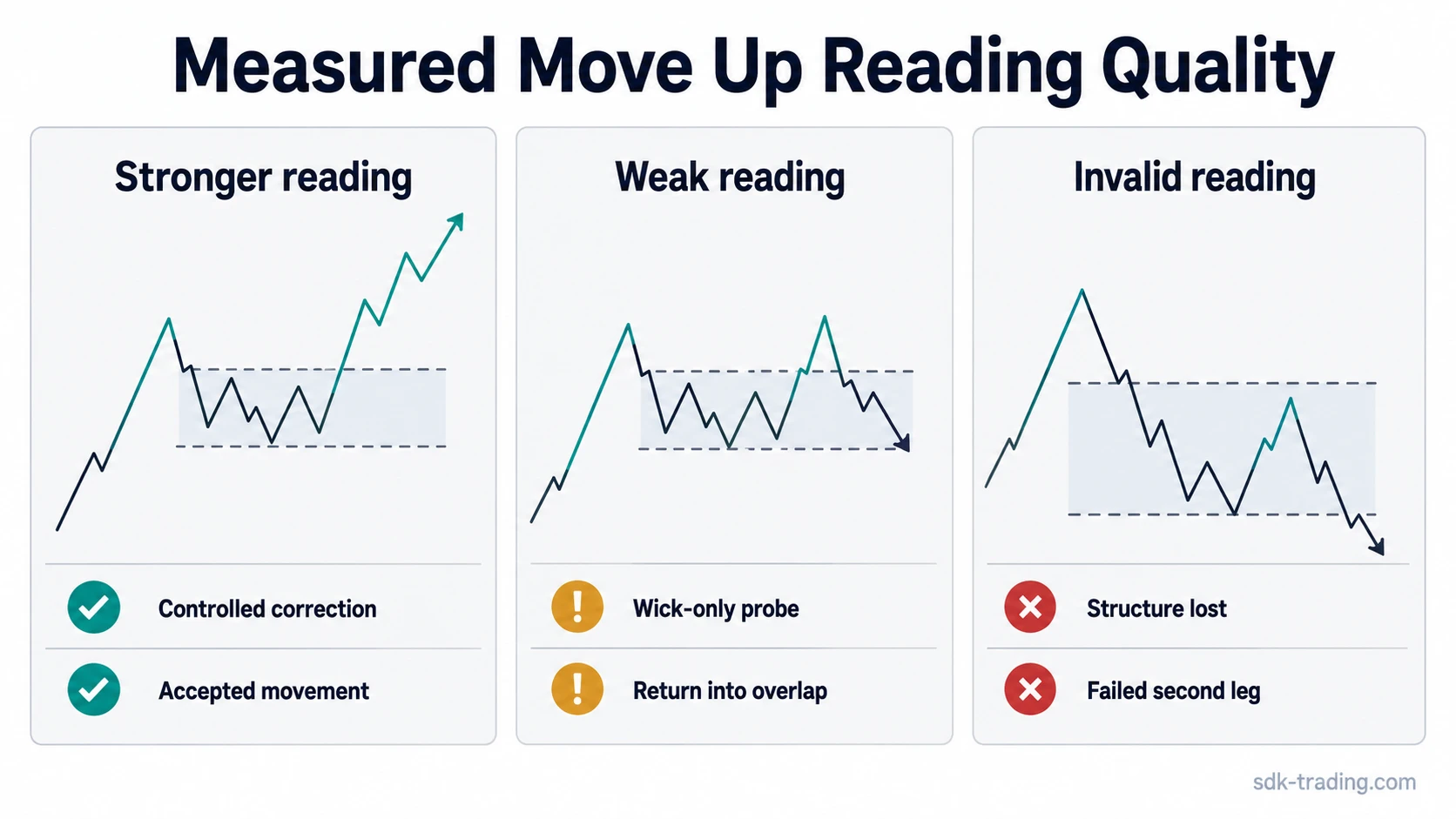
| Clean measured move up | Clear first upward leg, contained correction, accepted second upward movement | The pattern remains structurally coherent because the second leg extends from a controlled pause rather than from a broken or random base. |
| Weak measured move up | Messy correction, shallow acceptance, poor proportional rhythm, or wick-only movement beyond the correction | The label is possible but less defensible because the market has not shown enough durable movement away from the corrective area. |
| Invalid measured move up | Deep or expanding correction, failed second leg, fast return into overlap, or full loss of structure | The measured-move label breaks down because the second leg no longer behaves like a continuation of the first leg’s rhythm. |
A brief touch above the corrective area is less useful than behavior that stays outside the overlap. When price quickly falls back into the old range, the structure becomes less convincing even if the first and second legs still look visually similar.
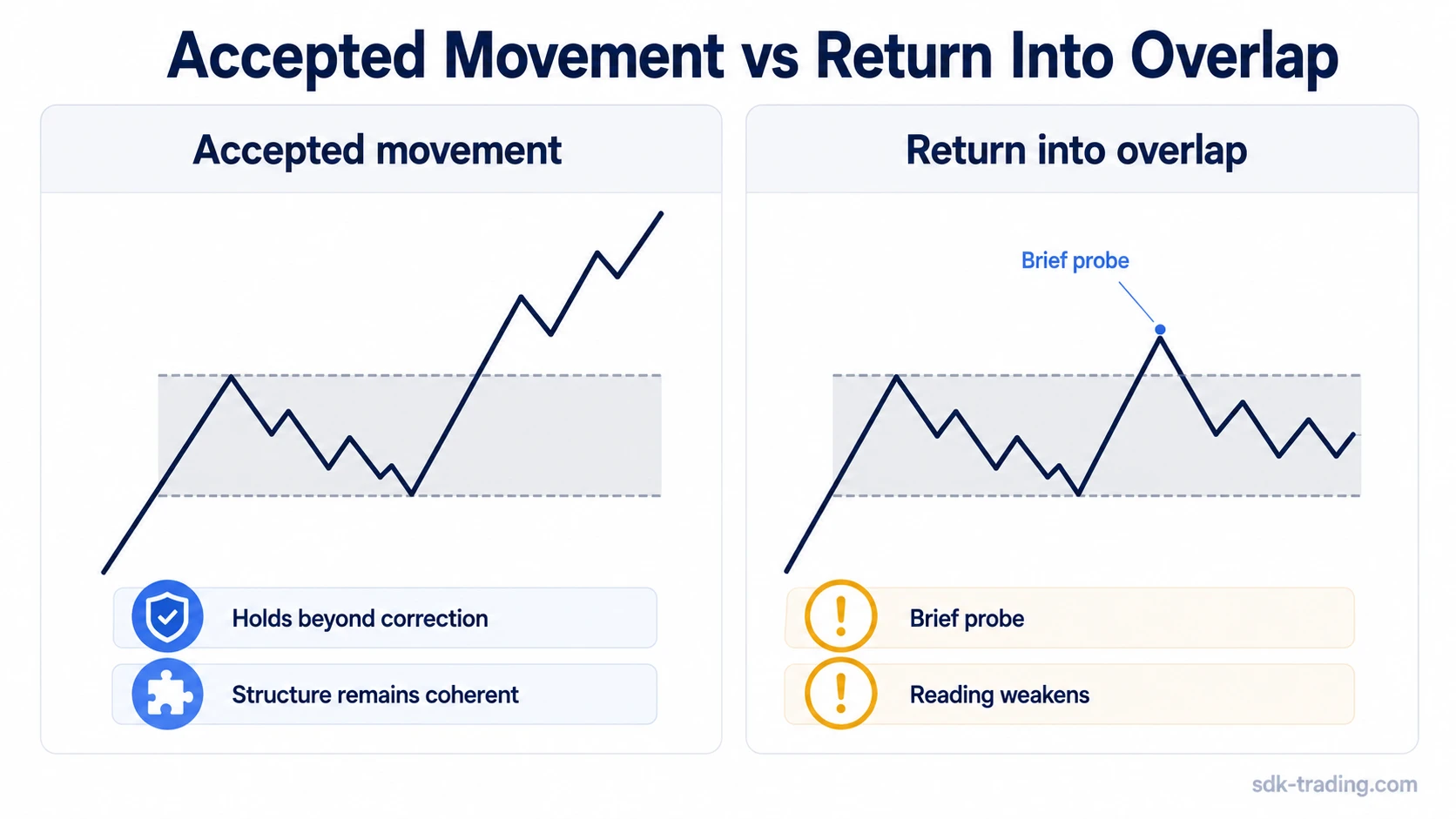
Example: Accepted Movement vs Return Into Overlap
Price advances from a prior base, then pauses in a narrow corrective area. The first advance is visible enough to act as a reference, and the correction does not fully erase it. A later upward movement leaves the corrective area and continues to hold above it, so the structure can be read as a cleaner measured move up. If the later movement only pushes briefly above the correction, drops back into the old overlap, and the next recovery attempt stalls below the same area, the label becomes weaker or unresolved.
The scenario is illustrative, not historical. It focuses on structure quality without turning the first leg into a promised destination or the second leg into trading instruction.
Measured Move Up vs Related Patterns
A measured move up is directionally opposite to a measured move down. The upward version focuses on a bullish two-leg structure, while the downward version focuses on a bearish two-leg structure separated by a corrective phase.
A bull flag is different because the consolidation is usually read through a channel-like pause after an advance. A pennant is different because the pause usually compresses into converging boundaries. A rectangle is different because the middle structure behaves more like a horizontal range. These shapes can appear near similar market conditions, but they are not the same pattern label.
| Pattern | Main structural focus | Key distinction |
|---|---|---|
| Measured move up | Two upward legs separated by a correction | Focuses on proportional rhythm between the first and second upward movements |
| Measured move down | Two downward legs separated by a correction | Uses the same measured-move idea in the bearish direction |
| Bull flag | Impulse followed by a channel-like pause | Focuses more on the flag channel than on two proportional legs |
| Pennant | Impulse followed by converging compression | Focuses on narrowing boundaries rather than a measured two-leg relationship |
| Rectangle | Horizontal range after directional movement | Focuses on repeated upper and lower range tests |
Common Mistakes When Reading a Measured Move Up
The first mistake is treating the first leg as a guaranteed objective. A projection can frame proportion, but it cannot prove continuation. The second leg still has to develop through accepted price behavior.
The second mistake is forcing exact equality between the two upward legs. A measured move up can remain structurally valid even when the second leg is shorter or longer than the first, as long as the broader rhythm and correction quality remain coherent.
The third mistake is ignoring the correction. A correction that expands too deeply, chops through the prior structure, or fails to hold a useful boundary can weaken the pattern before the second leg is judged.
The fourth mistake is labeling every renewed rally as a measured move up. A second rally without a clear first leg, controlled correction, and durable movement away from the correction is only a rally, not a strong measured-move reading.
Limitations of the Measured Move Up Pattern
A measured move up is interpretive. Different chart scales, different swing definitions, and different boundary choices can change whether the structure looks clean or forced.
The pattern also has projection limits. The first leg can help frame a possible proportional relationship, but the market does not owe the chart an equal second leg. Structure, acceptance, and failure behavior matter more than a drawn distance.
Context can change the reading. A measured move up inside a strong trend may look cleaner than one forming into a major resistance area, a broad range, or a market that repeatedly rejects higher prices. The structure is useful only when the surrounding behavior supports it.
Limitation: A measured move up does not predict price by itself. It is a way to describe a bullish two-leg structure and judge whether the second leg remains proportionally and structurally connected to the first.
Measured Move Up FAQ
What is a measured move up in trading?
A measured move up is a bullish chart structure with a first upward leg, a correction or consolidation, and a later upward leg that can be compared with the first leg for proportional rhythm.
Does the second leg need to equal the first leg?
No. The first leg gives a reference for scale, but the second leg does not need to match it exactly. The reading depends on structure, correction quality, and accepted movement.
When does a measured move up become weak?
The reading becomes weak when the correction is messy, the move beyond the corrective area is not accepted, or price quickly returns into the prior overlap.
What invalidates a measured move up reading?
The reading is no longer defensible when the correction expands enough to destroy the structure, the second upward leg fails, or price returns into overlap and loses the proportional relationship.