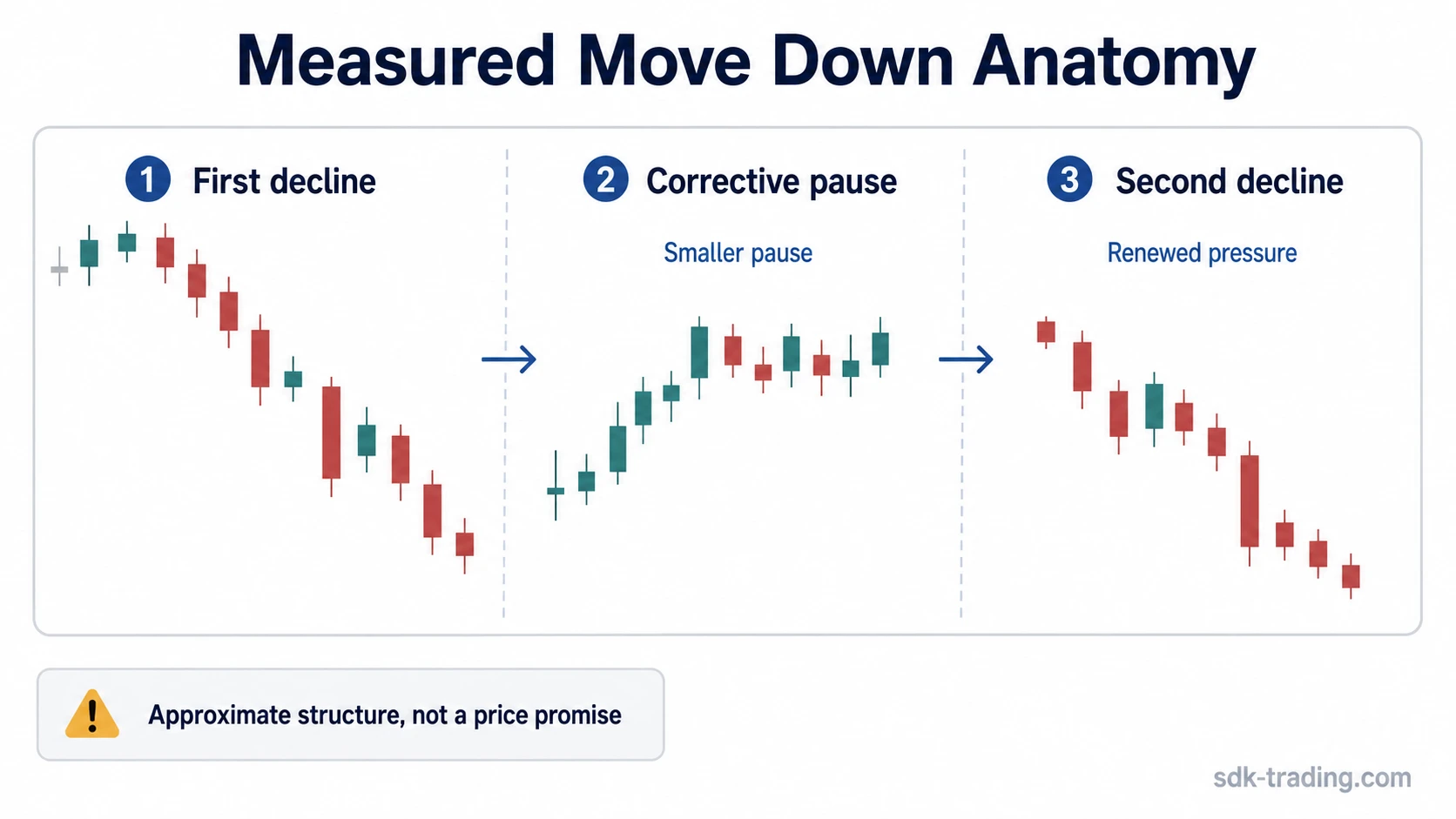
A measured move down is a bearish chart-pattern structure where price makes an initial decline, pauses in a smaller corrective phase, and then attempts a second downside leg with roughly similar character.
The clearest version has three linked parts: first pressure, a controlled pause, and renewed downside resolution. The legs do not need to match exactly; the value of the label comes from the relationship between the decline, the correction, and the next attempt lower.
Definition: A measured move down is a bearish two-leg continuation structure formed by an initial downside leg, a corrective pause, and a second downside leg that attempts to continue the prior pressure.
Key Points
- A measured move down has three visible parts: first decline, corrective pause, and second decline.
- The pause should look smaller than the first decline, not like a full reset into a new balanced range.
- The second leg supports the reading only when bearish displacement returns after the pause.
- Leg similarity is approximate. A projected distance is not a promise that price must travel that far.
- The reading weakens when the pause becomes too deep, too wide, or the second decline cannot separate from the correction.
What a Measured Move Down Is – and What It Is Not
A measured move down is a chart-reading label for a bearish continuation sequence. The label is more defensible when the first decline creates clear downside pressure, the correction stays contained, and the next push lower shows renewed displacement rather than immediate overlap.
It is not an exact-distance rule. The first and second legs are often compared visually, but that comparison only describes proportional rhythm. The structure can still be messy, incomplete, or invalid even if a rough projection can be drawn.
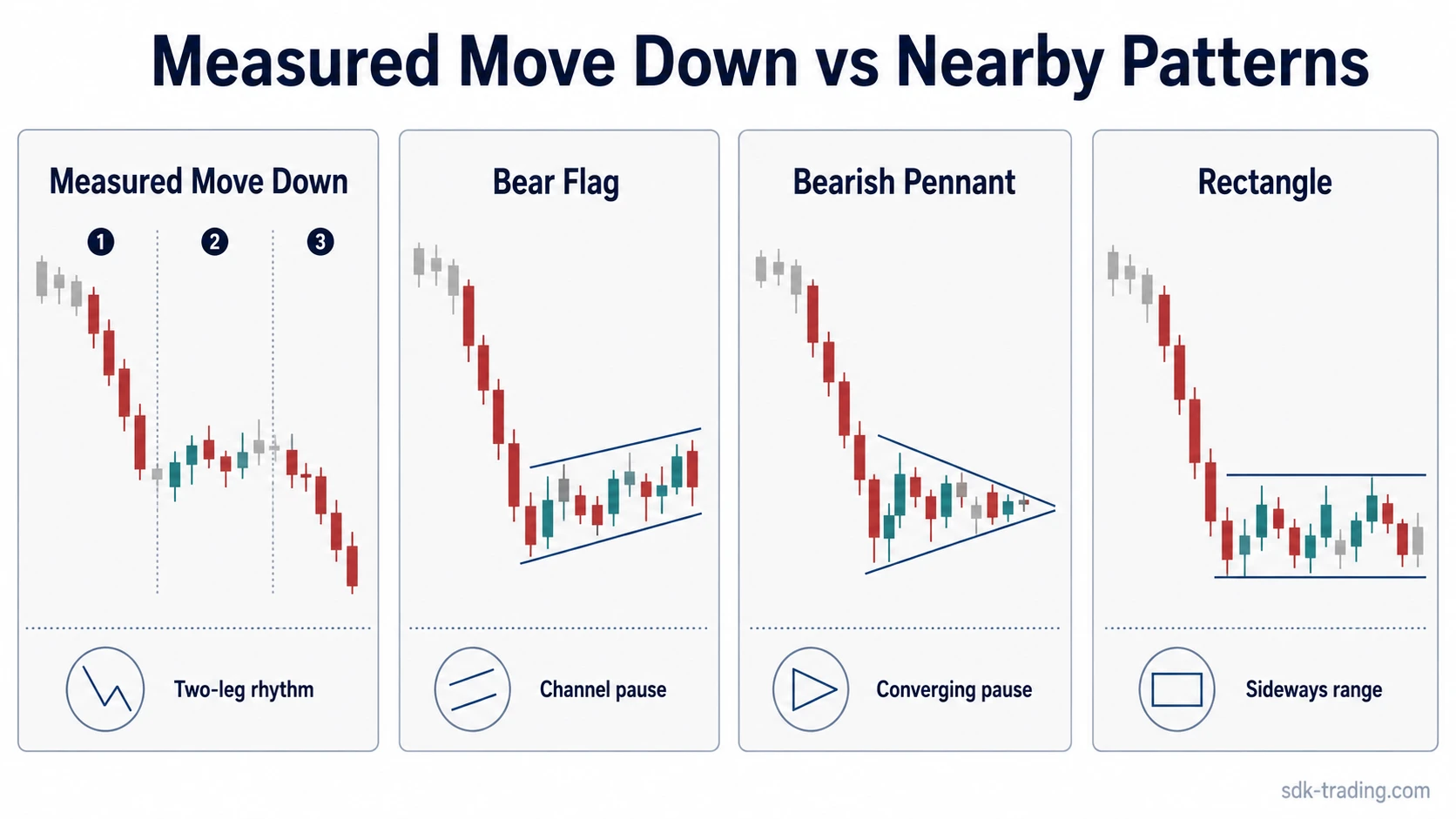
It is also not the same as every bearish consolidation. A bear flag depends more on channel-like containment inside the pause. A pennant depends more on converging compression. A rectangle depends more on sideways range behavior. A measured move down is mainly about the relationship between the first decline, the pause, and the attempted second decline.
Measured Move Down Anatomy
The anatomy is simple, but the quality of the reading depends on how the parts interact.
| Part | What to Observe | Why It Matters |
|---|---|---|
| First decline | A clear bearish leg with directional pressure, lower closes, or visible downside displacement. | It creates the prior move that the later structure is measured against. |
| Corrective pause | A smaller counter-move, consolidation, or shallow recovery after the first decline. | It shows whether sellers are losing control or whether price is only pausing before another attempt lower. |
| Second decline | A renewed downside move after the pause, ideally with enough displacement to separate from the correction. | It determines whether the structure remains a measured move down or turns into a failed continuation reading. |
How to Identify a Measured Move Down
A measured move down reading starts with sequence, not with projection. The first question is whether price has already made a meaningful bearish leg. The second question is whether the recovery or consolidation after that leg remains smaller and less forceful than the decline. The third question is whether bearish pressure returns after the pause.
Useful criteria include:
- a visible first decline rather than random sideways noise;
- a corrective pause that does not erase most of the first decline;
- lower-close pressure returning after the pause;
- a second bearish displacement that separates from the correction;
- limited overlap between the second leg and the pause;
- no quick reclaim that turns the downside attempt into a failed continuation.
The label becomes harder to defend when the pause absorbs the whole first leg, builds higher highs and higher lows, or produces a second leg that stalls immediately. In those conditions, the chart may resemble a measured move down shape without forming a strong bearish continuation structure.
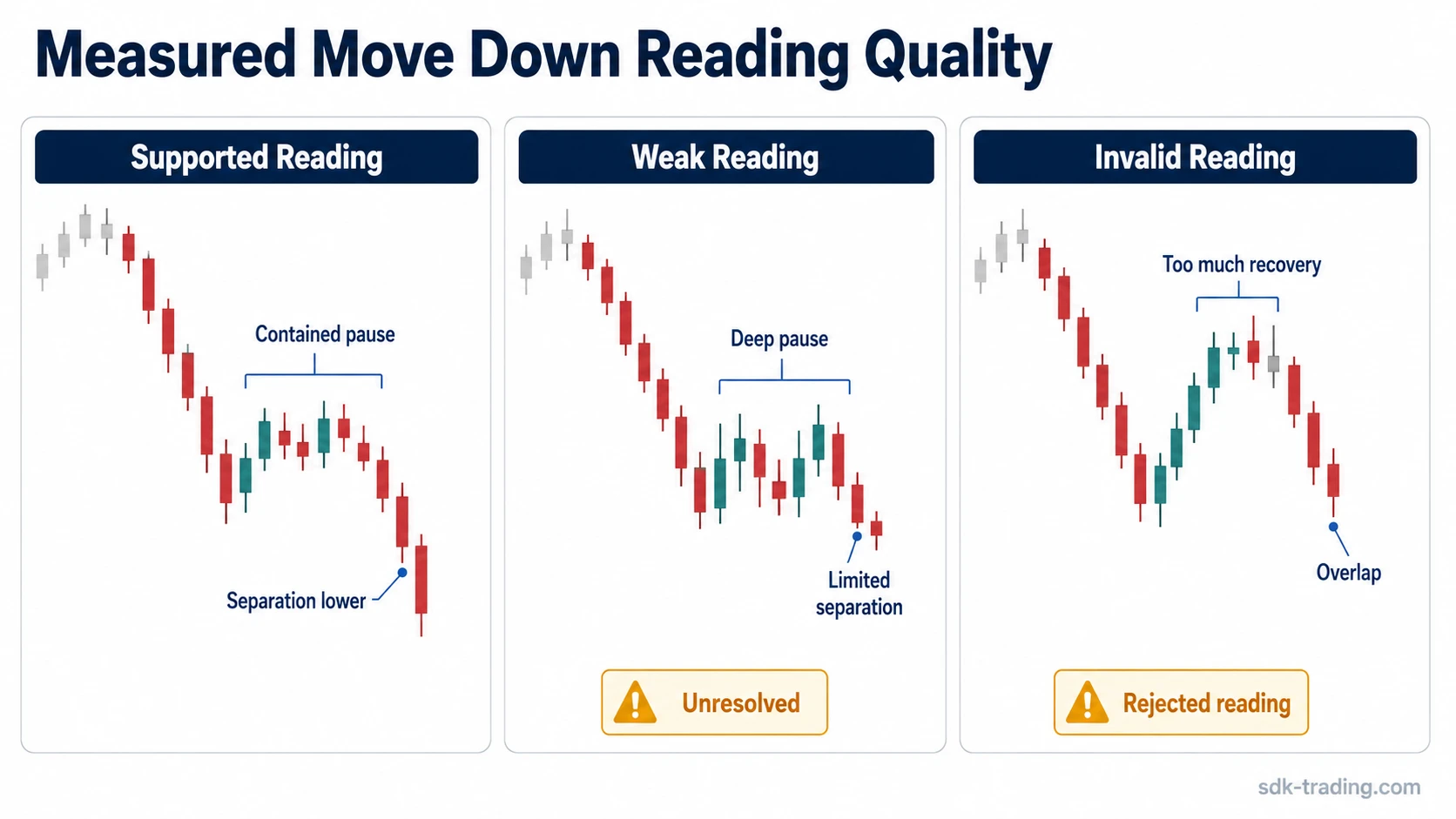
Clean, Weak, and Invalid Measured Move Down Readings
The strongest use of the label is diagnostic. A measured move down reading should separate clean continuation pressure from weaker or failed structures.
| Reading Quality | Typical Structure | Interpretation Boundary |
|---|---|---|
| Clean reading | First decline is clear, the pause stays contained, and the second decline restores downside displacement. | The label is structurally supported because the pause did not reset the move. |
| Weak reading | The first decline is visible, but the pause is deep, wide, choppy, or the second leg lacks force. | The structure may still resemble a measured move down, but the continuation reading is less reliable. |
| Invalid reading | The correction reclaims too much of the first decline, reorganizes into bullish structure, or the second leg fails into overlap. | The pattern label no longer describes a clean bearish continuation sequence. |
Reading boundary: A measured move down is stronger when structure resolves in the direction of the first decline. If the pause becomes a reset and the second leg cannot separate lower, the reading should stay unresolved or be rejected.
Measured Move Down vs Nearby Patterns
A measured move down is the bearish counterpart to a measured move up. The difference is directional: measured move down starts with bearish pressure and looks for a second downside leg after a pause, while the bullish counterpart starts with upward pressure and looks for a second upside leg after a pause.
| Concept | Main Structure | Key Distinction |
|---|---|---|
| Measured move down | First decline, corrective pause, second decline. | The relationship between the two bearish legs is the main feature. |
| Bear flag | Sharp decline followed by a smaller channel-like pause. | The pause geometry matters more than leg similarity. |
| Bearish pennant | Sharp decline followed by narrowing compression. | Converging swings define the pause. |
| Rectangle | Sideways range after a prior move. | Horizontal containment matters more than a two-leg rhythm. |
Limitations of Measured Move Down Readings
The main limitation is that the measured part can sound more precise than the chart actually is. A market does not need to repeat the first leg perfectly. Volatility, overlap, liquidity, and changing participation can all distort the second leg.
The first leg can help describe proportion, but it should not be treated as a forecast of where the second leg must end. A visual comparison is descriptive, not predictive.
A second limitation is correction depth. A shallow or contained pause can preserve the bearish sequence. A deep correction can change the structure completely by turning the move into a broader range or a possible reversal attempt.
Common mistake: Drawing a projected leg first and then forcing the chart to fit the projection. The safer reading starts with observed structure: prior decline, pause quality, and whether bearish pressure actually returns.
The pattern should remain a chart-reading tool, not a prediction. When the second leg stalls, overlaps the pause, or gets quickly reclaimed, the measured move down label loses much of its value.
Measured Move Down Scenario
Price declines from a prior range with several lower closes, then pauses in a smaller recovery that does not reclaim most of the drop. The structure is tempting to label as a measured move down because the first bearish leg is clear and the pause remains subordinate.
The label gains support if the next move leaves the pause and restores downside displacement. It loses quality if the second leg immediately stalls and trades back into the correction. It fails if the recovery reorganizes into higher highs and higher lows before renewed bearish pressure appears.
The structure stays unresolved until the relationship between the pause and the attempted second leg becomes clear. The label is useful only when it describes observable behavior, not when it is used to force a bearish expectation onto a mixed structure.
When the Pattern Reading Fails
A failed downward continuation usually appears when the pause stops acting like a pause. Price may reclaim the upper part of the correction, overlap the first decline too deeply, or create a new structure that no longer respects the original bearish sequence.
Failure does not require a dramatic reversal. Sometimes the structure simply loses definition. A second leg that cannot separate lower can leave the pattern in an unresolved state, especially when price keeps returning to the middle of the pause.
The cleanest boundary is structural: if the second leg cannot re-establish bearish pressure after the correction, the measured move down reading should be treated as weak, failed, or unfinished.
FAQ
What is a measured move down in trading?
A measured move down is a bearish chart-pattern structure with an initial decline, a corrective pause, and an attempted second downside leg with roughly similar directional character.
Does a measured move down require both legs to be equal?
No. The leg comparison is approximate. Similarity can help describe the rhythm of the structure, but exact distance is not required and should not be treated as a certainty rule.
How does a measured move down differ from a bear flag?
A measured move down focuses on the relationship between two bearish legs separated by a pause. A bear flag focuses more on the geometry of the pause, usually a smaller channel-like correction after a sharp decline.
When does a measured move down reading fail?
The reading fails or weakens when the pause becomes too deep, the second leg cannot restore downside pressure, or price reorganizes into a structure that no longer follows the original bearish sequence.