A stop loss order is a predefined exit instruction used to reduce or close exposure after an unfavorable price condition is reached. It defines a risk boundary in advance, but it does not guarantee that the final execution price will match the planned stop level exactly.
Once the stop condition is reached, the exit process begins according to the order type, market conditions, and available liquidity. The stop level defines when the response should start. It does not control the later price path or the exact fill.
Definition: A stop loss order is a trading order or instruction designed to activate an exit when price reaches a specified stop condition. It is a risk-boundary tool, not a market prediction and not a guarantee of an exact execution price.
Key Points
- A stop loss order defines the condition that can start an exit on the unfavorable side of a trade plan.
- The stop condition activates the exit process, but it does not guarantee the final fill price.
- A brief price event can trigger a stop even if price later recovers.
- Fast markets, gaps, low liquidity, wide spreads, and order type can change execution.
- Stop-loss placement is a separate decision from the basic meaning of a stop loss order.
What Is a Stop Loss Order?
A stop loss order is used when a trader wants the position to begin exiting after price reaches a predefined boundary. In many trade plans that boundary sits on the unfavorable side of the setup, because it marks the point where the trader no longer wants to keep the same exposure under the same conditions.
The main purpose is not prediction. A stop loss does not tell the market where it should turn. It tells the trader what the exit response should be if a specified condition appears.
Trading context: A stop loss belongs to order mechanics and risk control. It describes how an exit may be triggered, while separate planning decisions determine where that boundary is placed and how position size is managed around it.
How a Stop Loss Order Works
The mechanics are easiest to understand as a sequence. A stop loss does not remove uncertainty. It defines what should happen after a specified market condition appears.
- Open exposure: A trader has an active position.
- Stop boundary: A stop condition is defined as the point where the exit response should begin.
- Trigger event: Market price reaches the relevant stop condition.
- Order activation: The stop instruction activates the next order action according to the order type.
- Execution attempt: The exit interacts with real market liquidity.
- Final fill: The actual execution price may differ from the planned stop level.
That is why the stop level and the final fill should not be treated as the same thing. The stop defines the trigger boundary. The fill still depends on what the market offers when the exit process reaches execution.
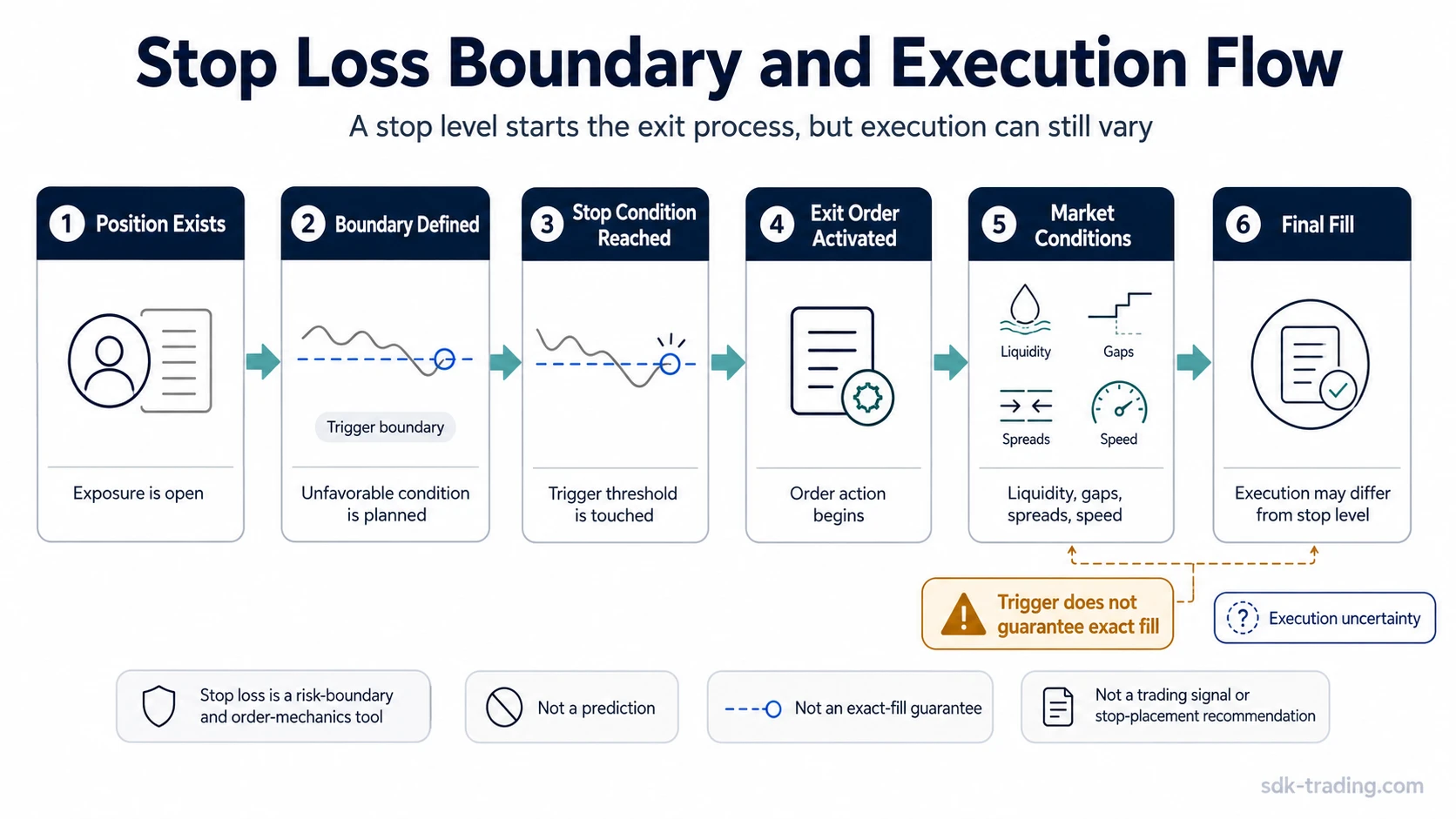
A Stop Loss Reacts to the Trigger Event, Not the Later Price Path
One of the most important distinctions is that a stop loss reacts to the triggering event itself. It does not wait to see whether price later recovers. If the relevant condition is reached and the exit process is activated, a later bounce does not undo the fact that the stop event already occurred.
This matters because traders often judge the stop only after the market moves again. If price recovers soon after the exit, the stop may feel unnecessary in hindsight. But the stop-loss mechanism is not built around hindsight. It is built around a predefined trigger condition and a predefined response.
A brief move through the stop area can therefore be enough to activate the exit logic, even if price later returns above or below the same area. The stop order reacts to the event that met the condition, not to the later narrative that becomes visible afterward.
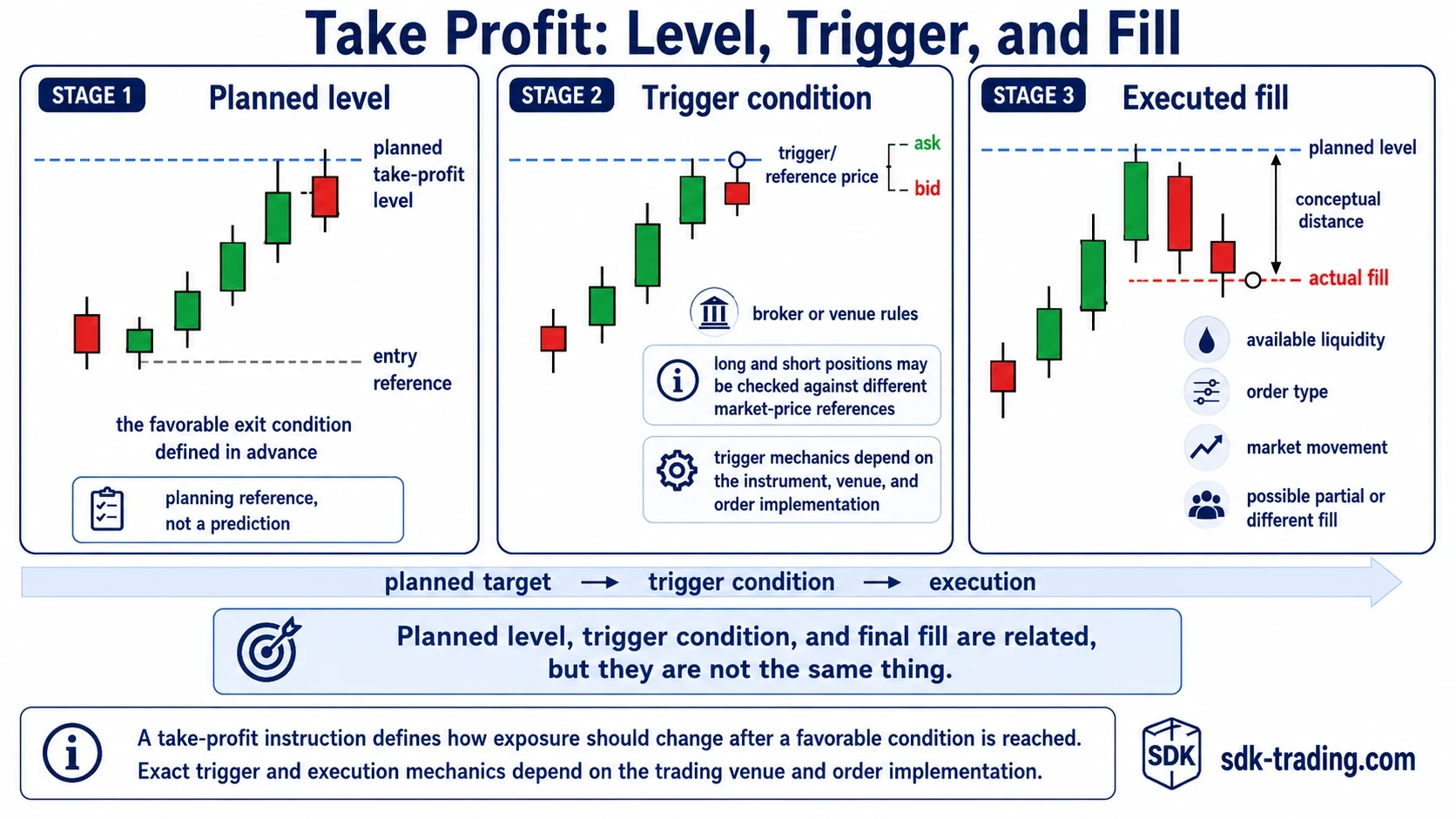
Execution limitation: A stop loss does not guarantee an exact exit price. Fast markets, overnight gaps, thin liquidity, wide spreads, and the selected order type can all affect the final fill.
What a Stop Loss Can and Cannot Control
A stop loss can control the planned response to an unfavorable move. It cannot control the entire execution environment after the stop condition is reached.
| Area | What a stop loss can define | What it does not guarantee |
|---|---|---|
| Exit boundary | The price or condition where the exit process should begin. | That the market will reverse from that area. |
| Trigger response | The condition that activates the next order action. | That price will not recover after the stop event. |
| Risk planning | A defined reference point for measuring adverse movement. | Protection from all losses or all gap risk. |
| Behavior control | A preplanned response before pressure increases. | Correct position sizing, trade quality, or emotional discipline by itself. |
Stop Loss vs Stop-Limit Order
A stop loss order and a stop-limit order both use a stop condition, but they handle execution differently. A basic stop loss is designed to start the exit process once the stop condition is reached. A stop-limit order adds a limit price, which can prevent execution outside that limit but can also leave the position open if the market moves through the limit without filling.
That trade-off is why the distinction matters. A stop loss emphasizes triggering an exit process. A stop-limit order emphasizes price control after the trigger, with the possibility of no fill. For the full distinction, see stop-limit vs stop-loss.
Stop Loss Placement Is a Separate Decision
The meaning of a stop loss order is not the same as the decision about where to place it. Placement depends on the trade structure, volatility, invalidation logic, position size, and the trader’s allowed exposure.
A wider stop does not automatically make the plan safer, and a tighter stop does not automatically make it more disciplined. The basic order concept explains the trigger mechanism. Placement explains where the boundary should sit inside the trade plan. For the dedicated planning topic, use the separate guide to where a stop boundary is placed.
Simple Stop Loss Order Example
Illustrative scenario: A trader holds a long position and defines a lower stop boundary. Price briefly drops into that stop area, the stop condition is reached, and the exit process begins. The final fill occurs during that execution step. If price later rebounds above the same area, the rebound does not change the fact that the stop event already activated the exit.
The example shows the difference between defining a trigger boundary and controlling the later price path. The stop loss reacts to the condition that was met. It does not evaluate afterward whether the move should have been ignored.
Common Misunderstandings About Stop Loss Orders
| Misunderstanding | Safer interpretation |
|---|---|
| A stop loss guarantees the planned exit price. | It can trigger an exit action, but the actual fill can differ from the stop level. |
| A stop loss prevents all losses. | It can limit planned exposure, but gaps, slippage, and execution conditions can still create larger losses. |
| If price recovers, the stop should not have triggered. | The stop reacts to the trigger event itself. Later recovery does not erase an already triggered exit. |
| A stop loss is a trading signal. | It is an exit-control instruction, not a reason to enter a trade. |
| Stop-loss placement is the same topic. | The order meaning describes the trigger mechanism. Placement describes where the boundary is set. |
Related Exit and Order Concepts
Several nearby order concepts use similar language but solve different problems. Keeping them separate helps prevent confusion between trigger mechanics, price control, favorable exits, and dynamic exit management.
| Concept | Main role | Key distinction |
|---|---|---|
| Stop order | Uses a stop condition to activate an order. | A stop loss is one practical use of a broader stop-order mechanism. |
| Stop-limit order | Adds a limit price after the stop trigger. | It may control price better but can fail to fill if the market moves past the limit. |
| Trailing stop | Moves the stop boundary as price moves favorably. | A trailing stop is dynamic rather than fixed at one original level. |
| Take-profit order | Defines a favorable exit objective. | It works on the favorable side of the trade, while a stop loss works on the unfavorable side. |
| Bracket order | Combines exit boundaries around a position. | It can pair unfavorable and favorable exits, but the mechanics depend on the order setup. |
When both sides of the exit plan need to be defined together, paired stop-loss and take-profit planning belongs to the broader exit-planning process.