A trailing stop is a moving exit-control boundary that follows favorable price movement and stays fixed when price reverses. It is used to define when an exit process should begin, but it does not predict where the market will go next and it does not guarantee the final execution price.
Definition: A trailing stop is an order condition that moves behind price by a selected trail distance as the position moves favorably. If price reverses far enough to reach that trailing boundary, the stop condition is triggered and the exit process begins.
The useful distinction is simple: the boundary can move, but only in the direction that protects more of the favorable move. If price moves against the position, the trailing stop normally does not widen to give the trade more room. It waits at its last adjusted level until price either continues favorably again or reverses into the stop condition.
A trailing stop is sometimes described as a trailing stop loss because it belongs to the stop-order family. The difference from a fixed stop loss is that the boundary can update as price moves favorably instead of remaining at the original level.
Key Points
- A trailing stop is a moving exit boundary, not a market forecast.
- The stop boundary adjusts only after favorable movement, based on the selected trail distance.
- When price reverses into the trailing boundary, the stop condition is triggered.
- The trigger level and the final fill price are not always the same.
- A trail that is too tight can react to normal noise; a trail that is too wide can reduce risk control.
What Is a Trailing Stop?
A trailing stop is a stop order condition that follows price from behind after the market moves in the position’s favor. For a long position, the trailing boundary usually rises as price rises. For a short position, the trailing boundary usually falls as price falls. In both cases, the stop is designed to trail favorable movement rather than chase unfavorable movement.
The trailing boundary has two jobs. First, it defines a point where the position should no longer remain open under the current exit plan. Second, it reduces the need to manually reset a fixed stop after every favorable move. That does not make the exit automatic in the sense of certainty. It only defines the condition that starts the order process.
Core idea: A trailing stop controls the exit boundary. It does not control market liquidity, gaps, slippage, spread conditions, or the final price available when the order is executed.
How a Trailing Stop Moves
A trailing stop moves only when price makes new favorable progress. The trail distance can be defined in different ways, such as a fixed amount, a percentage, or another platform-supported distance rule. The common feature is that the stop is calculated behind the most favorable price reached after the order is active.
If price keeps moving favorably, the trailing boundary keeps adjusting. If price reverses, the boundary does not normally move farther away. That one-way adjustment is what separates a trailing stop from a manually widened stop. The stop is intended to follow favorable price movement, not to expand risk after the market turns.
| Element | What it controls | What it does not control |
|---|---|---|
| Trail distance | The space between favorable price movement and the trailing boundary. | The best setting for every market, strategy, or volatility condition. |
| Stop trigger | The condition that starts the exit process when price reaches the boundary. | The exact final fill price after the order activates. |
| One-way adjustment | The rule that moves the boundary only after favorable movement. | Protection from all reversals, gaps, or execution differences. |
| Execution process | The order action after the stop condition is reached. | Guaranteed liquidity at the trigger level. |
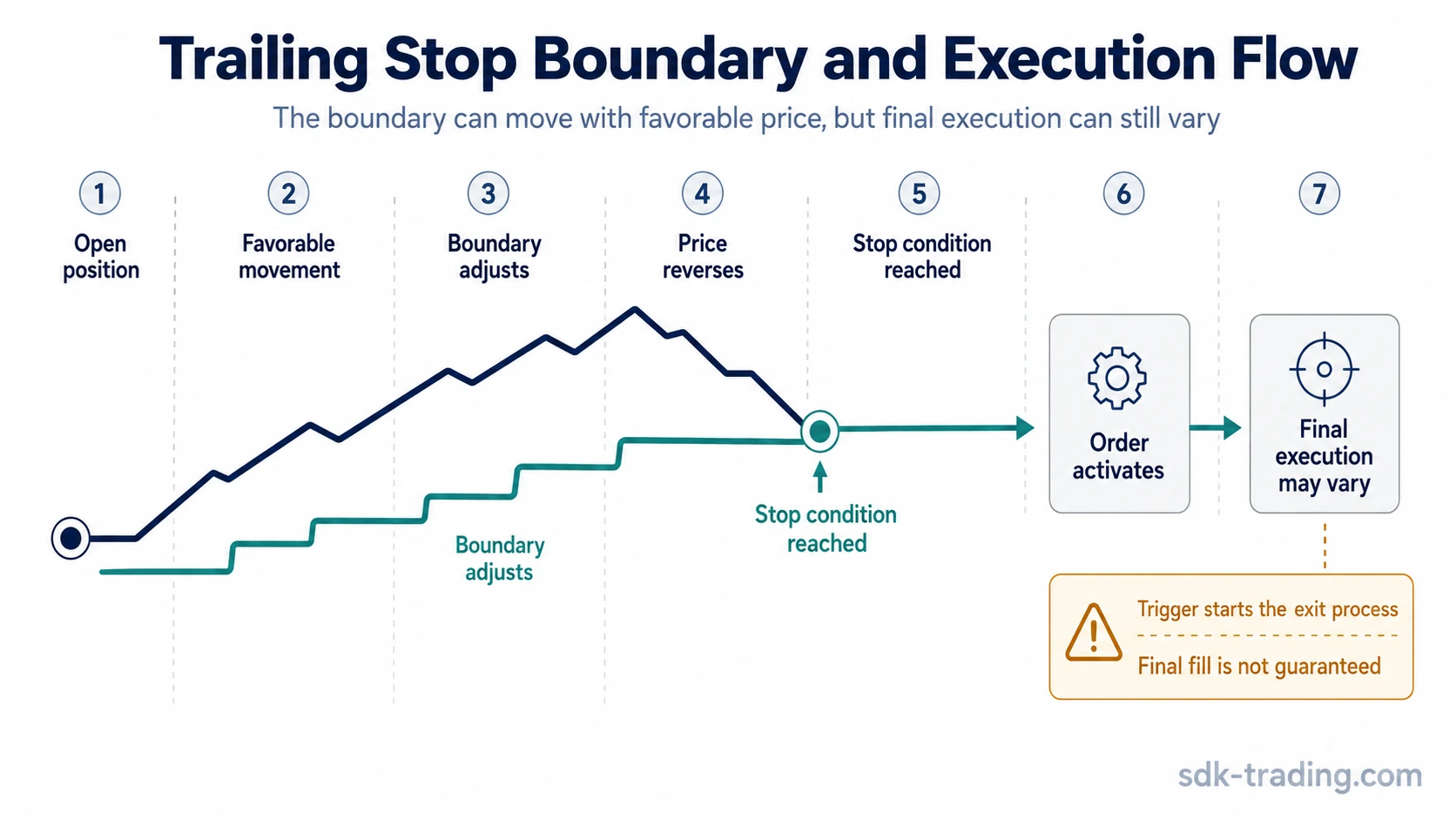
Trigger Price vs Final Execution
The stop trigger is the price condition that activates the order. The final execution is the actual price where the position is closed. Those two points can match in orderly conditions, but they can also differ when price moves quickly, spreads widen, liquidity is thin, or the market gaps through the stop area.
A trailing stop can make the exit plan clearer, but it does not make execution exact. A trader may define the boundary in advance, but the market still decides what price is available once the condition has been reached.
Execution limitation: A trailing stop can define when an exit should be attempted. It cannot guarantee that the final fill will occur at the trailing boundary, especially during gaps, fast markets, thin liquidity, or platform-specific order handling differences.
Trail Distance and Stop Distance
Trail distance is the amount of space between the most favorable price reached and the trailing stop boundary. A smaller distance keeps the boundary closer to price. A larger distance gives the position more room before the stop condition is reached.
The distance can be expressed as a fixed amount, a percentage, or another supported method. Some traders also describe the idea as stop distance, meaning the space between current or reference price and the stop boundary. The concept is measurement-based, but it should not be confused with a universal setting.
A tight trail can close the position during ordinary price noise. A wide trail can allow a larger giveback before exit. That trade-off is why stop-loss placement and trailing behavior should be understood as different questions: one concerns where an exit boundary belongs; the other concerns how that boundary updates after favorable movement.
Step-Based Trailing Stop vs Fixed Exit: Internal Sample
A step-based trailing stop moves the exit boundary only after price reaches predefined reward steps. For example, after price reaches 2R, the stop can move to breakeven. After price reaches 3R, the stop can move to 2R. After price reaches 4R, the stop can move to 3R. The trailing gap stays one reward unit behind the latest reached step.
In an internal 58-position exit-rule review, the baseline exit was a later technical exit condition rather than an early fixed profit target. The sample was then compared against several simplified exit models using final R-multiple outcomes. This is a proxy test, not a complete intratrade path test, because it does not include maximum favorable excursion or maximum adverse excursion data.
| Exit model tested | Net result index | Average R | Result vs baseline | Main interpretation |
|---|---|---|---|---|
| Baseline technical exit | 100.0 | 1.55R | Reference model | Allowed larger winners to remain in the sample. |
| Full exit at 2R | 63.0 | 0.83R | -37.0% | Improved simplicity, but capped too much right-tail participation. |
| Full exit at 5R | 91.8 | 1.30R | -8.2% | Preserved more upside than 2R, but still capped the largest winners. |
| 2R to breakeven, then wait for 5R | 57.4 | 0.78R | -42.6% | Reduced realized losses after 2R, but many mid-sized winners became flat outcomes in the proxy model. |
| Step-based trailing stop with 1R gap | 77.2 | 1.21R | -22.8% | Protected part of the move while preserving more continuation than a full 2R exit. |
The useful lesson is not that a step-based trailing stop is always better than a fixed target. The lesson is that exit rules change the payoff shape. In this sample, 14 of 58 positions finished above 2R, 11 finished above 3R, and 5 finished above 5R. That right-tail group was important enough that closing the full position at 2R materially reduced the modeled result.
This comparison uses final R-multiple outcomes only. A complete trailing-stop backtest needs path data showing whether each position reached 2R, 3R, 4R, or 5R before reversing into the adjusted stop boundary. Without that data, the table should be read as an exit-rule proxy, not a confirmed execution simulation.
Simple Trailing Stop Scenario
Illustrative scenario: A position is opened at 100 with a trailing boundary set behind price. Price moves favorably to 110, so the trailing boundary adjusts upward behind that move. Price then reverses. When the reversal reaches the trailing boundary, the stop condition activates. If the market is liquid and orderly, the final fill may be close to the trigger area. If price moves quickly or gaps, the final fill may differ.
The favorable move adjusts the boundary, the reversal reaches the boundary, the trigger starts the exit process, and final execution still depends on market conditions after activation.
What a Trailing Stop Can and Cannot Do
A trailing stop can help convert an exit plan into a defined boundary. It can reduce the need to manually move a fixed stop after favorable movement. It can also help avoid the mistake of assuming that an unrealized favorable move is already protected without an exit condition.
A trailing stop cannot decide whether the original trade idea is valid. It cannot identify the exact top or bottom of a move. It cannot protect against every gap or execution problem. It also cannot replace judgment about volatility, structure, liquidity, and whether the trail distance is appropriate for the market being traded.
| Condition | Possible issue | Cleaner interpretation |
|---|---|---|
| Trail is too close to price | Normal noise can trigger the stop earlier than expected. | The boundary may be reacting to ordinary fluctuation rather than meaningful invalidation. |
| Trail is too far from price | The position can give back a larger part of the favorable move. | The boundary may be too loose to provide the intended risk control. |
| Price gaps through the boundary | The final fill can differ from the trigger area. | The stop condition can activate without guaranteeing the available execution price. |
| Liquidity is thin or spreads widen | Execution can become less precise. | The order condition is defined, but market depth still matters. |
Trailing Stop vs Fixed Stop Loss
A fixed stop loss is usually placed at a defined level and stays there unless the trader or platform changes it. A trailing stop is designed to update automatically as the position moves favorably. Both are exit-control tools, but they control different parts of the process.
The fixed stop is simpler: the boundary remains stable. The trailing stop is more dynamic: the boundary can follow favorable movement. The confusion begins when a trailing stop is treated as a guarantee that profit is locked. It is better understood as a moving condition for exit activation.
| Concept | Boundary behavior | Main confusion to avoid |
|---|---|---|
| Fixed stop loss | The stop level stays fixed unless it is manually or programmatically changed. | Assuming it adapts automatically to favorable movement. |
| Trailing stop | The stop boundary follows favorable movement by the selected trail distance. | Assuming the trigger level guarantees the final fill. |
| Take profit | The exit is tied to a favorable target or limit condition. | Confusing a favorable exit target with a protective trailing boundary. |
| Trailing stop limit | The trailing condition may activate a limit-based exit order. | Assuming activation guarantees execution if the limit price is not available. |
Common Misunderstandings
- “It locks profit perfectly”: A trailing stop can move the exit boundary after favorable movement, but execution can still differ from the trigger area.
- “It moves both ways”: A trailing stop normally updates only in the favorable direction. It does not usually widen when price reverses.
- “It is the same as take profit”: A take-profit order is tied to a favorable exit objective. A trailing stop is a protective boundary that follows favorable movement from behind.
- “The trigger price is the final fill”: The trigger starts the exit process. The final fill depends on the order type, market conditions, liquidity, and speed of movement.
- “Any trail distance works”: Trail distance changes the behavior of the boundary. A close distance can react to noise; a wide distance can allow larger giveback.
Where Trailing Stops Fit in Exit Planning
A trailing stop is most useful when the exit question is no longer only “where is the original risk boundary?” but also “how should the exit boundary behave after favorable movement?” That makes it an exit-management concept rather than a prediction method.
The boundary can help structure the decision, but it should not be treated as a substitute for understanding volatility, order type, spread behavior, and liquidity. The cleaner interpretation is that a trailing stop lets the exit boundary follow price under defined conditions while leaving execution uncertainty visible.
Practical distinction: A trailing stop manages the boundary after favorable movement. It does not remove the need to understand why the position is open, where risk is unacceptable, or what can happen when market conditions change quickly.
FAQ
Does a trailing stop guarantee the final exit price?
No. A trailing stop defines the condition that activates the exit process, but the final fill can differ because of gaps, fast markets, thin liquidity, spreads, and order handling.
Does a trailing stop move both ways?
No. A trailing stop normally moves only in the favorable direction. When price reverses, the boundary usually stays at its last adjusted level until the stop condition is reached or favorable movement resumes.
Is a trailing stop the same as a stop loss?
It belongs to the stop-order family, but it is not the same as a fixed stop loss. A fixed stop normally stays at one level, while a trailing stop can adjust after favorable price movement.
Is a trailing stop the same as a trailing stop limit?
No. A trailing stop limit adds a limit condition after activation. That can control the minimum acceptable execution price, but it can also mean the order does not fill if the market moves beyond the limit.