Stop loss placement fails when the stop distance is chosen before the invalidation boundary is clear. In trading, stop loss placement means locating a stop near the point where the original premise would no longer hold, while still allowing for normal price noise, volatility, and execution uncertainty.
A level can look close, convenient, or emotionally comfortable without being structurally meaningful. The stronger question is what market behavior would make the original idea no longer coherent, and whether the account-risk impact remains definable at that distance.
Definition: Stop loss placement means choosing the location of a stop level relative to structure, volatility, invalidation, and account-risk boundaries. It is separate from the basic mechanics of a stop-loss order, which defines the order instruction itself.
Key Points
- Stop loss placement defines a failure boundary, not a prediction that price will reverse from that level.
- Invalidation should come before distance, convenience, or emotional comfort.
- Noise and volatility can make a nearby level vulnerable to routine fluctuation.
- Position sizing controls account exposure; placement defines the market boundary.
- A stop level does not ensure the actual fill occurs exactly at the marked price.
Stop Loss Placement as an Invalidation Boundary
A coherent stop-loss level sits near the point where the trade premise weakens or fails. For a structure-based idea, that may involve a failed reclaim, a break beyond the structure being used, or a move that changes the original scenario. The level is not useful simply because it is nearby.
Mechanical placement risk appears when a fixed habit decides the stop before the market boundary is clear. A fixed distance may be narrow in a volatile structure and excessive in a quieter structure. The same distance can therefore carry different meaning depending on the chart environment.
Execution note: A stop order marks an intended control level. It may still fill away from that level if price moves quickly, liquidity is thin, or the market gaps through the area.
Noise Zone Versus Invalidation Zone
The noise zone is the area where routine fluctuation can occur without clearly breaking the idea. The invalidation zone is the area where the original premise becomes meaningfully weaker. Stop loss placement becomes fragile when those two areas are treated as the same thing.
| Area | What it represents | Placement risk | Safer interpretation |
|---|---|---|---|
| Minor candle low or high | A small local reference point | Often sits inside ordinary noise | Check whether a break would actually damage the structure |
| Recent swing area | A more visible structural reference | Still vulnerable if volatility is expanding | Compare the level with current range behavior and acceptance |
| Volatility-adjusted distance | A buffer based on recent movement size | May detach from invalidation when used alone | Use volatility as a distance input, not as the full reason for the stop |
| Account-risk boundary | The exposure the position can tolerate | May conflict with the chart level | Reassess the idea if the market boundary and risk boundary cannot fit together |
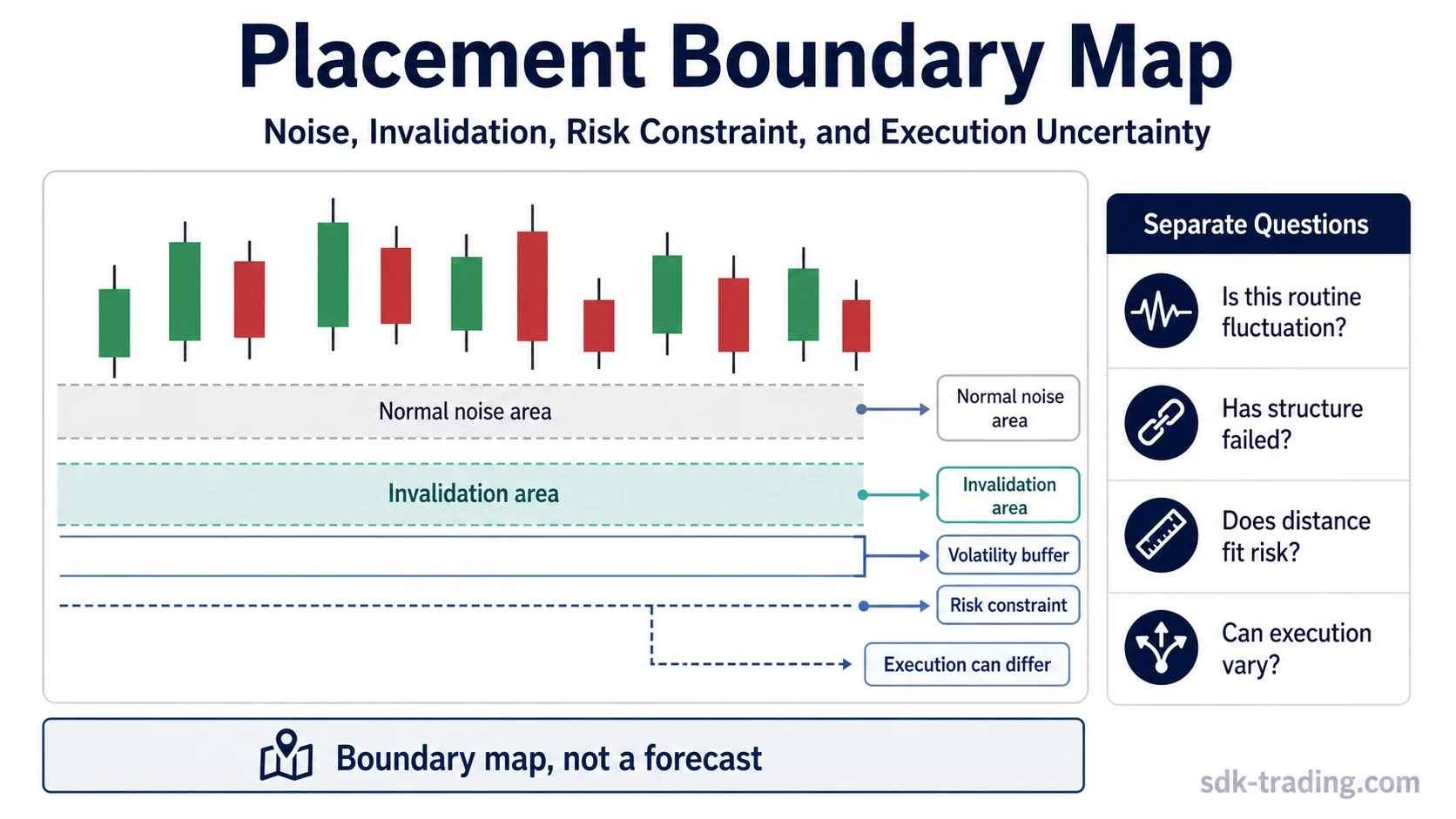
Common Bases for Stop-Loss Placement
Different placement bases solve different problems. Structure, volatility, and account-risk thresholds can all matter, but none of them replaces the others. A level that is structurally meaningful may still create too much account exposure. A level that fits account risk may still be arbitrary if it has no relationship to the market structure.
| Placement basis | What it helps solve | Main failure mode | Better use |
|---|---|---|---|
| Structure-based location | Connects the stop to a visible market boundary | May ignore changing volatility or account impact | Use structure to define invalidation, then test whether the risk remains acceptable |
| Volatility or ATR distance | Allows for changing movement size | May become a formula without a premise | Treat volatility as a buffer around structure, not as proof of a correct level |
| Account-risk threshold | Defines how much account exposure the idea can tolerate | May ignore whether the market boundary has actually been reached | Use as a risk constraint after the chart boundary is understood |
| Soft or time-based invalidation | Handles ideas that fail by stalling rather than breaking a level | Becomes vague if no condition is defined | Use only when the failure condition is stated clearly before the trade is managed |
Common Stop-Loss Placement Mistakes
Mechanical placement risk appears when the stop is selected for convenience rather than meaning. The level may be easy to calculate, but the market may have no reason to treat that level as important.
Failure mode: A stop placed only because it is close may sit inside normal price noise. A stop placed only because it is wide may create account exposure that is too large for the idea. A stop placed only because it matches a fixed percentage may ignore the structure that would actually invalidate the premise.
- Too close: The stop may sit where routine fluctuation can reach it before the structure changes.
- Too far: The stop may protect the chart idea while exposing the account to more risk than the setup can justify.
- Fixed distance without volatility: The same number of points or percent may be narrow in one market condition and excessive in another.
- Moving the stop without a new premise: Adjusting the level after price moves against the idea can turn risk control into emotional delay.
- Treating placement as prediction: The stop level defines failure conditions; it does not prove that price will move in the preferred direction.
- Confusing placement with position sizing: Placement locates the market boundary, while sizing determines the account impact if the boundary is reached.
Stop-Loss Placement vs Nearby Concepts
Stop loss placement is narrower than the full stop-loss concept. A stop-loss order describes the control instruction, while placement asks where that instruction belongs relative to invalidation, noise, volatility, and account exposure.
A trailing stop introduces a moving boundary after price changes. That is a different problem from the initial placement question, because the level may adjust as market structure develops.
| Concept | Main question | How it differs from stop loss placement |
|---|---|---|
| Stop-loss order | What instruction controls downside exposure? | Order mechanics define the instruction; placement defines where the level belongs. |
| Trailing stop | How does the stop boundary move after price changes? | Trailing logic adjusts the boundary; placement first defines the original boundary. |
| ATR stop loss | How can volatility distance inform the stop? | ATR can inform the buffer, but it does not replace invalidation or account-risk checks. |
| Position sizing | How much account exposure does the trade create? | Sizing controls exposure; placement defines the market condition that would invalidate the idea. |
Stop Loss Placement Example in Context
Price pulls back below a recent minor candle low but remains inside the normal fluctuation range of the broader structure. A stop placed directly under that minor low may be exposed to routine noise rather than true invalidation. If the next recovery attempt quickly reclaims the area, the break may still belong to noise; if acceptance develops beyond the broader structure, the original premise is weaker.
A wider level beyond the structure may express the premise more clearly, but only if the account-risk impact remains acceptable. The diagnostic point is the separation between ordinary fluctuation and failed structure, not the identification of a correct stop level by itself.
What Makes Stop Loss Placement More Coherent
Stop loss placement becomes more coherent when the market boundary, volatility buffer, execution uncertainty, and account-risk impact can be described separately. If those pieces cannot be separated, the level may be arbitrary even when it looks precise on a chart.
The cleanest interpretation is conditional: structure suggests where invalidation may sit, volatility affects how much noise the structure can absorb, and account risk decides whether the idea can be held at that distance.
FAQ
Is a wider stop loss always safer?
No. A wider stop may avoid some normal noise, but it can also create larger account exposure. The placement still needs a clear invalidation reason and acceptable risk impact.
Does stop loss placement guarantee the exit price?
No. The stop level marks the intended control area, but fast movement, gaps, or thin liquidity can cause the actual fill to differ from the marked level.