Orders, stops and exits are separate control functions in a trade plan. Orders are instructions sent to the market or broker, stops define trigger boundaries, and exits describe how exposure may be reduced or closed.
Core distinction: an order tells the market what action to attempt, a stop defines a condition that may trigger action, and an exit defines the closing logic for existing exposure.
The same trade can involve several control layers. One instruction may open exposure, another condition may reduce loss, another boundary may take profit, and another rule may trail exposure if price moves. These tools organize decisions, but they do not predict market direction or guarantee execution quality.
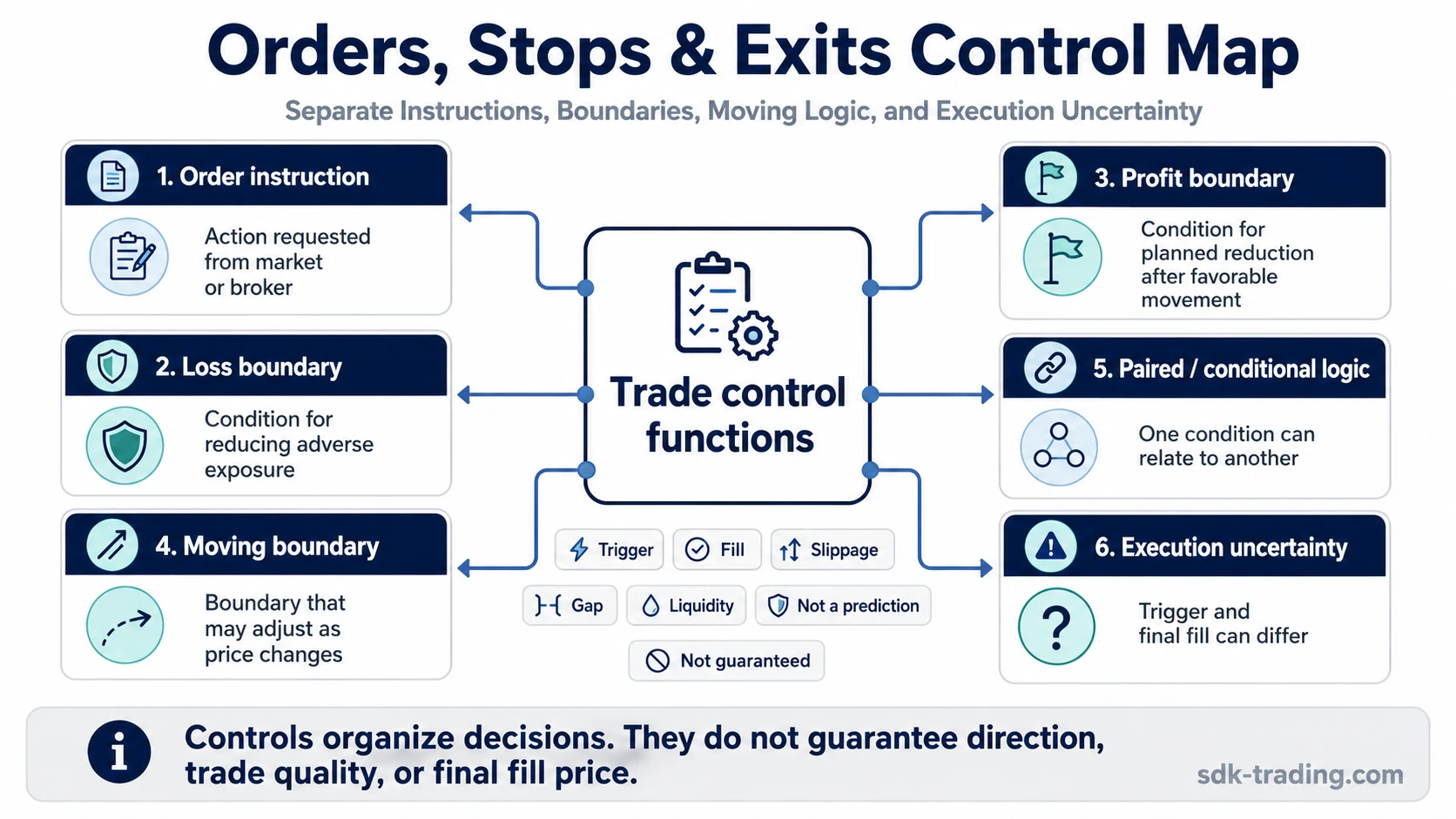
What Orders, Stops and Exits Control
The useful distinction is functional. Some orders open exposure. Other orders close exposure. Some stop conditions trigger only after price reaches a defined boundary. Some exit methods are fixed, while others move as the trade develops.
| Control function | What it controls | Typical concept | What it does not control |
|---|---|---|---|
| Order instruction | The action requested from the market or broker | Market order, limit order, stop order, conditional order | Whether the trade idea is valid |
| Loss boundary | The condition where exposure may be closed or reduced if the trade moves against the plan | stop loss | The exact final fill price in all conditions |
| Profit boundary | The condition where exposure may be closed or reduced if the trade reaches a planned profit area | take profit | A guaranteed profit outcome |
| Moving boundary | A boundary that can adjust as price moves | trailing stop | Protection from every gap, spread change, or liquidity problem |
| Paired or conditional logic | How one order condition may relate to another | OCO, stop-limit, bracket-style logic | Whether the market must fill every condition cleanly |
| Execution uncertainty | The difference between the intended boundary and what can actually happen in the market | Slippage, gaps, missed fills, no-fill risk | Market liquidity or broker-specific availability |
Core Concepts: Stop Loss, Take Profit and Trailing Stop
Most confusion around orders, stops and exits comes from mixing the purpose of the tool with the market outcome the trader wants. The main exit-control concepts separate different boundary problems.
| Trading question | Concept to review next | Why it fits | Boundary to keep clear |
|---|---|---|---|
| How do I define where the loss should be limited? | Stop loss | Defines the loss-side boundary for reducing or closing exposure. | A stop loss is a risk-control boundary, not proof that the trade was wrong in every market context. |
| How do I define where profit should be taken? | Take profit | Defines the profit-side boundary for closing or reducing exposure. | A take-profit order does not guarantee that price will reach the level or that the full position will fill. |
| How do I let an exit boundary move with price? | Trailing stop | Shows how a stop boundary can adjust after favorable movement. | A trailing stop can reduce manual adjustment, but it does not remove gap risk or poor liquidity risk. |
| How do I compare loss exits with profit exits? | Stop loss vs take profit | Separates loss-side and profit-side closing logic directly. | The two tools solve different boundary problems and should not be judged by the same purpose. |
| Where should a stop be placed relative to structure? | Stop-loss placement | Focuses on the placement problem rather than the general definition of a stop. | Placement is about boundary logic; it is not a guaranteed safety mechanism. |
| How can part of a position be closed while part remains open? | Partial take profit | Explains staged profit-taking rather than a single all-or-nothing exit. | Partial exits can simplify some decisions while adding their own planning trade-offs. |
| How does volatility affect stop distance? | ATR stop loss | Connects stop distance to a volatility-based reference. | ATR is a reference tool, not a guarantee that the stop distance is correct. |
| Can a stop guarantee the final exit price? | Guaranteed stop vs regular stop | Separates ordinary stop behavior from guaranteed-stop structures. | Guaranteed-stop conditions can differ from ordinary stop behavior and should not be assumed for every instrument or provider. |
Entry Orders and Exit Orders Are Not the Same Job
An entry order is used to create exposure. An exit order is used to reduce or close exposure that already exists. The same order family can sometimes appear on either side of a trade, so the label alone is not enough. The important question is what the instruction is trying to control.
Practical distinction: a limit instruction used for entry is different from a limit instruction used for taking profit. The order type may look similar, but the decision job changes from opening exposure to closing exposure.
Order types and exit planning should not be treated as interchangeable terms. Order types describe execution instructions. Exit planning describes the conditions under which exposure may be reduced, closed, trailed, or left alone.
Execution Limits: Trigger, Fill, Slippage and Gaps
A trigger is not the same as a completed fill. A stop level can define when an order becomes active, but the market still needs available liquidity at executable prices. When price moves quickly, gaps through a level, or trades in a thin market, the final fill can differ from the planned boundary.
Execution limitation: a stop can define the condition that activates an order, but it does not always guarantee the exact exit price. Slippage, gaps, spreads, volatility, and liquidity can all affect the final result.
| Execution issue | What can happen | Why it matters |
|---|---|---|
| Slippage | The fill occurs at a different price than the intended boundary. | The exit may control the decision point without controlling the exact final price. |
| Gap | Price moves beyond the planned level before an orderly fill is available. | The order may activate after the market has already moved through the boundary. |
| Low liquidity | There may not be enough opposing interest near the intended level. | Fill quality can weaken even when the order logic is clear. |
| Stop-market conversion | A stop condition may activate a market-style exit instruction. | The position may close, but the final execution price can vary. |
| Stop-limit no-fill risk | The stop condition may trigger, but the limit price may not be fillable. | The position can remain open even after the boundary condition appears. |
| Missed limit fill | Price may touch or approach a planned area without filling the order. | A planned profit or entry boundary is not the same as guaranteed execution. |
How Exit Controls Reduce Emotional Decisions
Exit controls mainly help separate decision categories before market pressure begins: loss boundary, profit boundary, moving boundary, and execution uncertainty.
Example scenario: an open position faces the next session with three unresolved questions: where the loss boundary sits, where profit may be reduced, and whether any remaining exposure should trail. The useful work is not predicting the next move. The useful work is separating the closing conditions before volatility or emotion changes the decision.
These controls can organize behavior, but they do not make the trade safe by themselves. Position size, liquidity, volatility, time horizon, and market conditions still affect whether the planned exit logic is practical.
Common Misreadings of Orders, Stops and Exits
Many order problems come from expecting one tool to do a different tool’s job. The safer reading is to ask which boundary the tool controls and which risk remains outside that boundary.
| Misreading | Safer interpretation |
|---|---|
| A stop loss guarantees a precise exit price. | A stop loss defines a trigger or closing condition, while execution quality can still depend on market conditions. |
| A take-profit order guarantees that profit will be captured. | A take-profit order defines a profit-side boundary, but price may not reach it or the full order may not fill as expected. |
| A trailing stop removes the need to manage risk. | A trailing stop can move a boundary, but it can still be affected by gaps, spreads, volatility, and poor placement. |
| A stop-limit order is always safer than a stop-market order. | A stop-limit can control the worst acceptable limit price, but it can also leave the position open if the market moves past the limit. |
| Order choice is a trading signal. | Order choice organizes execution and exits; it does not predict market direction by itself. |
When to Use Each Exit-Control Concept
Once the question becomes specific, the correct concept depends on the boundary being defined. Loss-side, profit-side, moving, staged, volatility-based, and guaranteed-price structures solve different problems.
| Question has become specific to | Concept | Reason |
|---|---|---|
| Loss-side closing logic | Stop loss | Loss-boundary logic defines when adverse movement may reduce or close exposure. |
| Profit-side closing logic | Take profit | Profit-boundary logic defines where planned reduction or closure may occur after favorable movement. |
| Moving stop behavior | Trailing stop | Adjustable exit boundaries can move after favorable price movement while still carrying execution risk. |
| Loss boundary versus profit boundary | Stop loss vs take profit | Loss-side and profit-side exits solve different boundary problems. |
| Stop location and structural placement | Stop-loss placement | Placement focuses on where the boundary sits relative to structure, not only what a stop is. |
| Scaling out of profit | Partial take profit | Staged profit-taking separates partial reduction from a single all-or-nothing exit. |
| Volatility-based stop reference | ATR stop loss | Volatility can be used as a stop-distance reference without becoming a complete stop-placement system. |
| Guaranteed stop conditions | Guaranteed stop vs regular stop | Guaranteed-stop structures differ from ordinary stops and require separate treatment. |
FAQ
Are orders, stops and exits the same thing?
No. Orders are instructions, stops define trigger boundaries, and exits describe how exposure may be reduced or closed. They can overlap in a trading workflow, but they do not describe the same control function.
Does a stop order guarantee the final exit price?
Not in ordinary market conditions. A stop can define the activation condition, but slippage, gaps, spreads, volatility, and liquidity can affect the final fill.
What is the difference between stop loss and take profit?
A stop loss defines a loss-side boundary, while a take profit defines a profit-side boundary. One is designed around adverse movement, and the other is designed around planned profit-taking.
Is a trailing stop safer than a fixed stop?
Not automatically. A trailing stop can move with price, but it can still be affected by poor placement, fast moves, gaps, spreads, and liquidity conditions.
Can order choice create a trading edge?
Order choice can improve how decisions are structured, but it does not create a directional edge by itself. Trade quality still depends on the broader setup, risk, execution conditions, and uncertainty.