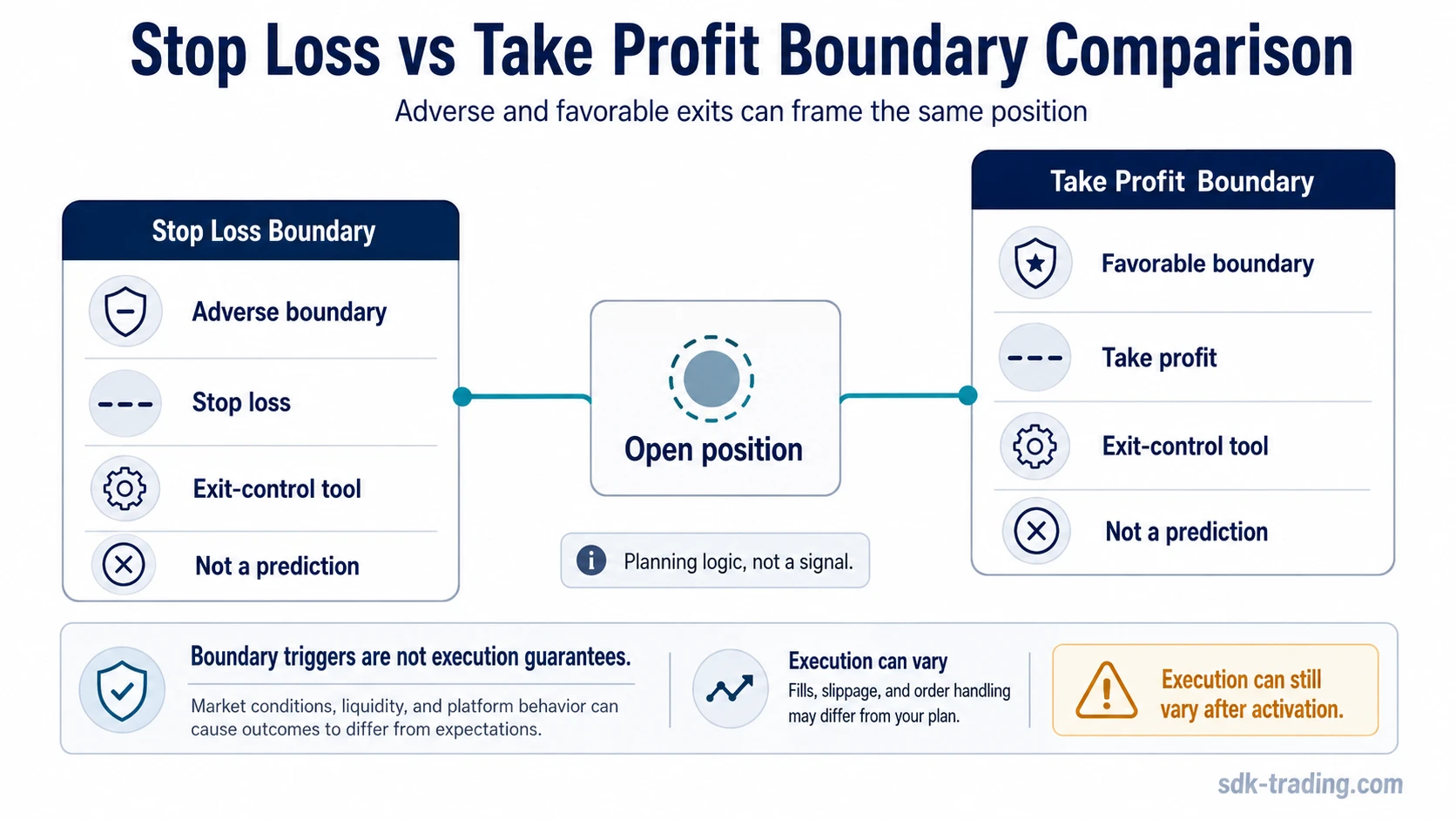
Stop loss vs take profit separates two exit boundaries around an open trade. A stop loss is an adverse boundary used when price moves against the planned scenario. A take profit is a favorable boundary used when price reaches a planned profit-taking area. Both are exit-control tools, not market predictions, trading signals, or guarantees of an exact final fill.
Core distinction: a stop loss defines where risk control begins if the trade moves unfavorably, while a take profit defines where favorable movement may be converted into an exit. The difference is not only direction. It is the purpose of the boundary, the condition that activates the order, and the execution risk that can remain after activation.
Key Points
- A stop loss is linked to unfavorable movement relative to the trade plan.
- A take profit is linked to favorable movement relative to the trade plan.
- Both can be planned before price pressure begins, but the plan does not make either level likely to be reached.
- Reaching a trigger or price condition can start execution, but the final result still depends on order type and market conditions.
Stop Loss vs Take Profit: The Core Difference
A stop loss is normally used to reduce or exit exposure when price reaches an unfavorable boundary. It marks the point where the trade scenario has moved far enough against the plan that risk control becomes more important than staying in the position.
A take profit is normally used to reduce or exit exposure when price reaches a favorable boundary. It marks the point where price has reached a favorable area where the trader no longer wants the full position exposed.
Practical distinction: stop loss and take profit orders can sit around the same position, but they answer opposite questions. The stop loss asks where the unfavorable scenario becomes unacceptable. The take profit asks where favorable movement is enough to justify closing or reducing exposure.
How Each Boundary Works in the Same Trade Scenario
Consider a generic long position. Price can move below the entry area or above it. The stop-loss boundary would sit on the unfavorable side of the plan, because the long position loses value as price falls. The take-profit boundary would sit on the favorable side, because the long position gains value as price rises.
Same-scenario example: a trader enters a long position after defining two separate exit conditions. If price falls into the adverse boundary, the stop loss may activate an exit process. If price rises into the favorable boundary, the take profit may activate an exit process. The same trade can therefore have two planned exits, but each exit answers a different control problem.
For a short position, the direction reverses. A rising price is unfavorable, so the stop-loss boundary is usually above the entry area. A falling price is favorable, so the take-profit boundary is usually below the entry area. The concept is the same: unfavorable boundary on one side, favorable boundary on the other.
Boundary, not recommendation: long and short orientation explains order logic only. It does not identify where a stop loss or take profit belongs, and it does not define a valid trade setup by itself.
Stop Loss vs Take Profit Comparison Table
| Criterion | Stop Loss | Take Profit | Why the difference matters |
|---|---|---|---|
| Primary purpose | Controls exposure when price moves against the planned scenario. | Closes or reduces exposure when price reaches a favorable planned boundary. | The stop loss is mainly about risk control; the take profit is mainly about profit realization or exposure reduction. |
| Price relationship | Placed on the unfavorable side of the trade plan. | Placed on the favorable side of the trade plan. | The same market level can mean different things depending on whether the position is long or short. |
| Long-position orientation | Usually below the entry or planning area. | Usually above the entry or planning area. | A long position is hurt by falling price and helped by rising price. |
| Short-position orientation | Usually above the entry or planning area. | Usually below the entry or planning area. | A short position is hurt by rising price and helped by falling price. |
| Order behavior | Often activates after a stop condition is reached, depending on the order type. | Often works as a resting exit order at a favorable price boundary, depending on the order type. | Activation and execution are separate issues; reaching a boundary does not remove execution risk. |
| Common misunderstanding | Assuming the stop price guarantees the final exit price. | Assuming the profit target proves price will reach that level. | Both errors confuse planning boundaries with market certainty. |
| Risk/reward context | Helps define the adverse side of the trade plan. | Helps define the favorable side of the trade plan. | Together, they can frame the distance between potential loss and potential reward without guaranteeing either outcome. |
Why Stop Loss and Take Profit Are Often Confused
The confusion often comes from platform order panels that display both exits near the same trade ticket. Seeing both labels together can make them look like interchangeable order choices. They are not interchangeable because each one responds to a different side of the trade plan.
Another source of confusion is that both orders can close a position. The closing action can look similar after execution, but the reason for the exit is different. A stop loss responds to adverse movement. A take profit responds to favorable movement.
Clean interpretation: the order label matters less than the boundary logic. Ask whether the exit is designed for unfavorable movement or favorable movement. That distinction usually separates stop-loss logic from take-profit logic more clearly than the order ticket alone.
Common Confusions and Execution Limits
A stop loss can start the exit process when the stop condition is met, but it does not always guarantee an exact exit at the stop price. Fast movement, thin liquidity, gaps, or order-type settings can cause the final fill to differ from the level that triggered the order.
Execution limitation: a stop level is a trigger or boundary condition, not a promise that the market will provide the same price as the final fill. The final execution depends on the order type and the conditions available when the order reaches the market.
A take-profit order also depends on execution conditions. If price reaches the boundary and liquidity is available under the order rules, the order may fill. If conditions change quickly or the order type has limits, the result can differ from the simplified planning idea.
A stop-limit order adds another layer of confusion. It combines a stop trigger with a limit condition. That can control the worst acceptable execution price, but it can also leave the order unfilled if the market moves through the limit too quickly. That distinction matters, but full stop-limit mechanics belong in a separate order-type explanation.
Using Both Orders Without Treating Them as Signals
Stop loss and take profit orders can be used together because they control different sides of the same exposure. One boundary defines where the unfavorable scenario becomes unacceptable. The other defines where favorable movement may be enough to exit or reduce the position.
The presence of both boundaries does not mean the trade is good, the setup is confirmed, or price is likely to reach either level. It only means the trader has defined what should happen if price moves to either side of the planned range.
Planning example: a trader can define the adverse boundary first, then define the favorable boundary, then compare the distance between the two. That comparison may help with risk/reward planning, but it does not prove the market will respect either boundary.
When the Difference Matters Most
The distinction matters before execution pressure begins. Separating the two boundaries in advance helps keep risk control separate from profit expectation and prevents a planned target from being treated as a forecast.
| Situation | Cleaner interpretation |
|---|---|
| Price moves against the position | The stop-loss boundary becomes relevant because the trade is moving toward the adverse side of the plan. |
| Price moves in favor of the position | The take-profit boundary becomes relevant because the trade is moving toward the favorable side of the plan. |
| Price gaps through a boundary | The planned level may not match the final execution price, especially under fast or thin conditions. |
| Both orders appear in the same platform ticket | The labels may sit together, but the boundaries still serve opposite purposes. |
| A trader treats the target as a forecast | The take-profit level is only a planned exit condition, not evidence that price must reach it. |
FAQ
Can stop loss and take profit be used together?
Yes. They can define two different exits around the same position. The stop loss relates to unfavorable movement, while the take profit relates to favorable movement.
Is a stop loss guaranteed to fill at the stop price?
No. A stop condition can activate the exit process, but the final fill can differ from the stop price because execution depends on order type, liquidity, volatility, gaps, and market conditions.
Is take profit the same as a trading signal?
No. A take-profit level is a planned favorable exit boundary. It does not prove that price will reach the level, and it does not confirm that the trade is valid.
How is stop loss different from stop-limit?
A stop loss generally refers to an exit process triggered by an adverse stop condition. A stop-limit order adds a limit condition after the stop trigger, which can control acceptable execution price but may also result in no fill.