Trading indicators organize market information into calculated or structured outputs that make specific features easier to compare. Some focus on trend, momentum, volatility, volume, breadth, or reference levels. Others compare one derived reading with another part of the chart, as in divergence or moving-average signal analysis.
Definition: A technical indicator is a tool that processes market data such as price, volume, open interest, or broader participation data into a derived reading. The useful question is not simply which indicator is best, but what data it uses, how that data is transformed, and what market property the output is designed to describe.
Indicator family and display format should also be kept separate. An oscillator describes one type of output format, while trend, momentum, volatility, and volume describe analytical roles. The same indicator can therefore belong to one analytical family while being displayed as an oscillator, overlay, index, band, or cumulative series.
How a Trading Indicator Produces a Reading
An indicator output can be traced through a sequence. This makes it easier to compare tools without assuming that similar-looking lines contain the same information.
| Stage | Question | Examples |
|---|---|---|
| 1. Market input | What information enters the calculation or classification? | Price, high-low range, volume, open interest, or participation across multiple securities. |
| 2. Transformation | What is done to that information? | Smoothing, averaging, normalization, accumulation, dispersion measurement, relative comparison, or level calculation. |
| 3. Analytical family | What market property is the tool intended to describe? | Trend, momentum, volatility, volume, breadth, reference levels, or price-versus-indicator divergence. |
| 4. Output form | How is the result presented? | Overlay, oscillator, index, cumulative line, band, channel, threshold, or relationship between multiple lines. |
| 5. Interpretation limit | What information is still missing? | The output does not automatically establish market structure, future direction, execution quality, or trade risk. |
Classification rule: identify the input and transformation before interpreting the plotted output. Two indicators can look different while using similar information, or look similar while measuring different properties.
Main Types of Trading Indicators
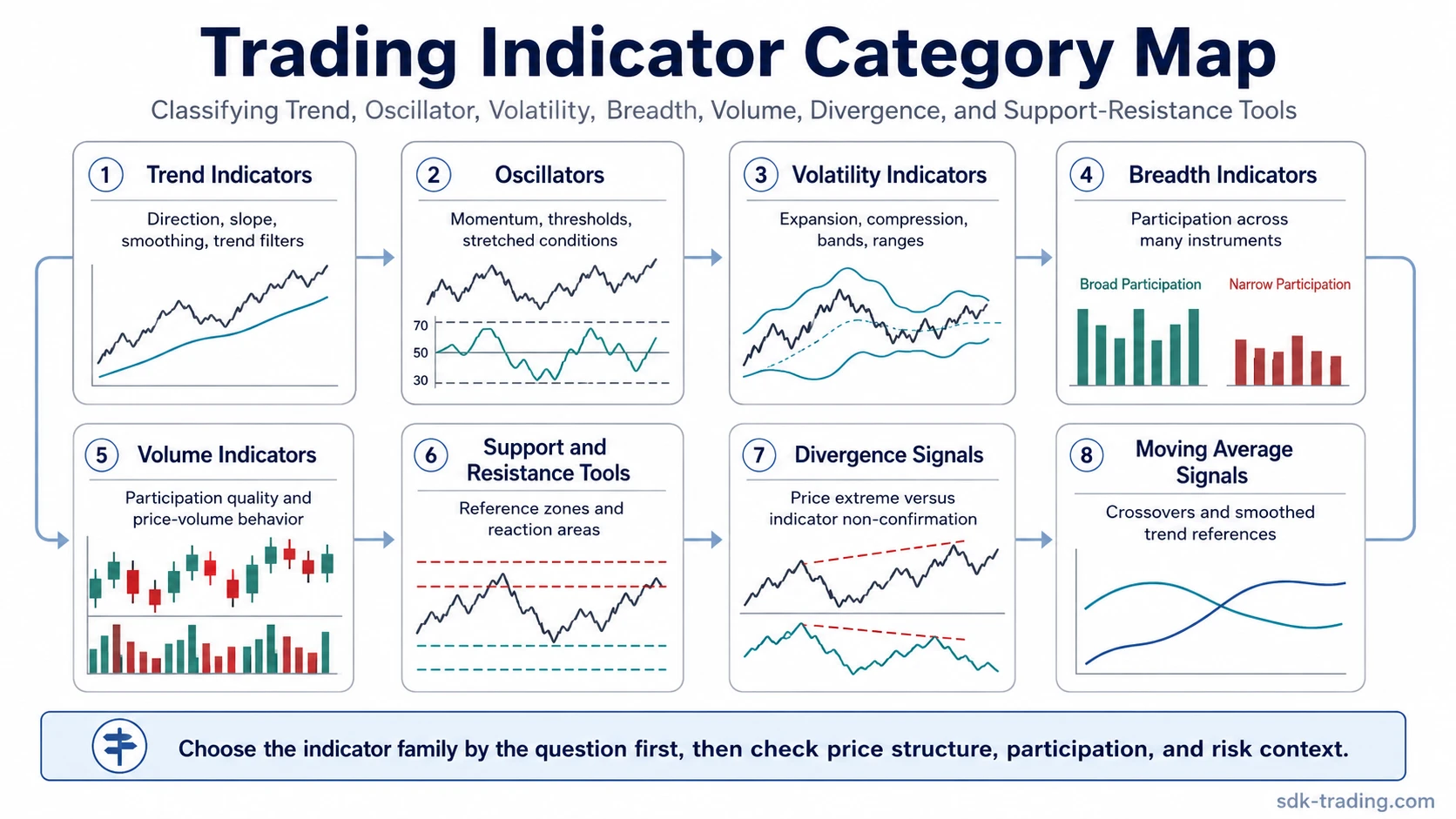
The main indicator families answer different analytical questions. They are more useful when selected by the information needed rather than by the popularity of an individual tool.
| Market question | Indicator family | Primary analytical role |
|---|---|---|
| Is directional behavior rising, falling, flattening, or strengthening? | Trend indicators | Organize direction, smoothing, slope, directional strength, and price relative to a trend reference. |
| Is momentum accelerating, fading, stretched, or moving around a reference level? | Oscillators | Transform price behavior into centered, bounded, or otherwise normalized readings. |
| Is the magnitude of price movement expanding or contracting? | Volatility indicators | Measure range, dispersion, band width, channel width, or other forms of movement variability. |
| Is participation broad across the market or concentrated in fewer securities? | Breadth indicators | Compare participation across groups of stocks, sectors, or other instruments. |
| Where does a tool place a calculated or observed price reference? | Support and resistance indicators | Organize horizontal levels, pivots, measured levels, projected levels, and other reaction references. |
| How is trading activity changing relative to price? | Volume indicators | Transform volume or price-plus-volume data into activity, accumulation-distribution, pressure, or participation readings. |
| Are corresponding price and indicator swings moving differently? | Divergence signals | Compare price pivots with corresponding indicator pivots to identify disagreement between the two series. |
| Is a signal based on relationships between smoothed trend references? | Trend and moving average signals | Organize crossovers, relative position, and other relationships between moving-average or trend references. |
Indicator Family Is Not the Same as Output Form
One source of confusion is classifying indicators only by how they look on the chart. The visual form does not necessarily tell you what the calculation measures.
| Output form | What it describes | Possible analytical families |
|---|---|---|
| Overlay | A calculated line, band, channel, or level plotted directly with price. | Trend, volatility, volume-weighted references, or support-resistance tools. |
| Oscillator | A derived series plotted around a centerline, threshold, or bounded scale. | Momentum, trend, volume, or volatility. |
| Index | A numerical series representing a calculated market condition. | Trend strength, volatility, breadth, sentiment, or participation. |
| Cumulative series | A running value that adds or subtracts information through time. | Volume, breadth, or other participation measures. |
| Signal relationship | A comparison between lines, levels, price, or another derived series. | Crossovers, divergence, threshold behavior, or relative-position signals. |
This is why the word oscillator does not mean that every oscillator measures the same thing. Output format and analytical purpose are separate classifications.
Why Different Indicators Can Disagree
Two indicators can process the same price sequence differently because their formulas emphasize different properties. One may smooth closing prices, another may compare gains with losses, another may measure high-low range, and another may include volume.
Lookback length and smoothing can also change the result. A faster calculation usually reacts more strongly to recent data, while a slower calculation retains more influence from earlier observations. Neither output is automatically more correct. They are describing the market through different transformations.
| Source of disagreement | What changes |
|---|---|
| Different input | Close-only data can produce a different reading from high-low-close or price-plus-volume data. |
| Different transformation | Averages, ratios, normalization, dispersion, and accumulation emphasize different properties. |
| Different lookback | Recent observations receive different weight relative to older data. |
| Different smoothing | The output can become faster, slower, noisier, or more stable. |
| Different analytical job | Trend direction, momentum, volatility, and participation can legitimately describe different conditions at the same time. |
Why Indicator Agreement Can Be Misleading
Agreement is not automatically independent confirmation. Several indicators can respond similarly because they are derived from the same price series or use closely related transformations.
For example, multiple momentum oscillators can all weaken during the same price move because each is responding to a loss of recent price momentum. That may be useful information, but it is not necessarily three independent pieces of evidence.
Interpretation limit: before treating several indicators as confirmation, check whether they use different inputs or measure genuinely different properties. Repeating the same underlying information through several formulas can create apparent agreement without adding much new evidence.
Other Indicator Questions
Some questions require a broader definition, beginner explanation, failure analysis, or direct comparison rather than another indicator-family classification.
| Question | Focused topic |
|---|---|
| What is a technical indicator and how do indicator calculations fit into technical analysis? | Technical indicators explained |
| How should someone new to indicators begin reading them? | Indicators for beginners |
| Why do apparently useful indicator readings produce weak or misleading results? | Why indicators fail |
| What is the difference between earlier-reacting and later-confirming indicator behavior? | Leading vs lagging indicators |
| How should disagreement between price and an indicator be classified in more detail? | Indicator divergence guide |