Trading indicators can fail even when their formulas calculate exactly as designed. The problem often begins when a reading created from one market condition is interpreted as if the same condition still exists.
Core mechanism: indicator failure often occurs when a valid calculation is given the wrong market meaning. The formula measures its input correctly, but the relationship between that measurement and the current market condition has changed.
This distinction matters because correcting the formula does not solve a regime mismatch. A moving average can calculate normally after a trend has already become rotational. An oscillator can respond normally to small price changes inside a range while the trader interprets each movement as directional evidence.
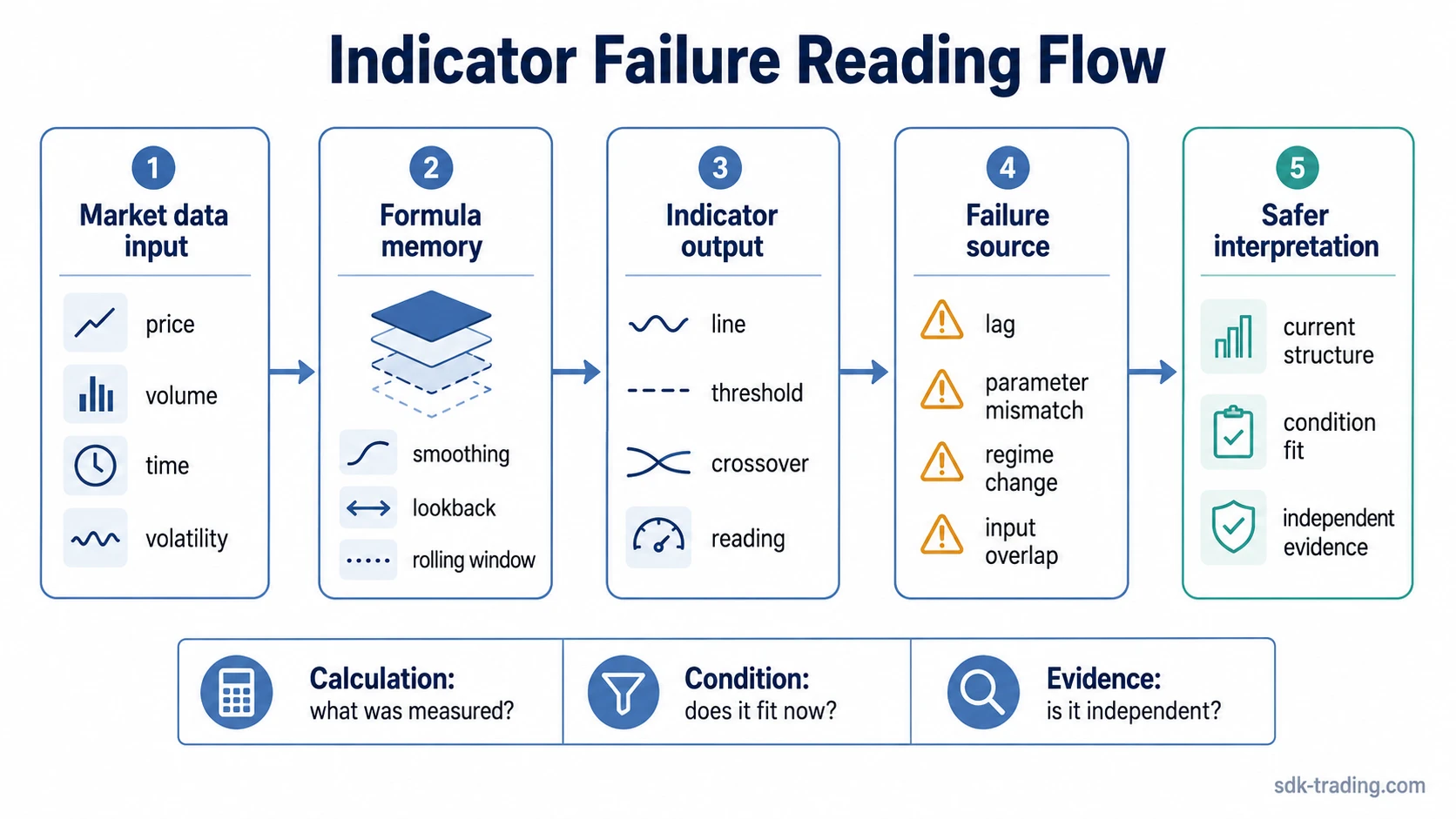
The Formula Can Be Correct While the Interpretation Is Wrong
An indicator transforms market data according to a fixed calculation. Price, volume, volatility, or another input enters the formula and produces an output.
The calculation itself does not know why the market is moving. It also does not know whether the environment has shifted from trend to range, from compression to expansion, or from orderly movement to sudden repricing.
| Layer | What happens |
|---|---|
| Market input | Price, volume, volatility, or another observable series changes. |
| Calculation | The indicator processes the input according to its formula and settings. |
| Reading | The output reaches a level, slope, crossover, threshold, or other state. |
| Interpretation | The trader assigns market meaning to that reading. |
| Failure point | The assumed market condition no longer matches the environment producing the data. |
The failure therefore often appears between the reading and its interpretation rather than inside the mathematical calculation.
A Trend Reading Can Become Stale After the Market Changes
Consider a market that has been advancing with relatively stable directional movement. A trend indicator responds to that history and continues to display a strong or rising reading.
Price then stops extending and begins rotating inside a range. The indicator may take time to adjust because its current value still contains information from the preceding trend.
EMA smoothing illustrates this mechanism. The EMA continues to incorporate prior price observations even while newer market behavior begins to change. The line is not malfunctioning. Its memory simply overlaps two different conditions.
Practical scenario: Price trends upward, then loses continuation and starts moving sideways. The EMA is still rising because recent trend data remains inside the calculation. Reading the rising EMA as fresh evidence of continuing trend strength confuses formula memory with the current market state.
Why the Same Indicator Reading Can Mean Different Things
A reading only has useful context when the measurement job fits the environment.
| Environment | Possible indicator behavior | Main interpretation risk |
|---|---|---|
| Directional trend | Trend-following readings may remain persistent. | Assuming persistence will continue after price structure begins to deteriorate. |
| Range | Momentum and crossover readings may alternate frequently. | Interpreting repeated rotations as separate directional changes. |
| Compression | Small movements may create sensitive short-term changes. | Giving a small calculation change more importance than the underlying price expansion. |
| Sudden repricing | Smoothed indicators can adjust after price has already moved materially. | Using delayed output to describe a market that has already changed state. |
The indicator can remain internally consistent in every row. What changes is whether the output still answers the question the trader thinks it answers.
Parameter Settings Change the Indicator’s Memory
Lookback length and smoothing determine how much previous market information remains in the current reading.
A shorter setting gives newer observations more influence and usually responds faster. A longer setting retains more historical information and usually changes more slowly.
Neither setting is inherently more accurate. They describe different measurement windows.
Boundary: changing a parameter changes what the indicator remembers. It does not reveal a single hidden market state that the previous setting failed to discover.
A setting that behaved cleanly during one volatility or trend regime can become too sensitive or too slow after that environment changes.
Several Indicators Can Repeat the Same Interpretation Error
Adding more indicators does not necessarily solve regime mismatch. Several tools can respond to the same underlying price movement and therefore reinforce the same stale interpretation.
A moving average, momentum oscillator, and price-derived trend filter may all react to a move that occurred during the previous market condition. Their agreement can look like independent confirmation even when much of the information originates from the same price history.
The useful question is not how many indicators agree. It is whether each tool is measuring a distinct feature of the current market and whether that measurement still fits the environment.
Separate Market Condition From Indicator Output
A better diagnostic sequence is to identify the market condition first, then ask what the indicator is actually measuring inside that condition.
| Step | Diagnostic question |
|---|---|
| 1. Identify the condition | Is price trending, ranging, compressing, expanding, or repricing? |
| 2. Identify the measurement | What specific input and calculation produced the reading? |
| 3. Check the memory window | How much earlier market behavior remains inside the current value? |
| 4. Compare with current structure | Does current price behavior still support the interpretation assigned to the indicator? |
| 5. Check independence | Does another tool add a different measurement or repeat the same input? |
An ADX trend-strength reading, for example, addresses trend-strength conditions rather than simply reproducing the visual role of a moving average. It still needs the same discipline: understand what it measures before assigning broader market meaning to the value.
The Main Failure Point
The most useful distinction is between calculation accuracy and interpretation fit.
Calculation fit: the formula processes its inputs according to its defined rules.
Interpretation fit: the meaning assigned to that output still matches the current market environment.
An indicator can satisfy the first condition while failing the second. This explains why technically valid crossovers, threshold readings, slope changes, and momentum shifts can still lead to weak conclusions.
Interpretation limit: indicators summarize selected market information. They do not automatically detect when the assumptions used to interpret that information have become stale.