A common mistake is treating indicator divergence as confirmation that price is about to reverse or continue. Divergence establishes something narrower: two comparable price swings and indicator swings are no longer moving in the same way.
Safer interpretation: first confirm that the price pivots and indicator pivots belong to the same swing sequence. Then classify the mismatch. Only after that should price structure and later behavior be used to judge whether the divergence matters.
This distinction matters because a technically correct divergence can remain visible while the existing price structure continues to hold. The mismatch is observable. The directional conclusion is a separate judgment.
Misread vs Safer Interpretation
| Observation | Common misread | Safer interpretation |
|---|---|---|
| Price makes a higher high while the indicator makes a lower high. | The uptrend has confirmed a reversal. | A bearish divergence exists if the swings are comparable. Price structure still determines whether the advance is actually weakening. |
| Price makes a lower low while the indicator makes a higher low. | A bullish reversal has started. | A bullish divergence exists if the pivots correspond. Recovery or structural change has not yet been established. |
| Divergence remains visible through several price swings. | The signal becomes stronger simply because it persists. | The indicator can continue losing momentum while price keeps extending in the existing direction. |
| One indicator shows divergence while another does not. | One of the indicators must be wrong. | Different calculations, smoothing, and lookback periods can produce different swing relationships from the same price sequence. |
The First Test Is Swing Matching
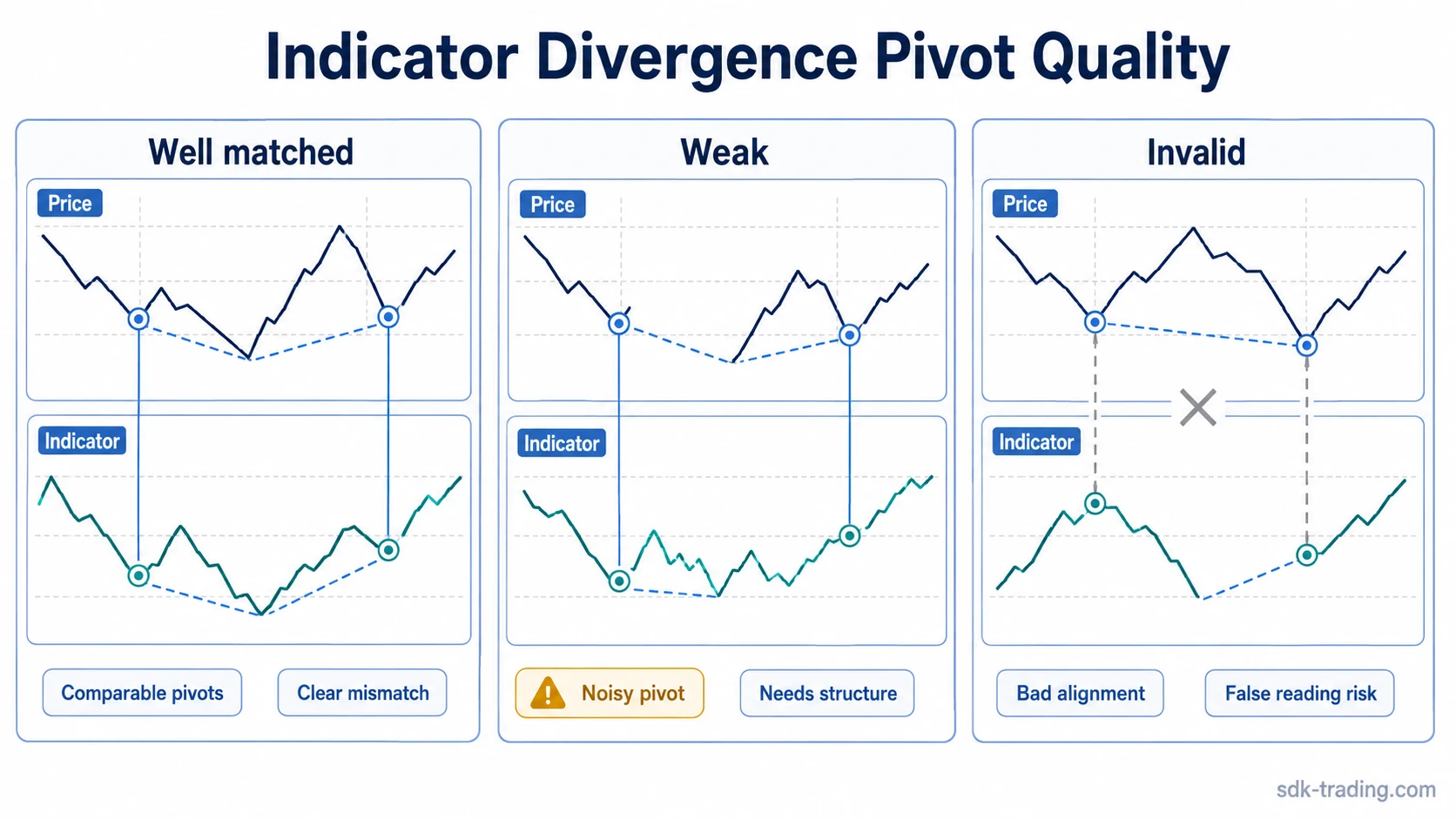
Divergence compares relationships between swings. A price high should be compared with the indicator high associated with that same part of the move. The same rule applies to lows.
The comparison becomes weak when a major price swing is paired with a minor indicator fluctuation, or when the indicator pivots are selected simply because they create the desired divergence line.
| Check | Better comparison | Failure mode |
|---|---|---|
| Pivot type | High with high, low with low. | Comparing different pivot types creates a meaningless relationship. |
| Swing sequence | Use price and indicator pivots produced by the same market move. | Pairing unrelated swings can manufacture divergence. |
| Structural relevance | Prefer visible swings that matter to the surrounding price structure. | Minor noise can create frequent but low-value divergence readings. |
| Consistency | Apply the same pivot-selection logic across the chart. | Changing the comparison method after seeing the result introduces selection bias. |
Core rule: if the swing pairing is not defensible before the divergence conclusion is known, the reading is too weak to carry much analytical weight.
Regular and Hidden Divergence Describe Different Relationships
Once the pivots are matched correctly, the relationship can be classified. Regular divergence compares a new price extreme with a weaker indicator extreme. Hidden divergence compares a trend-side price pullback with an indicator swing that moves further in the opposite direction.
| Type | Price relationship | Indicator relationship | What it establishes |
|---|---|---|---|
| Regular bullish | Lower low | Higher low | Price extended lower while the indicator did not confirm with a corresponding lower low. |
| Regular bearish | Higher high | Lower high | Price extended higher while the indicator did not confirm with a corresponding higher high. |
| Hidden bullish | Higher low | Lower low | Price maintained a higher structural low while the indicator made a deeper low. |
| Hidden bearish | Lower high | Higher high | Price maintained a lower structural high while the indicator made a stronger high. |
For the broader concept and its main divergence types, see divergence in trading.
Why a Correct Divergence Can Still Fail as a Directional Read
A divergence can be technically valid and still produce a poor reversal or continuation interpretation. The reason is simple: the indicator describes a transformed version of price behavior, while the market can continue accepting new prices even as that transformation weakens.
Failure-mode example: Price reaches a prior resistance area, makes a marginal higher high, and the oscillator forms a lower high. The bearish divergence is correctly drawn. Price then holds above the prior breakout area and the next pullback remains structurally higher. The divergence did not disappear, but the expected bearish interpretation received no support from price.
In that situation, the correct conclusion is not that the divergence was drawn incorrectly. The swing mismatch existed. What failed was the assumption that the mismatch alone would force price to reverse.
Price Structure Comes After the Divergence Test
Once a valid mismatch is identified, the next question is whether price behavior supports the interpretation.
| Price check | What it adds |
|---|---|
| Failure to hold a new high or low | Shows that the price extension itself is becoming less stable. |
| Return through a tested level or area | Shows that acceptance beyond the previous structure was not maintained. |
| Failure of the next recovery or pullback | Adds evidence that control may be changing rather than merely momentum slowing. |
| Continued acceptance in the original direction | Weakens the directional interpretation even though the divergence can remain visible. |
Divergence therefore belongs before confirmation in the analytical sequence, not after it.
The Indicator Formula Changes the Reading
RSI, MACD, stochastic, CCI, Williams %R, and other indicators do not transform price in the same way. Their pivots can differ because their calculations, lookback periods, range logic, and smoothing differ.
This means the question is not whether every indicator confirms the same divergence. The relevant question is whether the divergence is meaningful for the specific property that the selected indicator measures.
RSI divergence deserves separate treatment because RSI has its own calculation behavior, range characteristics, and momentum interpretation limits.
A Practical Divergence Reading Sequence
| Step | Question |
|---|---|
| 1. Identify price swings | Which two highs or lows are actually being compared? |
| 2. Match indicator swings | Do the indicator pivots correspond to the same parts of the price move? |
| 3. Classify the relationship | Is the mismatch regular, hidden, or not a valid divergence at all? |
| 4. Check structure | Has anything changed in the actual price sequence? |
| 5. Observe later behavior | Does price support the divergence interpretation or continue absorbing it? |
Interpretation limit: divergence can establish disagreement between price and an indicator. It cannot establish future direction by itself.