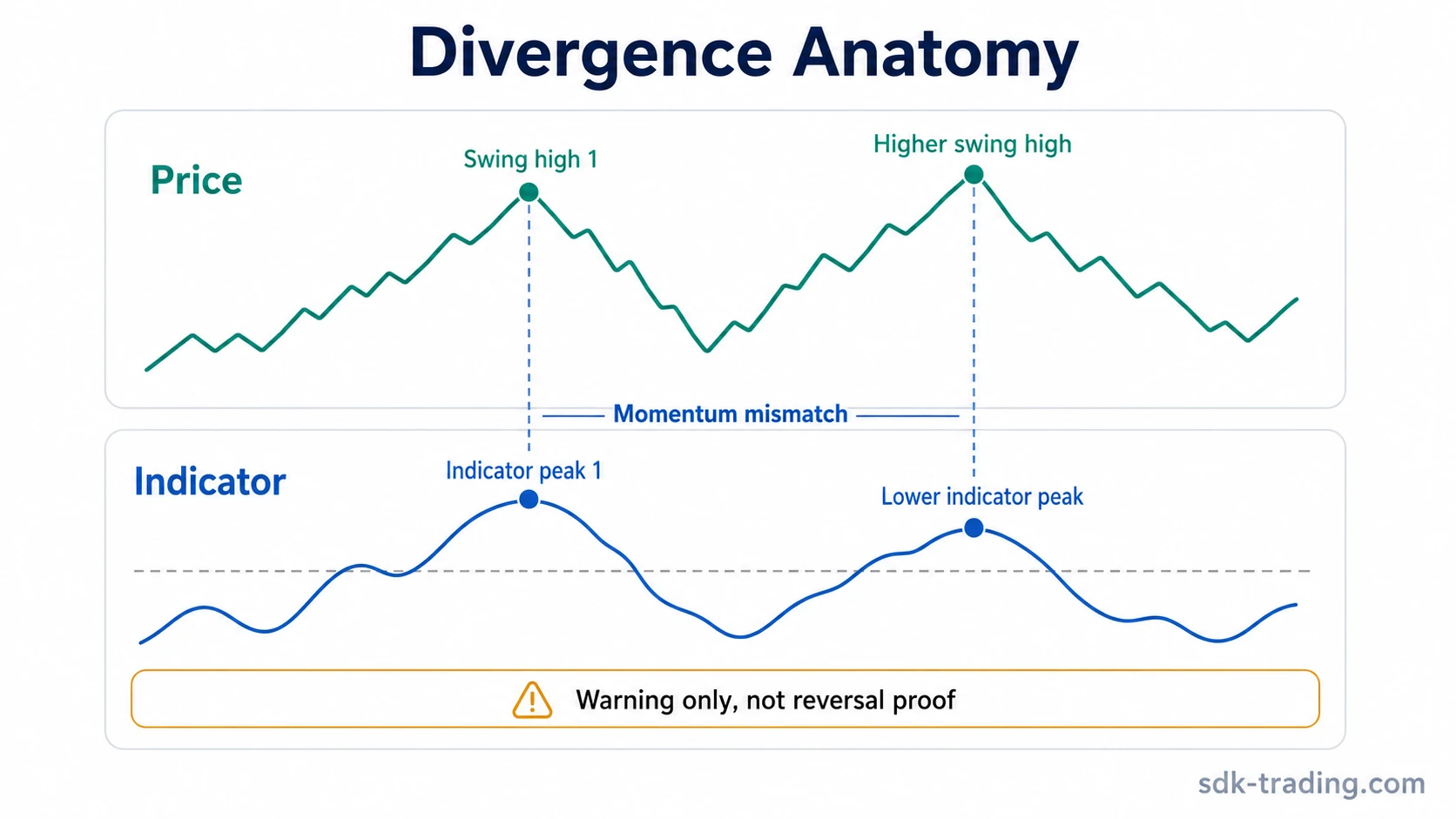
Divergence in trading appears when price and a technical indicator move out of agreement across comparable swing points. The reading points to a momentum mismatch, not automatic proof that price must reverse or continue. It is cleaner when the swing highs or lows are comparable, the timing is close enough to compare, and later price behavior supports the warning.
Definition: Divergence in trading is a technical-analysis condition where price makes one swing pattern while an indicator or oscillator makes a different swing pattern. The most common comparison is between price highs or lows and indicator peaks or troughs.
Key Points
- Divergence compares price swings with indicator swings.
- It can show a loss or shift in momentum beneath price movement.
- It does not prove reversal, continuation, or trade direction by itself.
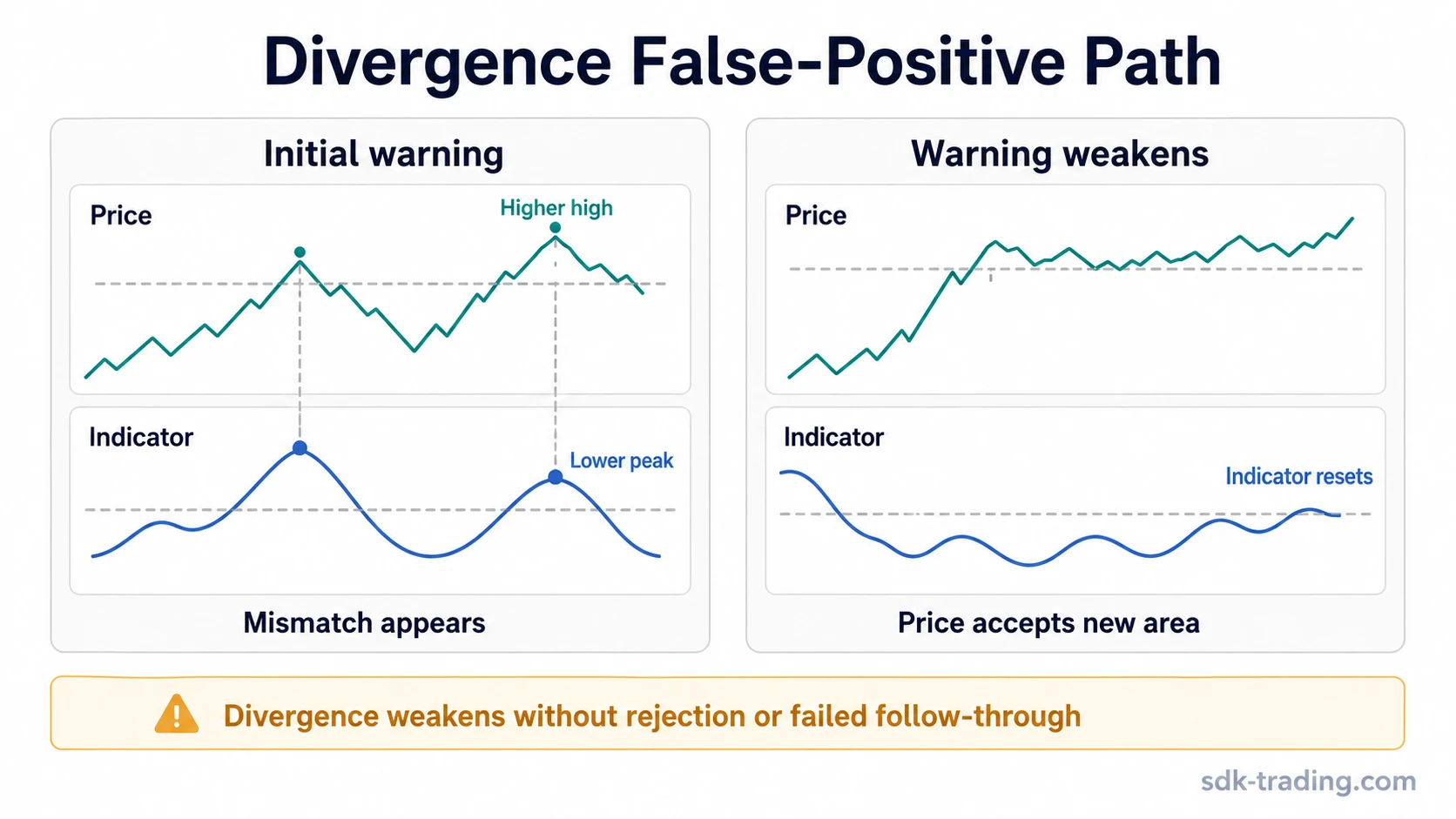
- It weakens when price accepts the new high or low and the indicator resets.
What Divergence in Trading Means
Divergence means the price chart and the indicator are not confirming each other. Price may be extending to a new swing high while the indicator forms a lower peak, or price may be pushing to a new swing low while the indicator forms a higher trough.
The idea is not that the indicator is “right” and price is “wrong.” The useful reading is that the latest price move may be occurring with a different level of momentum than the previous swing. That mismatch can make the move worth watching more carefully, especially near important market structure.
A divergence reading becomes less useful when the compared swings are not similar, the indicator peak is stale, or the market continues accepting the new price area. In that case, the mismatch may be noise rather than a useful warning.
How Price and Indicator Divergence Forms
Divergence starts with two comparable price swings. For bearish divergence, traders usually compare two swing highs. For bullish divergence, they usually compare two swing lows. The indicator is then checked against the same part of the chart.
The comparison needs timing discipline. A fresh price high compared with an old indicator peak can create a misleading reading. The cleaner comparison is between swings that belong to the same market sequence and can reasonably be measured against each other.
Indicator choice also matters. Oscillators such as RSI, MACD, Stochastic, CCI, or Williams %R can all produce divergence-style readings, but each tool measures momentum differently. The concept stays the same: price and the indicator are being compared for agreement or disagreement.
Diagnostic Boundary: What Makes Divergence Cleaner or Weaker
| Diagnostic point | Stronger interpretation | Weaker or invalid interpretation |
|---|---|---|
| What it is | Price and indicator swings disagree across comparable highs or lows. | The comparison is made across unrelated or poorly timed swings. |
| What it is not | A warning that momentum may not confirm the latest price move. | A complete trading method or automatic reversal call. |
| Cleaner reading | The second price swing is clear, the indicator swing is visible, and the mismatch appears near a meaningful structure. | The mismatch is tiny, the swings are noisy, or the indicator is only slightly different from the prior reading. |
| Confirmation condition | Price later fails to hold the extended high or low and begins to show rejection or loss of follow-through. | Price holds the new area, continues through it, and the indicator resets without meaningful rejection. |
Main Types of Trading Divergence
The main divergence types separate direction and market context. Regular divergence is usually watched for possible momentum exhaustion. Hidden divergence is usually read as a continuation-type condition, but it still needs context and later price behavior.
| Type | Price behavior | Indicator behavior | Basic reading |
|---|---|---|---|
| Regular bullish divergence | Price makes a lower low | Indicator makes a higher low | Downside momentum may be weakening. |
| Regular bearish divergence | Price makes a higher high | Indicator makes a lower high | Upside momentum may be weakening. |
| Hidden bullish divergence | Price makes a higher low | Indicator makes a lower low | Pullback momentum may not confirm a deeper reversal. |
| Hidden bearish divergence | Price makes a lower high | Indicator makes a higher high | Recovery momentum may not confirm a broader reversal. |
Bullish divergence needs its own directional reading because lower price lows and higher indicator lows create a different diagnostic problem from bearish or hidden forms.
Indicators Commonly Used for Divergence
Divergence can be checked with several momentum tools, but the interpretation should not become indicator-only. RSI, MACD, Stochastic, CCI, and Williams %R can all disagree with price, yet the chart structure still decides whether the comparison is meaningful.
RSI divergence behavior focuses on how RSI highs and lows compare with price swings. MACD divergence readings involve MACD line, histogram, or momentum changes. The broader concept remains price-versus-indicator disagreement.
A common mistake is treating the indicator name as the entire reading. A safer question is whether price structure, indicator behavior, and later follow-through point in the same direction or create a conflict that still needs confirmation.
Clean, Weak, and Invalid Divergence Readings
| Reading quality | What to observe | Why it matters |
|---|---|---|
| Clean | Comparable swing points, visible mismatch, and later failure to hold the extended price area. | The divergence is tied to structure and later behavior rather than a single indicator mark. |
| Weak | Noisy swings, shallow indicator difference, poor timing, or no clear market structure. | The mismatch may be too small or too poorly aligned to carry much interpretive weight. |
| Invalid or weakened | Price holds the new high or low, follow-through continues, and the indicator resets. | The market is accepting the move rather than rejecting it, so the earlier mismatch loses usefulness. |
Confirmation is a condition, not a guarantee. A divergence reading becomes more defensible when later price action rejects the extended area or loses follow-through. It weakens when the market absorbs the warning and continues without meaningful rejection.
Divergence False-Positive Example
Price advances into a prior resistance area and pushes slightly above the earlier swing high. At the same time, the oscillator forms a lower peak. That creates a bearish divergence reading because price extends higher while the indicator does not confirm the same strength.
The reading remains incomplete if price holds above the prior high instead of rejecting it. If later candles continue holding the higher area and the oscillator resets, the mismatch loses much of its value. The initial warning was visible, but the market did not confirm it through rejection or failed follow-through.
Common Divergence Mistakes
Mistake: Treating divergence as reversal proof. Divergence can warn that momentum is changing, but the market can still continue if price accepts the new area.
Mistake: Comparing unrelated swings. A divergence reading is weaker when the price swing and indicator swing do not belong to the same market sequence.
Mistake: Ignoring context. A small indicator mismatch inside a strong accepted trend can be less useful than a clear mismatch near a tested structure with later rejection.
Related Divergence Concepts
Divergence becomes easier to separate when the umbrella concept stays distinct from its variants. Bullish, bearish, hidden, RSI-based, and MACD-based readings all use the same broad comparison logic, but each one asks a narrower question about direction, indicator behavior, or continuation context.
The core discipline is to identify the mismatch first, then test whether the compared swings, market structure, and later price behavior support the interpretation. Without that sequence, divergence can become a loose label for almost any indicator disagreement.
FAQ
What does divergence mean in trading?
Divergence in trading means price and a technical indicator move out of agreement across comparable swing points. The reading usually highlights a possible momentum mismatch.
Can divergence fail?
Yes. Divergence can fail when price accepts the new high or low, continues the move, and the indicator resets instead of confirming rejection or loss of follow-through.
Is RSI divergence the same as divergence in trading?
No. RSI divergence is one indicator-specific form of divergence. Divergence in trading is the broader concept of comparing price swings with indicator swings.
Is divergence enough to call a reversal?
No. Divergence can warn that momentum is not confirming price, but reversal interpretation needs supporting context and later price behavior.