Trend moving average signals classify moving-average events by crossover type, trend context, sequence quality, and recross risk. This routing page separates broad crossover mechanics from named long-term crossover structures so the signal can be interpreted through sequence and context before it is reduced to a label.
Trend moving average signals are indicator readings created when moving averages slope, cross, separate, converge, or recross in a way that changes trend interpretation. They classify moving-average behavior by structure, sequence, and trend context.
Key Points
- Trend moving average signals need a sequence check before the pattern label is trusted.
- A crossover, golden cross, and death cross are related, but they do not describe the same event.
- The trend context filter matters because the same moving-average event can mean continuation, transition, or noise.
- Flattening averages, overlap, and quick recrosses weaken the reading because they show poor trend separation.
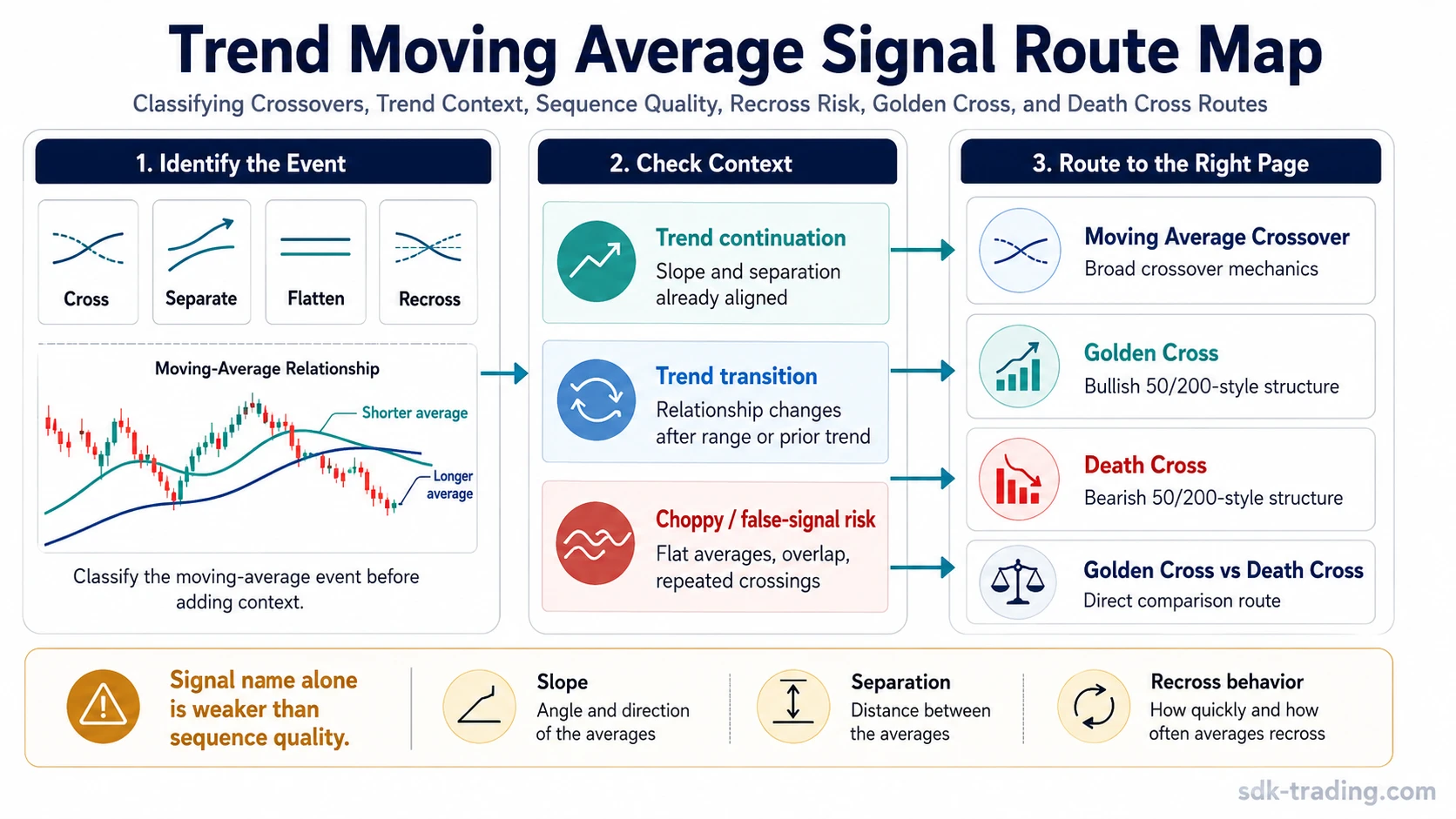
Trend Moving Average Signal Route Map
The main distinction is whether the moving-average event describes a broad crossover mechanism, a bullish 50/200 structure, a bearish 50/200 structure, or a direct comparison between the two named crossover patterns.
| Signal situation | Relevant concept | Scope boundary |
|---|---|---|
| A shorter moving average crosses a longer moving average, but the event is not limited to a named 50/200 pattern. | Moving Average Crossover | Broad crossover logic before the event is narrowed into a specific bullish or bearish structure. |
| A shorter long-term average moves above a longer long-term average and the focus is bullish trend transition. | Golden Cross | The 50/200-style bullish crossover concept, including lag and recross risk. |
| A shorter long-term average moves below a longer long-term average and the focus is bearish trend transition. | Death Cross | The 50/200-style bearish crossover concept and its trend-state boundary. |
| The two named 50/200 crossover structures are being separated from each other. | Golden Cross vs Death Cross | Direct bullish-versus-bearish comparison rather than a standalone definition. |
Sequence Before Pattern
A moving-average event becomes easier to classify when the sequence is checked before the label. The first step is the average relationship: crossing, separating, flattening, converging, or recrossing. The second step is trend location: whether price and averages are already trending, transitioning, or moving sideways.
This prevents a common classification error. A fresh crossover after a long sideways range is not the same as a clean cross with expanding average separation. A cross that quickly reverses is also different from a cross that develops after persistent slope change.
Routing filter: treat the moving-average event as a classification cue first. The reading becomes cleaner when slope, separation, price location, and recross behavior all point in the same direction.
Trend Context Filter
The trend context filter separates three broad cases: continuation, transition, and countertrend ambiguity. Continuation readings occur when the moving averages already show direction and the newer event confirms the existing structure. Transition readings occur when the averages begin changing relationship after a prior trend or range. Countertrend ambiguity appears when the event forms against the larger structure or while the averages are still flat.
| Context | What to inspect | Why it changes interpretation |
|---|---|---|
| Trend continuation | Average slope, distance between averages, and whether price remains on the same side of the main average. | The reading supports an existing trend structure rather than introducing a new one. |
| Trend transition | Recent flattening, change in slope, and whether the crossover follows a real structural shift. | The signal may describe a transition, but it still arrives after price has already moved. |
| Countertrend ambiguity | Whether the event forms against the larger trend or inside choppy movement. | The same cross can become noise when average separation is weak and price quickly moves back across the averages. |
| False-signal context | Repeated crossings, overlapping averages, and low directional slope. | The reading weakens because the averages are describing rotation rather than directional acceptance. |
Signal Boundaries Inside the Cluster
Broad crossover mechanics belong to the moving average crossover concept. Bullish long-term transition belongs to the golden cross pattern. Bearish long-term transition belongs to the death cross pattern. Direct bullish-versus-bearish separation belongs to the golden cross versus death cross comparison.
The boundary is simple: classification comes before detail. Once the event type is clear, the specific concept can handle definition, mechanism, interpretation, limitations, and examples.
Moving-average signals are derived from prior prices, so the reading is usually lagging rather than predictive. Late crosses, flattening averages, and quick recrosses matter because they weaken signal quality even when the label itself looks clear.
Common Misreadings
| Misreading | Safer interpretation |
|---|---|
| Treating every crossover as the same type of trend signal. | Separate generic crossover mechanics from named golden cross and death cross structures. |
| Ignoring whether the averages are sloping or flat. | Flat and overlapping averages often show weak directional separation. |
| Reading a late crossover as if it appeared before the move. | Moving averages are derived from prior prices, so crossover signals often arrive after part of the move has already developed. |
| Using one 50/200 interpretation for all moving-average pairs. | Shorter lookbacks and longer lookbacks respond differently, so the same label should not be copied across every parameter set. |