Partial take profit means closing part of a trading position while leaving the remaining part open. It can realize part of a trade outcome and reduce the size still exposed to price movement, but it does not close the whole trade, remove all risk, or make the trade better by itself.
Definition: A partial take profit is a partial exit. One portion of the position is closed, while the rest remains active and can still gain, lose, reverse, or continue with the market.
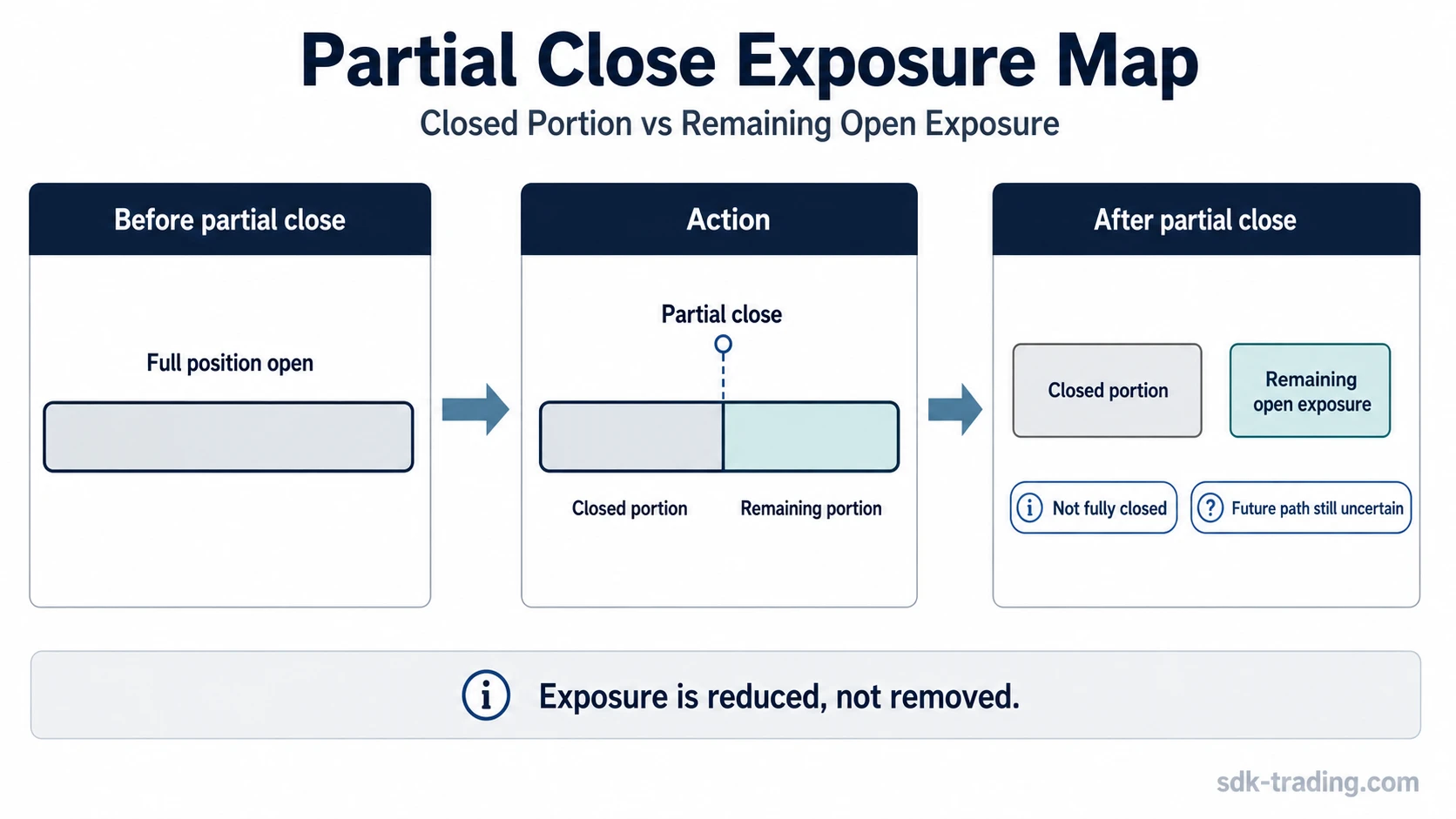
The useful distinction is exposure state. Before the partial exit, the full position is still open. After the partial exit, one part has been closed and the remaining part is smaller than the original position. That changes the trade’s exposure profile, but it does not change the uncertainty of the next price move.
Key Points
- Partial take profit closes only part of a position.
- The remaining position stays exposed to future price movement.
- A partial exit can reduce open exposure, but it can also reduce full-size participation if price continues favorably.
- Partial profit is not the same as a full exit, a stop, or proof that the trade was high quality.
- The concept describes position exposure, not a universal exit method.
What Partial Take Profit Means
Partial take profit is used when only a portion of an open trade is closed. The closed portion is no longer exposed to later price movement. The remaining portion stays open and continues to respond to the market.
This creates two separate states inside the same trade outcome. One part has been realized. The other part is still uncertain. That is why partial profit should not be read as the same thing as being fully out of the position.
Not this: “The trade is finished because part of it was closed.”
Instead: “Part of the position is finished, while the rest remains exposed.”
Partial profit taking is closer to exposure resizing than to a complete trade exit. It reduces what remains open, while the remaining portion keeps its own outcome path.
Partial Take Profit vs Full Take Profit
A full take-profit exit closes the whole position. Partial take profit closes only part of the position and leaves the rest open. The two actions may both realize some outcome, but they leave different exposure behind.
| Exit type | What closes | What remains exposed | Main boundary |
|---|---|---|---|
| Full take profit | The whole position | Nothing from that position | The trade is fully exited |
| Partial take profit | Only one portion of the position | The remaining portion | Exposure is reduced, not removed |
A take profit describes an exit objective or order logic for closing a position at a favorable price. Partial take profit is narrower: it describes closing only part of the position instead of closing the entire trade.
What Changes After a Partial Exit
After a partial exit, the trade no longer has the same exposure size. The closed portion is separated from the open portion, and the remaining position carries the next part of the trade’s uncertainty.
| What changes | What it means | What it does not mean |
|---|---|---|
| Open exposure size | The amount still affected by price movement becomes smaller. | The market has not become more predictable. |
| Remaining risk profile | The open part can still move against the trader. | Risk has not disappeared automatically. |
| Future participation | The remaining part can still benefit if price continues favorably. | The trader no longer participates with the original full size. |
| Decision pressure | The position may feel different because less size remains open. | A smaller position does not prove the decision was correct. |
The trade-off is simple but often misunderstood. Reducing open exposure can reduce the size still at risk, but it can also reduce the size that benefits if the favorable move continues.
What Partial Take Profit Does Not Solve
Partial take profit does not prove that the trade was well planned. It also does not remove execution risk, replace a risk boundary, or guarantee a better final outcome. It only changes how much of the original position remains open.
Boundary: A partial exit changes position exposure. It does not change market uncertainty, guarantee the remaining trade, or replace a stop loss boundary for the part that remains open.
This is especially important when partial profit is confused with risk removal. The closed portion is no longer exposed, but the remaining portion still needs its own risk interpretation. Price can continue, stall, reverse, gap, or fill differently than expected depending on market conditions and order execution.
Common Mistake: Treating Partial Profit as Automatic Risk Removal
A common mistake is treating a partial profit as if the entire trade has become safe. That reading skips the main distinction between realized portion and remaining exposure.
| Misread | Cleaner interpretation |
|---|---|
| Part of the position was closed, so the trade is finished. | Only the closed portion is finished. The remaining portion is still open. |
| Partial profit makes the setup better. | Partial profit changes exposure. It does not improve the original setup by itself. |
| Partial profit removes the need to manage the rest. | The remaining position still has its own exposure, uncertainty, and exit logic. |
| Partial exits are always better than full exits. | Partial and full exits create different payoff and exposure profiles. Neither is universally better from the concept alone. |
The cleaner question is not whether partial profit is automatically good or bad. The cleaner question is what remains open after the partial exit and how that remaining exposure changes the trade’s profile.
Example of Partial Exposure Reduction
Illustrative scenario: A trader has one open position. Part of that position is closed, while the rest remains open. After the partial close, the closed portion no longer changes with price. The remaining portion still moves with the market and can still produce a different result from the closed portion.
This example does not require an entry price, target level, stop level, pip value, lot size, or fixed percentage ladder. The point is the exposure split: one portion is realized, while the remaining portion still carries future price uncertainty.
If price continues favorably, the smaller remaining position participates with less size than the original full position. If price reverses, the remaining position is still exposed. Both outcomes come from the same structural fact: partial take profit reduces open exposure without eliminating it.
How Partial Take Profit Relates to Scaling Out
Scaling out is a broader position-sizing label. Partial take profit is narrower because it describes closing less than the full position after a favorable move while leaving the rest exposed.
The staged nature of the exit does not create a rule by itself. A partial exit can be planned, discretionary, mechanical, or platform-specific, but those details belong to the trader’s broader execution process. The concept of partial take profit only says that less than the full position is closed.
When Partial Take Profit Can Reduce Participation
Partial take profit can reduce remaining exposure, but that same reduction can also reduce participation if price keeps moving favorably. The smaller remaining position cannot capture the same full-size continuation as the original position.
Limitation: Reducing size can lower the amount still exposed, but it can also reduce the benefit of a strong continuation. That trade-off is why partial exits should not be framed as automatically safer, smarter, or more profitable.
This is the main payoff boundary. A partial exit changes the shape of the outcome. It does not make the future path certain.
Partial Exit Test: 30% vs 50% vs Full Exit
A partial take-profit rule changes how much size remains available for continuation. This matters most when a strategy does not depend only on frequent small winners, but also on a smaller number of larger winners.
In an internal 58-position exit-rule review, the baseline exit model produced a 72.4% win rate, an average result of 1.55R, and a median result of 0.54R. The sample was then re-modeled with several partial and full exit assumptions to test how early exposure reduction changed the outcome profile.
| Exit rule tested | Net result index | Average R | Modeled change | What changed |
|---|---|---|---|---|
| Baseline technical exit | 100.0 | 1.55R | Reference model | Kept full exposure until the later exit condition. |
| Close 100% at 2R | 63.0 | 0.83R | -37.0% | Removed all exposure before larger continuation could develop. |
| Close 50% at 2R, leave 50% to 5R or later exit | 77.4 | 1.06R | -22.6% | Reduced exposure, but kept only half-size participation in larger winners. |
| Close 30% at 2R, leave 70% to 5R or later exit | 83.2 | 1.16R | -16.8% | Protected less early profit, but preserved more continuation exposure. |
| Full exit at 5R | 91.8 | 1.30R | -8.2% | Allowed larger winners to develop, but still capped outcomes above 5R. |
The partial-exit comparison shows the core trade-off. Taking 50% off at 2R was more conservative than taking 30% off at 2R, but it also left less size available for continuation. In this sample, the 30% partial exit preserved more of the baseline result than the 50% partial exit because larger winners mattered to the overall distribution.
A partial take-profit rule can make a position easier to hold, but it is not automatically better. The better question is whether the strategy needs right-tail participation. In this sample, the top 5 winners accounted for roughly half of the net result, so reducing size too early had a measurable opportunity cost.
FAQ
Is partial take profit the same as closing a trade?
No. Partial take profit closes only part of a trade. The remaining part stays open and continues to move with the market.
Does partial take profit remove all risk?
No. The closed portion is no longer exposed, but the remaining position can still gain, lose, reverse, or continue as market and execution conditions change.
Can partial take profit reduce future upside?
Yes. If price continues favorably after the partial exit, the remaining position participates with less size than the original full position.