A regular stop and a guaranteed stop both define where a position should be closed if price moves against the trade. The difference appears at execution. A regular stop triggers an order that still depends on available market prices, while a guaranteed stop is designed to preserve an accepted stop level under the broker’s guarantee terms.
Core distinction: a regular stop defines a trigger. A guaranteed stop adds a broker-backed fill condition to the accepted stop level, subject to availability, cost, distance, platform, product, and modification rules.
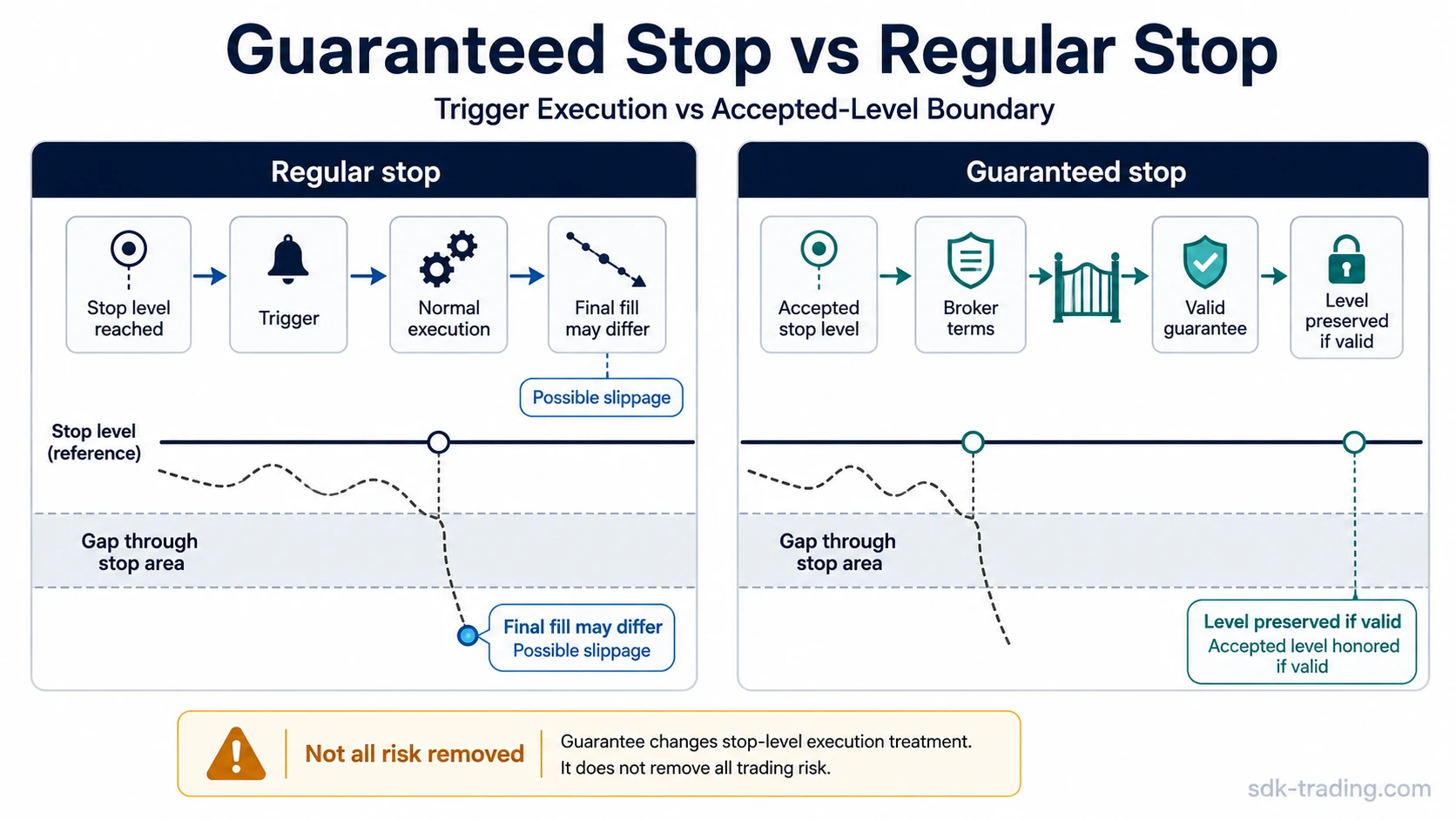
Guaranteed Stop vs Regular Stop: The Main Difference
Both order types begin with the same planning decision: the trader selects a price boundary where the position should no longer remain open. The distinction is what happens when that boundary is reached.
With a regular stop-loss, reaching the stop level activates the exit instruction. The final transaction still takes place under normal market conditions. If available prices move quickly or the market gaps through the stop, the actual fill can be worse than the selected level.
A guaranteed stop-loss order adds a guarantee to the accepted stop level. When the order qualifies under the provider’s terms and is triggered, the provider handles the exit at that guaranteed level rather than passing the gap or slippage at that stop level to the trader.
Guaranteed Stop vs Regular Stop Comparison
| Criterion | Regular stop | Guaranteed stop |
|---|---|---|
| Basic purpose | Defines when an exit instruction should activate. | Defines an exit level and adds a guarantee to that accepted level. |
| After the stop is reached | The exit is handled through normal market execution. | The guaranteed level is used when the order remains valid under the provider’s terms. |
| Slippage | The final fill can differ from the stop level. | Designed to remove slippage from the guaranteed stop level. |
| Market gap | A gap can move the next executable price beyond the planned stop. | A valid guarantee is designed to preserve the accepted stop level through the gap. |
| Additional cost | No separate guarantee premium, although normal trading costs still apply. | Provider-specific. A premium or fee may apply under the broker’s stated charging model. |
| Availability | Generally part of standard stop-order functionality, subject to the broker and product. | May be restricted by instrument, region, account, platform, or market conditions. |
| Placement rules | Subject to the provider’s normal stop-order rules. | Often subject to specific minimum-distance or acceptance requirements. |
| Modification | Usually follows normal order-modification rules before execution. | Changes may need to continue meeting the guarantee conditions or require renewed acceptance. |
| Risk controlled | Controls the planned exit trigger. | Controls a specific source of stop-level execution uncertainty. |
Why Gaps and Slippage Create the Difference
The two stop types can produce almost identical results when price trades continuously and sufficient liquidity is available near the stop. Their difference becomes more important when the market moves across prices without offering execution at every intermediate level.
Suppose a long position has a stop at 100. If the market trades normally through 100, a regular stop may execute close to that level. If the next available price after a gap is 96, the same regular stop can fill around the available market price rather than at 100.
Under a valid guaranteed-stop arrangement, the same gap is treated differently. The accepted guaranteed level is used according to the broker’s terms. The guarantee therefore addresses the difference between the intended stop level and the executable market price at the moment the stop is activated.
Execution distinction: the regular stop protects the instruction to exit. The guaranteed stop adds protection for the accepted stop price itself.
Same Scenario, Different Execution Result
A trader holds a position with a planned stop at 100. The market closes above that level and later reopens at 95.
With a regular stop, the stop condition has been crossed, but there was no continuous trading at 100. The order therefore depends on the price available when execution becomes possible, so the realized exit can be materially below the original stop.
With a guaranteed stop accepted at 100, the gap does not change the guaranteed stop level if the order still satisfies the provider’s terms. The economic difference between the two orders is therefore concentrated in the five-point execution gap rather than in the original decision to place the stop at 100.
Cost and Availability Depend on the Broker
Guaranteed stops are not standardized across every broker, instrument, platform, or jurisdiction. Providers can differ in where GSLOs are offered, how far the stop must be placed from the current market, when the order may be added or modified, and how the guarantee is priced.
For example, some current providers charge a guaranteed-stop premium only when the stop is triggered. Others reserve a premium when the order is placed and refund it if the guaranteed stop is never triggered. The important point is therefore not to assume one universal fee model.
| Broker term to check | Why it matters |
|---|---|
| Instrument availability | The provider may allow guaranteed stops on some markets but not others. |
| Platform availability | The order type may be supported on one trading platform but unavailable on another. |
| Minimum distance | The stop may need to sit a specified distance away from the market or entry price. |
| Premium or fee | The amount and charging method can vary by provider and instrument. |
| Modification rules | Moving the stop may be restricted or require the modified order to satisfy the guarantee rules again. |
What a Guaranteed Stop Actually Changes
The guarantee changes one part of the risk chain: the uncertainty between the accepted stop level and the eventual stop fill. It does not change the size of the position, the distance to the selected stop, the quality of the original trade idea, or the amount the market can move against the position before that boundary is reached.
An oversized position can therefore remain oversized even when its exit price is guaranteed. A poorly selected stop level can remain poorly selected. Product leverage, financing, margin requirements, and other account-level risks also remain separate from the stop-level guarantee.
When the Difference Matters Most
| Situation | Regular stop | Guaranteed stop |
|---|---|---|
| Normal liquid trading near the stop | May execute close to the selected level. | The guarantee may produce little practical difference in the final price. |
| Fast movement through the stop | The fill can move away from the trigger. | The valid guaranteed level remains the execution boundary. |
| Overnight or session gap | The position can close at the next available price. | The valid guarantee is designed to absorb the stop-level gap. |
| GSLO is unavailable on the product or platform | The standard stop remains the available stop structure. | The guaranteed alternative cannot be used. |
| Guaranteed protection carries a premium or tighter rules | No guarantee-specific cost is incurred. | The additional execution protection has a provider-defined cost or restriction. |
Guaranteed Stop, Regular Stop, and Trailing Stop
A guaranteed stop should also be separated from a trailing stop. A trailing stop changes its boundary as price moves according to its trailing rule. The guaranteed-stop comparison concerns whether a selected stop level receives guaranteed execution treatment.
The distinction is therefore functional: a regular stop defines an exit trigger, a guaranteed stop adds stop-level execution protection under provider terms, and a trailing stop changes where the stop boundary sits as the market moves.