Stop limit vs stop loss is the difference between execution priority and a price boundary after a stop trigger. A stop-loss order prioritizes getting an order executed once the stop price is reached, while a stop-limit order adds a limit price that can block execution beyond that boundary.
The tradeoff is not simply safer versus riskier. A stop-loss can execute away from the stop level during fast movement, gaps, or thin liquidity. A stop-limit can avoid a worse-than-limit fill, but it can also leave the position open if the limit price is not available.
Core distinction: a stop-loss answers the execution question first. A stop-limit answers the price-boundary question first. Both begin with a stop trigger, but they create different order behavior once activated.
Key Points
- Stop-loss orders prioritize execution after the stop trigger.
- Stop-limit orders add a limit boundary once the stop trigger is reached.
- A stop-loss can slip in fast or gapping markets.
- A stop-limit can fail to fill if the limit price is not available.
- Neither order type removes execution risk.
What Is the Difference Between Stop Limit and Stop Loss?
The difference between stop limit and stop loss is what happens once the stop price is reached. A stop-loss order becomes a market-style order, so execution becomes the priority. A stop-limit order becomes a limit order, so the accepted price boundary becomes the priority.
That difference changes the remaining risk. The stop-loss may fill, but not at the exact stop level. The stop-limit may protect the limit boundary, but it may not fill at all. The comparison is therefore a tradeoff between fill likelihood and price constraint, not a simple ranking of one order as universally safer.
False-equivalence warning: both orders use a stop trigger, but the trigger is only the first step. The resulting order type is what separates the two.
Stop-Loss Order: Execution Priority After the Trigger
A stop-loss order is designed to activate when a specified stop price is reached. After activation, the order normally seeks execution rather than holding to a fixed final price.
This makes the stop-loss easier to understand as an execution-priority tool. It can help convert a planned boundary into an active order, but the actual fill still depends on available liquidity, market speed, gaps, and order-handling rules. The stop price is the trigger level, not a guaranteed fill level.
Limitation: when the market moves quickly through the stop area, the fill may occur at a worse price than the stop level. That difference is slippage.
Stop-Limit Order: Price Boundary After the Trigger
A stop-limit order also begins with a stop trigger. Once activated, it becomes a limit order instead of a market-style execution order. The limit price sets the boundary beyond which the order should not execute.
This gives the order more control over the acceptable fill price, but that control introduces a separate risk. If the market moves through the stop area and the limit price is not available, the order may remain unfilled. The original position or exposure can remain open even though the stop trigger was reached.
Limitation: a stop-limit can refuse a worse fill, but refusal is not the same as closure. The remaining exposure can still be affected by later price movement.
Stop Limit vs Stop Loss Comparison Table
| Criterion | Stop-loss | Stop-limit | Why it matters |
|---|---|---|---|
| Trigger condition | The stop price is reached. | The stop price is reached. | The trigger can look similar even when the later order behavior is different. |
| Order created after trigger | Market-style execution order. | Limit order with a price boundary. | The resulting order type controls the main risk difference. |
| Execution likelihood | Often higher, depending on market conditions and order handling, because execution is prioritized after activation. | Lower when price moves beyond the limit boundary before liquidity is available. | Fill likelihood and price boundary cannot both be maximized in every condition. |
| Price boundary | No fixed final fill price is guaranteed by the stop level. | The limit price defines the accepted execution boundary. | The stop level and the actual fill level can be different concepts. |
| Main residual risk | Slippage after activation. | Non-fill after activation. | Each order reduces one kind of uncertainty while leaving another risk open. |
| Gap / fast-market behavior | Can fill away from the stop price if the market gaps or moves quickly. | Can remain unfilled if price jumps beyond the limit and does not trade back. | Fast movement exposes the difference between execution priority and price control. |
| Practical interpretation | Prioritizes closing or reducing exposure after the trigger, but not at a guaranteed price. | Prioritizes a defined fill boundary, but not guaranteed execution. | The central decision boundary is execution certainty versus price boundary. |
Same Market Move, Different Order Outcome
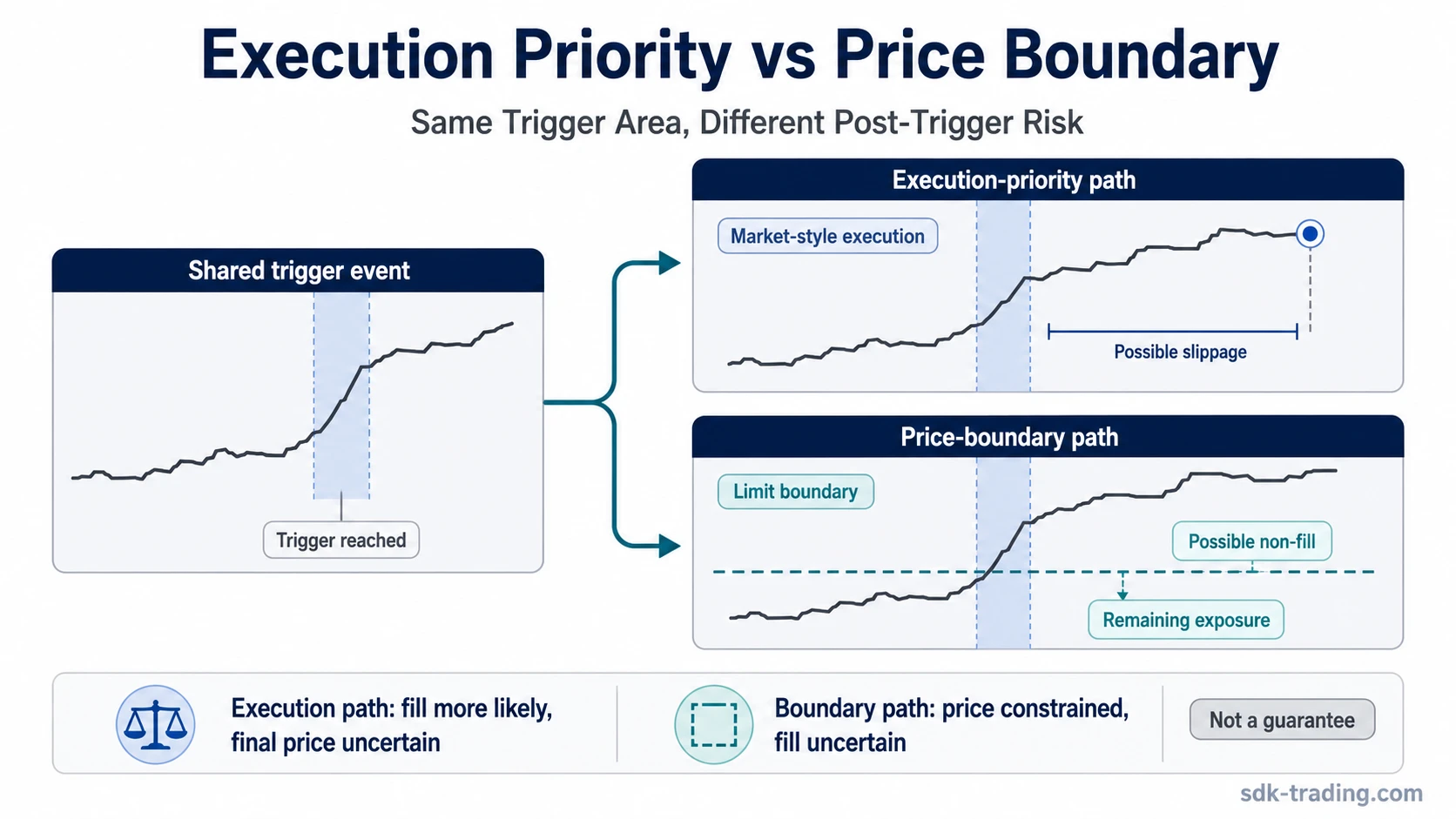
Price trades near a stop area, then moves quickly through it. The trigger is reached, but available liquidity is thin at the intended level. The stop-loss and stop-limit now behave differently because the activated order is different.
Stop-loss outcome: the order can activate and seek execution. The position may be closed or reduced, but the fill may occur away from the stop level depending on direction, liquidity, and market speed.
Stop-limit outcome: the order can activate, but execution remains limited by the specified price boundary. If the market has already moved beyond that boundary, the order may not fill and exposure can remain open.
The same price move can therefore create two different residual risks. The stop-loss accepts possible slippage to prioritize execution. The stop-limit accepts possible non-fill to preserve the limit boundary.
False Equivalence: Why More Control Is Not Always Less Risk
A common mistake is treating the stop-limit as automatically safer because it includes a limit price. The limit price controls the worst accepted execution price, but it does not guarantee that an execution will happen.
Another mistake is treating a stop-loss as if the stop price were a fixed fill price. The stop price activates the order. The market still has to provide executable liquidity after activation.
Decision boundary: a stop-loss asks whether the order should prioritize execution after the trigger. A stop-limit asks whether execution should happen only inside a defined price boundary.
Slippage Risk vs Non-Fill Risk
Slippage risk belongs mainly to the stop-loss side of the comparison. When the stop triggers during a gap, news-driven movement, thin order book, or fast market, the actual fill may be worse than the stop level. Execution can happen, but the final price can differ from the expected boundary.
Non-fill risk belongs mainly to the stop-limit side of the comparison. The limit boundary can prevent an execution at an unacceptable price, but the order may remain open if the market does not trade at the limit or better after activation.
| Risk type | Most associated order | What can happen | Remaining exposure question |
|---|---|---|---|
| Slippage risk | Stop-loss | The fill occurs away from the stop level. | Was execution achieved at a materially different price? |
| Non-fill risk | Stop-limit | The limit boundary prevents execution. | Is the position still open after the trigger? |
When the Distinction Matters Most
The distinction matters most when price availability and execution certainty are both uncertain. Gaps, rapid selloffs or rallies, thinly traded instruments, premarket or after-hours conditions, and fast news reactions can expose the difference between a trigger and a final fill.
In calmer conditions, the two order types may appear less different because price may trade through the trigger area more gradually. The difference becomes more visible when the market does not provide the exact liquidity expected at the stop area.
Boundary: neither order type predicts direction, proves trade quality, removes execution uncertainty, or guarantees a desired outcome. The comparison only explains how the order mechanics differ after activation.
Common Mistakes
| Mistake | Cleaner interpretation |
|---|---|
| Treating stop-limit as a guaranteed exit | The limit boundary can block worse fills, but it can also leave the order unfilled. |
| Treating stop-loss as a fixed fill price | The stop level is the trigger, while the final fill depends on available execution conditions. |
| Comparing only the stop trigger | The post-trigger order type is the main distinction. |
| Assuming broker labels remove risk | Order labels describe mechanics. They do not remove slippage, non-fill risk, or remaining exposure. |
Related Order Controls
Stop limit and stop loss sit inside order-control mechanics that separate trigger logic, execution method, price boundary, and exposure management. Keeping those parts separate reduces confusion when two orders share similar labels but behave differently after activation.
A trailing stop adds a moving boundary, so it is a nearby order-control concept, but it is not the same comparison. Stop limit vs stop loss stays focused on what happens after a fixed trigger is reached.
Practical distinction: order controls organize execution decisions. They do not create certainty about price movement, fill quality, or final risk removal.
FAQ
What is the main difference between stop-loss and stop-limit?
The main difference is the order created after the stop trigger. A stop-loss prioritizes execution after activation, while a stop-limit creates a limit order that respects a price boundary.
Can a stop-limit fail to close a position?
Yes. A stop-limit can trigger but remain unfilled if the market moves beyond the limit price and does not provide executable liquidity at the limit or better.
Can a stop-loss fill away from the stop price?
Yes. A stop-loss can fill away from the stop price if the market gaps or moves quickly through the stop area before execution occurs. In a sell-side example, that can mean a fill below the stop price.
Is a stop-limit safer than a stop-loss?
Not automatically. A stop-limit can control the accepted fill boundary, but it can also leave exposure open. A stop-loss can make execution more likely, but the fill price can slip.