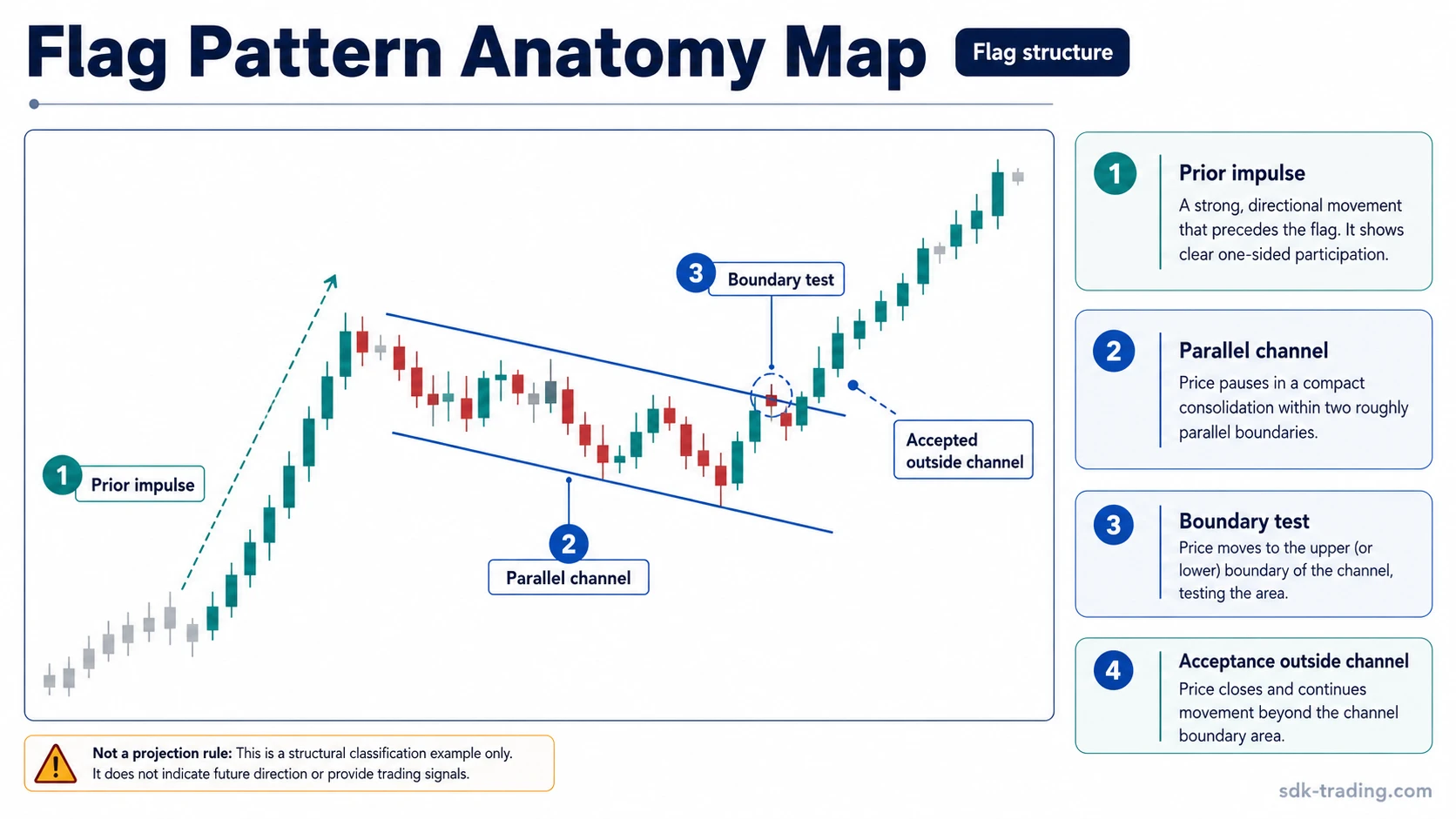
A flag pattern is a continuation chart pattern in technical analysis that forms after a sharp price move, then develops as a compact parallel-channel pause. The structure becomes easier to classify when the prior impulse, channel boundaries, and later movement beyond the boundary all support the same reading.
Shape alone is not enough. A defensible flag reading needs three things working together: a meaningful impulse, a controlled parallel channel, and boundary behavior that does more than briefly pierce the line.
Definition: A flag pattern is a chart pattern made of a strong directional move, often called the flagpole, followed by a short consolidation that slopes or drifts inside roughly parallel boundaries.
Key Points
- A flag pattern needs a clear prior impulse before the channel pause has meaning.
- The flag portion should usually look compact, controlled, and roughly parallel rather than wide, random, or converging.
- Bull and bear versions describe directional context, but the general flag structure comes first.
- A boundary break carries less weight when it is only a wick or when price quickly returns inside the channel.
- Clean, weak, and invalid readings depend on structure quality, not on the pattern name alone.
- Pennants, rectangles, and wedges can look similar, but their boundary shapes are different.
What Is a Flag Pattern?
A flag pattern is a pause after a directional price move. In an upward context, the pause often slopes down or sideways inside a small channel. In a downward context, the pause often slopes up or sideways inside a small channel. The channel gives the structure its flag-like appearance.
The main classification point is structure. A sharp move creates the context, the parallel channel creates the flag, and the later boundary test helps decide whether the reading remains defensible. Without a clear prior move or a controlled channel, the same price action may be only an ordinary pullback or range.
Flag patterns are commonly grouped with continuation chart patterns because they often appear as pauses inside an existing directional move. That classification stays conditional. The continuation reading is cleaner when price is no longer accepted inside the channel and weaker when the move falls back into the same consolidation.
How a Flag Pattern Forms
A flag pattern starts with a strong price move that creates directional pressure. The next phase is not another immediate expansion, but a smaller pause where price moves against the prior impulse or drifts sideways in a controlled way.
The pause separates an orderly consolidation from a chaotic retracement. A clean flag usually has two visible boundaries that are close to parallel. The channel should not erase too much of the prior move, stretch for too long, or lose its shape through wide overlapping swings.
The final test is boundary behavior. A brief wick beyond the channel is weaker evidence than movement that holds outside the channel area. If price quickly returns inside the flag, the structure remains unresolved or weak. If the market no longer accepts the prior channel, the flag label becomes more defensible as a classification.
Structure note: The flagpole explains why the pause has context, but it should not be treated as a mechanical projection. The safer use is descriptive: prior impulse, compact channel, boundary test, and acceptance or failure.
How to Identify a Flag Pattern
A useful flag pattern reading starts with observable structure, not with the label. The criteria below help separate a controlled flag from a loose pullback, a broad range, or a different continuation pattern.
| Criterion | What to Look For | What Weakens the Reading |
|---|---|---|
| Prior move | A clear directional impulse before the consolidation begins. | No strong move before the channel, or only a slow drift. |
| Channel shape | Two reasonably parallel boundaries around the pause. | Boundaries are unclear, too wide, or strongly converging. |
| Depth | The pause retraces only part of the prior move. | The retracement becomes so deep that the prior impulse loses relevance. |
| Compactness | The pause remains short and controlled relative to the impulse. | The consolidation stretches into a broad range or loses channel structure. |
| Volume behavior | Volume may support the reading when activity contracts during the pause or changes around the boundary test. | Volume is treated as proof by itself or ignored when price action is unclear. |
| Boundary behavior | Movement beyond the channel is accepted rather than immediately rejected. | A wick-only breach or fast return inside the channel. |
Bull Flag and Bear Flag Versions
A bull flag appears after an upward impulse and uses the flag channel as a pause against that move. The bullish version usually has a downward-sloping or sideways channel before the upper boundary is tested.
A bear flag appears after a downward impulse and uses the flag channel as a pause against that decline. The bearish version usually has an upward-sloping or sideways channel before the lower boundary is tested.
The general flag pattern explains the shared structure across both versions: impulse first, compact parallel consolidation second, boundary acceptance or failure third. Direction changes the reading context, but the structural test remains similar.
Flag Pattern Reading Quality: Clean, Weak, and Invalid
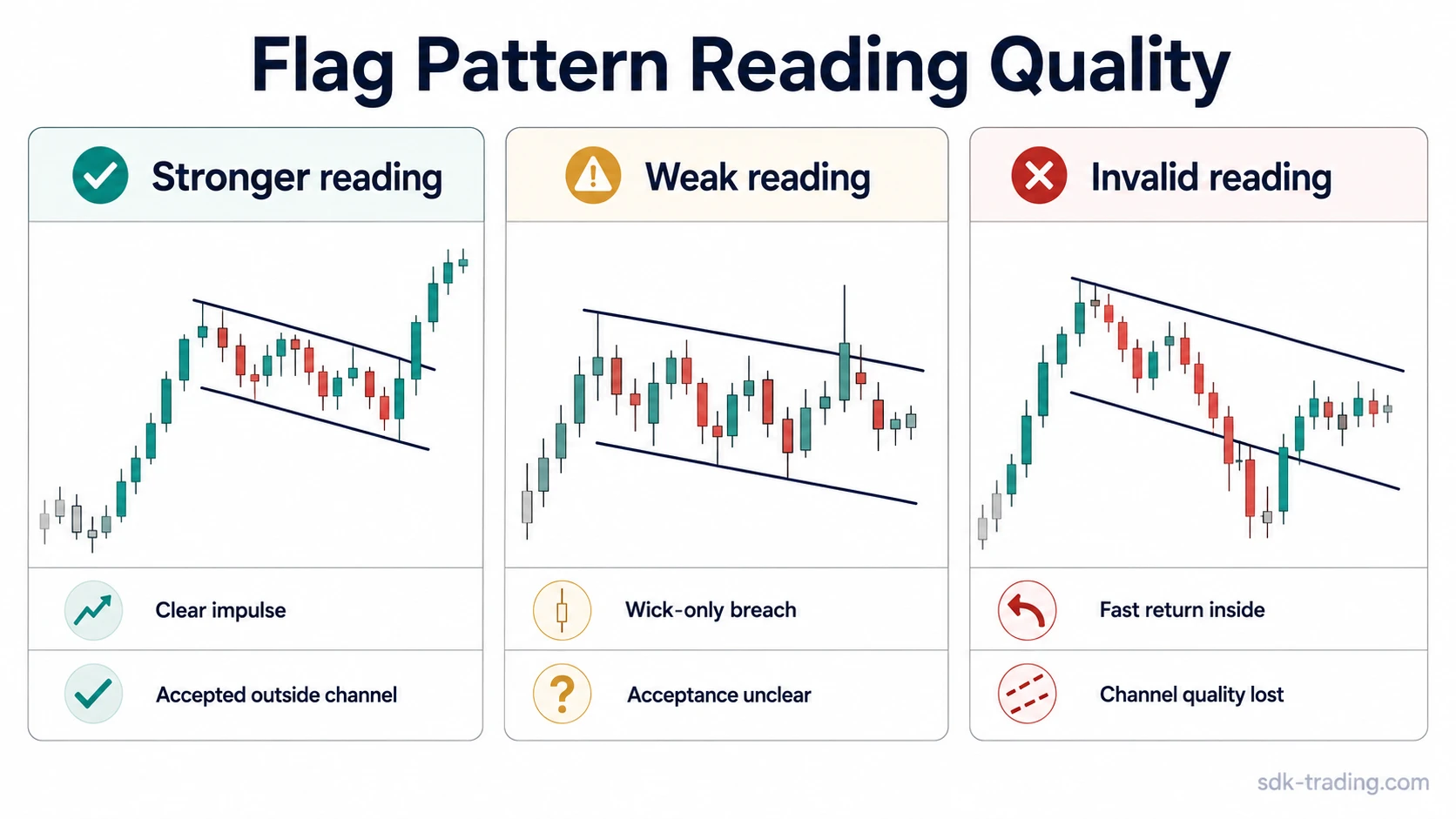
The strongest flag readings are not created by shape alone. They come from the alignment of the prior move, channel quality, and boundary behavior. A weak reading may still resemble a flag visually, but the evidence behind the label is thinner.
| Reading Type | Typical Structure | Boundary Behavior | Interpretation Limit |
|---|---|---|---|
| Clean flag | Clear prior impulse, compact parallel channel, controlled pause. | Movement beyond the relevant boundary is accepted rather than instantly rejected. | The pattern is structurally defensible, but still conditional on later price behavior. |
| Weak flag | Loose channel, unclear impulse, extended pause, or uneven retracement. | The boundary is touched or pierced, but acceptance is unclear. | The label may describe the shape, but the structure does not carry strong evidence. |
| Invalid flag | The pause becomes too deep, too wide, or no longer resembles a compact channel. | Price fails to hold beyond the boundary or quickly returns inside the channel. | The flag label should be questioned because the structure no longer supports it. |
For bullish versions, bull flag reliability examines channel quality, accepted movement, failed continuation readings, and weak bullish-flag structures more narrowly.
Flag Pattern Example in Context
Price rallies into a prior resistance area, then pauses in a small downward parallel channel. The flag label is more defensible if the pullback stays controlled and later trading accepts above the upper channel boundary. If the move above the boundary is only a wick and price falls back into the channel, the structure is still unresolved rather than a clean flag reading.
The diagnostic point is the sequence: impulse first, controlled channel second, accepted boundary behavior third. A shape that skips one of those steps is weaker even if it resembles a flag.
Flag Pattern vs Pennant, Rectangle, and Wedge
Several continuation patterns can appear after a strong move, but their boundary shapes are different. The distinction is structural, not predictive: a flag is built around a compact parallel channel, while nearby structures use compression, range behavior, or sloping convergence.
| Pattern | Main Boundary Shape | Typical Difference From a Flag |
|---|---|---|
| Flag pattern | Parallel or near-parallel channel. | The pause slopes or drifts in a compact channel after a prior impulse. |
| Pennant | Converging boundaries. | The pause compresses into a small triangle-like structure rather than a channel. |
| Rectangle | Horizontal range boundaries. | The pause is broader and more range-like, often less tied to a sharp flagpole. |
| Wedge | Sloping converging boundaries. | The structure narrows while both boundaries slope, which separates it from a parallel flag channel. |
A broader classification view in the chart patterns cheat sheet helps compare flags with other chart-pattern families without collapsing every continuation pattern into the same label.
Common Flag Pattern Mistakes
Calling every pullback a flag: A pullback needs a prior impulse and a visible channel before the flag label becomes useful.
Overusing the flagpole: The prior move gives context, but it should not turn the pattern into a fixed projection rule.
Treating a wick as acceptance: A quick pierce beyond the channel is weaker than movement that holds beyond the boundary.
Ignoring channel quality: A loose, broad, or overlapping pause can look like a flag at first glance while lacking the structure that makes the label useful.
Forcing prediction onto classification: A flag pattern names a structure. It does not guarantee that the next move will follow the earlier impulse.
When a Flag Pattern Reading Weakens
A flag reading weakens when the channel stops looking controlled, when the retracement becomes too deep, or when a move beyond the boundary fails quickly. The label also weakens when the prior impulse is unclear, because the pause then lacks the directional context that made the structure meaningful.
Volume can support the reading, especially when activity contracts during the pause or changes around the boundary test. It should not be treated as standalone proof. Price structure, boundary quality, and accepted movement remain the main classification checks.
Limitation: A flag pattern is a visual and structural reading, not a certainty claim. The safer interpretation separates the pattern label from later confirmation or failure.
FAQ
What is a flag pattern in trading?
A flag pattern is a continuation chart pattern that forms after a sharp price move, followed by a compact pause inside roughly parallel boundaries.
What makes a flag pattern weak or invalid?
A flag pattern becomes weaker when the channel is loose, the pause lasts too long, the retracement is too deep, or price quickly returns inside the channel after a boundary break.
How is a flag pattern different from a pennant?
A flag pattern uses parallel or near-parallel channel boundaries, while a pennant uses converging boundaries that compress into a small triangle-like shape.
Does volume confirm a flag pattern?
Volume can support a flag pattern reading, but it is not proof by itself. The structure, channel quality, and boundary behavior still need to align.