A bull flag pattern is a trading chart pattern that forms after a strong upward impulse, followed by a controlled pause that often slopes sideways or slightly downward. The structure is useful only when the flagpole, corrective flag, boundary quality, volume behavior, and later acceptance or failure all support the same reading.
Definition: A bull flag is a bullish continuation chart pattern made of two main parts: a sharp upward flagpole and a smaller corrective flag. The pattern label becomes less reliable when the flag is too deep, too loose, poorly bounded, or unable to hold beyond its corrective structure.
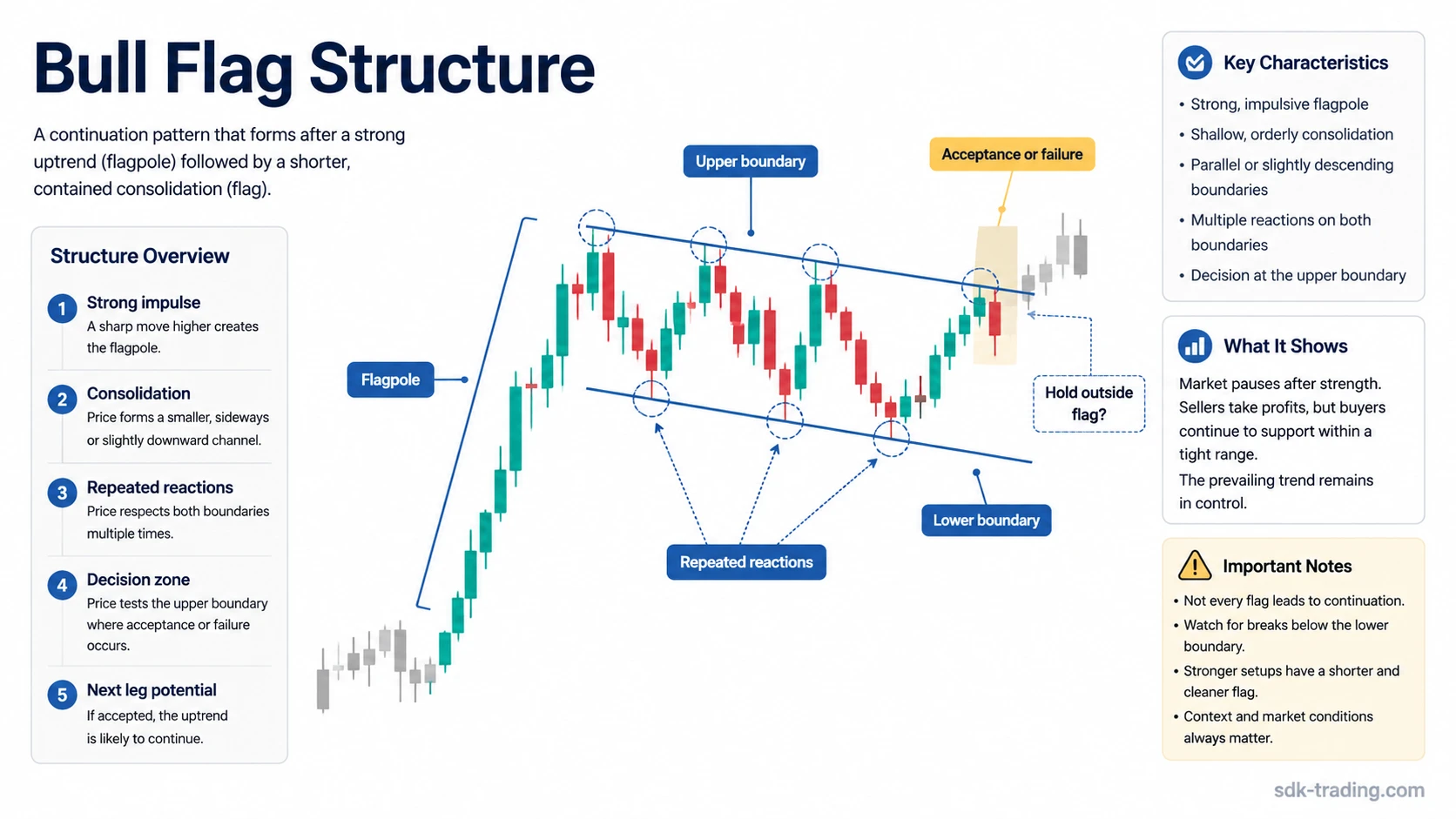
A coherent bull flag needs more than a rally followed by a pause. It needs a prior impulse, an orderly correction, roughly parallel boundaries, repeated reactions inside the flag, and a later test of whether price can accept beyond the flag instead of only piercing it briefly.
Key Points About Bull Flags
- A bull flag starts with a clear upward impulse that forms the flagpole.
- The flag is a smaller pause or pullback, not a full reversal of the prior move.
- Useful boundaries are usually roughly parallel and tested more than once.
- Volume can support the reading, but volume alone does not confirm the pattern.
- The structure loses coherence if price returns into the flag after a boundary test or if the correction becomes too deep and disorderly.
What Is a Bull Flag Pattern?
A bull flag pattern describes a market that first expands upward, then pauses in a controlled corrective structure. The upward move forms the flagpole; the pause forms the flag. The pattern belongs to the continuation chart-pattern family because the correction is read against the prior upward impulse, not as a standalone event.
The important distinction is that a bull flag is a structure, not a prediction. The shape becomes more meaningful when the pullback stays contained, the boundaries remain readable, and the move beyond the flag shows acceptance instead of a wick-only test.
A broader flag pattern can be bullish or bearish. A bull flag is the bullish version, where the prior impulse is upward and the corrective flag is judged by whether it preserves that structure.
Bull Flag Structure: Flagpole, Flag, and Boundaries
The pattern is easier to evaluate when each component is separated. A strong flagpole without an orderly flag is only an impulse with a pullback. A neat-looking flag without a strong prior impulse is usually too weak to carry the same continuation reading.
| Component | What to Look For | What Weakens the Structure |
|---|---|---|
| Flagpole | A strong upward move that creates the initial impulse. | A slow drift upward, overlapping candles, or no clear expansion before the pause. |
| Corrective flag | A smaller sideways or downward-sloping pause after the flagpole. | A pullback that retraces too much of the flagpole or becomes erratic. |
| Upper and lower boundaries | Roughly parallel lines with more than one reaction on each side. | Forced lines, one-touch boundaries, or a widening structure that no longer behaves like a flag. |
| Volume behavior | Volume that contracts or stabilizes during the pause and expands only as participation returns. | Heavy selling pressure during the flag or volume that contradicts the idea of a controlled correction. |
| Acceptance or failure | Price holds beyond the flag rather than only creating a brief boundary pierce. | Price moves outside the flag and then quickly returns into the corrective range. |
How to Identify a Bull Flag
Identification starts with sequence. The upward impulse must come first. The flag then needs to behave like a contained pause rather than a new downtrend, a broad range, or a messy consolidation.
- Start with the impulse: look for a clear upward flagpole before labeling the correction.
- Check the flag: the pause should be smaller than the flagpole and usually move sideways or slightly downward.
- Test the boundaries: the upper and lower lines should be roughly parallel and have repeated reactions.
- Compare depth: a shallow-to-moderate correction is more coherent than a deep retracement that erases most of the impulse.
- Read volume as context: volume may help, but it should not replace structure and acceptance.
- Check acceptance: a boundary pierce is weaker than price holding outside the flag and avoiding an immediate return into the structure.
Reading note: A move beyond the flag needs acceptance, not just a wick above the boundary. If price cannot hold beyond the flag, the continuation interpretation becomes harder to defend.
Clean, Weak, and Invalid Bull Flag Readings
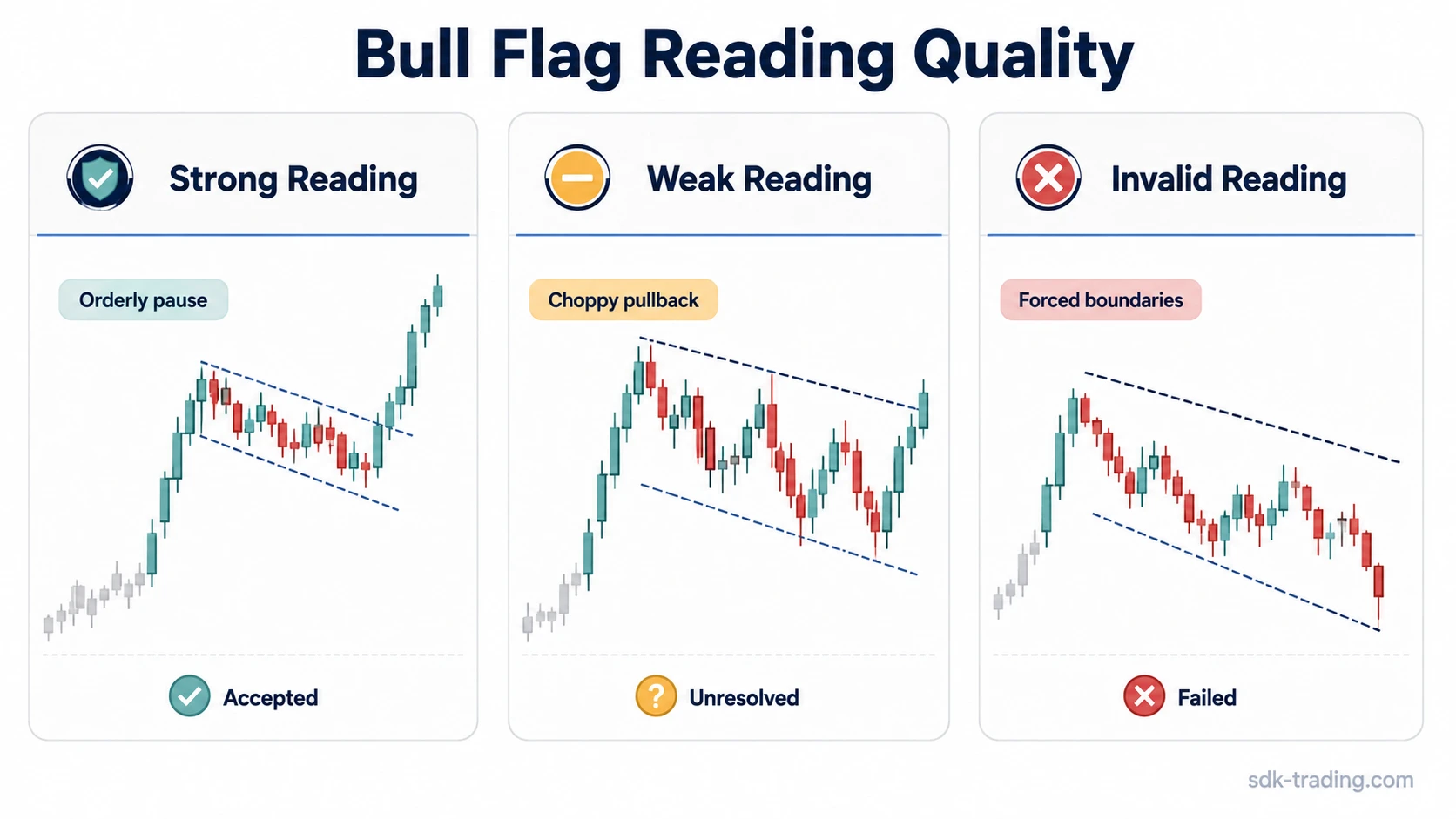
The same general shape can produce very different readings. The strongest version has aligned evidence across impulse, correction, boundary quality, and acceptance. Weak versions may still resemble a bull flag, but the structure leaves more unresolved questions. Invalid versions force the label onto a pattern that no longer behaves like a controlled flag.
| Reading Type | Structure | Boundary Quality | Acceptance / Failure Logic |
|---|---|---|---|
| Clean bull flag | Strong upward flagpole followed by a smaller, orderly pause. | Roughly parallel boundaries with multiple reactions. | Price can hold beyond the flag instead of quickly returning inside it. |
| Weak bull flag | Impulse exists, but the flag is deep, choppy, or too long compared with the flagpole. | Boundaries are only partly respected or need adjustment to fit the structure. | The move beyond the flag remains unresolved or shows limited acceptance. |
| Invalid or forced reading | The prior impulse is unclear, or the correction erases the structure that made the flag plausible. | Lines are non-parallel, after-the-fact, or based on too few reactions. | Price fails back into the flag or breaks the corrective structure in a way that contradicts the continuation reading. |
This clean / weak / invalid distinction keeps the pattern label tied to observable structure. A chart can resemble a bull flag visually while still failing the quality checks that make the label useful.
Bull Flag Volume and Acceptance Beyond the Flag
Volume is supportive evidence, not a standalone confirmation. A constructive reading often has quieter participation during the corrective flag and stronger participation when price attempts to move beyond the flag. That pattern can support the idea that the pause was corrective rather than distributive.
The volume clue becomes less useful when selling pressure expands during the flag, when the flag loses containment, or when the boundary test immediately fails. The stronger test is whether price can remain accepted beyond the corrective structure.
Questions about consistency, failure frequency, and evidence quality belong with bull flag reliability. The pattern reading should remain conditional until structure, context, and later price behavior support it.
Bull Flag vs Bear Flag, Pennant, and Flag Pattern
Related continuation patterns can look similar during the corrective phase, so the distinction depends on the prior impulse and the shape of the consolidation.
| Concept | Main Difference | Common Confusion |
|---|---|---|
| Bear flag | A bearish counterpart with a downward flagpole and a corrective pause against that decline. | Both use flagpole-and-flag structure, but the prior impulse points in the opposite direction. |
| Flag pattern | The broader family that includes bullish and bearish flag structures. | The family label can hide whether the current structure is bullish, bearish, clean, weak, or invalid. |
| Pennant | A continuation structure with converging boundaries rather than a mostly parallel flag channel. | Both can appear after a sharp move, but boundary geometry separates the readings. |
| Rectangle | A range-like consolidation with horizontal containment rather than a tilted corrective flag. | A sideways flag can resemble a rectangle if the prior flagpole and corrective character are ignored. |
In crypto markets, fast impulse moves and sharp pullbacks can make pattern labels tempting before the structure is complete. Chart patterns for crypto require the same boundary discipline, because volatility alone does not make a flag reading more reliable.
Common Bull Flag Mistakes
A bull flag becomes less useful when the label is applied before the structure is visible. The most common errors come from forcing boundaries, treating every pullback after a rally as a flag, or reading a boundary pierce as acceptance too early.
| Mistake | Why It Creates a Weak Reading | Better Diagnostic Question |
|---|---|---|
| Calling any rally-pullback a bull flag | The chart may lack a clear flagpole or an orderly corrective flag. | Is there a real impulse followed by a contained pause? |
| Forcing non-parallel boundaries | The structure may be a wedge, range, or messy pullback rather than a flag. | Do the boundaries behave like a coherent channel? |
| Ignoring pullback depth | A deep retracement can erase the continuation logic of the flagpole. | Has the correction stayed proportionate to the impulse? |
| Overweighting volume alone | Volume can support the read, but it cannot repair poor structure. | Do structure, volume, and later acceptance point in the same direction? |
| Treating a wick as acceptance | A brief move outside the flag can fail quickly and return into the structure. | Does price hold beyond the flag, or does it fail back inside? |
Bull Flag Reliability and Limitations
A bull flag is more defensible when structure quality is high, the correction remains orderly, and later behavior confirms that the market accepted the area beyond the flag. It is weaker when the pullback becomes too deep, boundaries are repeatedly redrawn, or the move outside the flag fails quickly.
No pattern removes the need for context. Broader trend conditions, volatility, liquidity, nearby resistance, and the quality of the prior impulse can all change the interpretation. A bull flag is best treated as a conditional chart-reading structure, not as proof that continuation must happen.
Limitation: The pattern label is only useful when the flagpole, flag, boundary reactions, volume context, and acceptance behavior support the same interpretation. Shape alone is not enough.
Simple Bull Flag Example
Price advances sharply into a previously tested resistance area and then pauses in a controlled downward-sloping channel. The pullback stays smaller than the impulse, and both channel boundaries receive more than one reaction. That is a cleaner bull flag candidate because the flagpole and flag are visually connected and the correction remains contained.
The same situation loses quality if the pullback cuts deeply into the flagpole, the boundaries need constant redrawing, or the first move beyond the flag quickly returns inside the channel. The diagnostic comparison is not whether the chart vaguely resembles a flag; it is whether the structure keeps behaving like an orderly pause after an upward impulse.
FAQ
What does a bull flag pattern mean?
A bull flag pattern means price made a strong upward impulse and then paused in a smaller corrective structure. The meaning remains conditional until the flag quality and later acceptance support the continuation reading.
How do you identify a bull flag?
Identify a bull flag by looking for an upward flagpole, a smaller sideways or downward corrective flag, roughly parallel boundaries, repeated reactions inside the flag, and later evidence that price can hold beyond the flag.
What invalidates a bull flag reading?
A bull flag reading weakens or becomes invalid when the pullback becomes too deep, boundaries are forced, volume contradicts the correction, or price fails back into the flag after testing the boundary.
Is volume required for a bull flag?
Volume is not enough by itself, but it can support the reading. A quieter corrective flag and stronger participation during acceptance can add context when the structure is already coherent.
What is the difference between a bull flag and a pennant?
A bull flag usually has roughly parallel corrective boundaries, while a pennant has converging boundaries. Both can follow a strong move, but the consolidation shape separates the two readings.