Bull flag reliability depends on evidence quality, not on the pattern label alone. A better-supported reading usually needs a strong prior advance, a controlled pullback, meaningful flag boundaries, and acceptance beyond the upper boundary rather than a brief wick through it.
A bull flag pattern can lose support when the pullback grows too deep, the flag becomes broad and disorderly, or price fails to hold outside the consolidation after the breakout attempt. Reliability is therefore a classification question first: does the structure still behave like a controlled pause after an advance, or has it turned into something less specific?
Definition: Bull flag reliability is the quality of evidence behind a bull flag reading. It is not a statistical guarantee and does not mean that a pattern will continue. It means the structure has enough support from impulse quality, pullback behavior, boundary control, and breakout acceptance to make the label better supported.
Key Points
- A bull flag reading is stronger after a clear prior advance and a controlled pause.
- A tight, orderly flag is better supported than a deep, wide, or drifting pullback.
- Breakout acceptance matters more than a wick that briefly moves beyond the boundary.
- Volume can support the read, but it should not be treated as universal proof.
- Reliability drops when price quickly reclaims the flag area or breaks the lower boundary.
What Makes Bull Flag Reliability More Defensible
A better-supported bull flag reading starts with the move before the flag. The prior advance should be clear enough to show directional pressure before the pause begins. If the move into the flag is choppy, overlapping, or already exhausted, the later consolidation has less value as a continuation reading.
The pause itself should stay proportionate to the prior advance. A shallow or moderate pullback with controlled overlap supports the idea of temporary digestion. A deep retracement changes the read because the market has already given back too much of the prior move for the flag label to carry the same weight.
The broader flag pattern category depends on structure, not only direction. The boundaries should be visible enough to separate a controlled pullback from random sideways movement. When the supposed flag becomes wide, unstable, or difficult to draw without forcing the lines, reliability drops.
Evidence Needed Before Calling a Bull Flag Reliable
The strongest bull flag readings usually combine several evidence layers. No single layer proves continuation. The useful question is whether the evidence aligns or whether the label depends on one attractive feature while other features undermine it.
| Evidence layer | Better-supported reading | Not enough evidence |
|---|---|---|
| Prior advance | Clear upward impulse before the pause | Choppy rise, weak impulse, or no clear directional move |
| Pullback depth | Shallow or moderate retracement relative to the prior advance | Deep pullback that erases too much of the previous move |
| Flag shape | Compact consolidation with meaningful upper and lower boundaries | Wide, drifting, noisy, or loosely connected candles |
| Breakout quality | Close and later acceptance beyond the upper boundary | Brief wick through the line with quick rejection back inside the flag |
| Follow-through | Price holds the new side of the boundary instead of immediately reclaiming the range | Fast return into the consolidation or break below the lower boundary |
| Volume context | Volume behavior supports the shift without being the only evidence | Volume is treated as proof while price structure remains weak |
Evidence threshold: A bull flag reading becomes better supported when the impulse, pause, boundary, and breakout behavior point in the same direction. One clean-looking candle is not enough when the surrounding structure does not support the label.
Clean, Weak, and Invalid Bull Flag Readings
Bull flag reliability is easier to judge when the structure is separated into reading quality levels. The same general shape can carry different meaning depending on what happens before, inside, and after the flag.
| Reading quality | Typical structure | Reliability implication |
|---|---|---|
| Clean reading | Strong prior advance, compact pullback, visible boundaries, and accepted break beyond the upper boundary | The bull flag label has stronger structural backing because several evidence layers align. |
| Weak reading | Prior advance exists, but the flag is too wide, too deep, or the breakout is mostly a wick | The label remains possible, but the structure has not yet earned a stronger classification. |
| Invalid or failed reading | Price breaks the lower boundary, quickly reclaims the consolidation after a breakout, or the pullback overwhelms the prior impulse | The bull flag label loses support because the market no longer behaves like a controlled continuation pause. |
A clean reading does not create certainty. It only means the pattern label is supported by better structure. A weak or invalid reading does not require a forecast either; it simply means the evidence no longer supports the same classification.
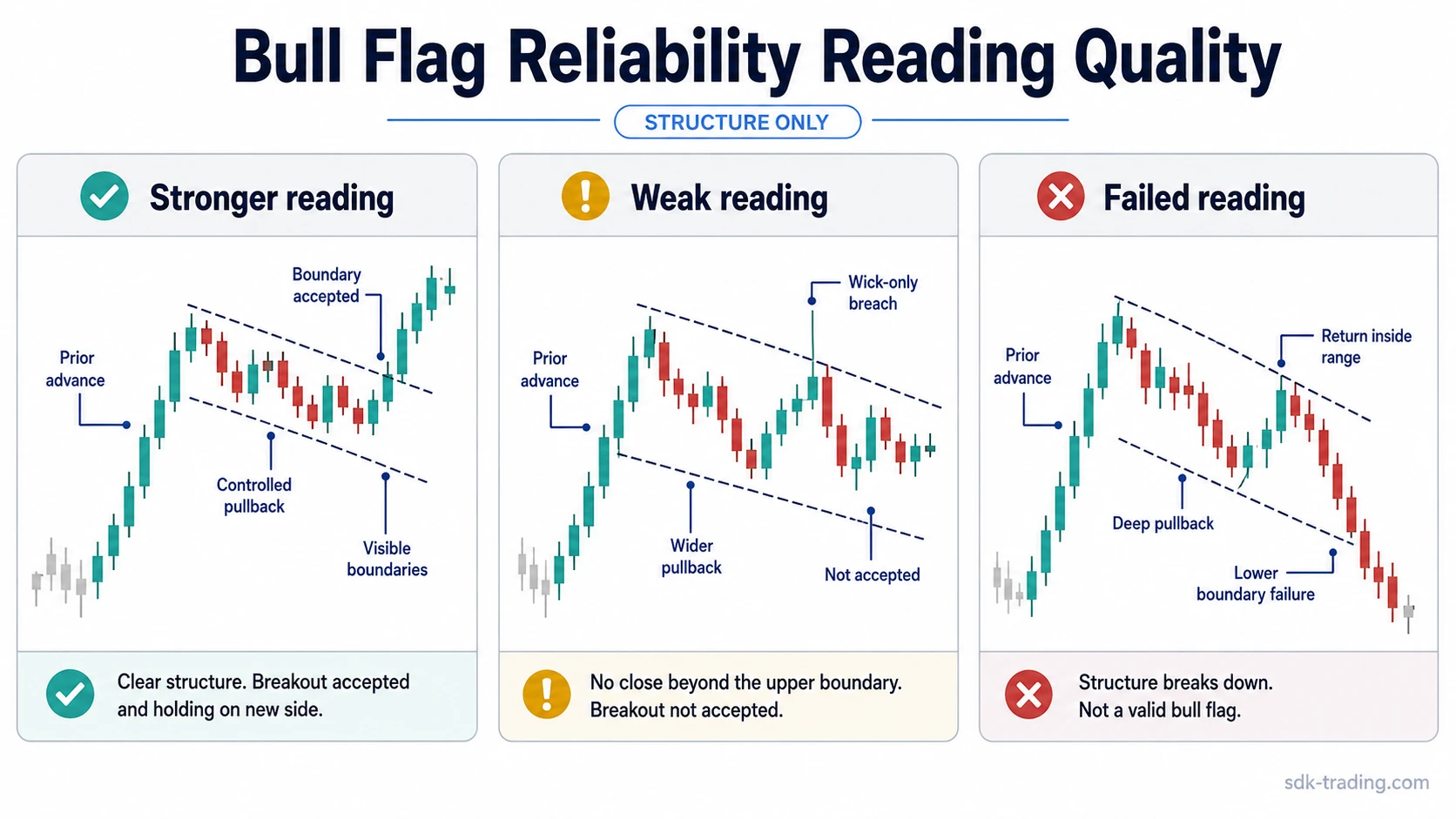
Why Bull Flag Reliability Breaks Down
Reliability often breaks down when the pullback stops behaving like a pause. A flag that keeps expanding, retracing, or overlapping may still point upward visually, but its structure becomes less disciplined. The longer the pattern needs to be defended by the label alone, the less useful the label becomes.
Another common failure is reading the first boundary breach as confirmation. A wick above the upper boundary can show that price tested the area, but acceptance requires more than a temporary print. A close outside the flag and later behavior on the new side of the boundary provide stronger structural evidence than a single intraperiod move.
Common mistake: Treating a textbook-looking slope as reliability can hide weak evidence. A bull flag shape is less meaningful when the prior advance is unclear, the pullback is too deep, or the breakout cannot hold outside the flag.
Volume, Breakout Acceptance, and Follow-Through
Volume can add useful context, especially when participation expands as price leaves the flag. Still, volume should not be isolated from price behavior. A high-volume breakout that quickly fails back into the flag does not carry the same classification quality as a breakout that closes beyond the boundary and holds afterward.
Breakout behavior is the cleaner reliability test. Price should show that the former flag boundary has changed from a limit of the consolidation into a level the market can operate beyond. Without that behavior, the breakout remains a probe rather than a stronger continuation reading.
Limitation: Volume patterns differ across markets, sessions, and instruments. A volume increase can support the reading, but the structure still needs a controlled pullback, meaningful boundaries, and accepted movement beyond the flag.
Measured Move Boundary: Reliability Is Not Projection
Reliability and projection are separate ideas. Reliability asks whether the bull flag label is supported by the evidence. Projection logic asks how a prior move might be estimated or mapped after a pattern has already been classified.
A measured move up belongs to upward projection logic, not to the reliability test itself.
A measured move down belongs to a different projection path and should not be mixed into a bullish reliability label when the flag evidence is already weak.
A pattern can look clean enough to classify but still fail later. It can also have projection logic without enough boundary behavior to make the label strong. Keeping these ideas separate prevents a target-style estimate from being mistaken for evidence quality.
Common Mistakes When Judging Bull Flag Reliability
| Mistake | Why it weakens the read | Safer classification check |
|---|---|---|
| Calling any upward consolidation a bull flag | The structure may lack a clear prior impulse or controlled pullback. | Check whether the advance, pause, and boundaries are all visible. |
| Ignoring retracement depth | A deep pullback can turn the pattern into a broader correction instead of a flag. | Compare the pullback against the size and quality of the prior advance. |
| Trusting a wick-only breakout | A wick can mark a test without showing acceptance beyond the boundary. | Look for close location, hold behavior, and later interaction near the former boundary. |
| Using volume as automatic confirmation | Volume without structural acceptance can produce a false sense of proof. | Read volume together with price result, boundary behavior, and follow-through. |
| Mixing reliability with projection | Projection logic does not prove that the original label is strong. | Classify the pattern first, then keep any projection logic separate. |
Simple Bull Flag Reliability Example
Price advances sharply, then pauses in a shallow downward channel. The candles overlap, but the pullback stays compact and does not erase much of the prior move. The upper and lower boundaries are visible without forcing the drawing.
The classification holds up better if price closes beyond the upper boundary and later holds outside the prior flag area. The reading loses support if the breakout is only a wick and price quickly returns into the consolidation. If the pullback expands, breaks the lower boundary, or retraces too deeply before acceptance appears, the bull flag label becomes harder to defend.
The shape alone is not enough. The stronger evidence is a controlled pause followed by accepted movement beyond the former boundary.
A Reliability Check Is Not a Trade Decision
A bull flag is a chart-reading structure, not a complete decision framework by itself. Reliability improves when the pattern has clear internal evidence. It loses value when the label depends on broad visual resemblance while the behavior around the boundaries remains unstable.
The most useful sequence is simple: prior impulse, pullback quality, boundary clarity, breakout behavior, and failed-acceptance check. If one of those pieces is missing, the reading can remain possible, but confidence in the label should stay limited.
FAQ
What makes a bull flag more reliable?
A bull flag reading is more reliable when a strong prior advance is followed by a controlled pullback, clear boundaries, and acceptance beyond the upper flag boundary. The label is weaker when the pullback becomes deep, broad, or fails after the breakout attempt.
Is a wick above the bull flag enough confirmation?
A wick above the flag boundary is weak evidence by itself. A close beyond the boundary and later acceptance on the new side provide a more defensible reading than a brief intraperiod breach.
Does high volume prove a bull flag breakout is reliable?
High volume can support the reading, but it does not prove reliability on its own. Price still needs a controlled pullback, meaningful boundaries, and accepted movement beyond the flag.
When does a bull flag reading fail?
A bull flag reading fails or weakens when price breaks the lower boundary, quickly returns into the flag after a breakout, or retraces so deeply that the prior advance no longer supports a controlled continuation pause.