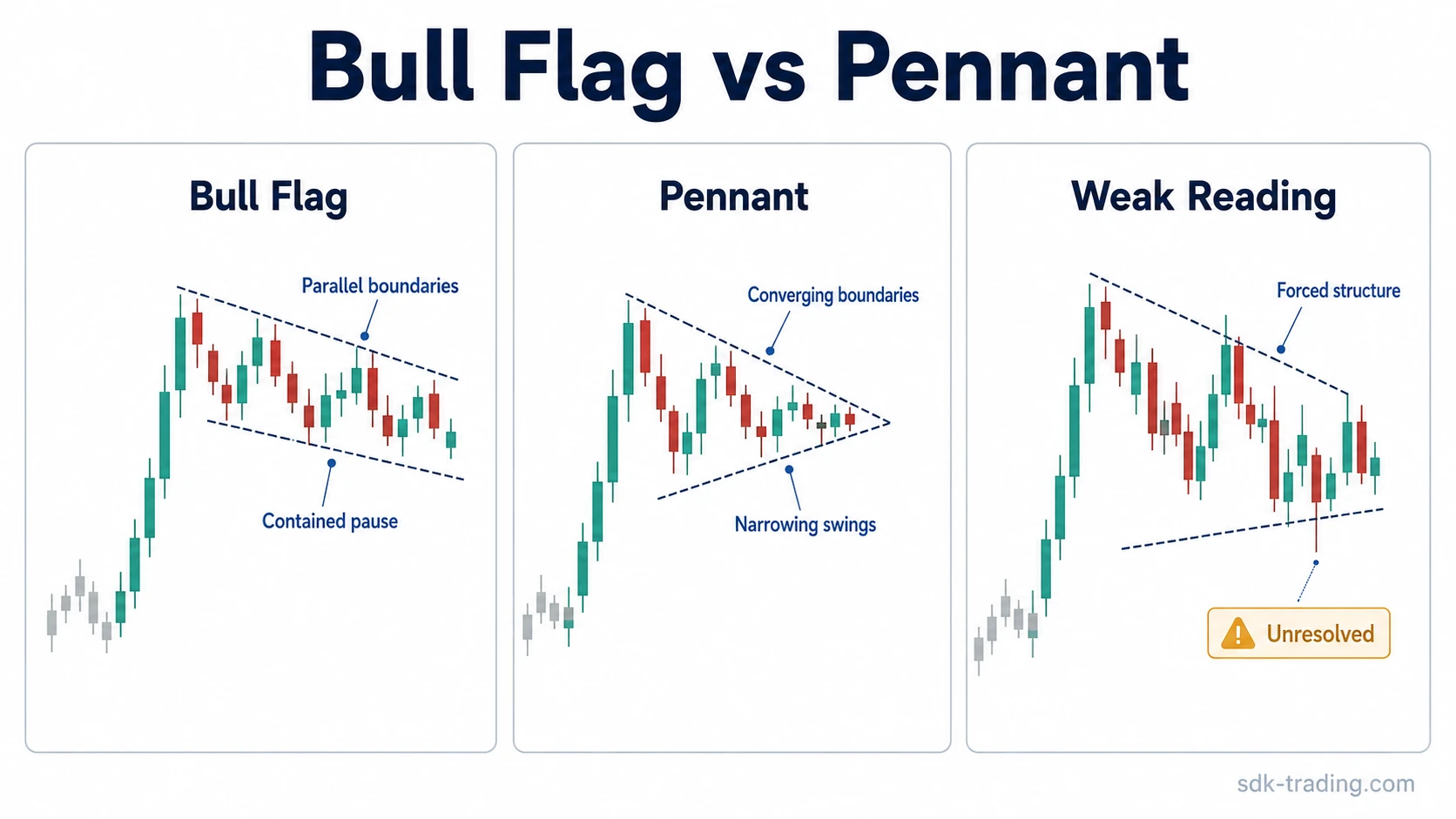
A bull flag vs pennant comparison comes down to how price pauses after a bullish impulse. A bull flag reading uses a pullback or sideways pause contained by roughly parallel boundaries, while a pennant reading uses narrowing compression between converging boundaries.
Both labels can start from the same first clue: a sharp bullish move followed by a smaller consolidation. The label stays provisional until the consolidation has enough structure to support one reading over the other. A clean label describes the shape and behavior of the pause; it does not prove that continuation will follow.
Quick Distinction
- A bull flag usually keeps its correction inside a channel-like structure with roughly parallel boundaries.
- A pennant usually narrows as each swing compresses toward a converging point.
- The shared flagpole can make both patterns look similar at first.
- Forced boundaries, deep pullbacks, and quick returns into the consolidation weaken both labels.
Bull Flag vs Pennant: The Core Difference
The core difference is containment versus compression. A bull flag is read as an organized corrective pause where price remains inside a small channel after a bullish impulse. A pennant is read as a tightening pause where buyers and sellers compress price into a smaller triangular range after a bullish impulse.
The shape is not the only criterion. Swing behavior matters as much as the drawn lines. A flag should show orderly reactions inside a channel-like pause. A pennant should show narrowing swings. If the structure only becomes visible after several forced lines are drawn, the interpretation is weaker.
Quick Comparison Table
| Criterion | Bull Flag Reading | Pennant Reading |
|---|---|---|
| Main structure | Corrective pause inside roughly parallel boundaries. | Corrective pause inside converging boundaries. |
| Typical shape | Small channel that slopes sideways or slightly against the prior move. | Small triangular compression after the prior move. |
| Swing behavior | Swings remain relatively orderly and contained. | Swings narrow as volatility compresses. |
| Width of consolidation | Width tends to remain more consistent from left to right. | Width tends to contract as the pattern develops. |
| Common confusion | A shallow pullback can be mislabeled as a flag before boundaries are clear. | A messy triangle can be mislabeled as a pennant even when compression is forced. |
| Weakening condition | The label becomes less useful if the pause becomes too deep, choppy, or loses channel quality. | The structure no longer supports the label cleanly if the swings stop compressing or the converging lines are imposed after the fact. |
What Both Patterns Have in Common
Both patterns begin with a bullish impulse that creates the context for a continuation-pattern reading. The impulse is often called the flagpole, but the flagpole alone is not enough. The next part of the chart must show whether price is pausing in a contained channel, compressing into a narrowing structure, or losing the original impulse entirely.
Both readings are conditional. A pattern label is a way to describe structure, not a forecast. Follow-through, failed acceptance, and later price behavior can change the interpretation.
How a Bull Flag Reading Forms
A bull flag forms when a bullish impulse is followed by a smaller corrective pause that stays organized inside roughly parallel boundaries. The pause can slope slightly downward, move sideways, or drift modestly against the prior move, but the key feature is channel-like containment.
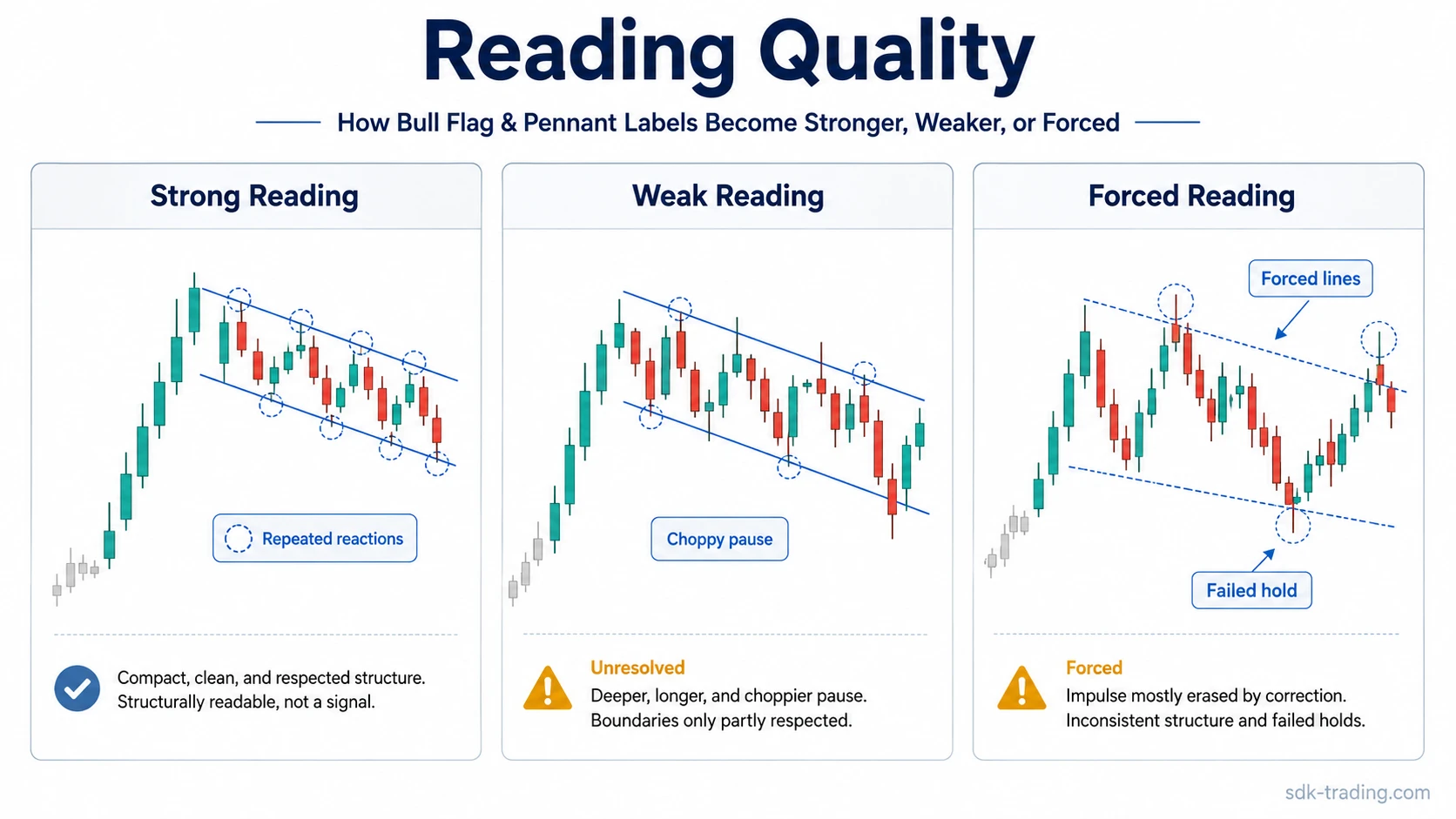
The reading is cleaner when the pullback does not erase too much of the prior impulse and when both boundaries have repeated reactions. If the pause becomes wide, erratic, or too deep relative to the prior move, the flag label becomes less useful.
How a Pennant Reading Forms
A pennant forms when price compresses after a bullish impulse and the swings narrow between converging boundaries. The structure is not just a small triangle. It needs a prior impulse, a compact compression phase, and enough boundary quality to make the narrowing behavior visible.
The interpretation remains unresolved when the consolidation keeps expanding, when the lines are adjusted repeatedly to fit the chart, or when the prior impulse is mostly erased before compression can develop.
Same Move, Different Reading
Price rallies sharply from a base and then pauses below a recent high. The first impulse could lead to either label, but the consolidation decides the reading.
| What happens after the impulse | More defensible reading | Why |
|---|---|---|
| Price drifts in a small, orderly channel with repeated reactions on both sides. | Bull flag | The pause is contained rather than compressed. |
| Each reaction becomes smaller and the upper and lower boundaries converge. | Pennant | The pause is narrowing into compression. |
| The pullback becomes deep, erratic, or requires redrawn boundaries to make a pattern visible. | Weak or invalid reading | The structure is no longer clean enough to support either label confidently. |
Example: Price advances into a prior resistance area and then pauses. If the pause holds inside a small downward channel, the chart can support a bull flag reading. If the same pause tightens into lower highs and higher lows, the chart can support a pennant reading. If the correction chops through both sides and returns into the middle of the structure, the label remains unresolved.
Clean, Weak, and Invalid Readings
The distinction is most useful when the chart is separated into clean, weak, and invalid readings. This prevents every small consolidation after a bullish move from being labeled as a continuation pattern.
| Reading quality | Diagnostic condition | Interpretation boundary |
|---|---|---|
| Clean bull flag | The pause remains organized inside roughly parallel containment. | The channel-like correction supports the flag label. |
| Clean pennant | The swings compress into converging boundaries after the impulse. | The narrowing structure supports the pennant label. |
| Weak reading | Boundaries are partly respected, but the pause is choppy, deep, or extended. | The label may still be possible, but the structure is not clean. |
| Invalid or forced reading | The prior impulse is mostly erased, boundaries are imposed after the fact, or price returns into the structure after failing to hold outside it. | The pattern label should be treated as unreliable. |
Common Mistakes When Comparing Bull Flags and Pennants
A common mistake is treating every small pullback after a strong upward move as either a bull flag or a pennant. The first impulse only creates the possibility. Boundary quality, swing behavior, and the depth of the pause decide whether the label is useful.
Another mistake is forcing a pennant label onto any small triangle. A pennant needs meaningful compression after an impulse, not just two converging lines. The same problem appears with bull flags when a trader draws a channel around a messy pullback that never showed orderly containment.
Common mistake: Do not choose the label first and then draw lines to justify it. Start with the impulse, read the consolidation behavior, and let the structure decide whether the pause is channel-like, compressive, weak, or invalid.
Does the Difference Matter?
The difference matters because the two labels describe different consolidation mechanics. A bull flag reading emphasizes controlled corrective movement. A pennant reading emphasizes compression. That distinction changes how the structure is interpreted, especially when the pause is messy or when the chart is close to invalidating the label.
The difference does not turn either pattern into a standalone signal. A cleaner label may improve chart description, but later acceptance, rejection, and failed follow-through can still change the reading.
Where Volume Fits
Volume can support the reading, but it should not replace the structure. A quiet pause after a strong impulse can fit either pattern if the boundaries are clear. A burst of activity near a boundary may add context, but it does not prove continuation. Shape, swing behavior, and later acceptance still carry the main diagnostic weight.
FAQ
What is the main difference between a bull flag and a pennant?
A bull flag usually pauses inside roughly parallel boundaries, while a pennant narrows between converging boundaries after a bullish impulse.
Can a bull flag and a pennant start from the same price move?
Yes. Both can begin after a similar bullish impulse. The consolidation that follows determines whether the reading is more flag-like, more pennant-like, or too weak to label cleanly.
Is a pennant just a small triangle?
No. A pennant is a compact compression pattern after a prior impulse. A small triangle without that impulse and narrowing behavior is not enough by itself.
Does either pattern prove continuation?
No. Both labels describe chart structure, not an outcome claim. The interpretation can weaken if price fails to hold outside the consolidation, returns into the structure, or erases the prior impulse.