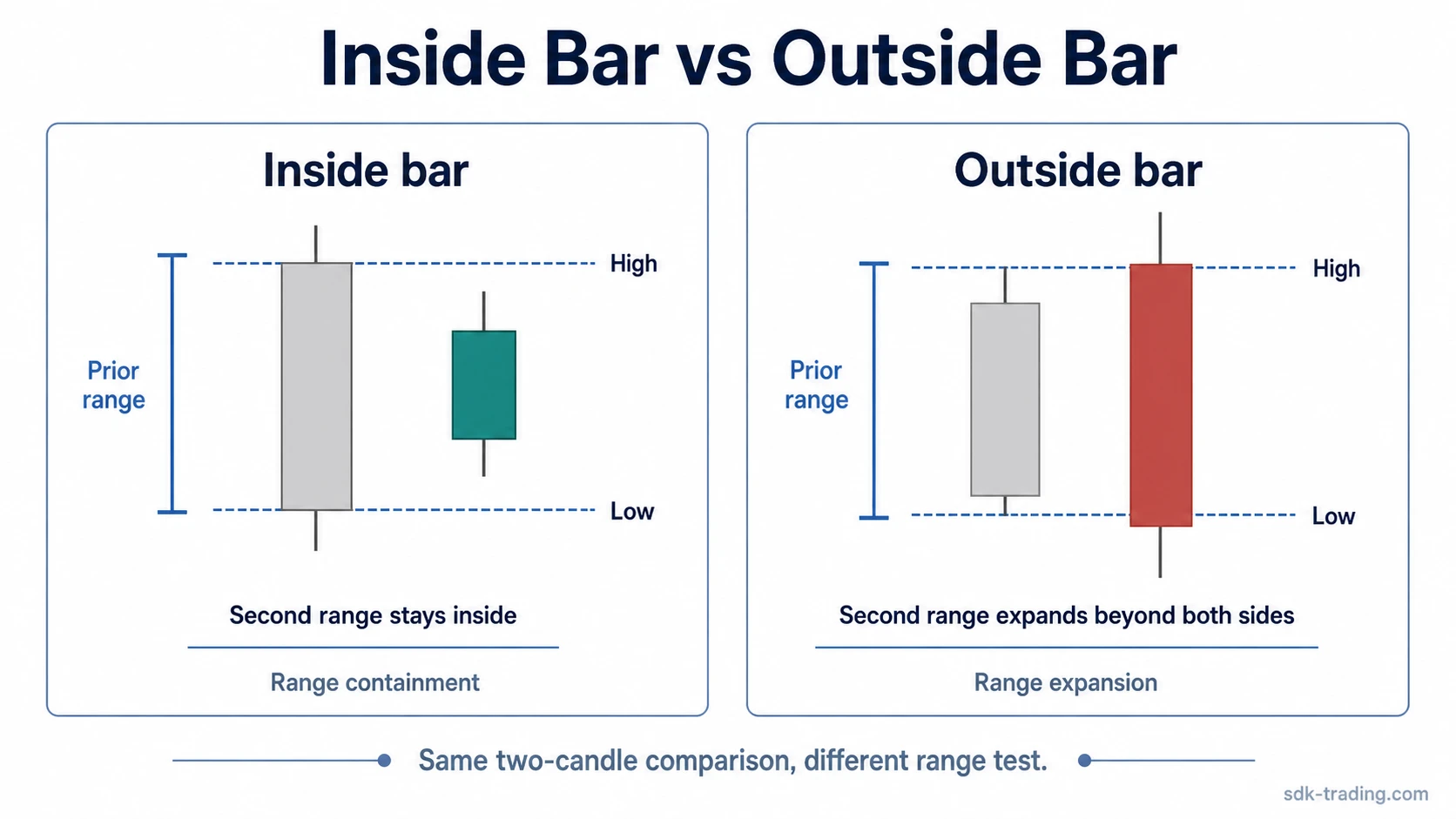
Inside bar and outside bar candles are opposite full-range relationships. An inside bar stays within the prior candle’s high-low range, while an outside bar expands beyond both the prior high and the prior low.
The distinction is not about which pattern is more bullish or bearish by itself. The useful trading question is whether the second candle compresses inside the earlier range or expands beyond it, and whether later candles accept or reject that new information.
Definition: An inside bar is a two-candle structure where the second candle’s full high-low range remains inside the prior candle’s high-low range. An outside bar is a two-candle structure where the second candle trades beyond both the prior high and the prior low.
Inside Bar vs Outside Bar: Core Difference
The inside bar is a containment pattern. It shows that the market failed to extend beyond the prior candle’s full range during the next candle. That can reflect compression, hesitation, temporary balance, or a pause before later expansion.
The outside bar is an expansion pattern. It shows that the next candle moved beyond both sides of the previous candle’s range. That can reflect volatility expansion, a sweep of both sides, a failed attempt to hold one side, or a stronger displacement candle depending on the close and follow-through.
| Comparison point | Inside bar | Outside bar |
|---|---|---|
| Range test | The second candle stays inside the prior high-low range. | The second candle moves beyond both the prior high and the prior low. |
| Main diagnostic idea | Containment and compression. | Expansion and range takeover. |
| Volatility reading | Often shows reduced short-term range compared with the prior candle. | Often shows wider short-term range compared with the prior candle. |
| False-breakout risk | The later breakout from the contained range can fail if price cannot hold outside the prior candle’s boundary. | The expansion can be misleading if the candle sweeps both sides but closes back into the prior range or loses follow-through. |
| Common confusion | Reading compression as directional confirmation before the market leaves the range. | Reading wide expansion as directional control before acceptance appears after the range sweep. |
| What not to assume | Do not assume the inside bar predicts continuation or reversal without later range behavior. | Do not assume the outside bar is the same as an engulfing candle or that it confirms direction by size alone. |
Inside Range vs Expanded Range
Inside bar analysis starts with the full candle range, not only the real body. The second candle must remain below the prior high and above the prior low. If either side breaks, the structure is no longer a strict inside bar.
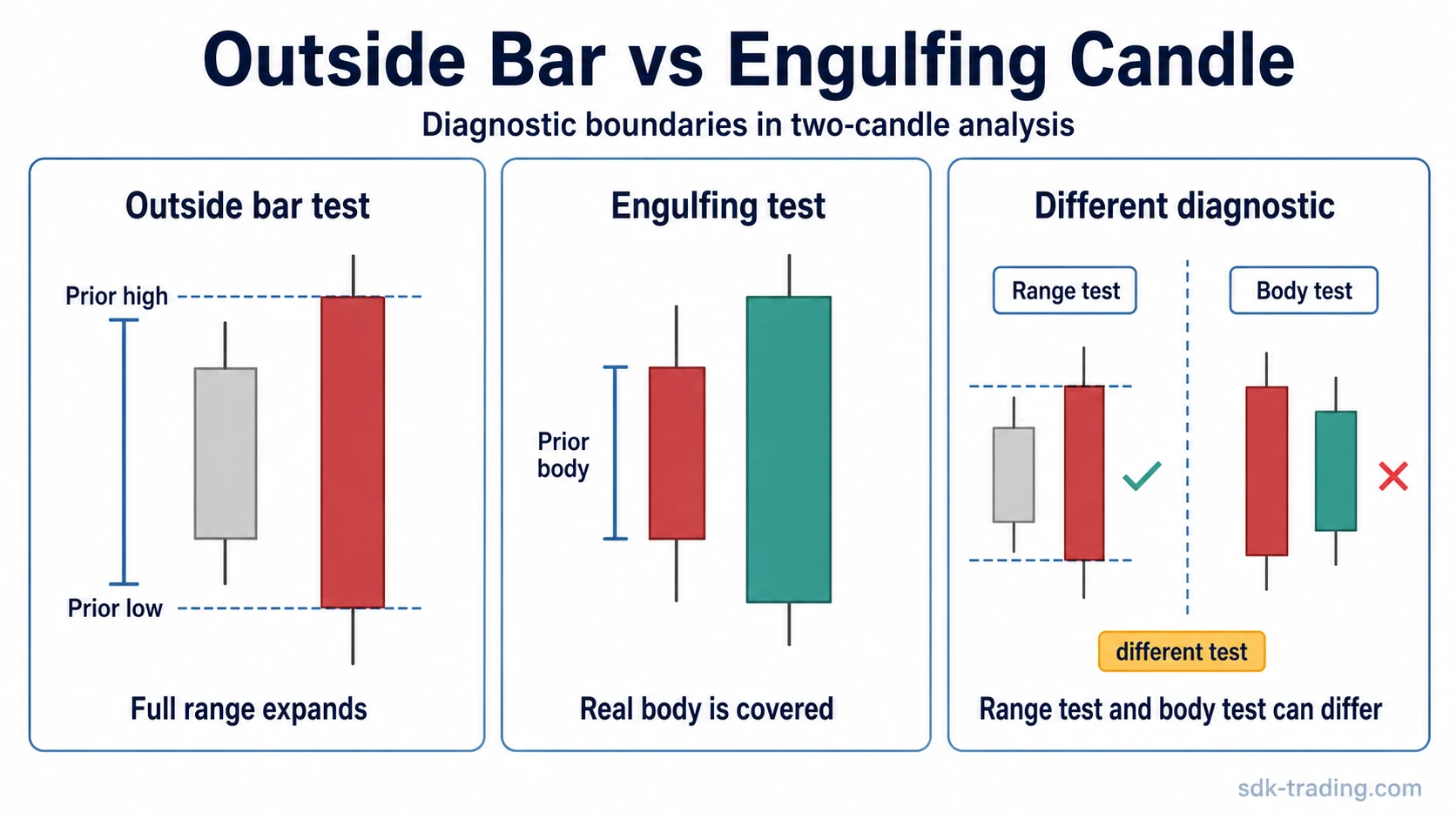
Outside bar analysis also starts with the full high-low range. The second candle must take out both sides of the prior candle. A candle that only breaks one side is not a full outside bar, even if the move looks forceful.
This is why outside bar and engulfing candle logic should not be collapsed into one test. An engulfing candle is usually judged by real-body takeover. An outside bar is judged by full-range expansion beyond the previous high and low. A candle can satisfy one test without fully satisfying the other.
How False-Breakout Risk Differs
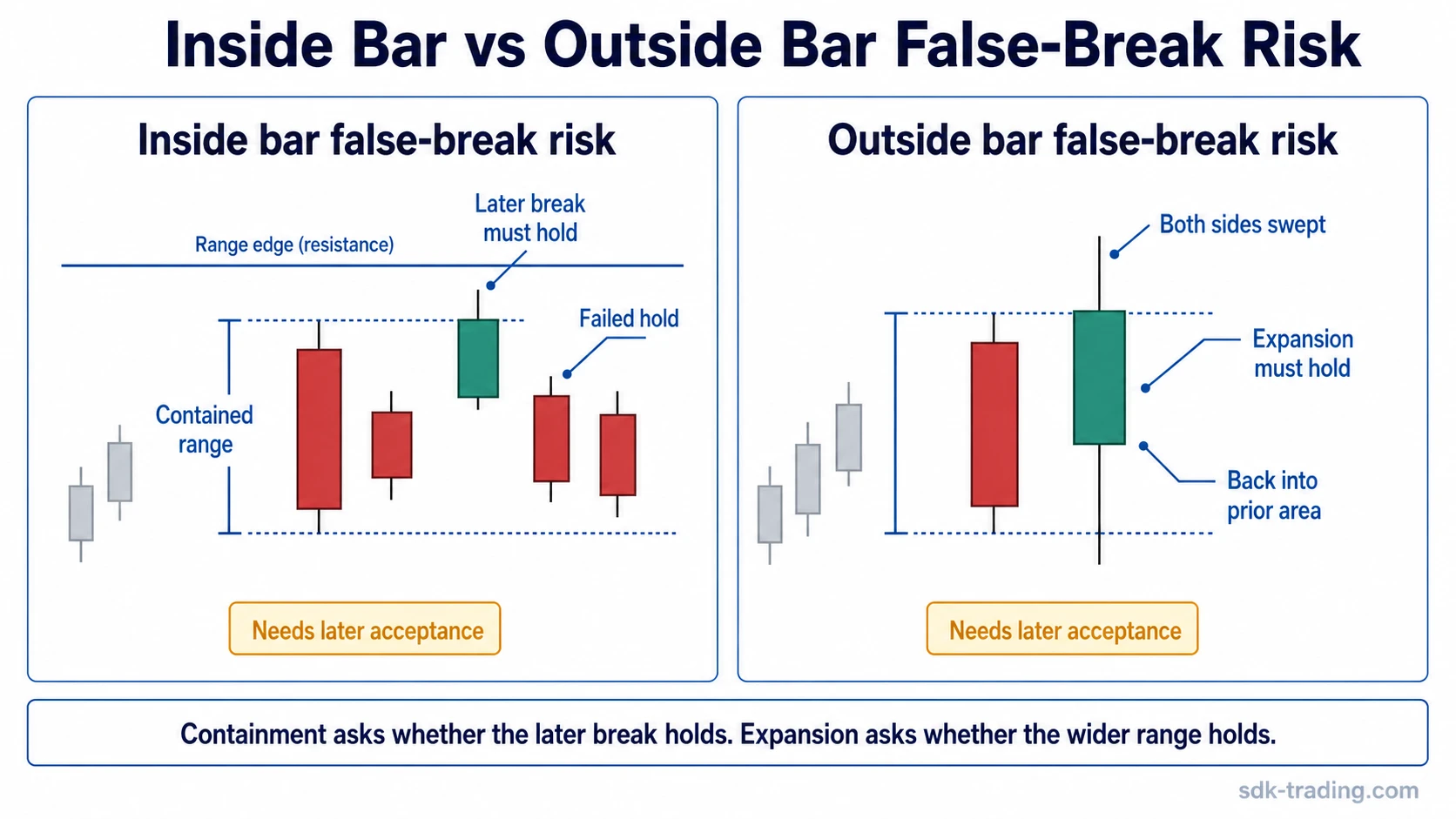
Inside bars and outside bars can both appear near failed breakouts, but they create different questions. An inside bar near a range edge often means the market paused after reaching a boundary. The later test is whether price can leave that contained range and hold outside it.
An outside bar near a range edge often means the market expanded through both sides of the previous candle. The later test is whether the close and follow-through support the expansion, or whether the candle was mainly a sweep that failed to hold new ground.
| False-breakout question | Inside bar reading | Outside bar reading |
|---|---|---|
| What happened first? | Price compressed inside the prior candle’s range. | Price expanded beyond both sides of the prior candle. |
| What needs later clarification? | Whether a later break from the contained range is accepted or rejected. | Whether the wide candle’s expansion leads to acceptance or reverses back into the prior area. |
| Rejected reading | The break out of the inside range fails and price returns into the prior candle. | The outside bar sweeps both sides but cannot hold the expanded direction. |
| Accepted reading | Price exits the contained range and later holds outside the boundary. | Price expands beyond both sides and later holds the area that was taken. |
Compression vs Expansion Around the Same Range
Price has been pressing into the upper edge of a trading range, but the last push above the edge did not hold cleanly. The next candle forms entirely inside the previous candle’s high and low. That inside bar can look like a calm pause before another attempt higher, but the read is incomplete until price leaves the contained range and shows whether the upper boundary is accepted or rejected.
A different candle in the same area trades above the previous high, drops below the previous low, and then closes back near the middle of the prior range. That outside bar gives a different message: the market expanded through both sides, but the close raises the question of whether the expansion was genuine control or a two-sided sweep.
The comparison is not “small candle versus large candle.” The inside bar asks whether compression resolves with acceptance. The outside bar asks whether expansion holds after both sides of the prior range were tested.
Common Mistakes When Comparing Inside Bars and Outside Bars
- Using candle size alone. A smaller second candle may still fail the inside-bar test if it breaks the prior high or low. A larger candle is not an outside bar unless it expands beyond both sides.
- Ignoring the full high-low range. Real-body comparison is useful for some candlestick patterns, but inside bar and outside bar classification depends on the complete candle range.
- Treating either pattern as immediate direction. Both structures need later behavior. Containment can break and fail. Expansion can sweep and reverse.
- Confusing outside bars with engulfing candles. Outside bars require range expansion beyond both prior extremes. Engulfing logic usually focuses on real-body coverage.
When Each Range Test Is More Useful
An inside bar gives a clearer range test when the prior candle creates a meaningful reference range and the second candle remains fully contained inside it. The structure becomes less informative when the surrounding chart is already choppy and the prior candle has no clear structural relevance.
An outside bar gives a clearer range test when the candle expands beyond both sides and later behavior shows whether that expansion was accepted. The reading becomes less informative when the outside bar only creates a dramatic range and the next candles immediately return to the prior area without follow-through.
Both patterns become more useful when structure is separated from prediction. The candle relationship defines the diagnostic test. Later acceptance, rejection, and context decide whether the test matters.
FAQ
What is the main difference between an inside bar and an outside bar?
An inside bar stays within the previous candle’s high-low range. An outside bar expands beyond both the previous high and the previous low.
Is an outside bar the same as an engulfing candle?
No. An outside bar is judged by full-range expansion beyond the previous high and low. An engulfing candle is usually judged by real-body coverage.
Can an inside bar or outside bar confirm direction by itself?
No. The candle structure only defines containment or expansion. Later acceptance, rejection, and surrounding market context decide whether the structure becomes meaningful.
Which pattern has more false-breakout risk?
Both can be involved in false-breakout readings. Inside bars can fail after a contained-range breakout. Outside bars can fail when a wide expansion sweeps both sides but does not hold new ground.