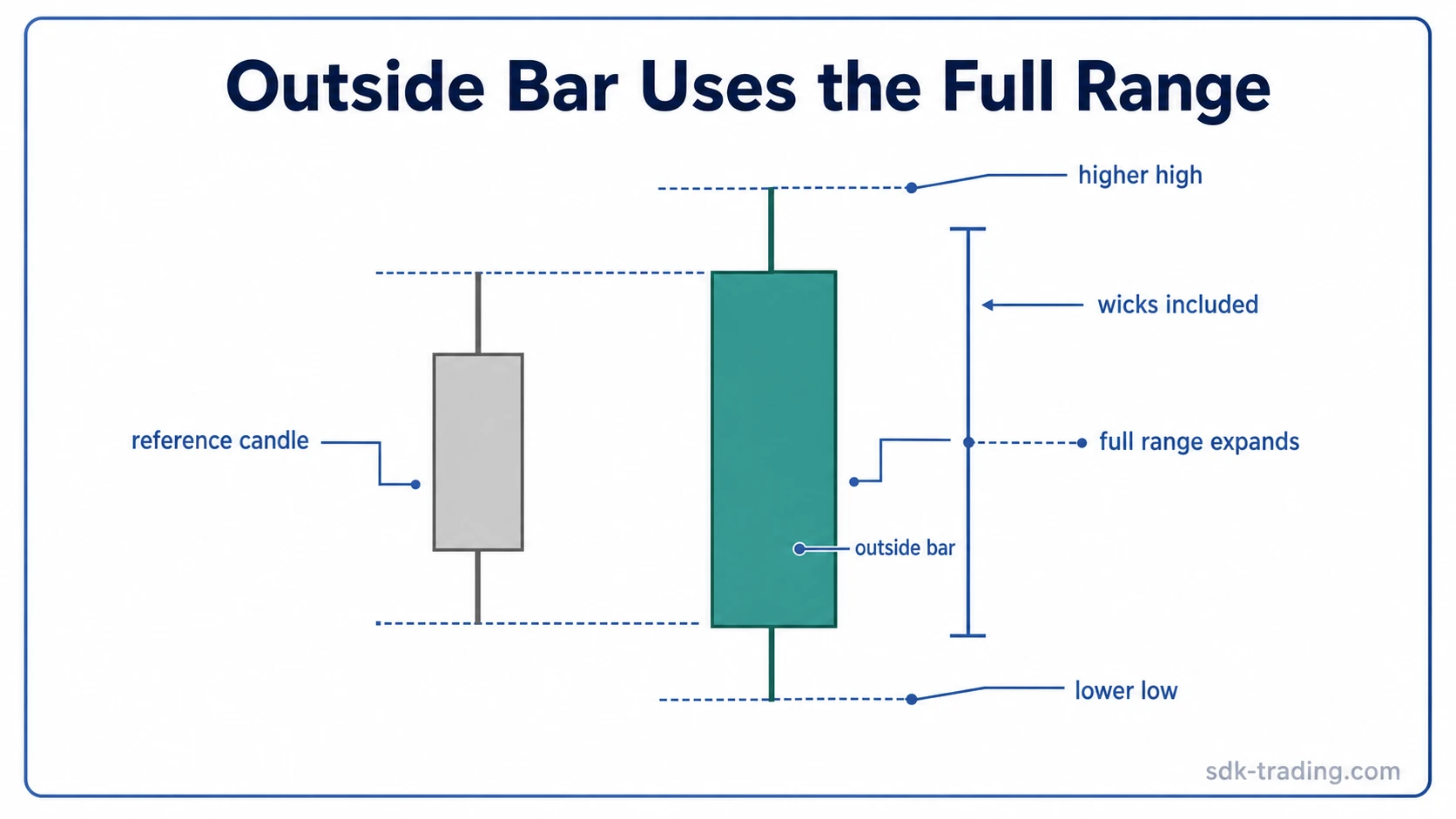
An outside bar candlestick pattern forms when the second candle expands beyond the full high-low range of the prior candle: its high is higher than the prior high, and its low is lower than the prior low.
This is a range-expansion pattern, not a real-body takeover rule. Wicks count, candle color does not define the pattern, and the later candles decide whether the expanded range is accepted, rejected, or left unresolved.
Key Points
- An outside bar is a two-candle structure based on full high-low expansion.
- The second candle must exceed both the prior high and the prior low.
- Wicks count because the rule uses the complete candle range.
- The real body does not need to engulf the prior real body.
- The outside bar itself shows expansion; it does not confirm direction by itself.
Outside Bar Definition
Outside bar: a two-candle candlestick pattern where the second candle has a higher high and a lower low than the candle immediately before it.
The prior candle acts as the reference range. The outside bar is the candle that breaks both sides of that reference range. If only the high is exceeded, or only the low is exceeded, the structure is not a complete outside bar.
The body can close near the high, near the low, or inside the expanded range. Those details affect interpretation, but they do not replace the core rule. The first diagnostic question is whether the full range expanded beyond both prior extremes.
How to Identify an Outside Bar
| Check | What to compare | Outside bar requirement |
|---|---|---|
| Prior high | Second candle high vs prior candle high | The second candle high must be higher. |
| Prior low | Second candle low vs prior candle low | The second candle low must be lower. |
| Wicks | Full candle range | Upper and lower shadows are part of the measurement. |
| Real body | Open-close area | Body engulfing is not required for the outside bar rule. |
A fast visual check is to mark the prior candle’s high and low, then ask whether the next candle exceeded both boundaries. If it did, the structure is an outside bar even if the body is not large. If it did not, another pattern may be forming instead.
What an Outside Bar Shows
An outside bar shows that the market traded through both sides of the prior candle’s range. That can reveal volatility expansion, a failed attempt to hold inside the prior range, or a contested area where both sides were tested.
The outside bar does not prove that the market has chosen a lasting direction. A wide candle can close strongly and still fail later. A mixed outside bar can look dramatic while leaving no clear acceptance beyond either side of the range.
The useful reading is sequential: first identify the full-range expansion, then watch whether later candles build outside one side of the expanded range, return inside it, or reject the attempted expansion.
Clean, Weak, and Invalid Outside Bar Readings
| Reading quality | What the candle shows | What weakens the interpretation |
|---|---|---|
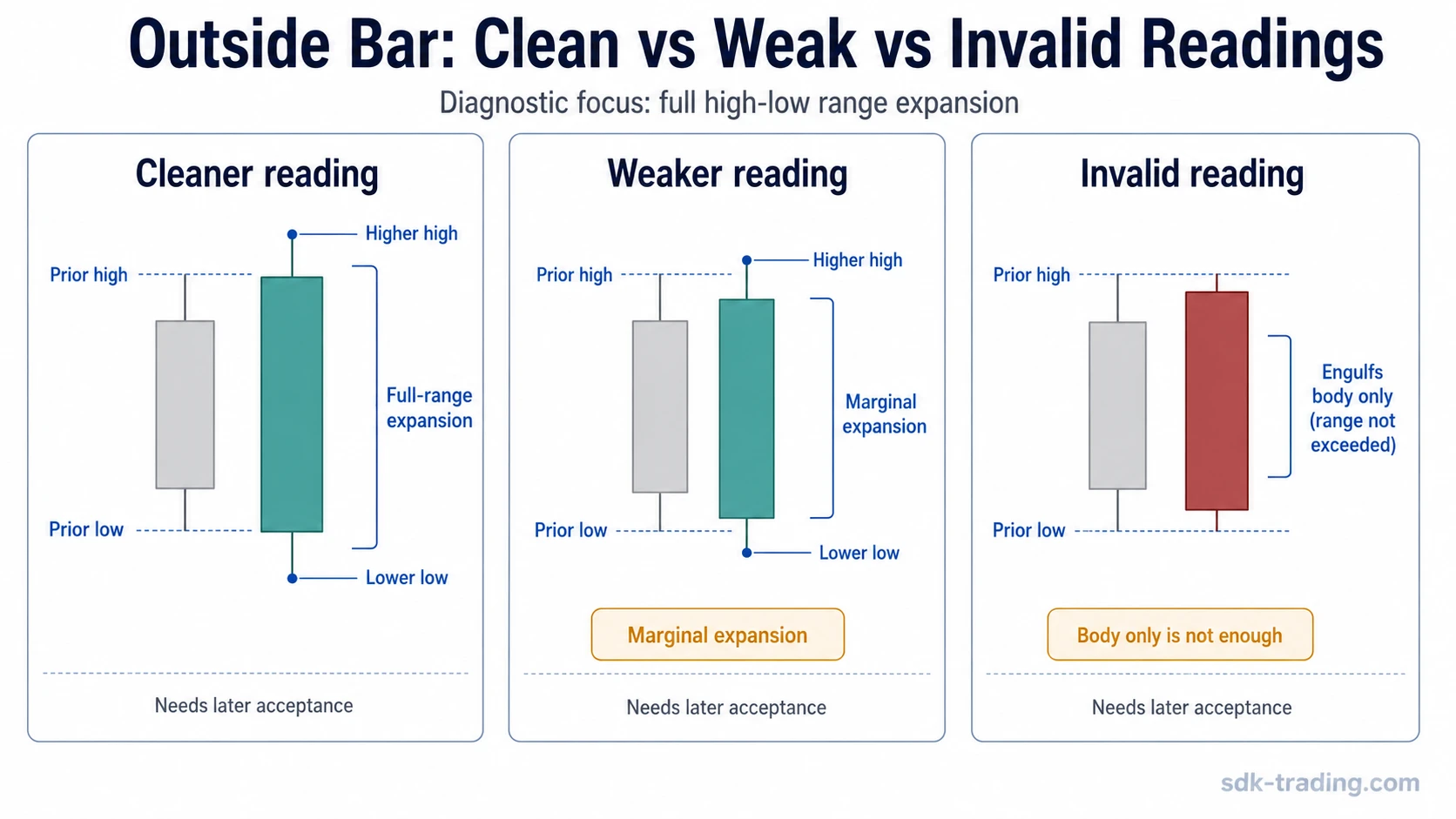
| Cleaner outside bar | The second candle clearly exceeds both the prior high and prior low, and the close shows pressure toward one side of the expanded range. | The reading still needs later acceptance; the outside bar alone is not confirmation. |
| Weaker outside bar | The candle technically expands beyond both extremes, but the close is indecisive, the excess is small, or the surrounding context is noisy. | Small marginal breaks, equal-level ambiguity, or immediate return inside the prior range reduce diagnostic value. |
| Invalid or false-positive reading | The second candle does not actually exceed both the prior high and prior low, or the reading is based only on real-body size. | A body engulfing pattern, a wide candle, or a one-sided breakout is not enough to call it an outside bar. |
The cleanest reading starts with an unambiguous range break on both sides. The stronger interpretation comes later, when subsequent candles show whether the market accepted the expanded area or rejected it back into the prior range.
Outside Bar vs Inside Bar vs Engulfing Pattern
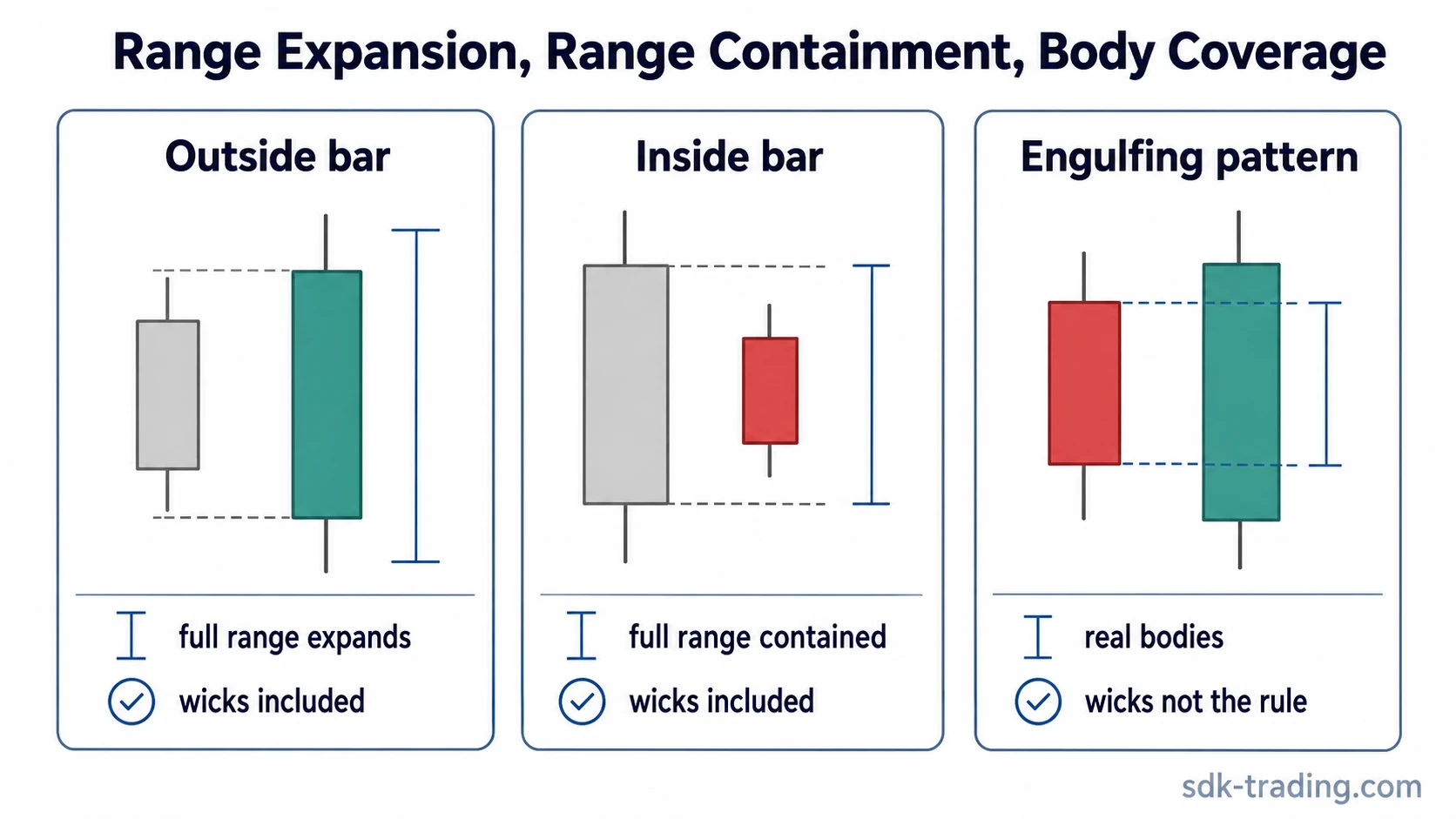
Outside bars, inside bars, and engulfing patterns are often confused because all three compare one candle with the candle before it. The difference is what part of the candle is being measured.
| Pattern | Measured part | Core rule | Main confusion to avoid |
|---|---|---|---|
| Inside bar | Full high-low range | The second candle stays inside the prior candle’s range. | Containment matters; the second candle does not expand beyond both sides. |
| Outside bar | Full high-low range | The second candle expands beyond both the prior high and the prior low. | Body size alone does not define the pattern. |
| Engulfing pattern | Real body | The second real body covers the prior real body. | Full-range expansion is not required. |
Outside Bar vs Other Two-Candle Structures
An outside bar should not be treated as a substitute label for every strong two-candle pattern. Piercing patterns, dark cloud cover, harami patterns, and tweezer structures each use different diagnostic boundaries.
| Nearby structure | Primary diagnostic idea | Why it is not the same as an outside bar |
|---|---|---|
| Piercing pattern | Second candle recovers into the prior bearish body. | It focuses on body recovery, not full-range expansion beyond both extremes. |
| Dark cloud cover | Second candle loses acceptance after opening above the prior candle. | It focuses on body penetration from above, not a required higher high and lower low. |
| Harami | Second candle contracts inside the prior real body. | It is a compression structure, while an outside bar is a range-expansion structure. |
| Tweezer top or bottom | Two candles test a similar high or low. | Equal or similar extremes are not the same as breaking both sides of the prior range. |
This boundary matters because the outside bar is the authority endpoint for full-range expansion. If the reading depends mainly on real-body penetration, midpoint recovery, equal extremes, or body compression, another two-candle structure may be more accurate.
Acceptance After an Outside Bar
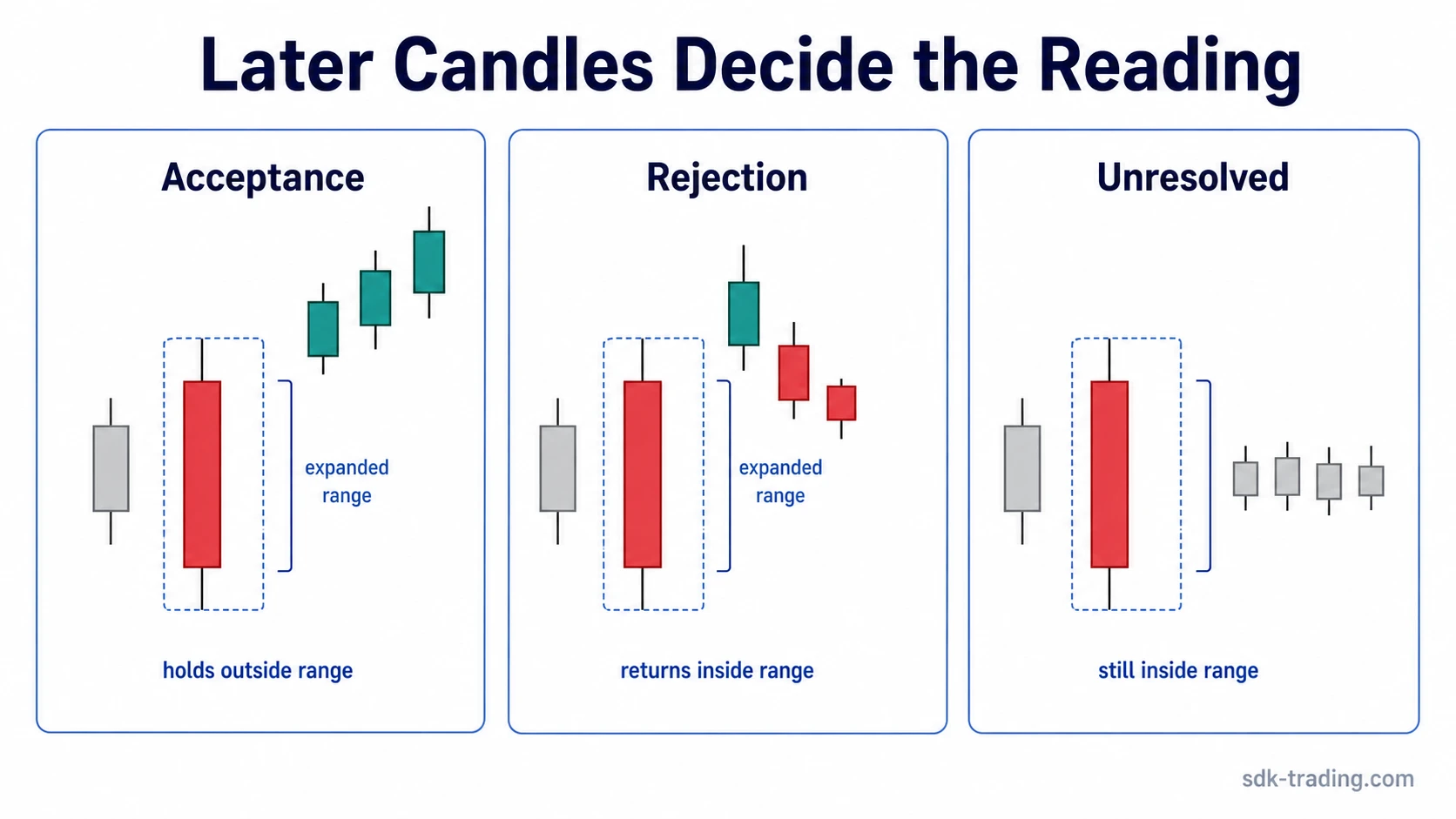
After an outside bar forms, the next question is not whether the candle was bullish or bearish. The better question is whether later price action accepts the expanded range.
Acceptance can appear when later candles continue to build outside one side of the outside bar, hold above or below the relevant part of the expanded range, or avoid an immediate return into the prior candle’s range.
Failure can appear when the market quickly returns into the prior range, cannot hold the attempted expansion, or treats the outside bar as a temporary volatility burst rather than a new accepted area. A deeper treatment belongs on the outside bar failure page.
Outside Bar Example in Context
Assume price has been moving through a narrow sequence of candles. One candle then trades above the prior high and below the prior low before closing back inside the expanded range.
The pattern is an outside bar because both extremes were exceeded. The close, however, does not settle the interpretation. A cleaner acceptance reading would need later candles to hold beyond one side of the range. A weaker reading appears if the next candles move back inside the earlier area and fail to build outside the expansion.
This is why the outside bar is best read as a structure first. It identifies range expansion. It does not, by itself, decide whether that expansion becomes continuation, rejection, a trap, or noise.
Common Outside Bar Mistakes
- Reading body engulfing as an outside bar. A large real body can engulf the prior body without exceeding both the prior high and prior low.
- Ignoring the wicks. The outside bar rule uses the full candle range, so wick highs and wick lows matter.
- Calling every outside bar directional. Range expansion shows activity, not an automatic bullish or bearish outcome.
- Overlooking location. The same structure can mean something different after compression, near a prior level, or inside a noisy range.
- Calling failure too early. A failed reading needs later rejection of the expanded range, not only the outside bar candle itself.
FAQ
What is an outside bar candlestick pattern?
An outside bar candlestick pattern forms when the second candle makes a higher high and a lower low than the prior candle. The rule compares the full high-low range, including the wicks.
Do wicks count in an outside bar?
Yes. Wicks count because an outside bar is measured by the candle high and candle low, not only by the open and close.
Is an outside bar the same as an engulfing pattern?
No. An outside bar compares the full high-low range. An engulfing pattern compares real bodies, so a candle can engulf the prior body without being a true outside bar.
Is an outside bar bullish or bearish?
An outside bar is not automatically bullish or bearish. Direction depends on location, close behavior, and whether later candles accept or reject the expanded range.