An outside bar failure is not the outside bar candle itself. It appears after a full high-low range expansion fails to hold, loses follow-through, or returns back into the earlier candle’s range.
An outside bar is defined by full-range expansion beyond the previous candle. Outside bar failure begins only when the expanded area does not attract follow-through, price returns back into the prior range, or later candles reject the wider range.
Definition: Outside bar failure is a post-candle interpretation in which a full-range outside bar loses its initial force because later candles move back inside the earlier range, reject the expanded area, or fail to build beyond it.
Key Points
- Outside bar failure is about failed follow-through after full high-low range expansion.
- The outside bar candle alone does not prove that the expanded area has been accepted.
- The reading weakens when price quickly returns into the prior range or cannot continue beyond the expanded area.
- A false breakout reading remains conditional until later candles clarify acceptance or rejection.
What Outside Bar Failure Means
Outside bar failure separates the candle fact from the later interpretation. The candle fact is full-range expansion beyond the previous high and low. The later interpretation depends on whether price can build outside that wider range or is pulled back into the earlier range.
A failure reading usually needs more than the outside bar itself. It becomes more defensible only after later candles show rejection, stalled continuation, or a return into the prior candle’s range.
Not This / Instead This
| Common misread | Safer reading |
|---|---|
| The outside bar proves direction because it broke both sides of the prior candle. | The outside bar only proves range expansion. Later acceptance, rejection, and follow-through decide whether the expansion matters. |
| A wide outside bar automatically makes the next move more reliable. | A wide candle can lose meaning if price cannot stay outside the prior range or if later candles reject the expanded area. |
| The first break beyond the prior candle is enough to label the move successful. | The first break is only the initial range event. The reading becomes more defensible when later candles support the breakout area. |
When Expansion Loses Continuation
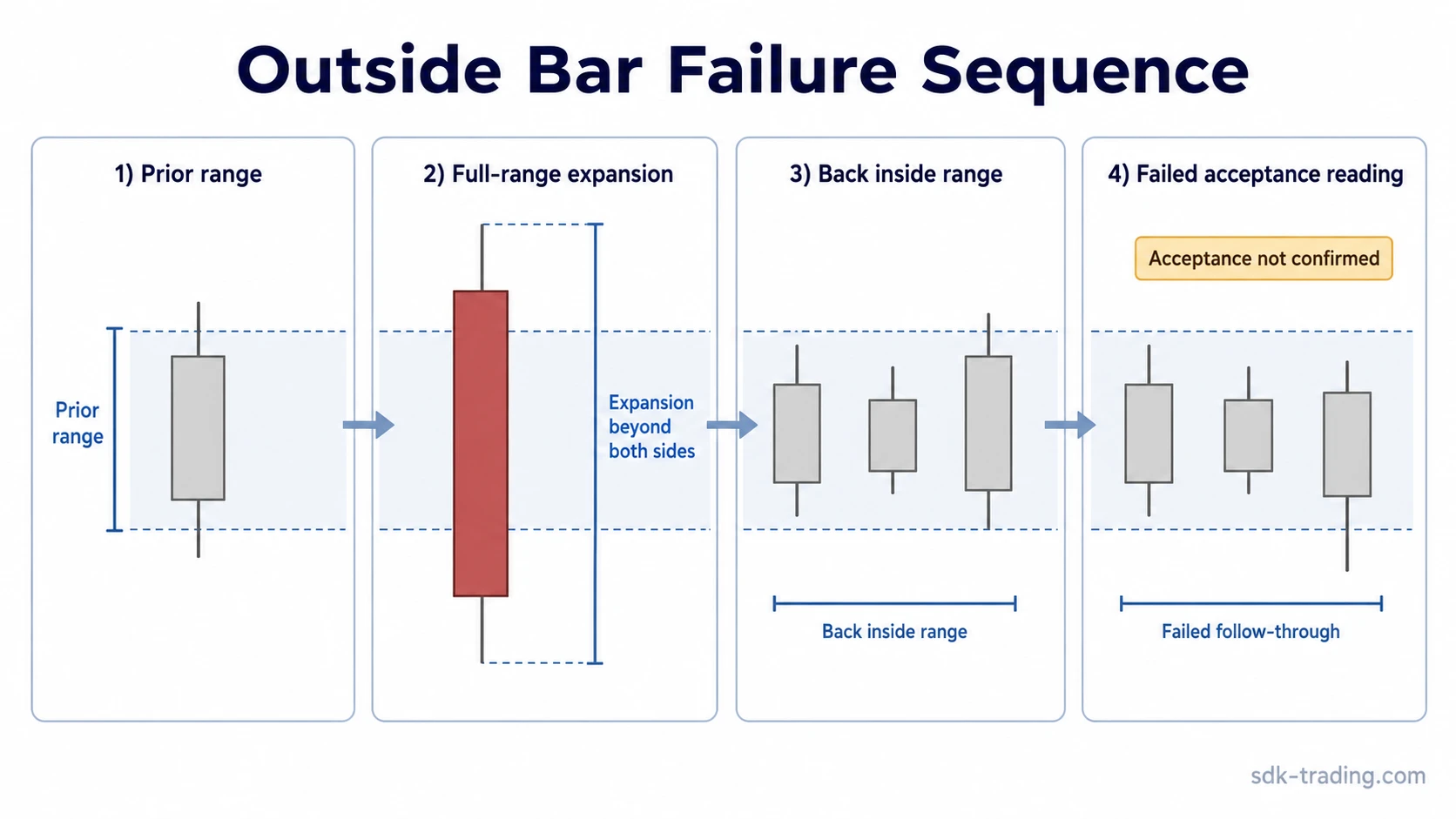
The sequence starts with a reference candle. The next candle trades beyond both sides of that reference range, creating the outside bar. At that point, the only confirmed fact is expansion. Failure appears when that wider range cannot produce continuation and price starts moving back through the expanded area.
- Prior range: the earlier candle sets the high-low boundary.
- Expansion: the outside bar trades above the prior high and below the prior low.
- Test of acceptance: later candles show whether price can remain outside the prior range or build from the expanded area.
- Failed follow-through: price returns into the prior range, rejects the expanded area, or stalls without directional continuation.
- Weaker reading: the outside bar becomes less useful as a directional clue unless later structure supports the move again.
This sequence does not require a fixed bullish or bearish interpretation. The same diagnostic idea can apply after upside expansion, downside expansion, or a two-sided sweep, depending on where price later holds or fails.
Why Range Expansion Can Be Misread
The common mistake is treating full-range expansion as confirmation before the market shows acceptance. A candle can expand aggressively and still fail to attract follow-through. In that case, the expansion may reflect temporary imbalance rather than a durable shift in control.
A quick return into the prior range does not automatically prove reversal. It does warn that the wider range did not create clean acceptance by itself.
Outside Bar Failure vs Outside Bar Fakeout
Outside bar failure is the broader failed follow-through reading after full-range expansion. Outside bar fakeout is narrower: it emphasizes a false break and quick rejection around the area that attracted attention.
The practical boundary is simple: failure asks whether the outside bar’s wider range held up; fakeout asks whether a visible break beyond a watched level or boundary was quickly rejected.
Outside Bar Failure vs Inside Bar False Breakout
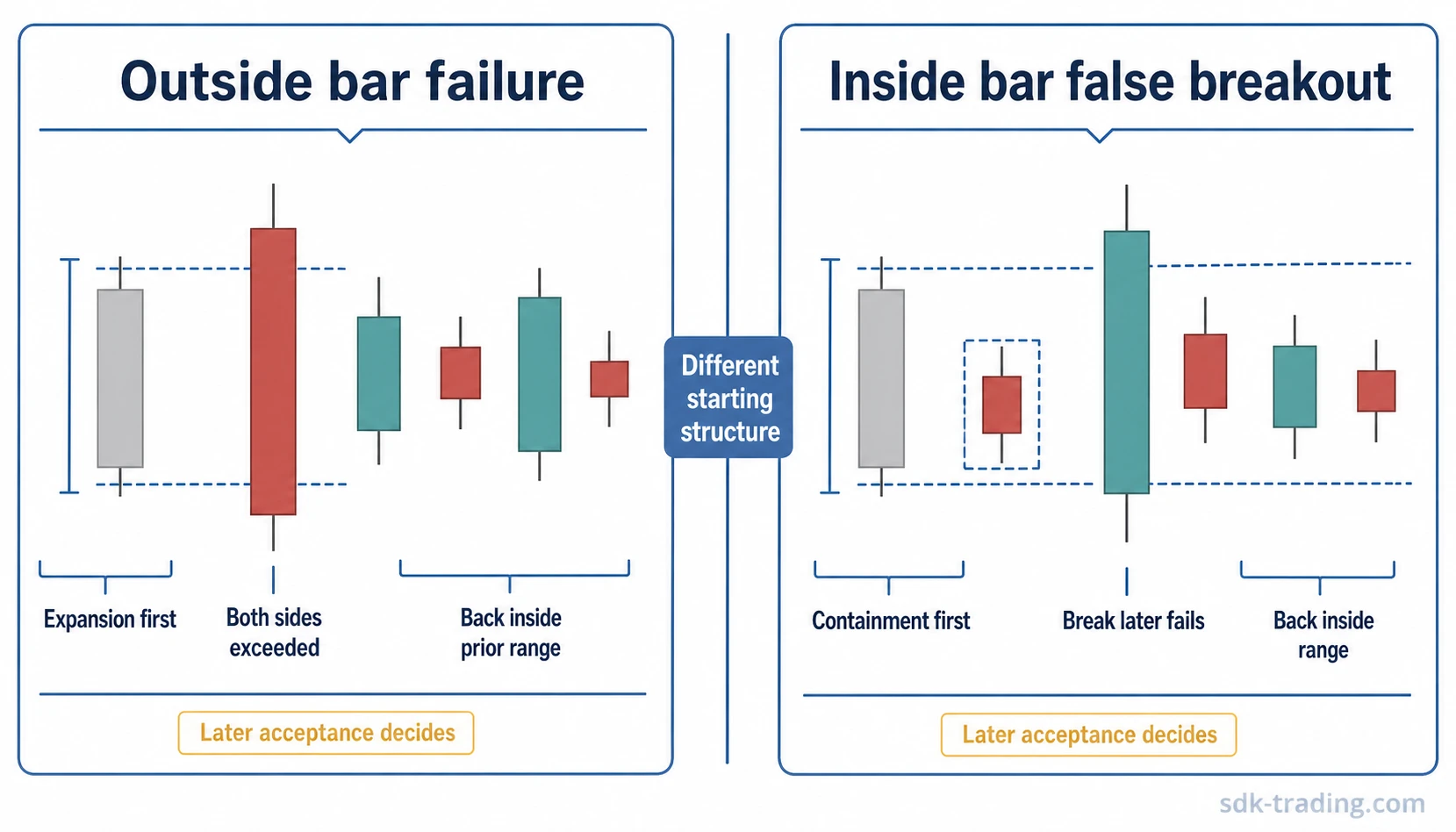
The difference starts with candle structure. An outside bar expands beyond both sides of the prior candle’s range. An inside bar stays contained within the prior candle’s high-low range, so an inside bar false breakout is judged from a contained setup that later breaks and fails.
Outside bar failure is not a containment problem. It is an expansion problem. The market already moved beyond the prior high and prior low, so the diagnostic question changes from “did containment break?” to “did the expanded range gain acceptance?”
Expansion That Cannot Hold Direction
A prior candle forms a clear high and low. The next candle trades above that high and below that low, creating an outside bar. At first, the candle looks forceful because it expanded both sides of the previous range.
The next candles do not continue from the expanded area. Price moves back into the prior range and spends time there instead of holding outside the expanded boundary. That behavior makes the original expansion less useful as directional evidence.
The safer interpretation stays conditional: the outside bar created a range event, but later behavior did not support a strong continuation reading. The candle name alone is not enough to decide whether the expansion was meaningful.
What Makes the Reading Weaker or More Defensible
| Condition after the outside bar | What it may suggest | What weakens the reading |
|---|---|---|
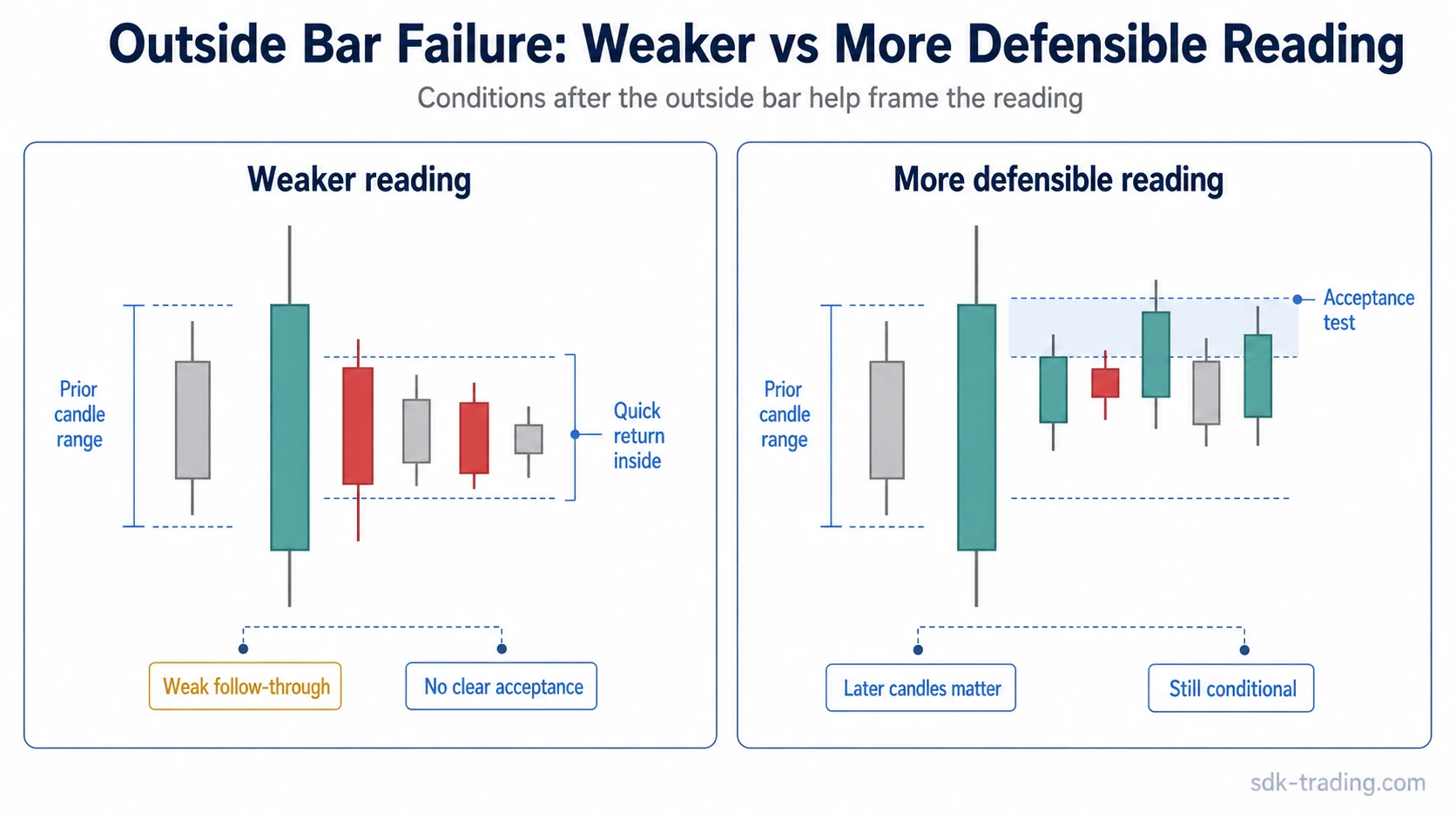
| Price quickly returns into the prior candle’s range | The expanded area may not have been accepted | No follow-through outside the range |
| Price stalls near the expanded high or low | The breakout area may be under test | Repeated failure to build beyond the expanded area |
| Later candles hold outside the prior range | The original expansion becomes more defensible | Conflicting closes back inside the prior range |
| Context conflicts with the candle direction | The outside bar may need more confirmation | Weak close location, rejected extremes, or no supporting structure |
Size alone does not make the outside bar useful. The reading improves only when later candles support the expanded area instead of rejecting it back into the earlier range.
Related Double-Candle Context
Outside bar failure belongs to the two-candle pattern family, but it should not be mixed with every two-candle reversal idea. A piercing pattern is judged through a different two-candle relationship, where the second candle closes meaningfully into the prior bearish candle’s real body after a lower open.
That difference matters because outside bar failure is about full-range expansion and later failed acceptance. Other double-candle structures may use body overlap, close location, equal highs or lows, or containment as their main diagnostic feature.
FAQ
What is an outside bar failure in trading?
An outside bar failure occurs when a full-range outside bar loses follow-through and later price action returns into, rejects, or fails to build from the expanded range.
Is outside bar failure the same as an outside bar fakeout?
No. Outside bar failure is the broader failed follow-through reading after range expansion. Outside bar fakeout usually emphasizes a false break and quick rejection around the expanded area.
Does outside bar failure mean price must reverse?
No. Outside bar failure does not prove reversal. It only shows that the original range expansion has weakened unless later price action supports a clearer reading.
How is outside bar failure different from inside bar false breakout?
Outside bar failure starts from full-range expansion beyond the prior candle. Inside bar false breakout starts from containment inside the prior range before the later break fails.