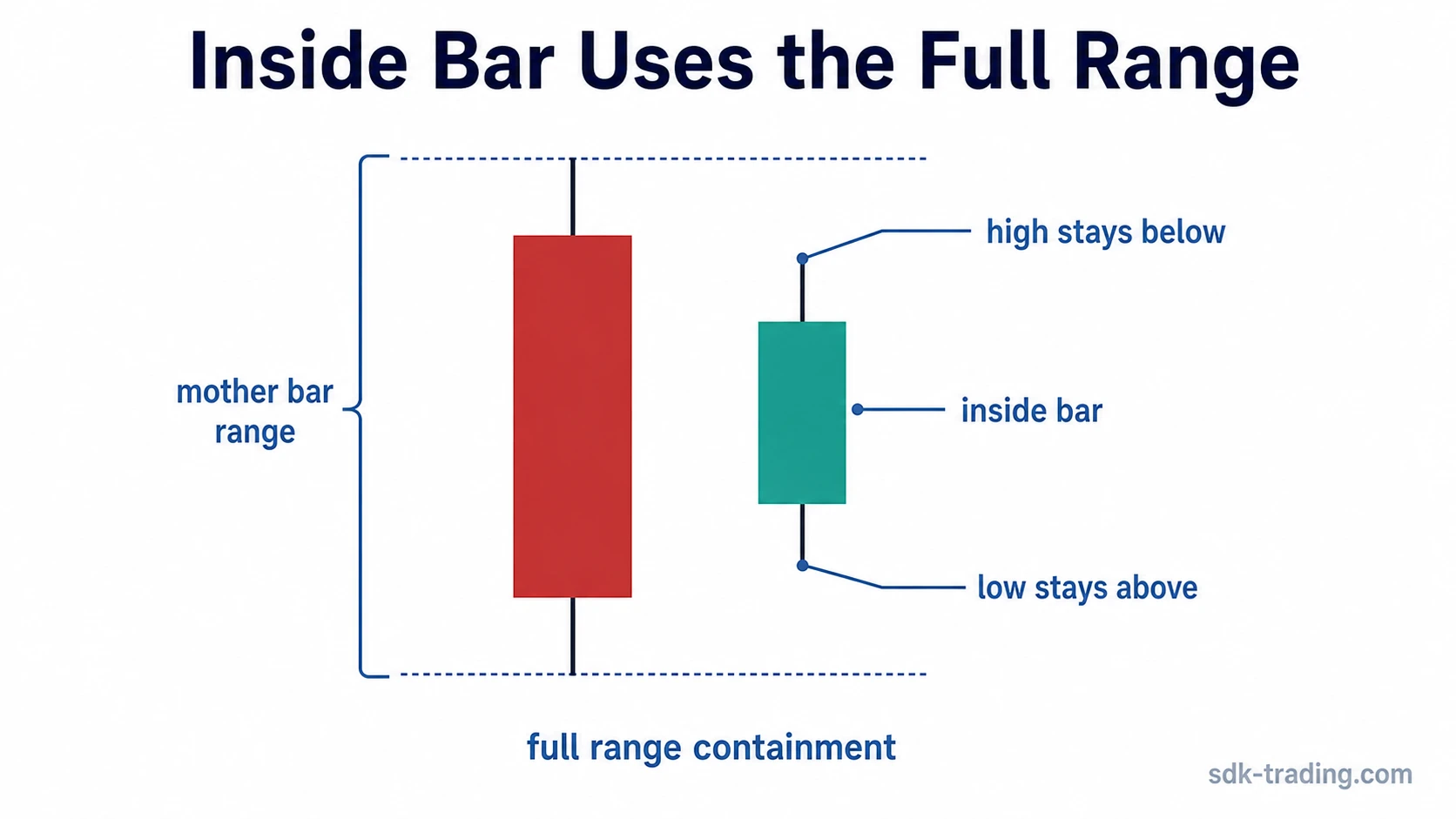
An inside bar is a two-candle structure where the second candle’s full high-low range stays inside the prior candle’s high-low range.
The prior candle is the mother bar. The inside bar shows range compression inside that mother-bar boundary, not a completed bullish or bearish decision by itself. The useful reading starts with the containment rule, then moves to how later candles behave around the mother bar high and low.
Definition: An inside bar is a candlestick pattern where the second candle has a lower high and a higher low than the prior candle, so its full range is contained inside the mother bar range.
Key Points
- An inside bar is defined by full range containment, not by candle color or body size alone.
- The second candle’s high must stay below the mother bar high, and its low must stay above the mother bar low.
- The pattern usually reflects range compression, hesitation, or a pause after prior movement.
- It differs from an outside bar because an outside bar expands beyond the prior range instead of staying inside it.
- A clean inside bar still needs later acceptance, rejection, or failed-breakout behavior before the reading becomes useful.
How to Identify an Inside Bar
The mother bar creates the reference range. The inside bar is valid only when the second candle’s full high-low range stays inside that reference range. A small real body is not enough if one wick breaks above the mother bar high or below the mother bar low.
| Check | Inside bar requirement | Why it matters |
|---|---|---|
| High | The inside bar high is below the mother bar high. | This confirms the upper side of the range stayed contained. |
| Low | The inside bar low is above the mother bar low. | This confirms the lower side of the range stayed contained. |
| Wicks | Wicks must also remain inside the mother bar range. | The pattern is based on full range, not only real bodies. |
| Body | The real body can be bullish, bearish, or small. | Body color adds context, but it does not define the pattern. |
| Context | The pattern is clearer when the mother bar boundary is easy to see. | Noisy overlap can make the reading weak even when containment exists. |
Inside Bar Meaning: Compression Inside the Mother Bar
The inside bar means that the market moved from a wider candle range into a narrower candle range. That contraction can appear after a strong candle, inside a trend pause, near a tested area, or during short consolidation.
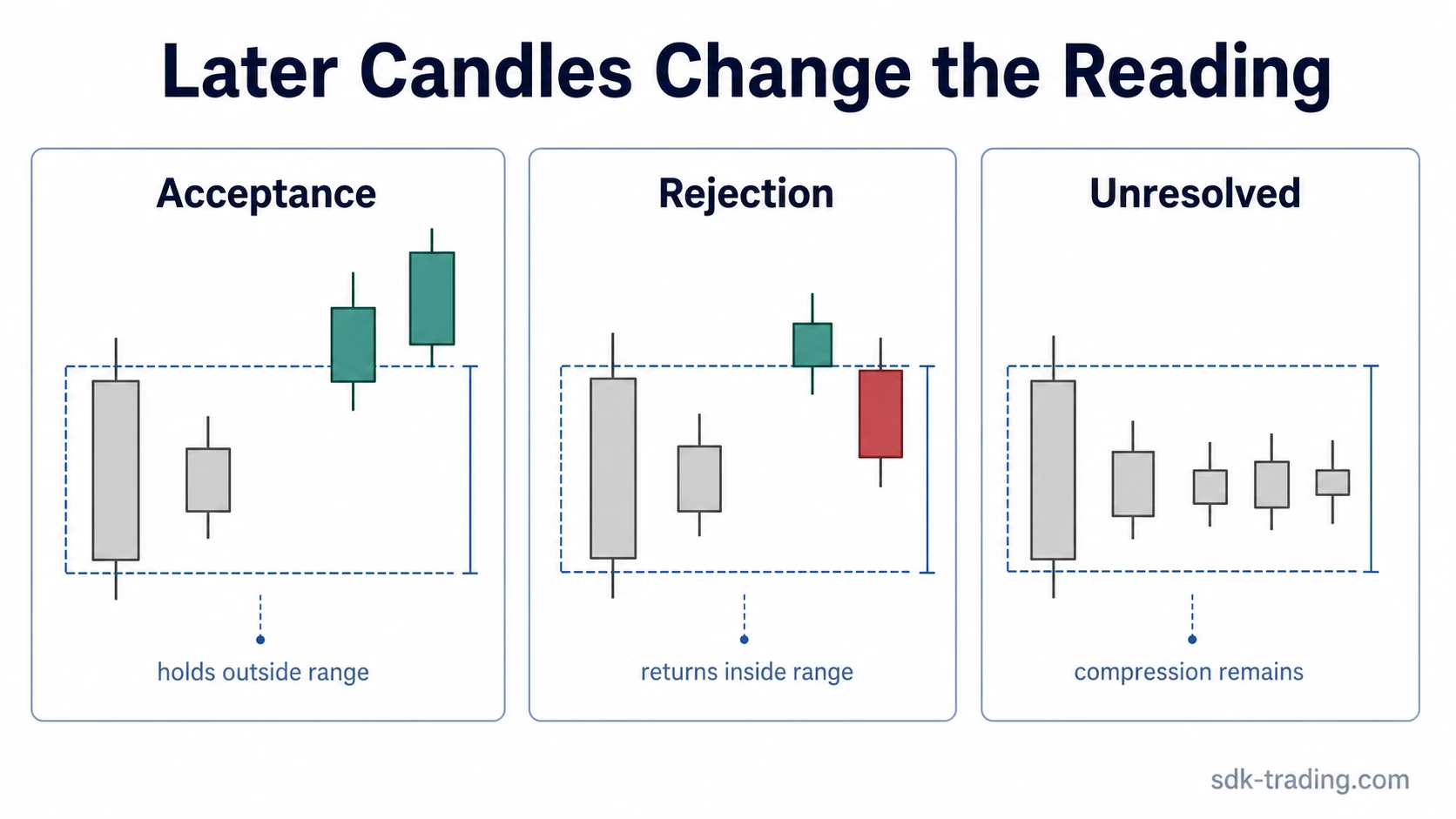
The pattern identifies compression first. It does not decide direction on its own. Later candles decide whether the mother bar range is accepted, rejected, or still unresolved.
Full Range Containment vs Body Containment
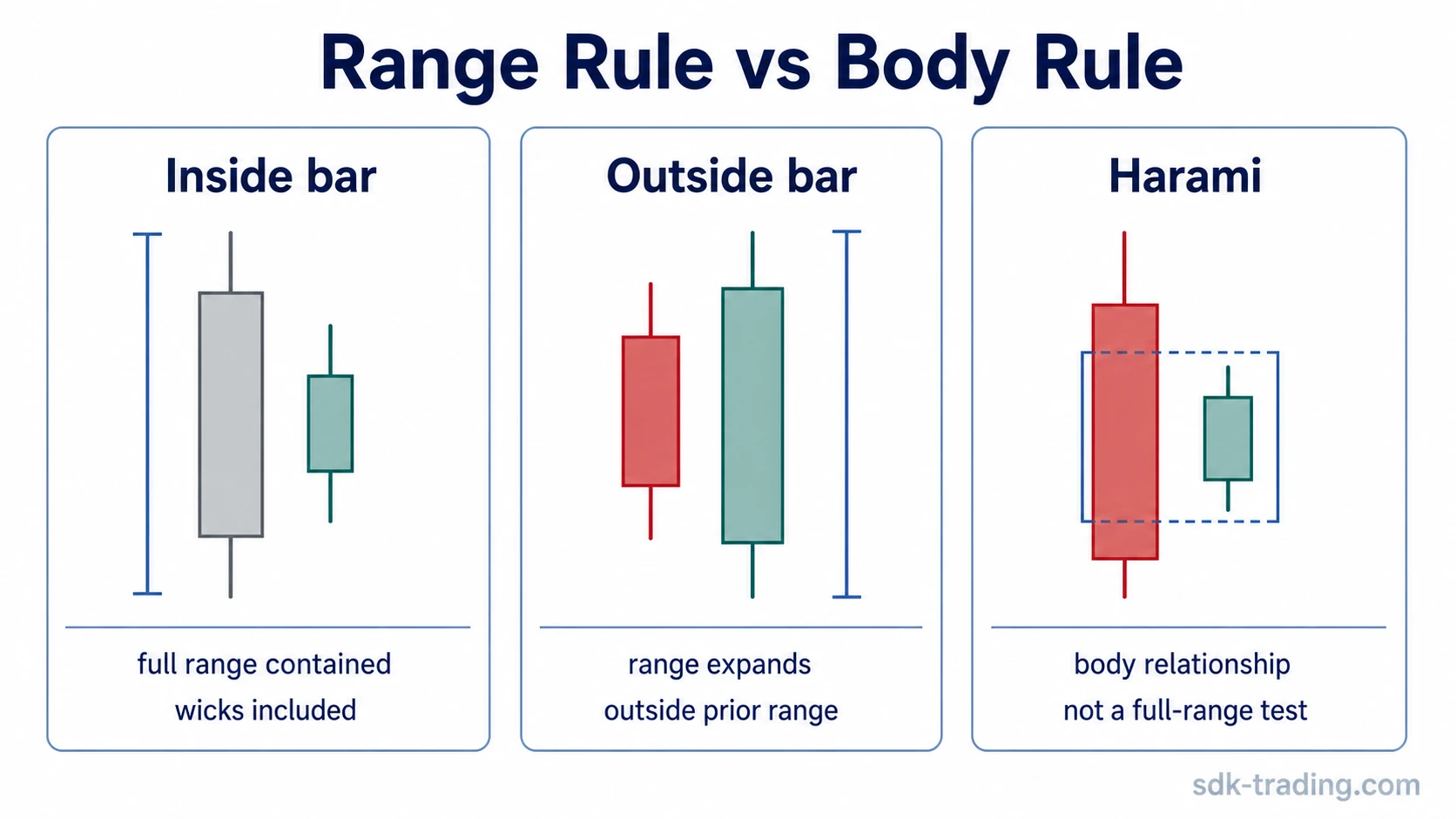
An inside bar is not the same as a body-only containment pattern. Harami readings focus more on real-body position. Engulfing readings focus on real-body takeover. The inside bar uses the complete candle range, including the wicks.
| Structure | Main measurement | Diagnostic boundary |
|---|---|---|
| Inside bar | Full high-low range | The second candle stays inside the prior candle’s full range. |
| Outside bar | Full high-low range | The second candle expands beyond the prior high and low. |
| Harami | Real-body relationship | The smaller candle is read mainly against the prior real body. |
| Engulfing pattern | Real-body takeover | The second real body covers the prior real body. |
Clean, Weak, and Invalid Inside Bar Readings
A cleaner inside bar reading does not mean the pattern has to break in either direction. It only means the pattern is easier to classify and less likely to be a false positive.
| Status | What it looks like | Safer interpretation |
|---|---|---|
| Clean inside bar | The second candle stays clearly below the mother bar high and above the mother bar low. | The compression is easy to define. Later behavior around the mother bar boundary becomes the next test. |
| Weak inside bar | The candle is technically contained, but it forms inside noisy overlap or a crowded range. | The containment may be ordinary chop rather than meaningful compression. |
| Invalid inside bar | The second candle’s wick breaks above the mother bar high or below the mother bar low. | The full-range rule is broken, so the candle pair should not be classified as an inside bar. |
| Failed response after an inside bar | Price breaks the mother bar boundary, then quickly moves back inside the range. | The break has not been accepted. This belongs closer to outside-bar failure or false-break logic than to a clean directional read. |
Multiple Inside Bars
Multiple inside bars form when two or more candles remain contained within the same mother bar range. This can show extended compression, but it can also appear in slow or inactive conditions.
The cleaner reading is not “more inside bars means a better signal.” The cleaner reading is that the reference range remains unresolved until later candles accept outside it, fail back inside it, or continue rotating within it.
Acceptance, Rejection, and Failed Breaks
The inside bar marks the compressed range. A close outside the mother bar range is more meaningful when later candles hold outside that boundary instead of snapping back inside it.
A brief break above or below the mother bar can mislead if the next candles erase the move. That is why the mother bar high and low should be treated as diagnostic boundaries, not automatic entry or exit levels.
Where Inside Bars Appear
Inside bars often appear after expansion because the market pauses after a wider candle. They can also appear inside trends, near tested areas, or during consolidation.
In a trend, an inside bar may show a pause while prior pressure remains intact. Near support or resistance, it may show hesitation before the market chooses whether to accept or reject that area. Inside a choppy range, the same pattern is less informative because containment is already common.
Common Inside Bar Mistakes
- Using only the real body. The inside bar rule includes wicks. A small body does not qualify if the wick breaks the mother bar range.
- Reading compression as direction. The pattern shows reduced range first. Directional interpretation requires later response around the mother bar boundary.
- Ignoring noisy conditions. A contained candle inside a messy range can be ordinary overlap rather than useful compression.
- Confusing the inside candle with the signal. The inside bar defines the compressed range. The following sequence decides whether the compression gains meaning.
- Treating every inside bar as equal. Multiple contained candles, higher-timeframe context, and clean boundary behavior can change the quality of the reading, but none of them guarantees the outcome.
FAQ
What is an inside bar?
An inside bar is a two-candle pattern where the second candle’s full high-low range stays inside the prior candle’s high-low range. The prior candle is usually called the mother bar.
Is an inside bar bullish or bearish?
An inside bar is not automatically bullish or bearish. It shows compression inside the prior candle’s range. The later reaction around the mother bar high and low gives the reading more directional context.
How is an inside bar different from a harami?
An inside bar is based on full high-low containment. A harami reading focuses more on real-body position, so the two structures can look similar while measuring different parts of the candles.
Can an inside bar fail?
Yes. An inside bar can fail when price breaks the mother bar range and then quickly moves back inside it, or when the pattern forms in noisy conditions where containment does not show meaningful compression.