Double candlestick pattern structures are the geometry tests behind two-candle pattern names. The main issue is not which name appears first, but what the second candle does to the first candle’s real body, full high-low range, close area, or tested extreme.
This separates the structure layer from the pattern-list layer. Engulfing, harami, inside bar, outside bar, tweezer, piercing pattern, and dark cloud cover become easier to read when body displacement, body containment, range containment, range expansion, partial penetration, and matched extremes are checked separately.
Key Points
- Double-candle structures compare the second candle against the first candle.
- Real-body structures and full-range structures are different readings, even when the candles look visually similar.
- The second candle’s close often changes the interpretation more than the pattern label alone.
- Reversal language stays conditional until the next response clarifies acceptance, rejection, or continuation.
- Named patterns are easier to read when they are grouped by body displacement, containment, range behavior, and matched extremes.
How Two-Candle Structures Are Grouped
Most double-candle structures can be grouped by what the second candle does to the first candle. It may take over the prior real body, recover part of it, compress inside it, stay inside the full range, expand beyond the full range, or retest a similar high or low.
| Structure type | What the second candle does | Typical pattern families | What to check |
|---|---|---|---|
| Body displacement | Its real body overtakes the prior real body. | Engulfing patterns | Whether body control actually changed. |
| Partial penetration | It closes into the prior real body without fully taking it over. | Piercing pattern, dark cloud cover | How deeply the prior body was penetrated. |
| Real-body containment | A smaller real body forms inside the prior real body. | Harami, harami cross | Whether compression holds, breaks, or remains unresolved. |
| Full-range containment | The entire second candle stays inside the prior high-low range. | Inside bar | Whether volatility is compressing inside the prior range. |
| Full-range expansion | It breaks beyond both the prior high and the prior low. | Outside bar | Whether the expansion is accepted or rejected later. |
| Matched extreme | It retests a similar high or low area. | Tweezer patterns | Whether the second test is rejected or absorbed. |
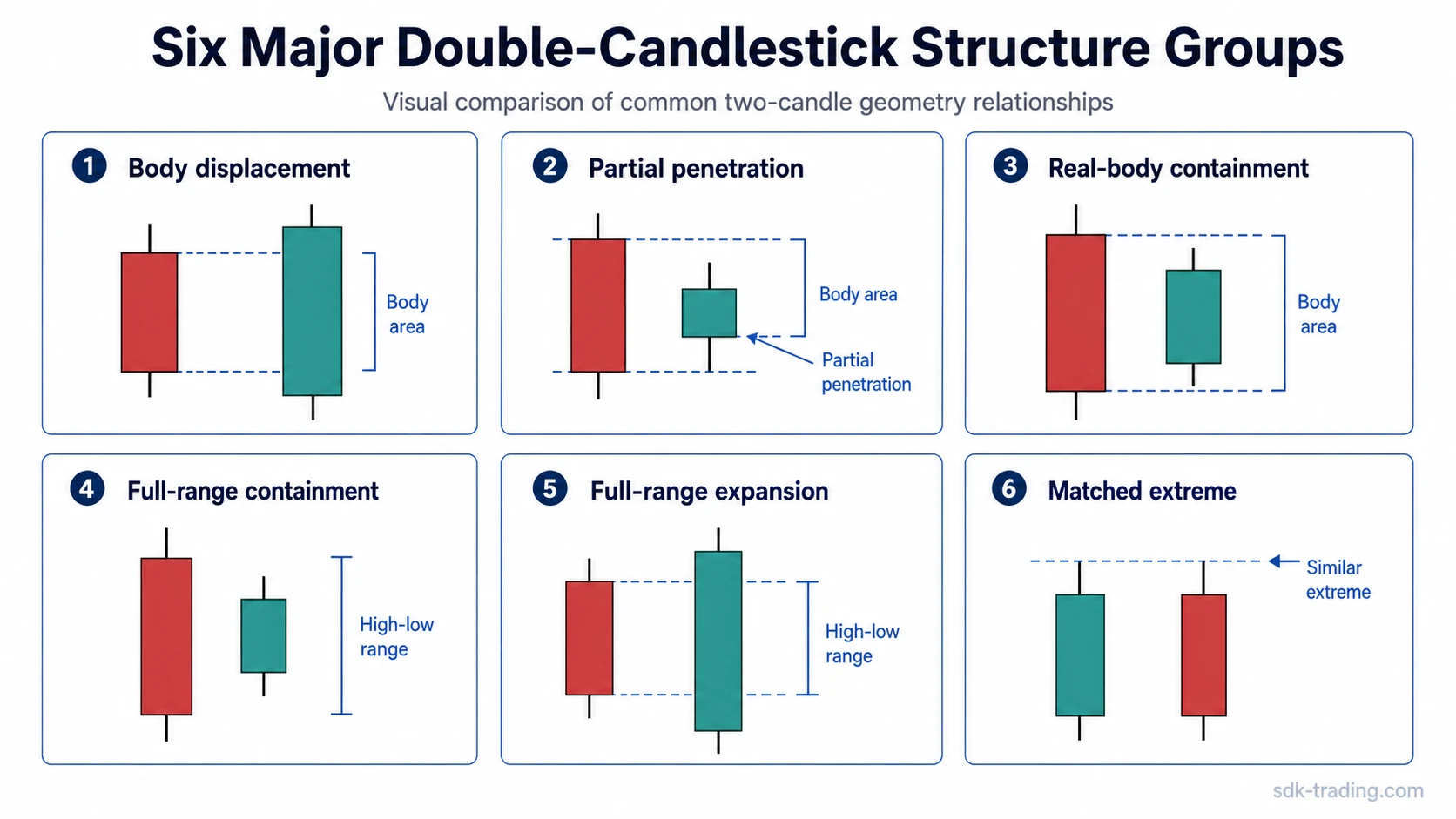
Body behavior and range behavior should not be merged too quickly. A candle can have a small body but a wide range, or it can stay inside a prior range while its real body gives a different message. Separating those layers prevents a common mistake: naming the pattern before checking what actually changed between the two candles.
Body Displacement Structures
Body displacement happens when the second candle’s real body overtakes the first candle’s real body. In an engulfing family, the focus is not only that the second candle is larger. The stronger structural question is whether the second candle has replaced the prior body’s control area with an opposite or stronger close.
Bullish engulfing and bearish engulfing are the most familiar examples, but the label alone is incomplete. A displacement structure becomes more meaningful when it appears after prior directional pressure and later candles do not immediately reject the displacement area. If the second body is large but closes into a noisy range with no later acceptance, the reading is weaker.
Partial Penetration Structures
Partial penetration structures close into the prior real body without fully overtaking it. The second candle challenges part of the first candle’s body, but it does not create the same body takeover found in a true engulfing structure.
The piercing pattern and dark cloud cover belong to this family. The useful question is depth. A close barely inside the prior body carries a different message from a close that reaches meaningfully beyond the prior body’s midpoint. Even then, the structure remains conditional because a partial penetration candle can be absorbed, rejected, or left unresolved by later price behavior.
Real-Body Containment Structures
Real-body containment means the second candle’s real body forms inside the real body of the prior candle. This is a compression structure, not a body takeover. The market has not displaced the prior body; it has narrowed inside it.
A bullish harami structure uses this containment after bearish pressure.
A bearish harami reading uses the opposite directional context after bullish pressure. In both cases, the body is smaller and contained, so the question shifts from takeover to hesitation, compression, and later clarification.
A harami cross tightens the same idea further because the second candle is near-doji-like inside the prior body. That does not make the structure automatically stronger. It only shows a narrower second-candle body relationship that needs location and later behavior before interpretation language becomes more defensible.
Range Containment and Range Expansion Structures
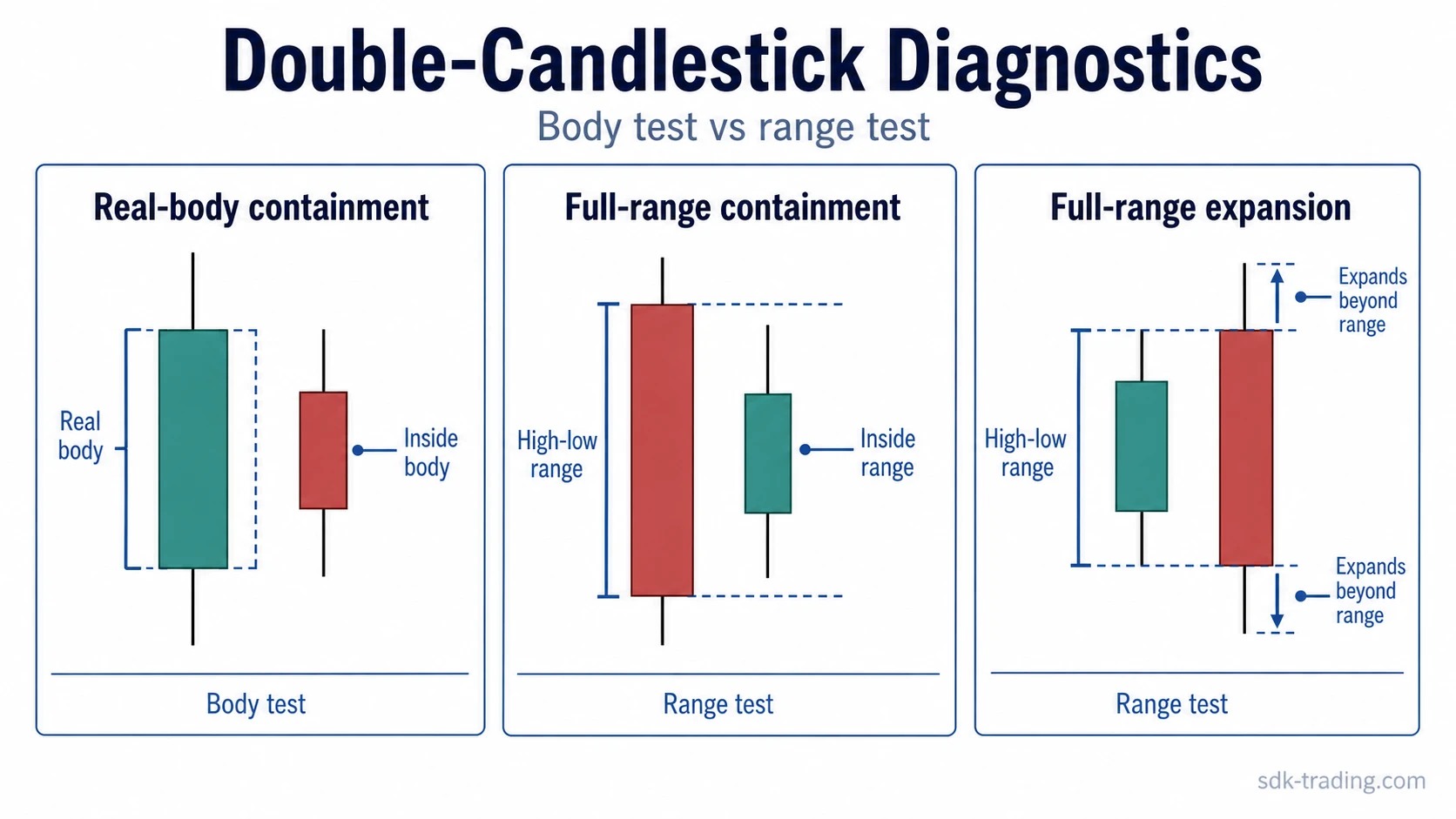
Range-based structures use the full high-low range instead of only the real body. This is the main reason body containment and range containment must be separated.
An inside bar structure forms when the entire second candle stays within the prior candle’s high-low range. The real body may be small, large, bullish, or bearish, but the defining feature is full-range containment. The range has compressed inside the prior candle.
An outside bar structure does the opposite. The second candle expands beyond both the prior high and the prior low. That expansion can show volatility expansion or a failed attempt to extend the range, depending on where it closes and how the following candles behave.
Body vs range distinction: a harami-style structure is defined by real-body containment, while an inside bar is defined by full high-low containment. An outside bar is defined by full-range expansion, even if the candle body does not fully engulf the prior real body.
Matched-Extreme Structures
Matched-extreme structures focus on a second test of a similar high or low area. The two candles do not need to create a body takeover or full-range containment. The important relationship is whether the second candle retests a similar extreme and how price behaves around that retest afterward.
A tweezer top formation uses this logic near a similar high area. The structure becomes more useful when the second test cannot accept above the prior high area. Without rejection or later weakness, matched highs may only show a pause rather than a meaningful supply response.
Tweezer bottom uses the same matched-extreme idea in the opposite direction. The shared lesson is that equal or similar extremes are only the starting point. The later reaction decides whether the second test was rejected, absorbed, or left unresolved.
Why Location Changes the Reading
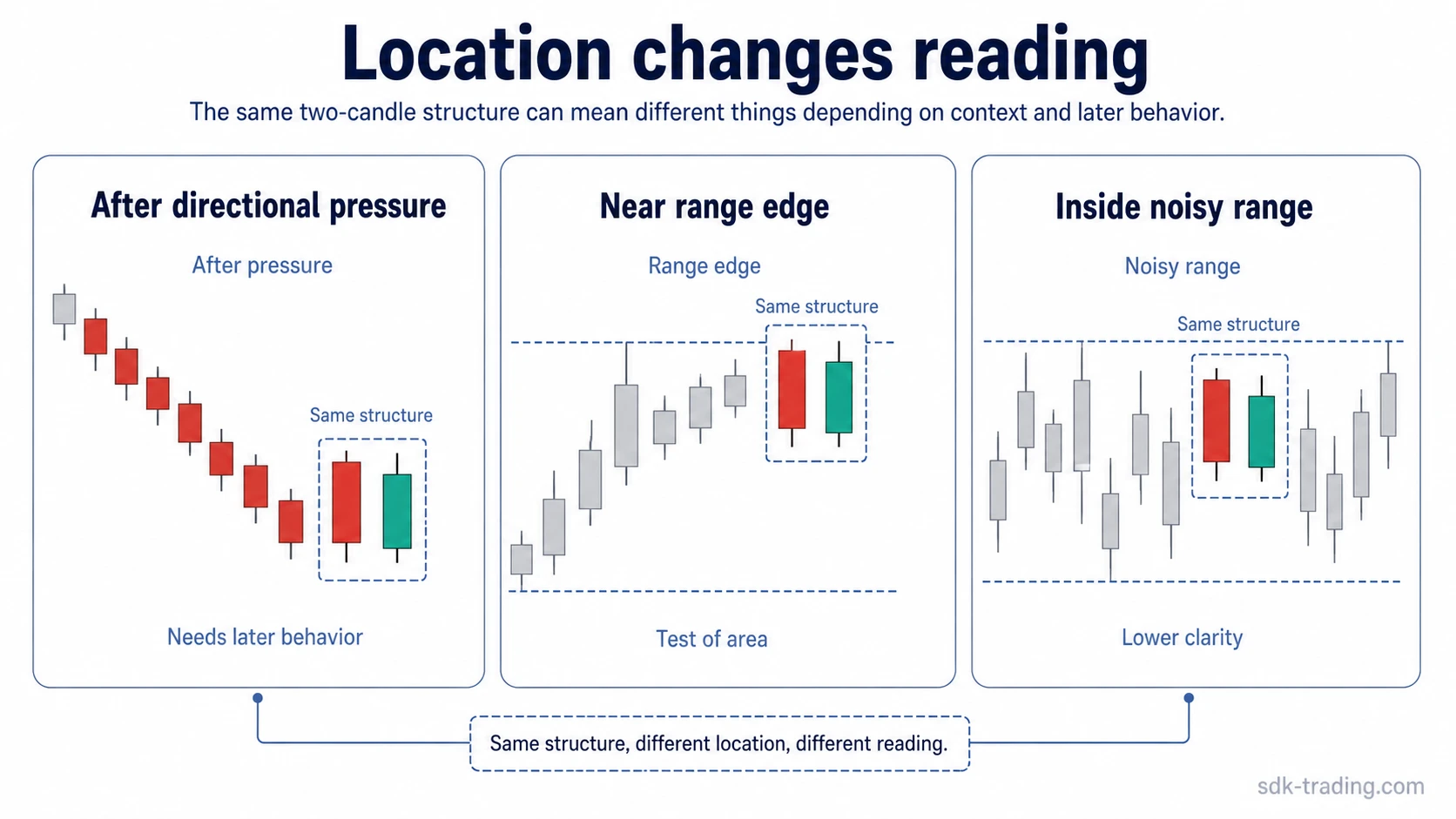
The same two-candle geometry can carry different meaning in different locations. A contained second body after an extended move can suggest hesitation, while the same containment in the middle of a range may only show temporary balance. A range expansion candle near a breakout area can mean something different from the same candle inside a choppy consolidation.
Location includes prior trend, range position, support or resistance area, volatility condition, and the way later candles treat the structure. A candle relationship becomes more meaningful when later behavior shows whether the area is accepted, rejected, or quickly neutralized.
A common scenario is a small second real body inside a larger prior body while the full high-low range still overlaps widely. That can tempt a quick harami label. The reading is incomplete if the range behavior, close location, and next candles do not support compression or rejection. The safer diagnostic sequence is geometry first, label second, interpretation third.
Common Mistakes When Reading Two-Candle Structures
| Mistake | Why it weakens the reading | Cleaner check |
|---|---|---|
| Naming the pattern before checking geometry | The label can hide whether the structure is body-based, range-based, or only a partial match. | Check real body, range, close, and relative position first. |
| Treating harami and inside bar as the same structure | Harami uses real-body containment; inside bar uses full high-low containment. | Separate body containment from full-range containment. |
| Calling every large second candle an engulfing pattern | A large candle may not actually overtake the prior real body. | Compare open-close bodies, not only candle size. |
| Reading matched highs or lows as automatic rejection | A retest can be rejected, absorbed, or left unresolved. | Watch whether later candles accept beyond the tested area. |
| Using reversal language too early | Two candles alone rarely settle the full market reading. | Keep the interpretation conditional until later behavior clarifies the area. |
FAQ
Which part of the candles should be compared first?
Start with the real bodies and the full high-low ranges separately. A body-based structure can give a different reading from a range-based structure even when the two candles look similar.
Why can two candles look like one pattern but belong to another structure?
The visual label can change when the second candle only penetrates part of the first body, stays inside the prior range, or expands beyond the full range without creating real-body engulfment.
What is the difference between body displacement and body containment?
Body displacement means the second real body takes over the first real body. Body containment means the second real body stays inside the first real body and shows compression rather than takeover.
What is the difference between range containment and range expansion?
Range containment means the entire second candle stays within the prior high-low range. Range expansion means the second candle breaks beyond the prior high-low range.
Why is the close important in two-candle structures?
The close shows whether the second candle finished with displacement, partial recovery, rejection, compression, or unresolved overlap. That close often decides whether the pattern label carries useful evidence.