An outside bar fakeout begins with a common mistake: treating a probe beyond the expanded outside-bar range as confirmed continuation. The outside bar pattern only creates the wider high-low range. The fakeout reading appears later, after price fails to hold acceptance outside that range and rotates back inside.
Definition: An outside bar fakeout is a failed-acceptance sequence after an outside bar expands beyond the prior candle’s high and low. The outside bar creates the reference range; the fakeout requires a later probe beyond that range, failed acceptance outside it, and rotation back inside.
Key Points
- An outside bar is not automatically a fakeout.
- The first break beyond the expanded range is only a probe until acceptance is visible.
- The fakeout reading strengthens when price cannot hold outside the range and rotates back inside.
- If price remains accepted beyond the outside-bar extreme, the fakeout reading weakens or fails.
Mistaking the First Probe for Acceptance
Common mistake: treating the first move beyond the outside-bar range as accepted breakout evidence.
Safer interpretation: the fakeout reading becomes stronger only after price fails to hold outside the expanded range and rotates back inside it.
An outside bar can look decisive because it expands beyond both sides of the prior candle. That range expansion can attract a breakout reading, especially when price later trades beyond the outside bar’s high or low. The problem is that a brief probe outside the range does not prove that the market has accepted that area.
The fakeout reading becomes more defensible only after price fails to hold outside the expanded range. Rotation back inside matters because it shows that the market tested continuation beyond the outside bar and could not sustain it.
Probe Outside, Reject Back Inside
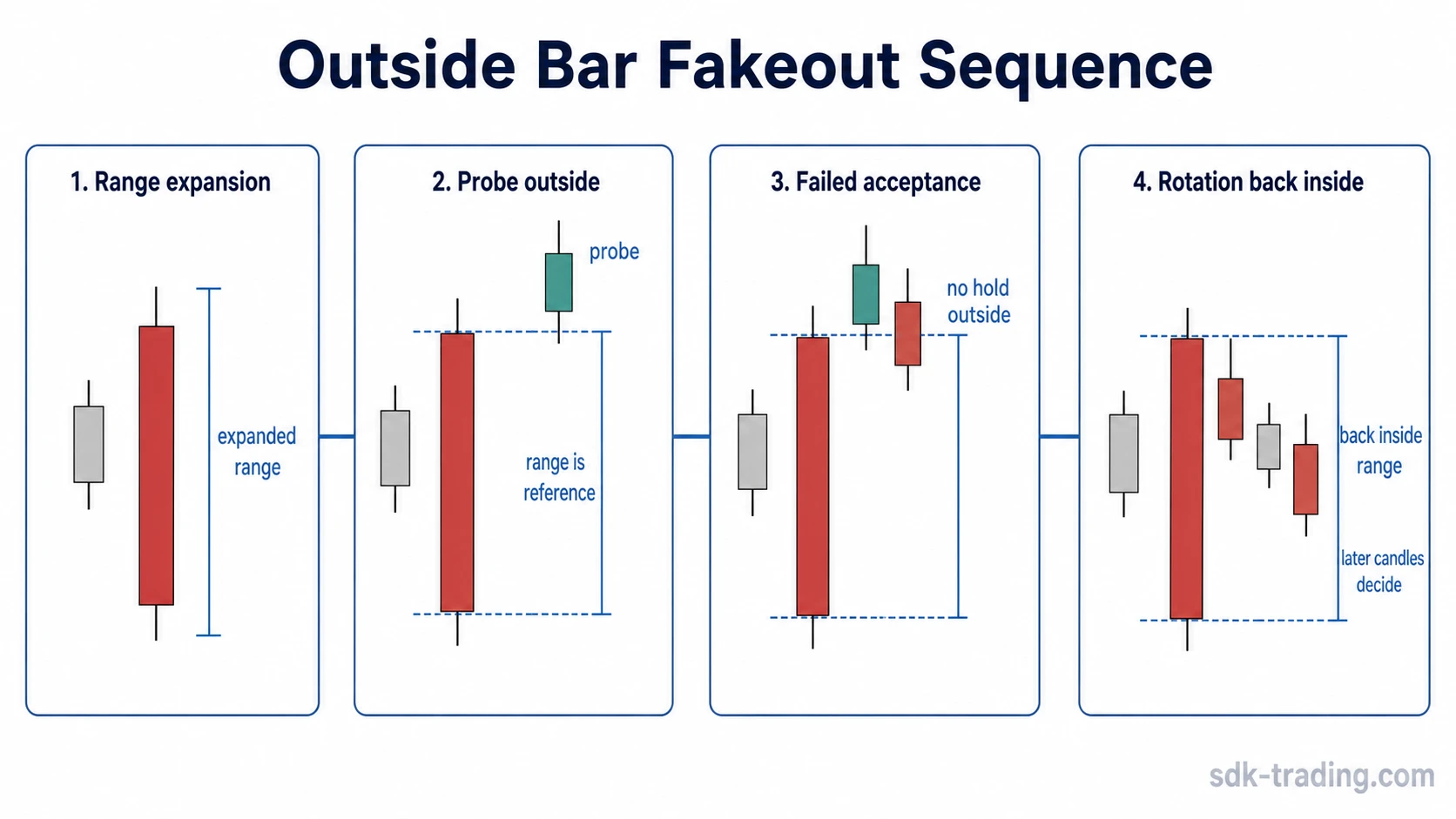
| Step | What appears on the chart | What it means |
|---|---|---|
| 1. Range expansion | A candle trades above the prior high and below the prior low. | The outside bar creates a wider reference range. |
| 2. Breakout-like probe | Price later moves beyond one side of the outside-bar range. | Continuation is being tested, but not confirmed. |
| 3. Failed acceptance | Price cannot hold outside the expanded range. | The attempted continuation loses quality. |
| 4. Rotation back inside | Later candles return inside the outside-bar range. | The fakeout reading becomes stronger because the outside area was rejected. |
The sequence is not about candle color alone. A bullish or bearish outside bar can still fail if later candles cannot maintain acceptance beyond the expanded high-low area. The range is the reference; the later response is the evidence.
What Strengthens or Weakens the Reading
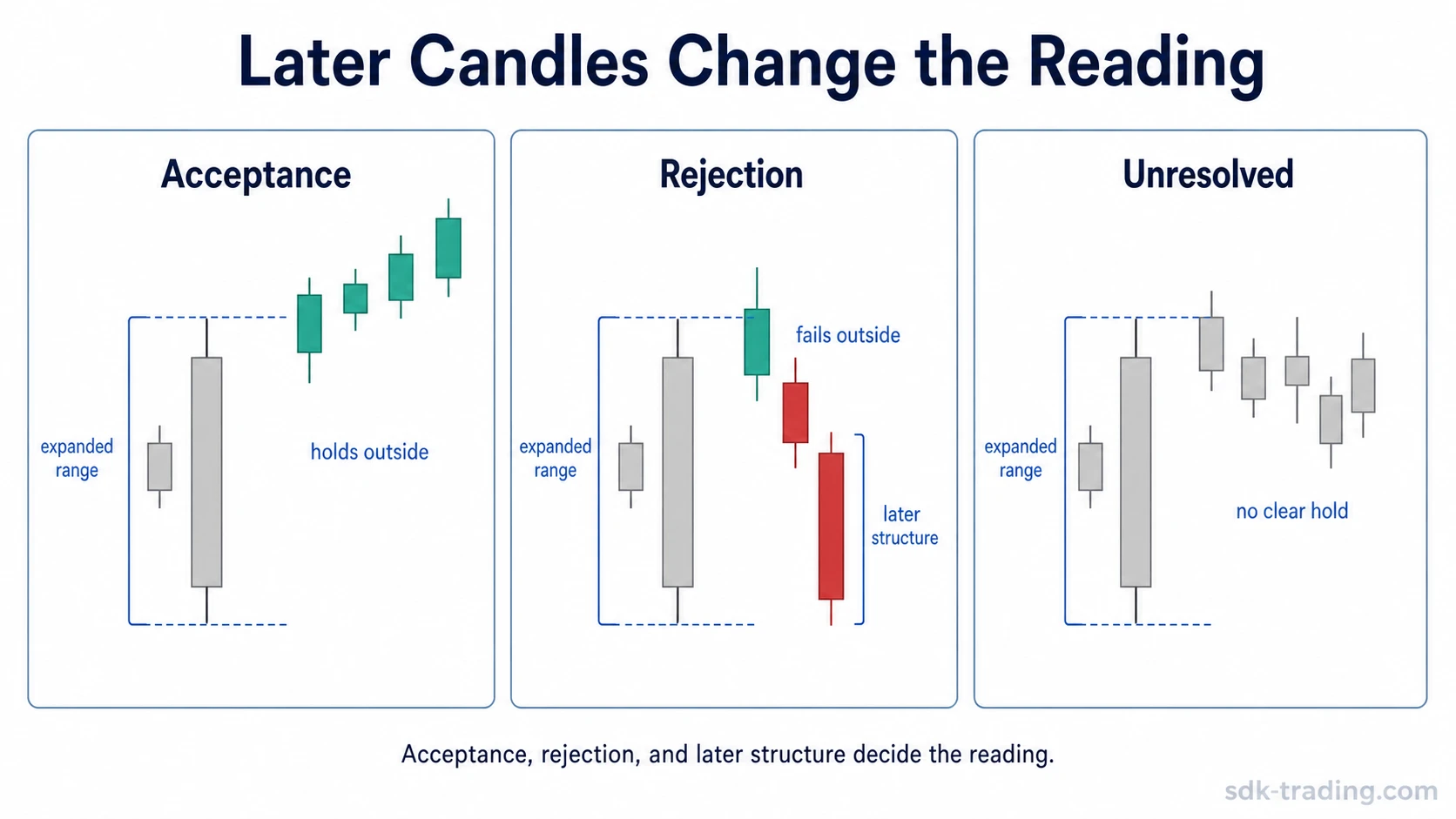
| Condition | Effect on the fakeout reading |
|---|---|
| Price probes beyond the outside-bar high or low, then closes back inside the range. | Strengthens the failed-acceptance reading. |
| The next recovery attempt stalls near the same boundary. | Suggests the outside area is still not being accepted. |
| Price stays outside the outside-bar extreme and holds there across later candles. | Weakens or cancels the fakeout reading. |
| Price remains inside the expanded range without rejecting either side clearly. | Leaves the reading unresolved. |
An outside bar fakeout does not automatically predict a reversal. It only shows that a breakout-like attempt beyond the expanded range failed to hold. A stronger reversal reading needs later structure, follow-through, and a visible shift in control.
Breakout Probe That Fails Back Inside the Range
Price advances into a prior resistance area and forms an outside bar that expands beyond the previous candle’s high and low. A later candle trades above the outside-bar high, but the close cannot hold above that expanded boundary. The next attempt to reclaim the same area stalls, and price rotates back inside the outside-bar range.
The fakeout reading comes from the failed hold outside the range, not from the outside bar alone. If price had stayed accepted above the outside-bar high instead, the fakeout interpretation would have weakened.
Outside Bar Fakeout vs Related Candle Readings
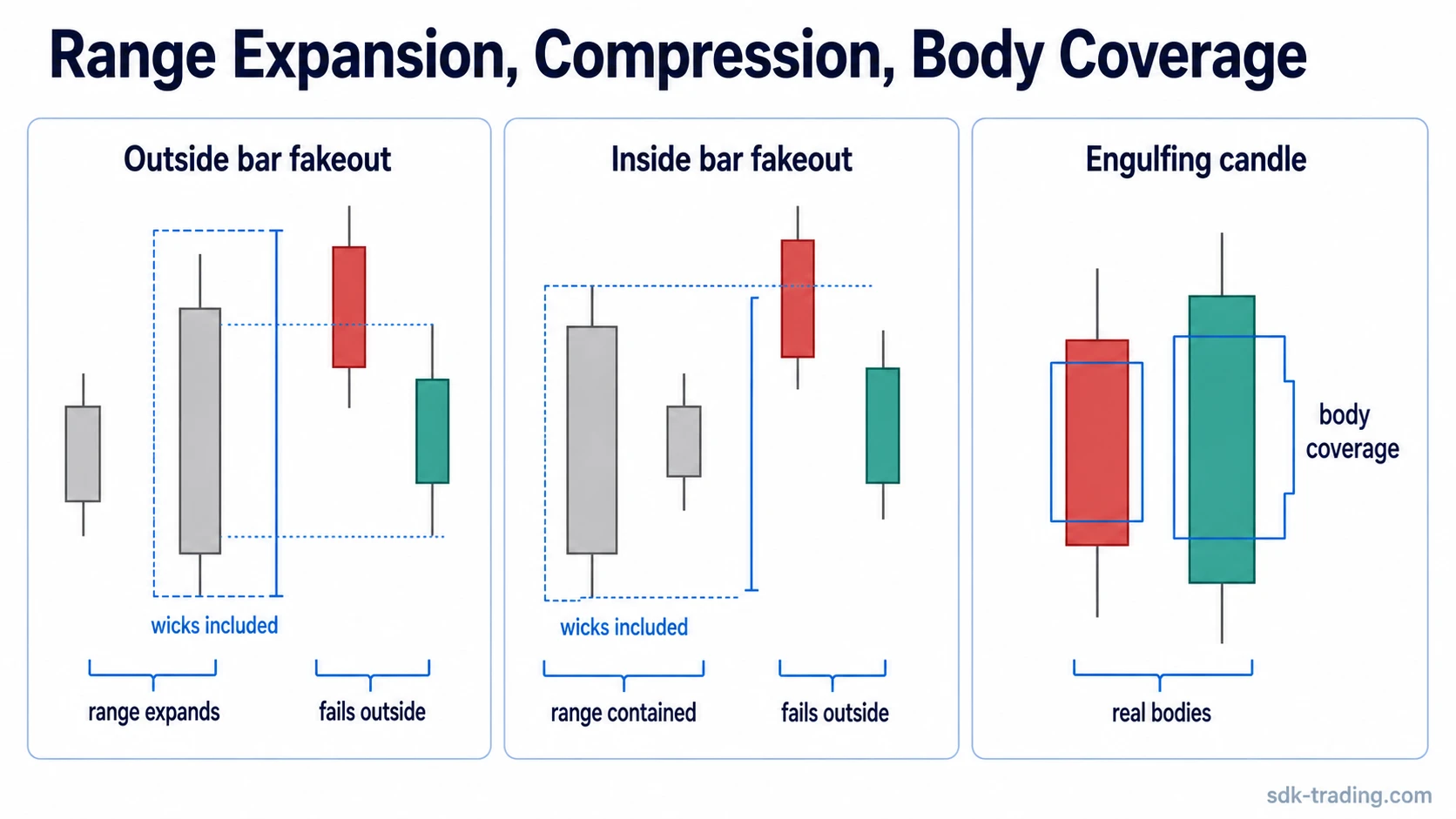
| Concept | Main rule | Main difference |
|---|---|---|
| Outside bar | Full high-low range expands beyond the prior candle. | The outside bar defines the expanded range; it does not prove a fakeout by itself. |
| Outside bar failure | Follow-through after the outside bar does not hold as expected. | Failure is broader; fakeout is a narrower failed-acceptance sequence after a breakout-like probe. |
| inside bar pattern | Full high-low range stays contained inside the mother bar. | Inside bar fakeouts start from compression; outside bar fakeouts start from expansion. |
| Engulfing candle | Real bodies are compared from open to close. | Outside bar fakeout depends on full-range expansion plus later failed acceptance, not body coverage alone. |
A piercing pattern also uses a two-candle relationship, but its reading comes from a different body-position rule. Outside bar fakeout logic stays centered on the expanded high-low range and the later failure to hold beyond it.
Practical Checklist
- Did the outside bar expand beyond both the prior high and the prior low?
- Did price later probe beyond one side of the outside-bar range?
- Did that probe fail to hold outside the expanded boundary?
- Did price rotate back inside the outside-bar range?
- Did later behavior confirm rejection, or did price become accepted beyond the range?
The cleanest reading separates three things: the candle expansion, the attempted continuation, and the later acceptance or rejection. Skipping the acceptance step is the mistake that turns a warning candle into an unsupported conclusion.
When the Fakeout Reading Fails
The fakeout reading fails when price becomes accepted beyond the outside-bar extreme instead of rotating back inside. Holding outside the expanded range means the breakout-like move is no longer failing in the same way.
Unclear follow-through also matters. If price hovers around the outside-bar boundary without clean rejection or acceptance, the reading remains unresolved. A candle can warn, but later structure decides whether the warning develops into a stronger interpretation.
FAQ
Is an outside bar itself a fakeout?
No. The outside bar creates the expanded range. A fakeout requires a later probe beyond that range, failed acceptance outside it, and rotation back inside.
Does an outside bar fakeout always reverse the market?
No. It only shows failed acceptance at the tested boundary. A reversal reading needs later structure and follow-through.
How is an outside bar fakeout different from outside bar failure?
Outside bar failure is broader. Outside bar fakeout is a narrower sequence where a breakout-like move beyond the expanded range fails to hold and rotates back inside.
Is an outside bar fakeout the same as an engulfing candle?
No. An outside bar uses the full high-low range, while an engulfing candle compares the real bodies from open to close.