A flip zone is a price-action area where a previously active supply, demand, support, or resistance area is broken and later behaves as the opposite side of the structure.
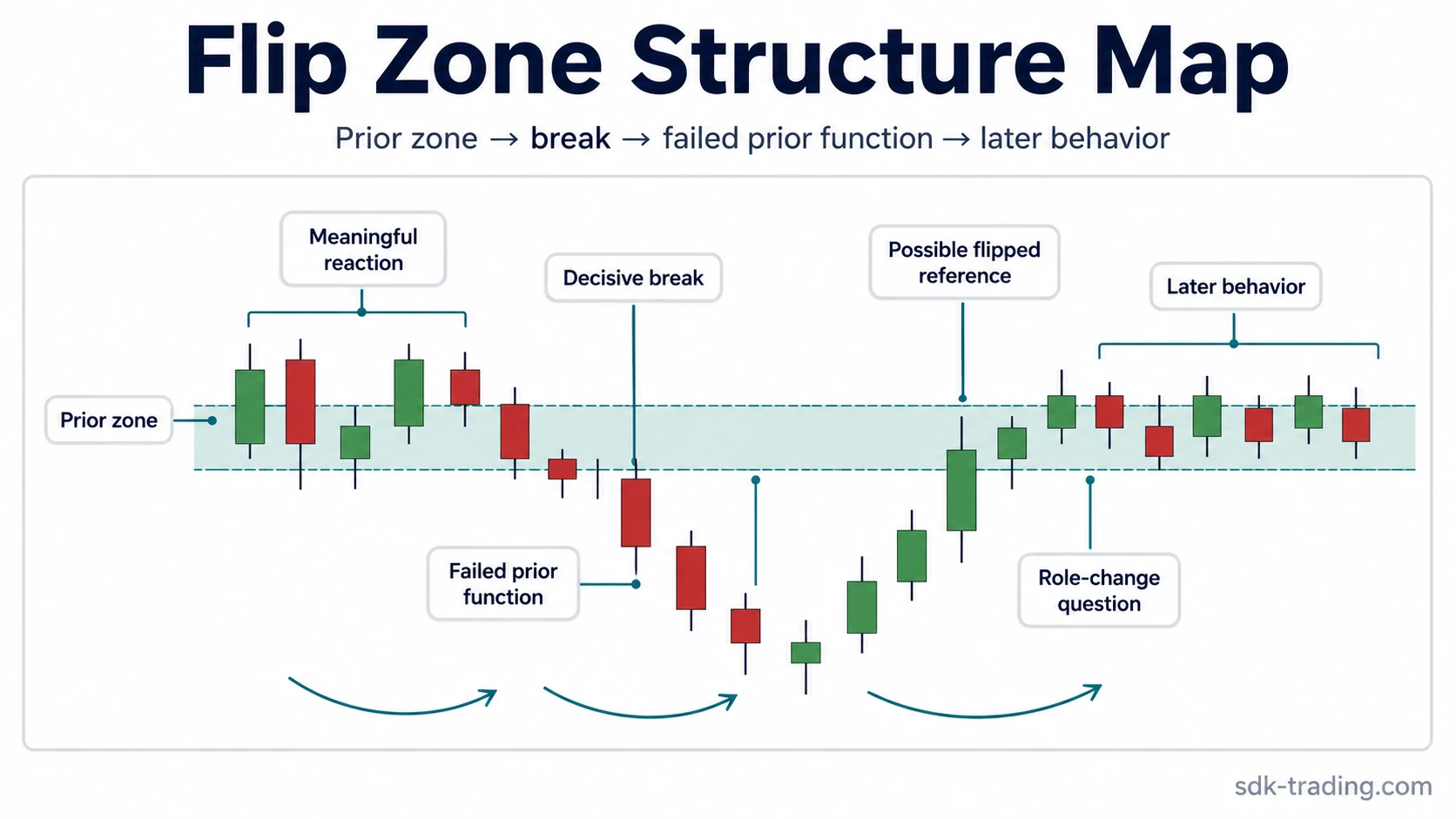
The classification depends on more than a broken boundary. A cleaner flip-zone reading needs a visible prior zone, a meaningful reaction from that zone, a decisive break, failure of the prior function, a possible flipped reference area, and later behavior that supports the changed interpretation.
Definition: In trading, a flip zone is a structural price area where the market stops respecting a prior zone in its former function and later reacts to that same area as a new reference point. The concept is descriptive, not predictive, and it does not provide entry, exit, or outcome certainty by itself.
Key Points
- A flip zone starts with a prior zone that already mattered, not with any random candle or isolated wick.
- The break must be meaningful enough to challenge the previous function of the zone.
- The later return matters because it shows whether price treats the area as a flipped reference point or simply moves through noise.
- A cleaner classification requires follow-up behavior; a weak reading remains unresolved; an invalid reading fails to show changed behavior.
- Flip-zone analysis is different from execution planning because it classifies structure rather than giving a trade instruction.
What Is a Flip Zone in Trading?
A flip zone is a role-change reading around a prior price area. The area first appears as a zone that market participants react to, such as a supply area, demand area, support area, or resistance area. After price breaks through it, the same area may later become relevant from the opposite side.
A broken zone does not automatically become a flip zone. The later reaction must show that the old function of the area has changed rather than simply been tested.
For example, a prior resistance area may be broken with a strong close beyond it. If price later returns to that area and the former resistance no longer caps the structure, the area can be read as a possible flipped reference zone. The classification loses quality if price repeatedly cuts through the area without clear acceptance or rejection.
How a Flip Zone Forms
A flip-zone reading usually develops through a sequence rather than a single event. The structure begins with a zone that has already produced a visible reaction. Then price breaks through that zone and later returns to test whether the former boundary still controls the structure.
- Prior zone: A visible area acts as support, resistance, supply, or demand.
- Meaningful reaction: Price responds to the zone strongly enough for the area to become structurally relevant.
- Decisive break: Price moves beyond the zone in a way that challenges its previous function.
- Failed prior function: The zone no longer behaves the way it did before the break.
- Possible flipped reference area: The same area begins to matter from the other side.
- Later behavior: Follow-up price action decides whether the reading is cleaner, unresolved, or invalid.
Structural note: The break creates the question, but later behavior answers it. A flip-zone label is better supported when the market shows both a change in boundary behavior and a new way of respecting the same area.
How to Identify a Flip Zone
Identification should focus on observable structure. The question is not whether price touched an old level, but whether the old area has enough prior importance, break quality, return behavior, and follow-up behavior to support a role-change classification.
| Criterion | What to look for | Why it matters |
|---|---|---|
| Clear original zone | A visible area that price respected before the break. | Without a meaningful prior zone, there is no clear function to flip. |
| Meaningful prior reaction | Price previously moved away from the zone with enough clarity to make the area relevant. | A weak or random touch makes the later classification less reliable. |
| Break quality | The break moves beyond the zone with clear displacement, acceptance, or follow-through. | A small probe or wick may only show testing, not a structural break. |
| Acceptance beyond the boundary | Price spends enough time beyond the area to question the old function. | Immediate rejection can shift the interpretation toward failure rather than role change. |
| Retest or return behavior | Price returns toward the old zone and reacts around it from the other side. | The return is where the possible flipped reference area becomes visible. |
| Follow-up behavior | Later candles respect, reject, accept, or cut through the area. | Follow-up behavior separates clean readings from unresolved or invalid readings. |
| Invalid or unresolved conditions | Price chops through the area, restores the previous behavior, or fails to show a new reference point. | The label weakens when the structure does not support a changed classification. |
Clean, Weak, and Invalid Flip Zone Readings
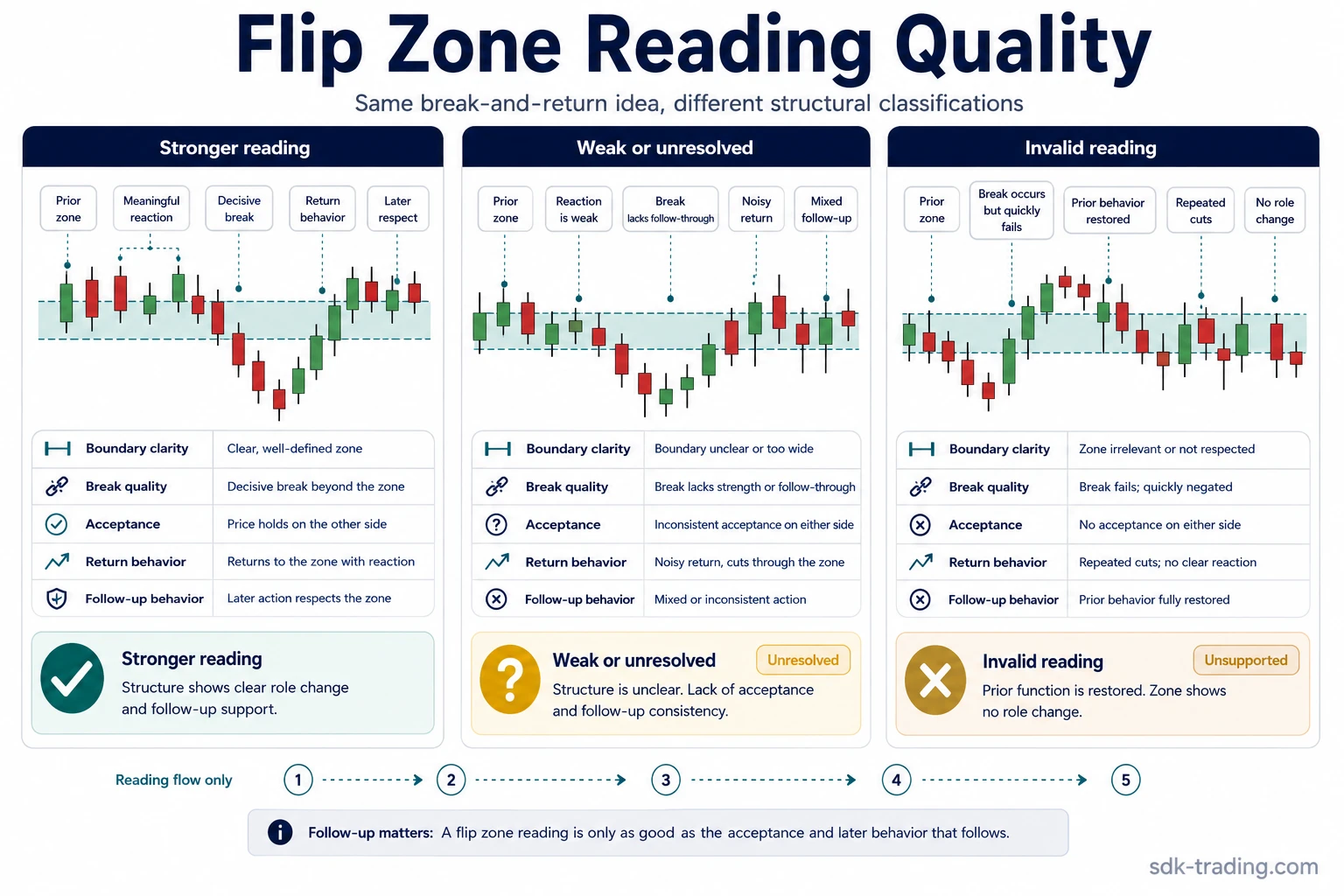
The same broad sequence can produce different structural classifications. A clean reading, weak reading, and invalid reading should not be treated as the same thing.
| Reading quality | Structural behavior | Safer interpretation |
|---|---|---|
| Cleaner flip-zone reading | The prior zone is clear, the break is meaningful, the former boundary fails, and later behavior respects the area from the other side. | The changed-area classification is better supported, while the future outcome still remains uncertain. |
| Weak or unresolved reading | The zone is visible, but the break is unclear, the return is noisy, or later behavior does not clearly accept or reject the area. | The structure may be developing, but the evidence is not strong enough for a clean flip-zone label. |
| Invalid reading | Price restores the previous behavior, moves through the area without respect, or shows that the original zone was not meaningful. | The flip-zone classification should be dropped or treated as unsupported. |
Boundary: A retest is not the same as acceptance. A market can revisit a broken area and still fail to treat it as a new reference point.
What Weakens a Flip-Zone Reading?
A flip-zone label becomes weaker when the structure depends on a vague boundary, a shallow break, or a return that does not show a clear behavioral change around the area.
| Weakening factor | Structural issue | Resulting caution |
|---|---|---|
| Vague original zone | The prior area did not produce a meaningful reaction. | The later flip-zone claim has a weak foundation. |
| Break without acceptance | Price only probes beyond the zone and immediately returns. | The move may be closer to a failed break than a confirmed change in area behavior. |
| Noisy repeated returns | Price cuts back and forth through the zone several times. | The area may be too unstable for a clean classification. |
| Previous behavior restored | The zone begins behaving as it did before the break. | The flip-zone reading is weakened or invalidated. |
| Later behavior ignored | The label is applied immediately after the first break. | The reading is premature because follow-up behavior has not supported the changed classification. |
Flip Zone vs Similar Price-Action Concepts
A flip zone can overlap with nearby price-action ideas, but the concepts do not describe the same structural job. The safest distinction is to ask what the concept is trying to classify.
| Concept | Main focus | Difference from a flip zone |
|---|---|---|
| CHOCH | A change in the prior swing or control structure. | CHOCH classifies a shift in structure. A flip zone classifies how a specific prior area behaves after a break and return. |
| Break and retest | A boundary break followed by a return toward the broken area. | Break and retest describes the sequence. A flip zone needs evidence that the area is now being treated differently. |
| False breakout | A move beyond a boundary that fails to continue. | A false breakout focuses on failure beyond the boundary. A flip zone focuses on changed behavior around the prior zone after a meaningful break. |
| Hikkake | An inside-bar false-break structure. | Hikkake is a specific pattern structure. A flip zone is broader and does not require an inside-bar setup. |
| Support and resistance flip | A level that changes from support to resistance or resistance to support. | A flip zone is similar in surface logic but needs clearer zone context, break quality, and follow-up behavior. |
Illustrative Scenario
Suppose price reacts several times from a resistance area, then closes clearly beyond it. Later, price returns to that same area. If the area no longer caps the move and price begins treating it as a reference point from the opposite side, the structure may support a flip-zone reading.
If price instead falls back through the same area, restores the previous resistance behavior, or chops through the zone repeatedly, the flip-zone reading becomes weak or invalid. The useful lesson is that the break alone does not decide the classification.
FAQ
Is a flip zone the same as break and retest?
No. Break and retest describes a boundary break followed by a return. A flip zone is narrower because the old area must show evidence of changed structural behavior after the break.
Is every broken support or resistance level a flip zone?
No. A broken level becomes a stronger flip-zone candidate only when the prior area was meaningful, the break was clear, the previous function fails, and later behavior supports a changed reading.
Does a flip zone predict price direction?
No. A flip zone classifies how price behaves around a prior zone. It does not forecast the next move or replace broader market context.
How is a flip zone different from a false breakout?
A false breakout focuses on failure beyond a boundary. A flip zone focuses on whether a prior zone changes behavior after a meaningful break and later return.