In trading, hikkake is a candlestick pattern where an inside-bar break fails and price returns through the prior range. The first break starts the structure question, but whether price accepts or rejects the break area is what makes a hikkake reading more defensible.
Definition: A hikkake pattern is an inside-bar false-break sequence. Price first moves outside the inside-bar range, fails to hold that break, and then moves back through the prior range, changing the interpretation from breakout attempt to failed acceptance.
The important misunderstanding is that hikkake is not every failed breakout and not every inside bar. The label depends on a specific sequence: compression, attempted range break, failure to accept beyond that break, and movement back through the inside structure.
Key Points
- Hikkake begins with an inside bar or similarly compressed candle structure.
- The first move outside the range is not enough to complete the reading.
- Failed acceptance and a return through the prior range make the pattern more defensible.
- Bullish and bearish hikkake forms describe the direction of the failed move, not a trade instruction.
- Clean, weak, and invalid readings depend on what price does after the initial break.
What Is Hikkake?
Hikkake is a price action and candlestick structure built around a failed break from an inside range. The inside bar creates a short-term boundary. A later candle pushes beyond that boundary, but the market does not continue accepting that new area. When price returns through the prior range, the failed break becomes the core of the hikkake reading.
The pattern belongs to the same family of false-break and trap-like structures, but it is narrower than a generic false breakout. A broad false breakout can occur around many boundaries. A hikkake reading starts from an inside-bar or contraction structure and then depends on how the break attempt behaves afterward.
Interpretation note: The breakout attempt shows possibility. The later return through the range shows whether that possibility failed to gain acceptance. Without the return, the hikkake label remains premature.
How the Hikkake Pattern Forms
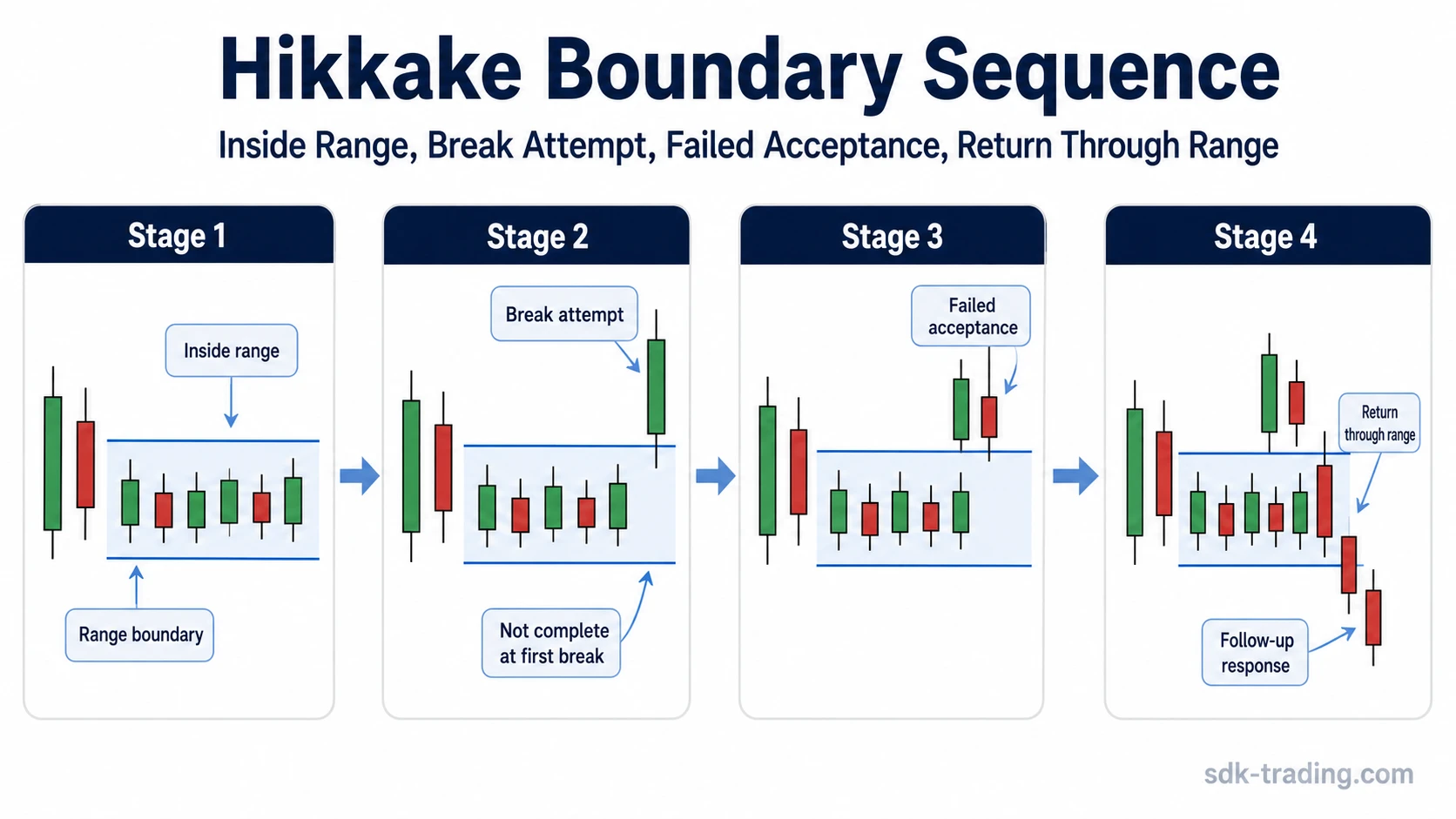
A hikkake pattern forms as a sequence, not as a single candle. The inside range defines the structure first. The next break tests whether price can move away from that range. The response after the break decides whether the break was accepted, rejected, or still unresolved.
- Inside structure: Price compresses inside a prior candle or narrow local range.
- Initial break: A candle moves above or below the inside structure.
- Failed acceptance: Price does not continue holding beyond the break area.
- Return through range: Price moves back through the inside structure instead of extending away from it.
- Follow-up action: The next response determines whether the reading is clean, weak, or invalid.
| Observable | What it contributes to the reading | What remains unresolved |
|---|---|---|
| Inside bar or compressed range | Creates the reference boundary for the pattern | Whether the next move will accept or reject that boundary |
| Break outside the inside range | Starts the hikkake question | Whether the break is genuine acceptance or only a probe |
| Return back through the range | Supports the failed-break interpretation | Whether follow-up behavior confirms control or remains noisy |
| Later rejection or failed recovery | Makes the label cleaner | Whether price continues to respect the prior structure |
Bullish and Bearish Hikkake Readings
Bullish and bearish hikkake readings describe the direction of the failed break and the later return, not a guaranteed market outcome. The distinction is structural.
| Variant | Typical sequence | Structural interpretation |
|---|---|---|
| Bullish hikkake | Price breaks below the inside range, fails to accept lower, then returns upward through the range | The lower break attempt failed to hold, so the structure may shift away from lower acceptance |
| Bearish hikkake | Price breaks above the inside range, fails to accept higher, then returns downward through the range | The upper break attempt failed to hold, so the structure may shift away from higher acceptance |
A bullish label does not mean price must continue higher. A bearish label does not mean price must continue lower. Each label describes the failed side of the initial break and the direction of the return through the range.
Clean, Weak, and Invalid Hikkake Readings
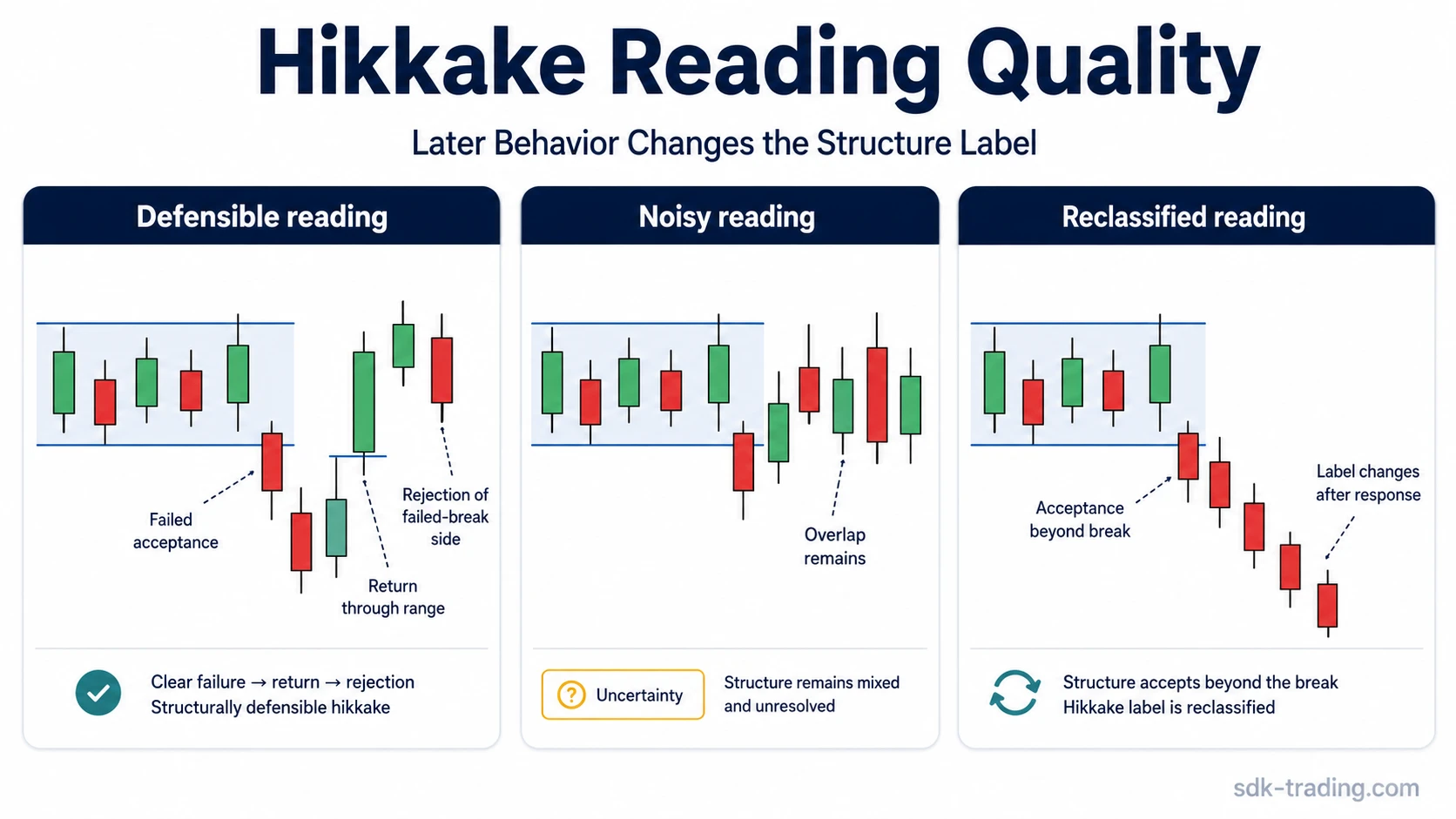
The strongest distinction in hikkake analysis is not bullish versus bearish. It is whether the failed-break sequence is clean enough to deserve the label. A clean reading shows a clear failed acceptance. A weak reading contains noise or incomplete follow-through. An invalid reading means later behavior no longer supports the hikkake interpretation.
| Reading quality | What price does | More precise label |
|---|---|---|
| Clean hikkake | Price breaks the inside range, fails to hold outside it, returns through the range, and later behavior rejects the failed-break side | Hikkake reading is structurally defensible |
| Weak or noisy hikkake | Price breaks the range and returns, but follow-up candles overlap heavily, hesitate, or fail to show clear rejection | Possible hikkake, but the sequence quality is uncertain |
| Invalid or reclassified reading | Price accepts beyond the initial break area or never develops a meaningful return through the range | Not a completed hikkake; the move may need a different structure label |
Boundary: A hikkake label becomes weaker when price accepts beyond the break area instead of returning through the inside range. It also becomes premature when the first break is treated as the whole pattern before later candles clarify acceptance or rejection.
Common Misunderstanding About Hikkake
A common mistake is treating the first inside-bar break as the pattern itself. The first break only creates the test. The hikkake reading needs later evidence that the break failed to gain acceptance.
- Not every inside bar is hikkake: An inside bar only creates the reference range. It does not prove a failed break.
- Not every false breakout is hikkake: A false breakout can happen around many types of boundaries. Hikkake requires an inside-bar or contraction-based starting structure.
- Not a complete trading strategy: The pattern classifies structure. It does not define position sizing, order placement, risk, or outcome.
- Sequence quality matters: The label becomes more defensible when the break attempt, failed acceptance, and return through the range are all visible.
Hikkake vs Related Price Action Setups
Hikkake often gets confused with nearby price action labels because all of them can involve boundaries, failed movement, and later behavior. The distinction is the starting structure and what the later move proves.
| Concept | Main idea | How it differs from hikkake |
|---|---|---|
| False breakout | A boundary break fails instead of gaining acceptance | Broader category; hikkake is a narrower inside-range false-break sequence |
| Fakey pattern | A related inside-bar false-break label often used to describe a failed break after an inside structure | Very close to hikkake, but the hikkake reading should still be judged by the inside-range break, failed acceptance, and return-through-range sequence rather than by the broader label alone |
| Break-and-retest behavior | Price accepts beyond a boundary and later retests it | Break-and-retest depends on acceptance and retest quality, while hikkake depends on failed acceptance and return through the inside range |
| Flip zone | A prior boundary changes role after acceptance | Flip-zone logic depends on role change after acceptance, while hikkake depends on a failed break that returns through the prior inside structure |
What Weakens a Hikkake Reading
A hikkake reading weakens when the follow-up structure does not support failed acceptance. The structure can still be worth observing as a chart event, but the label should not be forced when the sequence is incomplete.
Weakening conditions: Price accepts beyond the initial break area, the return through the range never develops, follow-up candles overlap without directional clarity, or the inside structure is too loose to define a meaningful boundary.
The strongest interpretation treats hikkake as a label for a completed structure, not as a prediction. The pattern can describe a failed attempt to move away from a compressed range, but it does not by itself establish what the market must do next.
Hikkake Example in Context
Price compresses into an inside range after a prior advance. The next candle briefly trades above the inside range, but the close fails to hold the higher area. A later candle moves back down through the inside range, and the next recovery attempt stalls below the failed break area.
That sequence creates a cleaner bearish hikkake reading because the upper break did not gain acceptance and the failed break area is not reclaimed. If price instead held above the break and retested the range from above, the structure would no longer fit the same hikkake reading. If price only moved sideways inside the range after the break, the label would remain weak rather than clean.
FAQ
What does hikkake mean in trading?
In trading, hikkake means a candlestick or price action pattern where an inside-range break fails and price returns through the prior range. The meaning depends on the failed acceptance after the first break, not on the first break alone.
Is hikkake the same as a false breakout?
Hikkake is related to false-breakout logic, but it is narrower. A false breakout can form around many boundaries, while hikkake begins with an inside-bar or contraction structure before the break fails.
Can a hikkake pattern be bullish or bearish?
Yes. A bullish hikkake usually starts with a failed break below the inside range and a return upward through it. A bearish hikkake usually starts with a failed break above the inside range and a return downward through it.
When is a hikkake reading invalid?
A hikkake reading is invalid or premature when price accepts beyond the initial break area, when no meaningful return through the range develops, or when later behavior no longer supports the failed-break label.