Break and retest is a price-action sequence where price breaks a visible support, resistance, or structural boundary and later returns to test the breached area.
Definition: In trading, break and retest means boundary first, break second, return third, and later behavior around the breached area last. The retest does not confirm continuation by itself. The reading depends on how price behaves after returning to the broken boundary.
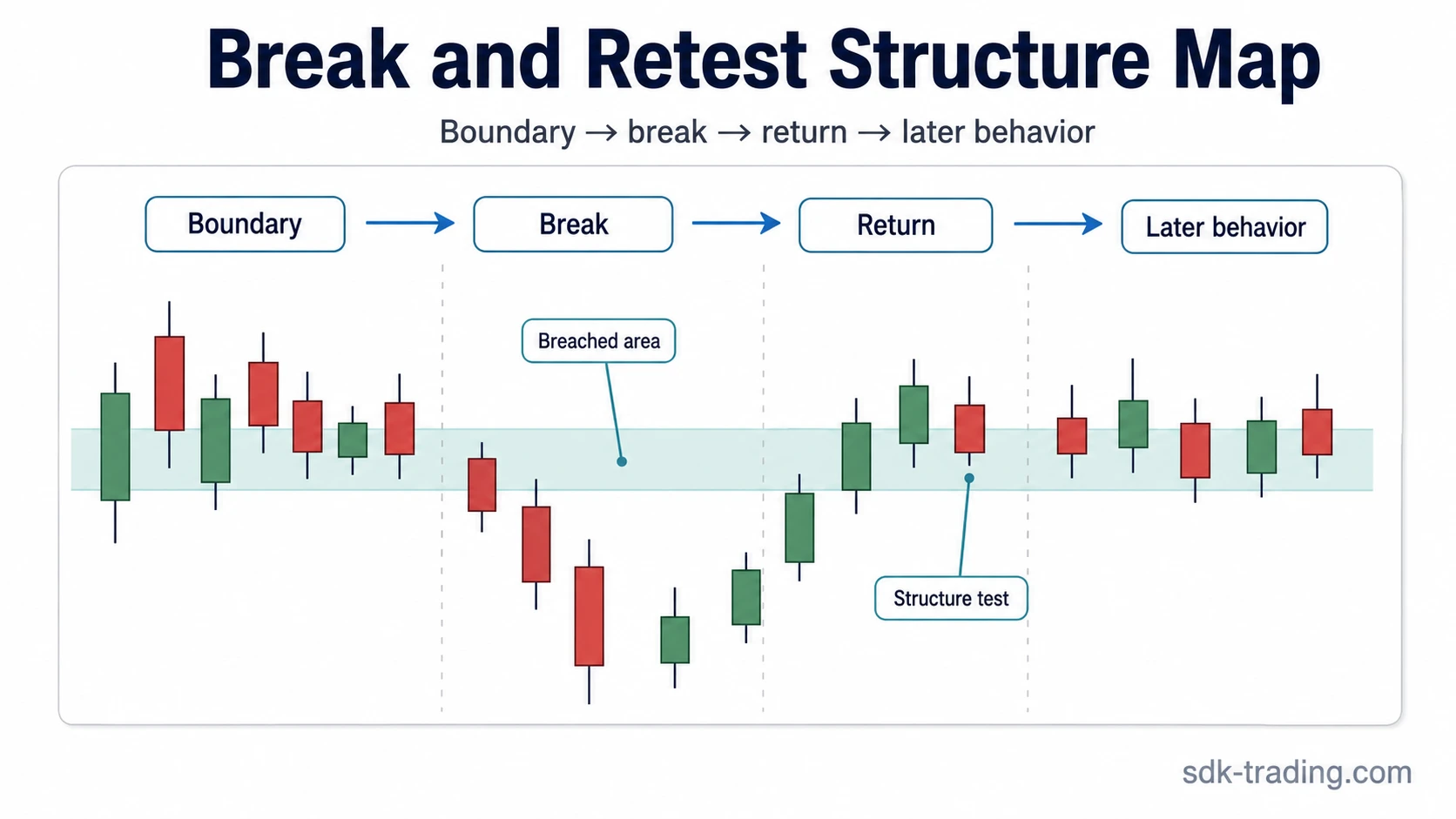
A meaningful break and retest needs a visible reference area before the break occurs. Without a prior boundary, the later return is only a pullback, a pause, or noise inside a developing move.
A return to an old level matters only when the prior boundary, the break, the return, and the later reaction form a coherent structure.
Key Points
- Break and retest starts with a visible price boundary, not an isolated candle.
- The break must happen before the retest. A pullback before a confirmed break is not the same structure.
- A former resistance or support area may change role only if later price behavior supports that reading.
- A clean reading needs boundary clarity, break quality, controlled return, and meaningful later behavior.
- A weak or invalid reading can appear when the break is shallow, the return is noisy, or price restores the prior range.
What Is Break and Retest?
Break and retest describes a market structure where price moves beyond a visible boundary, then returns to that same area. The boundary may be a prior support level, resistance level, range edge, trendline, channel boundary, or another area that price has already made meaningful.
The pattern is often discussed as if former resistance automatically becomes support, or former support automatically becomes resistance. That role shift is only a possible interpretation. It becomes more defensible when later behavior shows acceptance around the breached area instead of immediate restoration of the old structure.
Neutral reading: A retest is a test of structure, not a complete decision. The later reaction can support the break, weaken the break, or invalidate the break-and-retest reading.
How the Break and Retest Sequence Forms
The sequence has four parts. Removing one part usually weakens the reading.
| Step | What must be visible | Why it matters |
|---|---|---|
| Boundary | A prior support, resistance, range edge, trendline, or structural level | The retest needs a reference area. Without a boundary, there is nothing meaningful to retest. |
| Break | Price moves beyond the boundary with enough clarity to question the old structure | A small wick or brief probe may not be enough if the market quickly returns inside the prior area. |
| Return | Price comes back toward the breached area | The return tests whether the old boundary still matters after the break. |
| Later behavior | Acceptance, rejection, chop, or restoration around the breached area | This decides whether the reading is clean, weak, unresolved, or invalid. |
A bullish version forms when price breaks above a prior resistance or upper boundary and later returns toward that breached area. A bearish version forms when price breaks below a prior support or lower boundary and later returns toward that breached area. The logic is symmetrical, but neither version guarantees continuation.
Break and Retest Structure Map
The structure can be read through four elements. The boundary comes first, the break changes the question, the return tests the breached area, and later behavior determines the reading quality.
| Structure element | Clean interpretation | Weaker interpretation |
|---|---|---|
| Boundary | Price has respected the area enough for it to act as a visible reference. | The level is vague, recent, or drawn around a single noisy candle. |
| Break | Price moves beyond the boundary with visible displacement or acceptance. | The break is shallow, wick-only, or immediately absorbed back inside the range. |
| Return | Price revisits the breached area without fully restoring the old structure. | The return slices through the level repeatedly or creates unresolved chop. |
| Later behavior | Price respects the area enough to support the role-shift reading. | Price reclaims the old range or fails to show any meaningful response. |
How to Identify Break and Retest
Identification starts before the breakout. A trader first needs a boundary that other market participants could plausibly see. The later break and return only matter if that first reference area is real enough to organize price behavior.
- Mark the boundary: Identify the support, resistance, range edge, trendline, or structural area that price has already respected.
- Check the break: Look for a move beyond the boundary that changes the structure more clearly than a minor wick or temporary probe.
- Watch the return: Price must come back toward the breached area. Without the return, there is a break, but not a retest.
- Evaluate later behavior: The reading strengthens if the market respects the breached area. It weakens if price chops through it or restores the prior structure.
Common mistake: A retest touch is not confirmation by itself. A level can be touched, crossed, reclaimed, rejected, or ignored. The later behavior around that area is what gives the sequence meaning.
Clean, Weak, and Invalid Break and Retest Readings
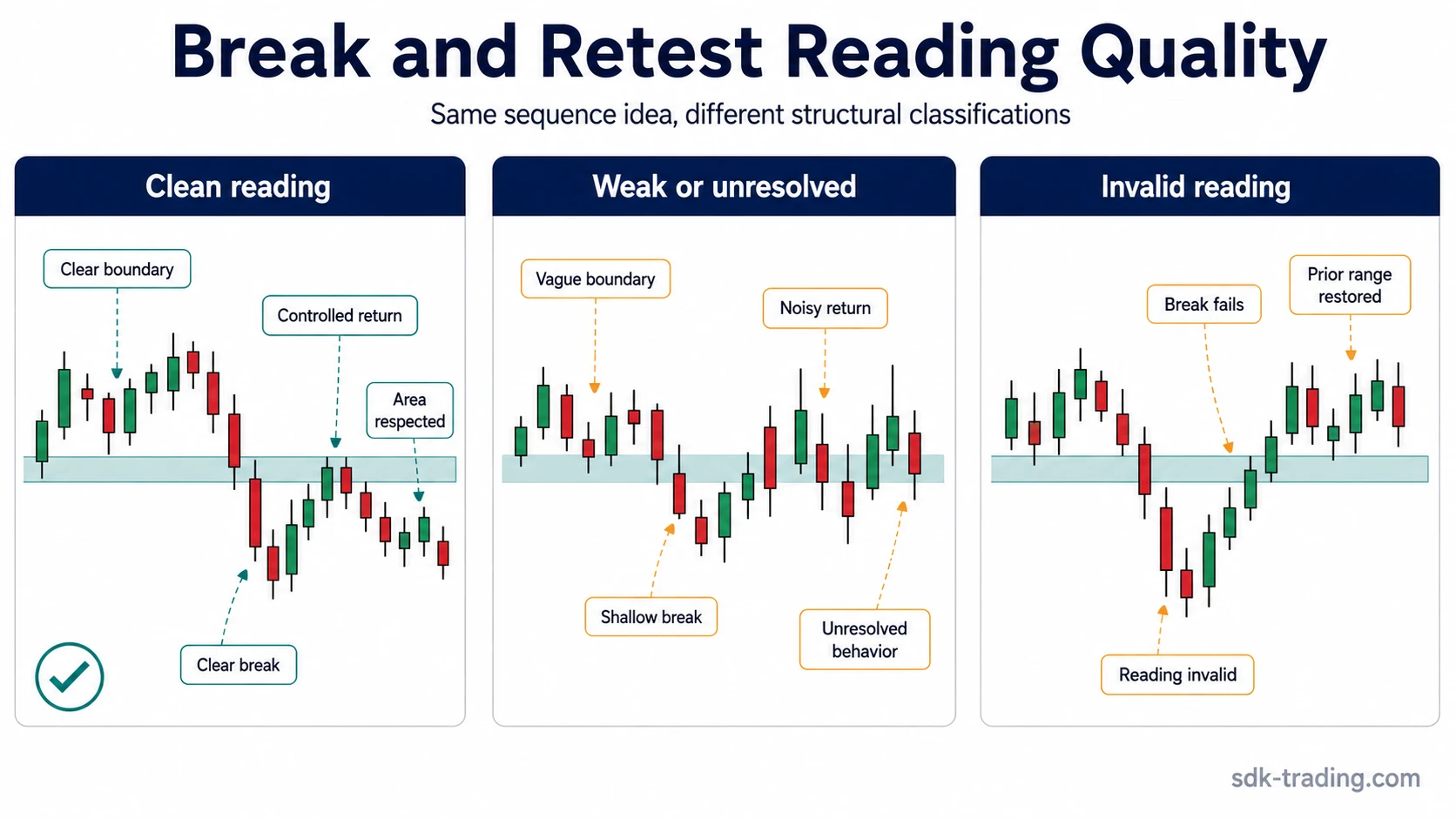
Break and retest is better treated as a reading-quality problem than as a fixed signal. The same basic sequence can produce different classifications depending on boundary clarity, break quality, return behavior, and what happens afterward.
| Reading type | Typical structure | Safer interpretation |
|---|---|---|
| Clean reading | Clear boundary, clear break, controlled return, and meaningful later reaction around the breached area | The structure supports a role-shift reading, but still does not guarantee continuation. |
| Weak or unresolved reading | Unclear boundary, shallow break, noisy return, repeated level crossing, or incomplete later behavior | The market has not given enough structure to treat the retest as clean. |
| Invalid reading | The break fails, price restores the prior range, or the old boundary no longer organizes behavior | The sequence no longer behaves like a meaningful break and retest. |
Break and Retest vs Pullback, Flip Zone, and Fakeout
Break and retest is often confused with nearby price-action ideas. The distinction depends on sequence and acceptance, not only on the shape of the move.
| Concept | Core idea | Difference from break and retest |
|---|---|---|
| Pullback | A temporary move against a prior move or trend | A pullback does not require a prior boundary break. A pullback trading strategy can use retracement logic without requiring the boundary -> break -> return sequence. |
| Flip zone | An area where prior resistance may behave as support, or prior support may behave as resistance | A flip zone requires later acceptance around the breached area. A single touch after a break is not enough by itself. |
| False breakout | A break beyond a boundary that fails to hold | A false breakout appears when the market fails to accept the area beyond the boundary and returns inside prior structure. |
| Hikkake | A trap-style structure built around failed breakout behavior | Hikkake focuses more directly on failed-break dynamics, while break and retest focuses on boundary breach, return, and later behavior around the breached area. |
| Breakout strategy | A broader trading framework built around breakouts | Break and retest is one structural sequence. It should not be treated as a full execution framework without separate rules and risk controls. |
Bullish and Bearish Break and Retest
The bullish and bearish versions use the same sequence in opposite directions.
| Variant | Sequence | What later behavior tests |
|---|---|---|
| Bullish break and retest | Price breaks above resistance or an upper boundary, then returns toward the breached area. | Whether the old resistance area can behave as support, or whether price falls back into the prior structure. |
| Bearish break and retest | Price breaks below support or a lower boundary, then returns toward the breached area. | Whether the old support area can behave as resistance, or whether price reclaims the prior structure. |
The labels describe structure, not certainty. A bullish reading can fail, and a bearish reading can fail. The classification changes when later price behavior contradicts the role-shift idea.
NVIDIA Example: Testing the $225 Boundary
In early August 2026, NVIDIA had advanced from the low $190s toward a visible resistance area around $225. On August 10, price was still below that boundary, so the structure was not yet a confirmed break and retest. The level first had to be cleared and then tested by later price behavior.
On August 12, NVIDIA traded slightly above $225 during the session but closed back below it at $224.09. That move was better classified as a probe of the boundary than as a completed role shift. On August 13, the stock closed at $225.30, followed by closes of $225.16 on August 14 and $225.01 on August 17.
Those sessions showed an attempt to hold around the breached area, but the evidence did not remain stable. On August 18, NVIDIA closed at $219.74, back below the $225 boundary. The later move weakened the interpretation that former resistance had established itself as durable support.
The sequence shows why the first move through a level is not enough. The classification changed as new evidence arrived: visible boundary, initial probe, several sessions around or above the boundary, then a return below it. A clean break-and-retest reading requires the later behavior to support the role shift rather than assuming confirmation from the breakout alone.
Where Break and Retest Can Appear
Break and retest can appear around horizontal support and resistance, range edges, channel boundaries, wedge boundaries, triangle boundaries, and trendlines. The boundary type is less important than whether the market had already made that area meaningful before the break.
Higher-timeframe boundaries can carry more structural weight than short-lived intraday noise, but timeframe alone does not make the reading valid. A clean reading still needs a visible boundary, a meaningful break, a return, and later behavior that supports the interpretation.
Candles and volume can add context when they show effort, rejection, or acceptance around the breached area. They should not replace the structure. A single candle pattern or one volume spike is not enough to define the whole reading.
Limitations and Common Mistakes
Break and retest can become misleading when the level is drawn too loosely, the break is too shallow, or the retest is treated as confirmation before the market has shown acceptance or rejection.
| Mistake | Why it weakens the reading | Cleaner interpretation |
|---|---|---|
| Calling every breakout a future retest | Not every breakout returns to the breached area. | A breakout without a return is not a break and retest. |
| Treating a wick as a complete break | A wick can be a probe rather than accepted movement beyond the boundary. | The break needs enough quality to question the prior structure. |
| Assuming role shift automatically | Former support or resistance does not always reverse function. | Role shift becomes more defensible only when later behavior supports it. |
| Ignoring volatility noise | Fast moves can cross levels without creating useful structure. | The reading is stronger when the sequence remains clear despite noise. |
| Over-reading one candle | One candle cannot resolve boundary quality, break quality, and later behavior by itself. | The full sequence matters more than a single bar. |
| Missing invalidation | A restored prior range can cancel the break-and-retest reading. | If the old structure is reclaimed, the original reading should be downgraded or removed. |
FAQ
What is break and retest in trading?
Break and retest is a price-action sequence where price breaks a visible support, resistance, or structural boundary and later returns to test the breached area. The later behavior around that area determines whether the reading is clean, weak, or invalid.
How do you identify a break and retest?
Start with a visible boundary, then check whether price breaks beyond it, returns toward the breached area, and behaves in a way that supports or rejects the role-shift reading. A retest touch alone is not enough.
Does every breakout retest?
No. Some breakouts continue without returning to the breached area, while others return only after the structure has changed. Without a return to the breached area, the sequence is a breakout, not a full break and retest.
Is break and retest the same as a pullback?
No. A pullback is a move against a prior move or trend. Break and retest specifically requires a visible boundary, a break beyond that boundary, and a later return to test the breached area.
How is break and retest different from a fakeout?
A break and retest remains possible when price breaks a boundary and later tests the breached area. A fakeout reading becomes stronger when price fails to accept beyond the boundary and restores the prior structure.
Can former resistance always become support after a retest?
No. Former resistance can behave as support only if later behavior around the breached area supports that interpretation. If price falls back into the old structure, the role-shift reading weakens or fails.