A pullback trading strategy evaluates several conditions together: an active trend, a meaningful retracement location, the quality of the counter-trend move, the response around the tested area, and a failure boundary. No single condition defines the setup on its own.
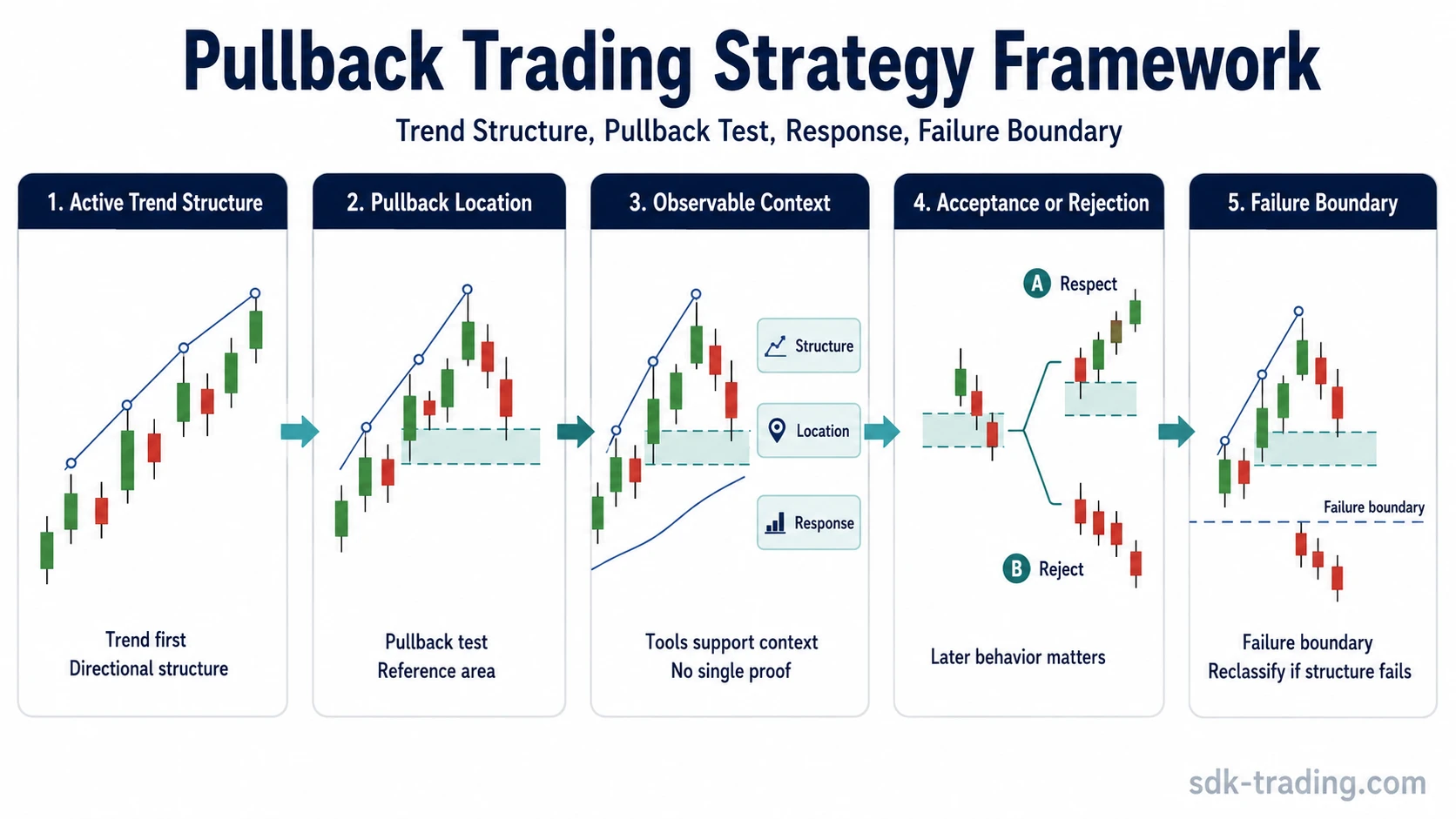
A counter-trend move becomes useful as a pullback reading only when it can be evaluated against the larger structure that existed before the retracement began. The framework then asks whether that structure remains intact as the move develops.
The Pullback Signal Stack
Pullback analysis works better when the conditions are read together rather than promoted into separate signals.
| Condition | What It Contributes | What Can Undermine It |
|---|---|---|
| Trend structure | Establishes the directional movement from which price is retracing. | The market is already overlapping, ranging, or losing directional progression. |
| Pullback location | Identifies the prior swing, trend boundary, breakout area, or other reference being tested. | The retracement develops in an area with little structural relevance. |
| Pullback quality | Shows how depth, overlap, pace, and internal structure compare with the earlier trend. | The counter-move increasingly resembles structural deterioration rather than a temporary retracement. |
| Price response | Shows whether the tested area can support renewed directional progress or whether price continues cutting through it. | The market fails to recover the tested area or continues building structure against the original trend. |
| Failure boundary | Defines the structural condition that would force the original pullback reading to be reconsidered. | The boundary is repeatedly moved after price has already broken the structure it was meant to protect. |
Core distinction: pullback depth by itself does not determine whether the trend remains valid. Depth has to be read relative to the larger structure and the level whose loss would change the classification.
See Pullback vs Reversal on Real Stock Charts
This part of the chart-reading walkthrough shows a normal retracement first, then follows the structure as the distinction between pullback and reversal becomes less clear.
The classification can change while the counter-move develops. A retracement may remain contained inside the larger trend at first, then damage a structural boundary later. The newer evidence should control the classification at that point.
Trend Structure Comes First
A pullback only has meaning relative to directional structure that existed before the counter-move began.
In an uptrend, that structure may appear through higher highs and higher lows, sustained directional progression, a rising channel, or repeated preservation of important swing areas. A downtrend applies the same principle in the opposite direction.
When price is already moving sideways through the same area with heavy overlap, calling one leg a pullback adds little information. There may no longer be a sufficiently clear directional structure to pull back from.
Pullback Location, Depth, and Structure
Location identifies what the retracement is testing. A return toward a prior swing, former breakout boundary, channel edge, or established support or resistance area creates a more specific structural question than movement through the middle of unrelated price noise.
A previous resistance area that later begins functioning as support, or previous support that begins functioning as resistance, can create a flip zone reference. Its usefulness depends on how price behaves when that area is tested from the new side.
Depth needs the same structural reference. A deep retracement can leave the larger trend intact when an important swing boundary still holds. A smaller retracement can be more damaging if it breaks a level that was carrying the directional sequence.
Pullback vs Reversal
Both can begin with price moving against the preceding trend. The distinction develops from the effect that counter-move has on the existing structure.
| Reading | Structural Condition | What Would Change It |
|---|---|---|
| Pullback | The counter-trend movement remains contained inside the larger directional structure. | Loss of the structural boundary that was preserving the trend. |
| Unresolved pullback | The retracement becomes deeper, slower, or more overlapping while the critical structure still holds. | Renewed directional progress would repair the reading; further structural damage would weaken it. |
| Potential reversal | The counter-move breaks an important part of the previous trend structure. | Failure to recover that structure, followed by development in the opposite direction, gives the reversal case more weight. |
| Range transition | Directional progression disappears and price repeatedly travels through the same broader area. | A new directional structure would need to develop before a clean trend-based reading returns. |
Pullback vs Breakout and Break and Retest
Pullback, breakout, and retest language can describe overlapping portions of the same chart, but each term answers a different structural question.
| Concept | Starting Condition | Main Structural Question |
|---|---|---|
| Pullback | An active directional structure already exists. | Can the counter-trend movement develop without destroying that structure? |
| Break and retest | Price first moves beyond a visible boundary and later returns toward it. | Does the breached area function differently after the break? |
| False breakout | Price moves beyond a boundary and then loses the outside area. | Did the attempted break fail and return price to the previous structure? |
A return toward a breakout area can therefore belong to a broader pullback while also forming part of a break-and-retest sequence. The two labels describe different relationships on the same chart.
The distinction becomes narrower with trap structures. A fakey pattern or hikkake pattern requires its own inside-range or failed-break structure. A failed pullback is defined by damage to the larger directional structure that supported the original retracement reading.
Framework Application Example
Suppose an uptrend has been producing higher highs and higher lows. Price then retraces toward a previous breakout area while remaining above the swing low that has been supporting the current directional leg.
Several parts of the stack now have information value. The prior trend is still visible, the retracement has reached a meaningful location, and the larger structural boundary remains intact. If the counter-move also begins to lose downside momentum and price stabilizes around the tested area, the movement still fits a pullback framework.
Now change one condition. Price continues lower, breaks the supporting swing, and remains below it instead of recovering the area. The original trend evidence has changed. Continuing to move the pullback boundary lower would preserve the label while discarding the condition that originally justified it.
Application rule: the stack should be re-evaluated when one of its structural conditions changes. The label should follow the chart rather than remain fixed to the first interpretation.
Simple, Complex, Shallow, and Deep Pullbacks
Simple and complex describe the path of the retracement. A simple pullback may contain one relatively clean counter-trend leg, while a complex pullback can contain several legs, repeated overlap, or sideways compression.
Shallow and deep describe magnitude. Neither classification determines the final outcome. A shallow retracement can still damage an important nearby swing, while a deeper retracement can remain inside a wider but intact trend structure.
The more useful comparison is between the pullback and the rhythm, boundaries, and swing relationships that were present before it began.
Tools That Can Support a Pullback Reading
Moving averages, Fibonacci retracements, trendlines, channels, support and resistance, volume, and momentum indicators can help describe different parts of the pullback. Their roles are different.
A moving average can provide a dynamic price reference. Fibonacci measures retracement depth. A trendline or channel can make the previous directional rhythm easier to see. Support and resistance identify prior reaction areas, while volume and momentum describe participation or force during the counter-move.
These tools become less useful when their presence replaces the structural question. A moving-average touch or Fibonacci ratio does not preserve a trend whose important swing structure has already failed.
Failure Boundary and Invalidation
A pullback framework needs a structural condition that can invalidate the original classification. The reference may be a prior swing, trend boundary, breakout area, support or resistance zone, or another level that materially supports the existing directional structure.
Structural invalidation here refers to the chart interpretation. It is separate from a trading stop or position-management rule.
Once price breaks the relevant structure and begins building beyond it, the pullback framework has lost part of its original basis. The chart may then require a reversal, range-transition, or failed-continuation reading instead of an indefinitely expanding definition of the same pullback.
Core boundary: a pullback remains a useful classification only while the larger structure that defines the pullback remains defensible.
Limits of Pullback Analysis
Trend quality, swing importance, retracement depth, and structural boundaries vary across instruments and timeframes. That makes pullback classification partly dependent on how the larger price structure is defined.
The classification can also change during the movement itself. A controlled retracement can develop into a complex correction, a range, or a reversal as additional price information appears.
The framework is designed to organize those changes. It does not specify an entry, stop distance, position size, target, or guaranteed continuation outcome.