Imbalances and blocks form a chart-reading map for separating displacement, fair value gaps, order blocks, breaker blocks, mitigation blocks, and inducement into different evidence types. The useful question is not which label sounds strongest, but what kind of price behavior is being read.
Key Points
- Imbalance language usually points to uneven price movement, fast displacement, or an area left with limited two-sided trading.
- Block language usually points to a prior candle area or reaction zone being used to read later behavior.
- Fair value gaps, order blocks, breaker blocks, mitigation blocks, and inducement can overlap on a chart, but they are not the same concept.
- A label identifies a chart-reading question; acceptance, rejection, neglect, or role change decides whether the reading remains useful.
How Imbalances and Blocks Fit Together
Imbalances and blocks sit inside the same price-action vocabulary, but they describe different kinds of evidence. An imbalance points to uneven movement or a visible gap in participation. A block points to a candle area or prior reaction area that later becomes relevant to interpretation.
That distinction prevents a common misread: treating every fast move as an order block, every gap as a tradeable imbalance, or every reaction area as proof that price must reverse. The label starts the review. It does not finish it.
Short boundary definitions:
- Imbalance: broad language for uneven price movement where buying and selling activity did not appear balanced in the visible sequence.
- Fair value gap: a specific gap-like price area often read as a more defined form of imbalance.
- Order block: a prior candle or candle area used to read whether later price behavior reacts around a possible decision area.
- Displacement: a strong directional move that can create or reveal imbalance, without being the same thing as a block.
- Breaker block: a prior block area that changes interpretation after price breaks and later interacts with it differently.
- Mitigation block: a block area used to read whether price revisits a prior decision zone and how it behaves there.
- Inducement: nearby liquidity or an attractive price area that can pull attention before a larger reaction, continuation, or invalidation.
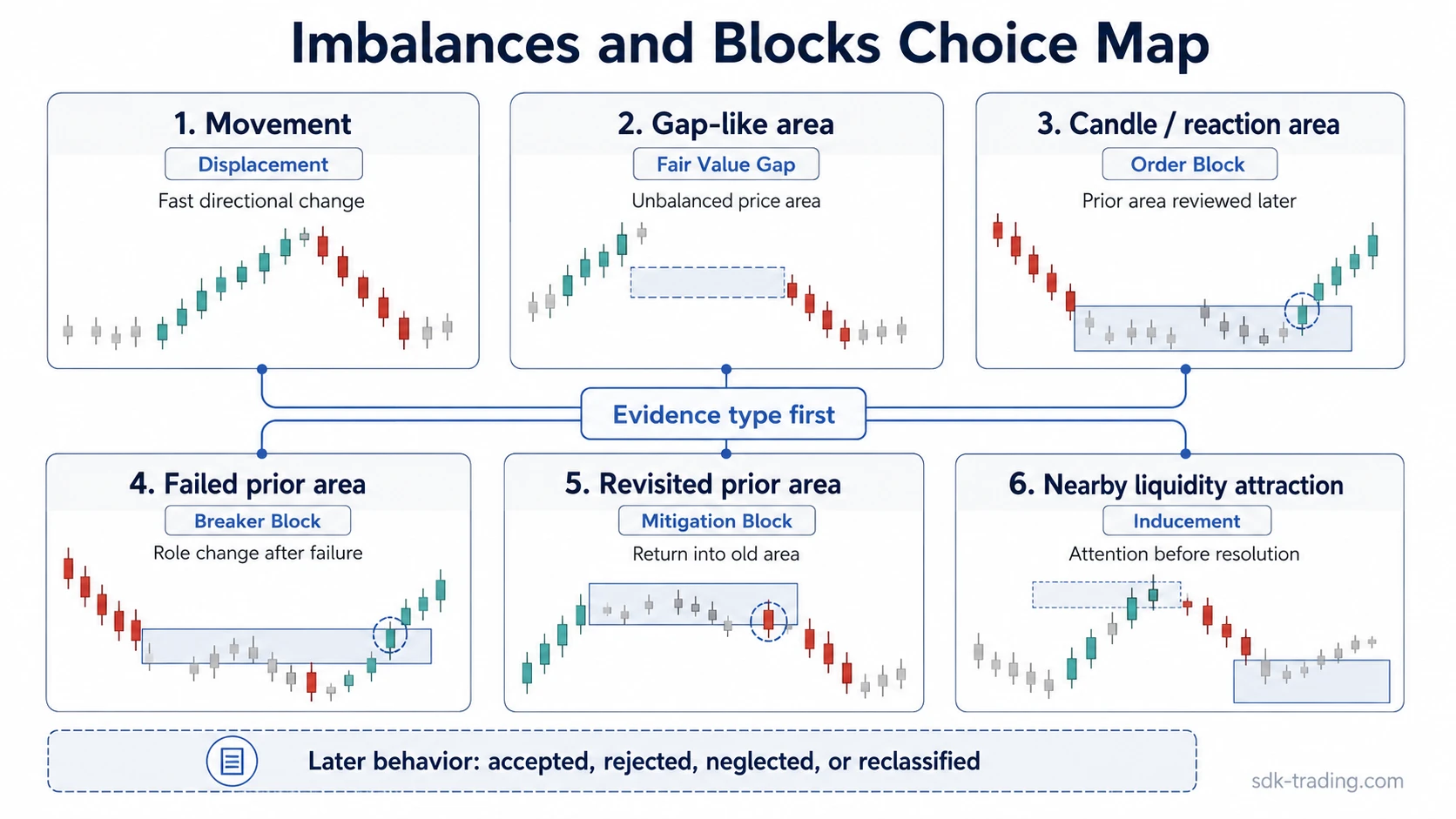
Choose the Right Concept
The first step is to name the evidence type before applying a label. A fast candle sequence, an unfilled price area, a prior reaction block, and a failed return into an old block area all ask different questions.
| Chart-reading question | Start with | Why it fits |
|---|---|---|
| Did a strong directional move change the visible pace? | displacement | Focuses on force and directional movement before deeper block labels are considered. |
| Did fast movement leave a gap-like area between nearby candles? | fair value gap | Narrows broad imbalance wording into a more specific price-area structure. |
| Is a prior candle area being watched as a possible reaction zone? | order block | Focuses on how later price behaves around a prior candle area. |
| Did a previous block idea fail and later change role? | breaker block | Depends on prior block failure and later interaction around that area. |
| Is the later reaction being read as the bullish version of a failed prior block? | bullish breaker block | Keeps the review focused on bullish role-change behavior after a previous area fails. |
| Is the later reaction being read as the bearish version of a failed prior block? | bearish breaker block | Separates bearish rejection or continuation behavior from generic block language. |
| Did price revisit a prior block area? | mitigation block | Focuses on revisit and response rather than the label alone. |
| Is the revisit being read through buyer response? | bullish mitigation block | Narrows the review to behavior around a bullish revisit area. |
| Is the revisit being read through seller response? | bearish mitigation block | Narrows the review to behavior around a bearish revisit area. |
| Is a nearby liquidity area attracting attention before the main reading is resolved? | inducement | Focuses on liquidity attraction and possible misleading reaction before the larger interpretation is clear. |
Displacement, Gaps, and Block Areas
Displacement, fair value gaps, and order blocks are often discussed together because they can appear in the same part of a chart. A strong move may create displacement. That move may leave a fair value gap. A nearby candle area may later be described as an order block. The concepts can sit close together without becoming interchangeable.
| Concept | Main evidence type | What not to assume |
|---|---|---|
| Displacement | Speed, range, and directional pressure | Do not assume every strong candle creates a useful block. |
| Fair value gap | A visible gap-like area inside a fast move | Do not assume every gap must fill. |
| Order block | A prior candle area tested by later behavior | Do not assume the label proves institutional activity. |
| Breaker block | A prior block idea that fails and changes role | Do not treat any break as a completed breaker without later interaction. |
| Mitigation block | A revisit into a prior block area | Do not assume the revisit is automatically a reaction signal. |
A cleaner reading starts by asking whether the chart shows movement, a gap-like area, a block area, a failed block, or a revisit. After that, acceptance, rejection, failure, or neglect of the area changes the interpretation.
When a Direct Comparison Helps
Some questions are not solved by choosing one term from the map. They need a direct contrast because the same chart area may be described with two nearby labels.
| If the confusion is | Use this comparison | What the comparison separates |
|---|---|---|
| Whether an imbalance and a fair value gap are the same thing | imbalance vs fair value gap | Broad imbalance language from the more specific fair value gap structure. |
| Whether a failed block and a revisit block should be read the same way | breaker vs mitigation block | Failure and role change from revisit and response behavior. |
A direct comparison helps when two labels point to the same chart area but ask different diagnostic questions. The concept map helps when the first problem is choosing which evidence type to study.
Common Misreads Around Imbalances and Blocks
Misread 1: Treating every label as a signal:
An imbalance, block, gap, breaker, or mitigation label does not prove trade quality. Each label identifies a type of chart behavior that still needs context, confirmation, or invalidation.
Misread 2: Merging every term into one setup:
Fast movement, unfilled price areas, prior candle blocks, failed blocks, and revisited blocks can appear near one another. Overlap does not make every term identical.
Misread 3: Assuming price must return:
An imbalance or block can remain relevant without forcing a return, fill, reversal, or continuation. The reading changes when the area is accepted, rejected, ignored, or reclassified.
Misread 4: Reading intent too strongly:
Order block and imbalance language can describe observable chart structure. It should not be used as proof of hidden institutional intent, guaranteed accumulation, or guaranteed distribution.
A Simple Route-Choice Scenario
Price moves sharply away from a tight area and leaves a visible gap-like space between nearby candles. The first question is whether the move shows displacement. The next question is whether the unfilled area behaves like a fair value gap. A nearby candle area may be reviewed as an order block only if later price behavior gives that area relevance.
If price breaks through a previously watched block and later reacts around it from the other side, breaker logic may fit better. If price returns into a prior block area and the reaction itself is the focus, mitigation logic may fit better. The useful distinction is the evidence type being read, not the most advanced label available.
FAQ
Are imbalances and blocks the same thing?
No. Imbalance is broader language for uneven price movement or an area left by fast movement. Block language usually refers to a prior candle area or reaction area used to read later behavior.
Is a fair value gap the same as an imbalance?
A fair value gap is commonly treated as a specific type of imbalance, but imbalance can be broader. The distinction matters because not every imbalance label points to the same chart structure.
Do order blocks always contain fair value gaps?
No. An order block and a fair value gap can appear near each other, but one does not automatically prove the other. The order block label focuses on a candle area, while the fair value gap label focuses on a gap-like price area.
Can an imbalance or block confirm a trade by itself?
No. These labels describe chart-reading areas. They do not confirm reversal, continuation, entry quality, stop placement, target placement, or trade outcome by themselves.
When should breaker block or mitigation block be reviewed separately?
Breaker logic fits better when a prior block idea fails and the area later changes role. Mitigation logic fits better when the focus is a return into a prior block area and the behavior around that revisit.