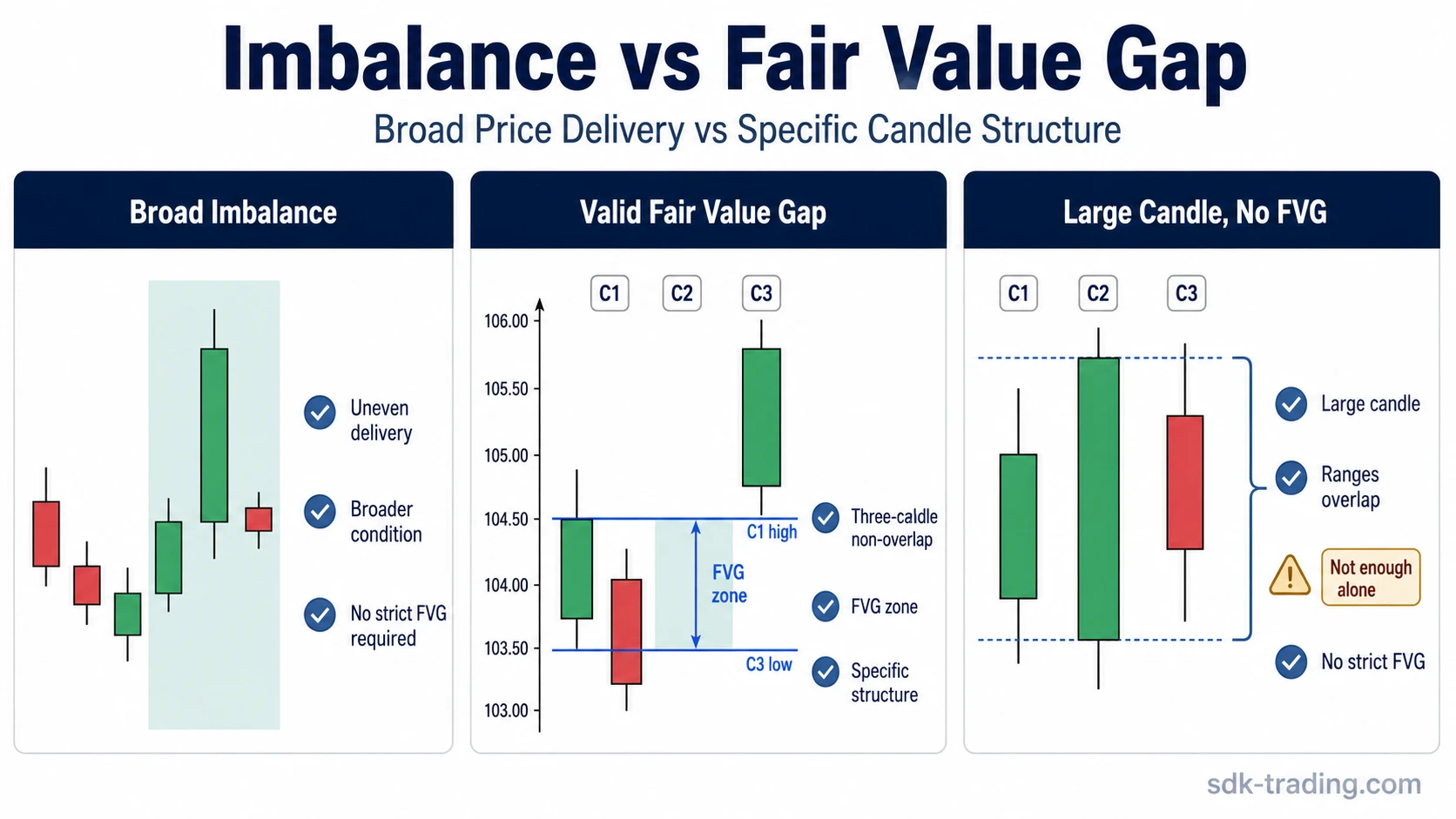
Imbalance is the broader condition of uneven price delivery, while a fair value gap is a specific visible structure that can appear when a candle sequence leaves measurable non-overlap. The confusion comes from the fact that a fair value gap can express imbalance, but imbalance does not always form a fair value gap.
Direct answer: Imbalance describes pressure or inefficiency in how price moves through an area. A fair value gap describes a stricter three-candle relationship where the first and third candles do not fully overlap, leaving a visible gap-like zone on the chart.
A fast directional move can be imbalanced because price moved unevenly, but the stricter FVG label depends on candle structure. If the surrounding candles overlap, the movement may still show aggressive price delivery, yet it should not be labeled as a fair value gap under the structural reading.
Key Points
- Imbalance is a broad price-delivery condition, not one fixed candle pattern.
- A fair value gap is narrower because it requires a visible candle relationship.
- A large candle can support an imbalance reading without creating an FVG.
- Later price behavior around the area is observation, not proof of direction or fill.
Imbalance vs Fair Value Gap: Core Difference
The core difference is scope. Imbalance describes the broader idea that buying and selling interest did not interact evenly through a price area. Fair value gap describes one specific way that imbalance can become visible through candle structure.
An imbalance reading may come from rapid expansion, thin two-way interaction, inefficient delivery, or a move that leaves little visible back-and-forth. A fair value gap needs more than speed. It needs a defined relationship between candles, usually described as a three-candle sequence where the high or low relationship between the first and third candle leaves a measurable non-overlap.
That distinction keeps the label cleaner. A chart can show force without a strict structural gap. It can also show a fair value gap inside a broader imbalance event. The FVG is the visible structure; the imbalance is the broader reading behind the move.
Comparison Criteria
The cleanest way to separate the two terms is to classify what is being observed. Start with the broad question: did price delivery look uneven? Then check the narrower question: does the candle sequence leave a measurable structural non-overlap?
| Criterion | Imbalance | Fair Value Gap |
|---|---|---|
| Scope | Broader inefficient or uneven price delivery | Specific visible chart structure |
| Requirement | Uneven participation, aggressive delivery, or thin interaction | Three-candle sequence with measurable non-overlap |
| Boundary | Often less precise and more contextual | More visually bounded by candle highs and lows |
| Candle dependency | Can appear without a strict FVG | Requires a candle relationship |
| Common misread | Any fast move must return or fill | Every FVG must fully fill |
| Reading role | Context or pressure lens | Structural inefficiency marker |
| What it does not prove | Direction, entry, continuation, or fill | Direction, entry, continuation, or fill |
How a Fair Value Gap Forms
A fair value gap is usually read through a three-candle sequence. In a bullish example, the low of the third candle may remain above the high of the first candle, leaving a visible area where price did not trade back through during that sequence. In a bearish example, the high of the third candle may remain below the low of the first candle.
The middle candle often carries the expansion, but the middle candle alone is not the full test. A large body, wide range, or aggressive close can support the idea of imbalance, yet the fair value gap label depends on whether the first and third candles leave the relevant non-overlap. Without that boundary, the move may be strong but not structurally an FVG.
Later price behavior around the area can be useful for interpretation. Price may partially revisit it, fully trade through it, respect it, or ignore it. None of those outcomes should be treated as guaranteed from the label alone.
How Imbalance Can Exist Without a Fair Value Gap
Imbalance can appear when price moves through an area with limited two-way interaction. The chart may show a strong directional candle, a rapid expansion from a prior area, or a sequence where one side of the market appears to dominate the delivery process. That can create a pressure reading even when the candles overlap enough to prevent a strict FVG.
This is why the terms should not be collapsed into one definition. A visible FVG is one possible expression of imbalance. A broader imbalance can also appear without a clean gap boundary. Treating every imbalance as an FVG makes the reading less precise and can turn a structural label into loose vocabulary.
The distinction also protects against fill assumptions. Uneven delivery does not mean price must return to the area. A visible FVG also does not mean price must fully close it. The safer reading is conditional: the area exists as a structure or context point, and later behavior decides how much weight it deserves.
Same Move, Different Reading
Consider a fast expansion away from a prior range. The move is strong, the candles are directional, and the market spends little time inside the expansion area. That can support an imbalance reading because price delivery was uneven.
Reading 1: broad imbalance only. Price expands quickly, but the surrounding candles still overlap. The move may show pressure, but the stricter FVG structure is absent.
Reading 2: fair value gap inside imbalance. The same expansion leaves a measurable non-overlap between the first and third candles. The broader condition is imbalance, and the specific visible structure is an FVG.
Reading 3: large candle without enough structure. A wide candle appears, but the nearby candles trade back through the same area. The move may still matter, but the FVG label becomes weak or invalid.
The same directional move can therefore carry different labels depending on the boundary. Size starts the review, but structure decides whether the stricter fair value gap label applies.
Common Misreads
Misread: every imbalance is a fair value gap. Cleaner reading: imbalance is the broad condition; FVG is the narrower structure.
Misread: every fair value gap must fill. Cleaner reading: a fill is one possible later behavior, not a rule built into the label.
Misread: a large candle is enough. Cleaner reading: a large candle can support an imbalance reading, but FVG classification still needs the candle relationship.
A related mistake is using the terms as trade instructions. Neither term gives direction, timing, risk definition, or outcome quality by itself. Both are chart-reading terms. Their value comes from classification and context, not from acting on the label alone.
How Displacement Changes the Context
A displacement move can strengthen the context behind an imbalance reading because it shows directional expansion with force. It still does not automatically create a fair value gap. The FVG question remains structural: did the candle sequence leave measurable non-overlap?
Displacement can explain why the market moved aggressively. Fair value gap criteria explain whether the move left a specific visible inefficiency. Imbalance sits above both as the broader delivery condition. Keeping those roles separate avoids turning one strong candle into several unsupported labels.
In liquidity-driven situations, inducement can add context when a move appears to draw participants into a weak assumption before later behavior changes the reading. That context can matter, but it should not replace the basic classification test between broad imbalance and specific FVG structure.
Classification Checklist
Use the checklist as a labeling filter, not as a trading sequence.
| Question | What it clarifies |
|---|---|
| Is the observation broad pressure or a specific candle structure? | Separates imbalance from FVG before labels are mixed. |
| Is there a three-candle sequence? | Checks whether FVG criteria can even be considered. |
| Is there measurable non-overlap between the first and third candles? | Identifies the structural boundary needed for an FVG. |
| Is the move only large, or structurally gapped? | Prevents large-candle false positives. |
| What does later behavior do around the area? | Frames later respect, reclaim, partial fill, or full trade-through as observation rather than certainty. |
FAQ
Is every fair value gap an imbalance?
A fair value gap is commonly treated as one visible expression of imbalance because the candle sequence shows inefficient price delivery. The FVG is the specific structure, while imbalance is the broader condition.
Is every imbalance a fair value gap?
No. Imbalance can appear as broad uneven price delivery without leaving the strict three-candle non-overlap needed for a fair value gap.
Can a large candle be an imbalance without a fair value gap?
Yes. A large candle can show aggressive delivery or pressure, but it becomes a fair value gap only if the surrounding candle relationship leaves measurable non-overlap.
Do fair value gaps always get filled?
No. Price may revisit, partially fill, fully trade through, respect, or ignore a fair value gap. Fill behavior is a later observation, not a certainty built into the label.
Why do traders use imbalance and fair value gap interchangeably?
The terms are often mixed because a fair value gap can visually express imbalance. The cleaner distinction is to treat imbalance as the broad delivery condition and fair value gap as the specific candle structure.