Inducement in trading is not simply any failed level or every liquidity sweep. It is a price-action reading where a visible area attracts participation before later price behavior shows whether that participation was trapped, absorbed, or only misread in hindsight.
The concept is mainly used in price-action and SMC discussions, but it should stay observable. A clean inducement reading depends on visible structure, the way price interacts with that structure, and what happens after the interaction. It is not a standalone buy or sell signal.
Definition: Inducement in trading is a structural price-action reading in which price draws attention toward an obvious high, low, range edge, pullback, or reference area before later movement confirms, weakens, or invalidates the idea that participation was encouraged into a vulnerable position.
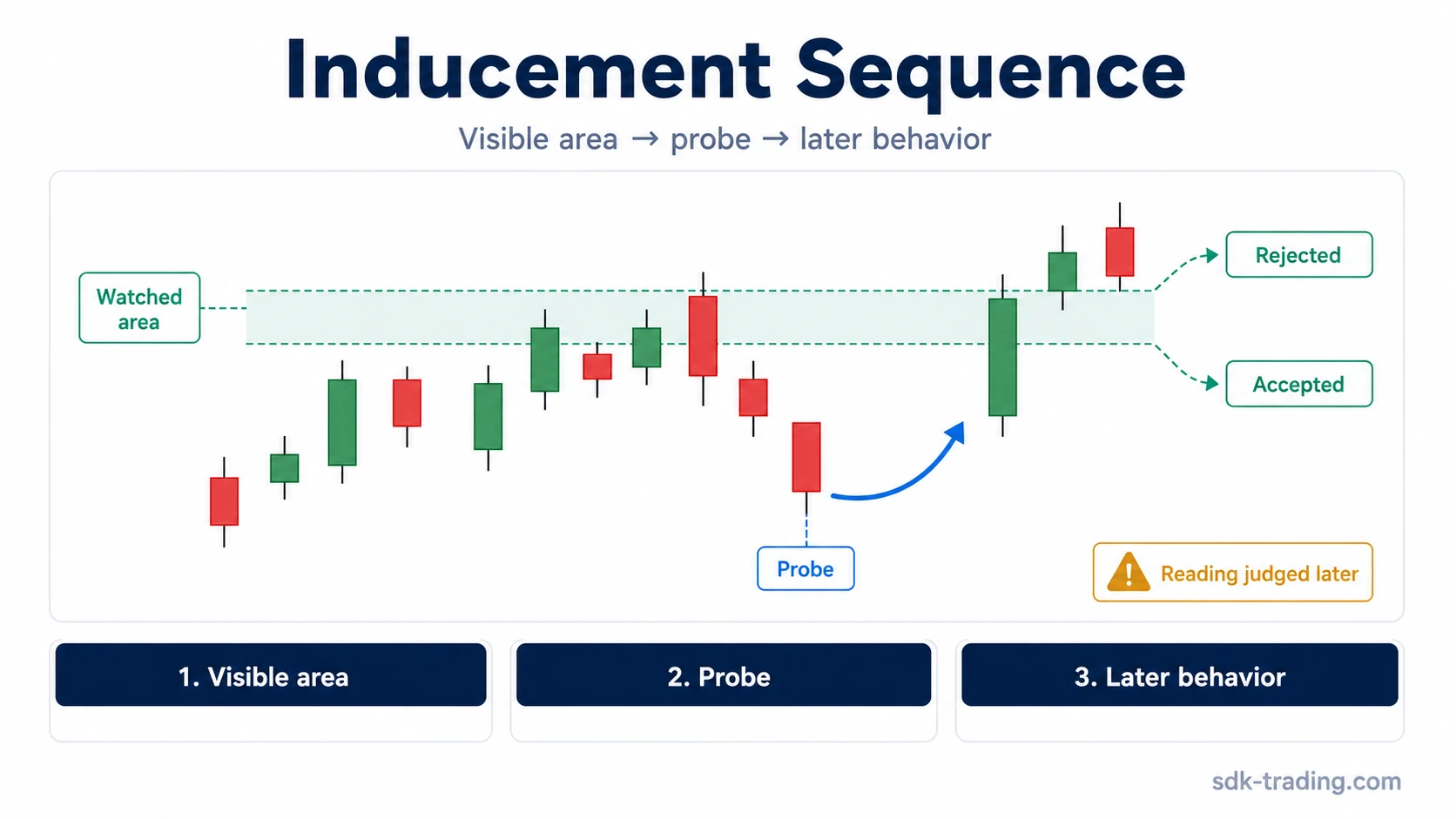
What Is Inducement in Trading?
Inducement describes a situation where a visible price area becomes attractive enough for traders to react to it. That area may be an obvious swing high, swing low, support or resistance level, range boundary, internal pullback, or a nearby reference zone. The inducement reading starts only when the structure is clear enough to plausibly attract participation.
The follow-up sequence matters just as much as the first interaction. Price may probe through the area, briefly violate it, sweep liquidity around it, or draw traders into an early reversal idea. The reading becomes more meaningful only when the next movement shows whether the move created a trap, failed to hold, or simply produced normal market noise.
Inducement is not proof that a market was manipulated. It is a way to describe how chart structure, liquidity, and later acceptance or rejection can interact around a watched area.
How Inducement Forms in Price Action
An inducement sequence usually begins with an area that traders can see without forcing the chart. The level may be a prior high, prior low, repeated reaction point, range edge, or internal swing that looks like a natural place for stops, breakout attempts, or early reversal positioning.
Price then interacts with that area in a way that encourages participation. It may trade just beyond the level, run into the area and reject, or create enough movement to make a continuation or reversal idea look obvious. At this stage, the reading is still incomplete because the chart has not yet shown whether the move was accepted or rejected.
The final part is confirmation or failure of the idea. If price cannot hold beyond the area and moves away with clear acceptance in the opposite direction, the inducement reading becomes cleaner. If price chops around the area, the reading is weaker. If price simply continues beyond the level and holds there, the inducement label may not fit.
| Stage | What to observe | What it means for the reading |
|---|---|---|
| Visible structure | An obvious high, low, pullback, range edge, or reaction area | Creates the possibility that traders may react around the same place |
| Probe or violation | Price trades into, through, or around the visible area | Shows participation may have been drawn into the move |
| Later behavior | Price accepts, rejects, stalls, or reclaims the area | Determines whether the inducement reading is clean, weak, or invalid |
How to Identify Inducement Without Over-Labelling
The safest way to identify inducement is to treat it as a sequence, not as a single candle or one broken level. A visible level alone is not enough. A sweep alone is not enough. The label needs a before-and-after structure.
| Check | Clean observation | Weak observation |
|---|---|---|
| Visibility | The level or structure is obvious enough to attract attention | The area is drawn only after the move has already happened |
| Participation logic | The move could plausibly invite breakout, reversal, or stop-driven activity | The move is random chop with no clear reason traders would react there |
| Reaction quality | Price fails to hold the tested area and later behavior supports the trap idea | Price moves around the area without a clear acceptance or rejection |
| Context | The reading fits nearby market structure, liquidity, and displacement | The label is isolated from the surrounding structure |
| Timing of the label | The level was visible before the reaction | The whole explanation is added only after the outcome is known |
A practical scenario is a market that approaches a prior high, trades slightly above it, and then quickly loses acceptance above that high. The first move can attract breakout interest or trigger resting orders above the level. The inducement reading becomes more defensible only if the next sequence rejects the area instead of building value above it.
Common Types of Inducement
Inducement can appear around different forms of visible structure. The label should describe the role of the structure, not create a new trade rule.
| Type | Where it appears | What to avoid assuming |
|---|---|---|
| Support or resistance inducement | A familiar horizontal level attracts breakout or reversal interest | Do not assume every failed support or resistance test is inducement |
| Range inducement | Price probes above a range high or below a range low | Do not assume every range sweep becomes a reversal |
| Order-block-adjacent inducement | Price reacts near a reference area that traders are already watching | Do not confuse the inducement sequence with the reference area itself |
| Internal pullback inducement | A small pullback or internal swing draws early continuation or reversal interest | Do not label every internal swing as inducement without later confirmation |
Clean, Weak, and Invalid Inducement Readings
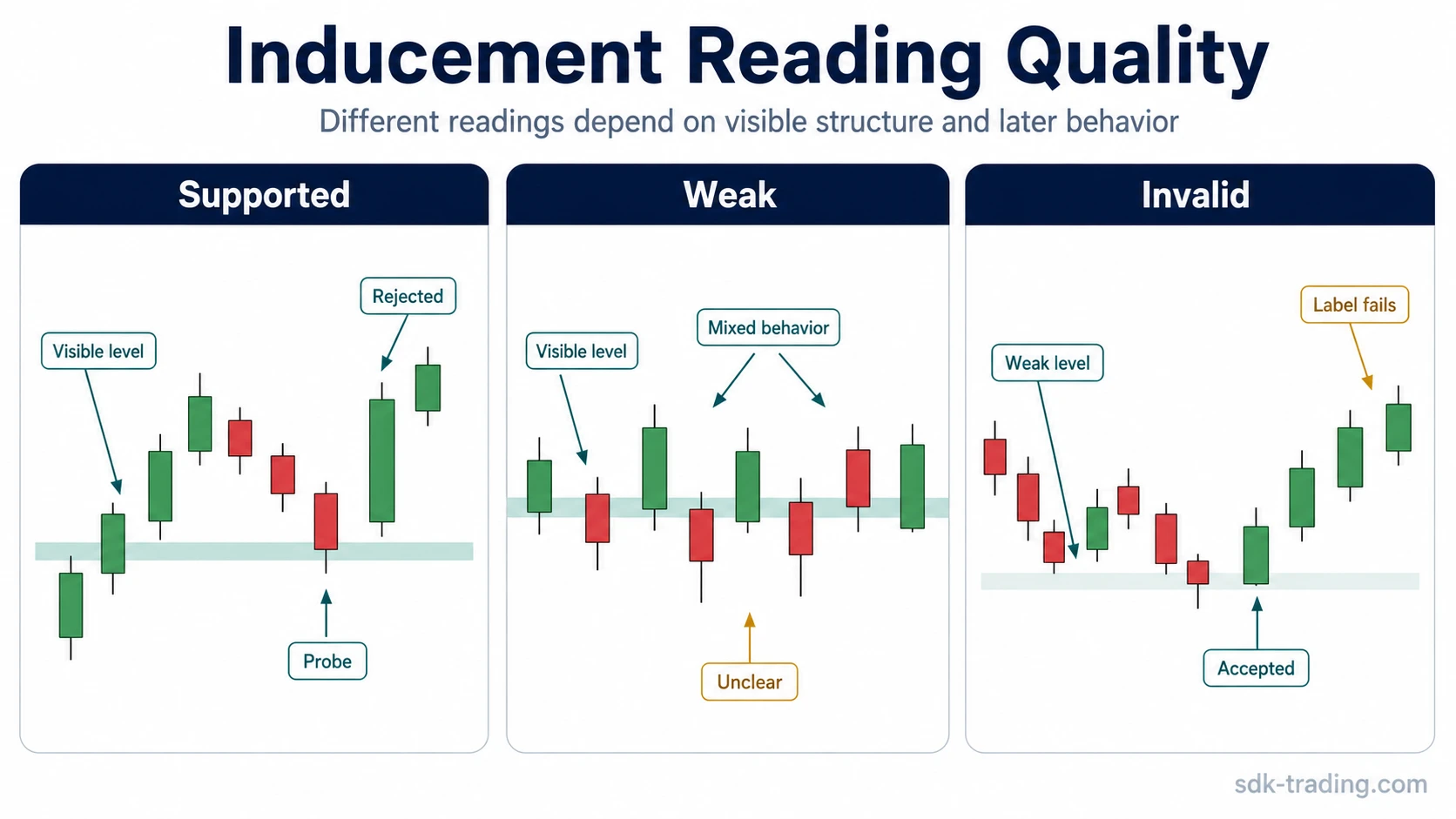
The useful question is not whether inducement appeared perfectly. The useful question is whether the chart gives enough evidence to treat the label as a clear reading, a weak possibility, or an invalid hindsight explanation.
| Reading quality | What it looks like | How to interpret it |
|---|---|---|
| Clean | A visible level attracts participation, price probes it, and later behavior clearly rejects or traps that participation | The inducement label is supported by structure and follow-through |
| Weak | The level is visible, but price action around it is choppy, mixed, or unresolved | The reading may be possible, but the evidence is not strong enough to treat it as clear |
| Invalid | The level was not meaningful before the move, or price accepts beyond it instead of rejecting it | The inducement label is probably hindsight over-labelling |
A clean reading needs more than a dramatic candle. It needs a visible area, a reason participation may have been drawn in, and later behavior that supports the idea that the participation was poorly positioned.
Common Inducement Misreadings
Inducement is easy to overuse because the label can be added to almost any failed move after the fact. The main protection is to keep the reading tied to visible structure and later confirmation.
| Misreading | Cleaner interpretation |
|---|---|
| Every failed level is inducement | A failed level becomes relevant only if it was visible before the move and later behavior supports the trap logic |
| Every liquidity sweep is inducement | A liquidity sweep may be part of inducement, but inducement also needs context and follow-up behavior |
| Inducement proves manipulation | The label describes observable price behavior; it does not prove intent by specific market participants |
| Inducement is a buy or sell signal | The label explains structure; it does not define execution, risk, or permission to trade |
| The label only works after the outcome | The level should be visible before the outcome, even if the quality of the reading is judged later |
Inducement vs Related Price-Action Concepts
Inducement overlaps with liquidity and reference-area concepts, but it should not replace them. The distinction is the role of visible attraction before later behavior confirms or weakens the reading.
| Concept | Main focus | Difference from inducement |
|---|---|---|
| Liquidity sweep or liquidity grab | A move through a prior high, low, or liquidity area | A sweep can be part of inducement, but the inducement reading also asks whether participation was attracted and later trapped or rejected |
| order block | A reference area traders may watch after a prior move | Inducement describes the attraction and later reaction sequence around visible structure, not the reference area itself |
| breaker block | A failed area that may later be assessed from the opposite side | Inducement can occur before or around a failed-area sequence, but the breaker reading depends on role-flip behavior |
| Fair value gap | A visible imbalance between candles | Inducement is not the imbalance itself; it concerns participation around visible structure and what price does afterward |
| Fake breakout | A breakout attempt that fails to hold | A fake breakout may look like inducement, but inducement requires a clearer attraction-and-reaction sequence, not just failure |
Why Context Matters
Context decides whether inducement is a useful reading or just a convenient label. The same move through a high can mean different things depending on the surrounding market structure, the strength of displacement, the location of nearby liquidity, and whether price accepts or rejects the tested area.
A move that briefly violates a level and immediately returns can support a cleaner reading if the level was visible and the rejection is clear. A move that violates the level, consolidates above it, and continues higher may invalidate the inducement idea. A move that chops across the same area without acceptance or rejection usually stays weak.
That makes inducement a conditional reading. The label is strongest when the level was visible before the move and the follow-up behavior clearly changes how that level should be interpreted.
FAQ
What does inducement mean in trading?
Inducement in trading means a visible price area appears to attract participation before later price behavior shows whether that participation was trapped, absorbed, or misread. It is a price-action reading, not a standalone trade signal.
Is inducement the same as a liquidity sweep?
No. A liquidity sweep can be part of an inducement sequence, but the two terms are not identical. Inducement focuses on the visible attraction of participation and the later behavior that confirms, weakens, or invalidates that reading.
Is inducement a trading signal?
No. Inducement describes structure and participation logic. It does not define entry, exit, stop placement, position size, target, or trade permission.
Can inducement be identified in real time?
The visible area can often be identified before the outcome, but the quality of the inducement reading depends on later behavior. A real-time label should remain provisional until price shows acceptance, rejection, or failure around the area.
What makes an inducement reading invalid?
An inducement reading becomes invalid when the supposed level was not meaningful before the move, when the label is added only after the outcome, or when price accepts beyond the area instead of showing the rejection or trap behavior required by the reading.