An order block is a visible price-action reference area where price previously built structure before a strong displacement move. The area is used to read how price behaves around a prior base, but the label does not prove hidden institutional orders, guarantee a reaction, or create a trade signal by itself.
Definition: An order block is a chart area formed around a prior consolidation, base, or final opposing candle sequence before price displaces away from that area. Its usefulness depends on the visible sequence before the move and the later behavior when price returns near the area.
Order block key points:
- It is a visible reference area, not a standalone signal.
- The reading depends on structure before displacement and behavior after displacement.
- A cleaner reading usually has a clear base, a strong displacement, and later respect of the area.
- A weak or invalid reading often comes from hindsight labeling, messy structure, or price accepting back through the area.
What Is an Order Block?
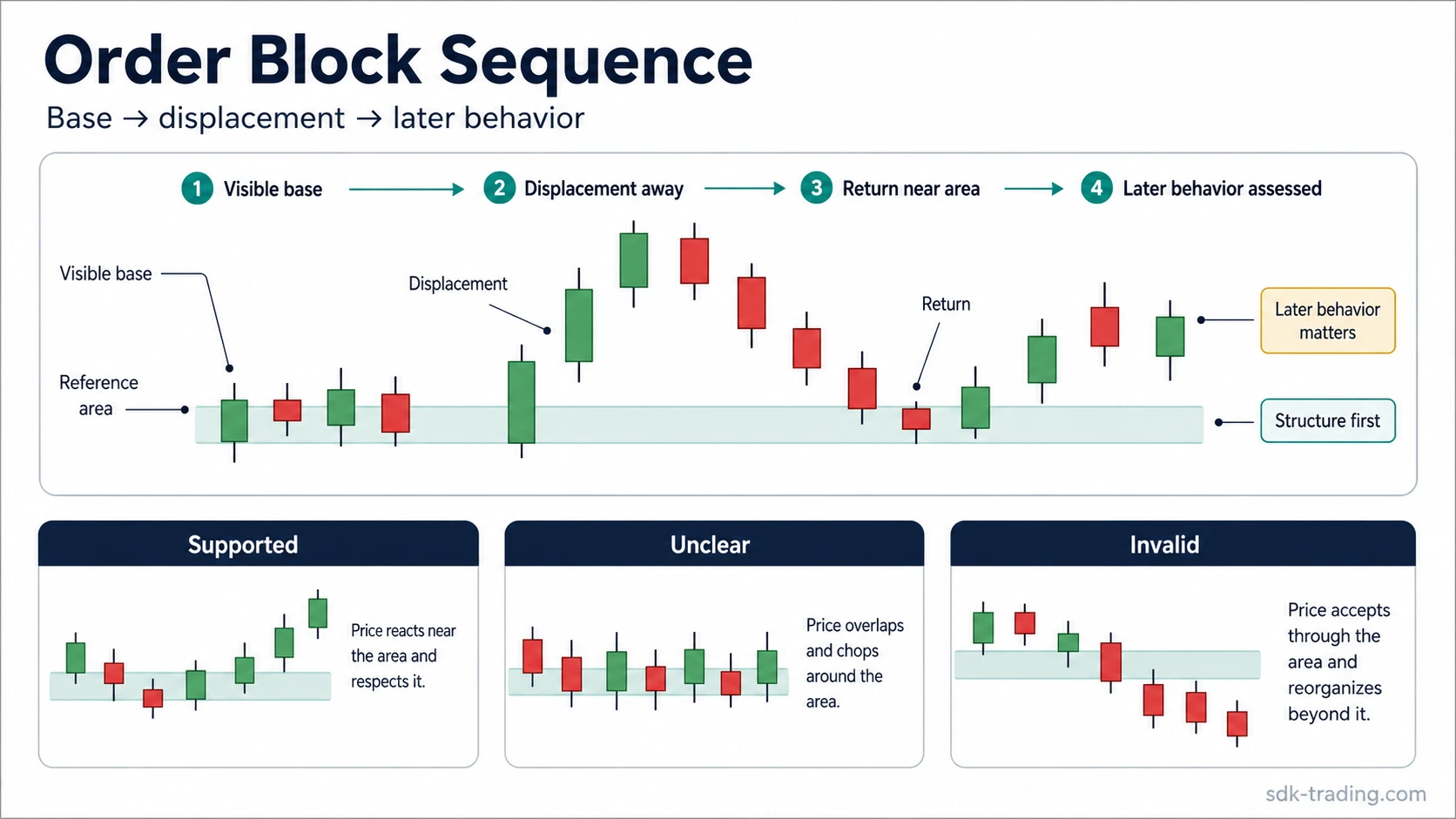
An order block is a price-action area that becomes important only after a sequence is visible: price builds a local base, leaves that base with displacement, and later gives evidence about whether the old area still matters. The concept is retrospective because the area is not confirmed by the base alone. The later move and later reaction are what give the area context.
The word “block” can make the concept sound more precise than it is. On a live chart, the area is usually a zone, not a single perfect line. The interpretation is strongest when the zone is tied to visible structure instead of being drawn around any candle that appears before a move.
An order block is related to imbalance concepts, but it is not the same thing as a fair value gap. A fair value gap focuses on the visible gap or imbalance between candles, while an order block focuses on the prior reference area that price displaced away from.
How an Order Block Forms
An order block reading usually begins with compression, a small base, or a local pause in price. That area becomes more meaningful if price then leaves it with displacement. Without displacement, the area may simply be ordinary consolidation.
The basic sequence is:
| Step | Visible behavior | What it means for the reading |
|---|---|---|
| Base | Price pauses, compresses, or forms a local reference area. | The chart now has a possible area to watch, but not a confirmed order block reading. |
| Displacement | Price leaves the area with a clear directional move. | The area becomes more relevant because price has moved away from it with force. |
| Return or reaction | Price later approaches, tests, rejects, accepts, or breaks back through the area. | Later behavior helps classify the reading as cleaner, weaker, or invalid. |
Displacement matters because it separates a meaningful departure from ordinary sideways movement. A candle or base without a later directional move is not enough to support a strong order block reading.
How to Identify an Order Block
Order block identification should stay tied to observable price behavior. The question is not whether the chart proves who placed orders. The question is whether price created a clear reference area, moved away from it with displacement, and later treated that area in a way that supports the reading.
| Check | Cleaner reading | Weaker reading |
|---|---|---|
| Prior area | The base or candle sequence is visible before displacement. | The area is chosen only after seeing the later move. |
| Displacement away | Price leaves the area with a clear expansion move. | The move away is small, overlapping, or choppy. |
| Return behavior | Price later reacts around the area without quickly accepting through it. | Price repeatedly chops through the area with no clear response. |
| Boundary clarity | The zone can be marked without stretching across too much price action. | The zone is so wide or vague that almost any reaction could fit it. |
| Nearby structure | The area fits the surrounding market structure and displacement leg. | The area conflicts with nearby structure or is crowded by overlapping zones. |
Common mistake: The last opposite candle before a move is not automatically an order block. A candle can only become part of a stronger reading when the surrounding structure, displacement, and later behavior support it.
Bullish and Bearish Order Blocks
Bullish and bearish order block labels describe the direction of the displacement and the side of the market structure being assessed. They are classification labels, not trade permissions.
| Type | Typical structure | Neutral interpretation |
|---|---|---|
| Bullish order block | Price forms a reference area and later displaces upward from it. | The old area may be watched for whether price later respects or accepts through it. |
| Bearish order block | Price forms a reference area and later displaces downward from it. | The old area may be watched for whether price later rejects, accepts, or reorganizes around it. |
A bullish label does not mean price must rise from the area. A bearish label does not mean price must fall from the area. The label only describes how the reference area was created and how later behavior is being interpreted.
Clean, Weak, and Invalid Order Block Readings
Order block quality depends on how well the full sequence holds together. The same chart area can look convincing in hindsight but become weak or invalid when price later behaves differently from the original reading.
| Reading quality | Visible evidence | What weakens or invalidates it |
|---|---|---|
| Clean | Clear base, strong displacement, and later behavior that respects the area without messy acceptance through it. | The interpretation weakens if the area is repeatedly pierced, widened, or redefined after the fact. |
| Weak | Some relationship exists between the area and later price behavior, but the base, displacement, or reaction is unclear. | The zone becomes less useful when it is too broad or when later price action is unresolved. |
| Invalid | The area no longer behaves like a meaningful reference area, or price accepts back through it and reorganizes beyond it. | The label should not be preserved only because it matched an earlier expectation. |
This is why order block reading is sequence-dependent. The initial area can start the question, but later behavior decides whether the reading remains useful.
Order Block vs Fair Value Gap, Breaker Block, and Mitigation Block
Order blocks are often discussed near other imbalance and block concepts, but each concept describes a different structural idea. Keeping the boundaries clear prevents one label from becoming a catch-all explanation for any strong move.
| Concept | Main focus | How it differs from an order block |
|---|---|---|
| Fair value gap | A visible imbalance or gap-like candle relationship. | It focuses on the imbalance left by movement, not the prior base area itself. |
| Breaker block | A failed reference area that later flips its structural role. | A breaker block depends on failure and role-flip behavior, not only the original displacement away from a base. |
| Mitigation block | A return into a prior reference area after displacement. | A mitigation block emphasizes how price revisits a prior area, while an order block begins with the reference area and displacement sequence. |
| Supply and demand zone | A broader area where price previously reacted or imbalanced. | Supply and demand zones are wider reference-area concepts; an order block is a narrower reading tied to base, displacement, and later behavior. |
Simple Order Block Example in Context
Imagine price pauses below a resistance area, forms a small base, and then moves sharply upward. That base can become a possible bullish order block reference only after the upward displacement is visible. If price later returns near the base and reacts without accepting below it, the reading becomes cleaner. If price chops through the area several times or accepts below it, the original reading weakens or becomes invalid.
The visible sequence is the important part: base, displacement, return, and later behavior.
What an Order Block Is Not
An order block is not a guarantee that price will reverse. It is not proof that banks or institutions placed orders in that exact area. It is not a buy or sell signal by itself.
Limitations: Order block analysis can become unreliable when the zone is drawn too wide, selected only after the move, repeated through many interactions, or treated as a mechanical trading rule. The structure should be read as evidence to assess, not as a prediction.
Repeated interaction can also change the character of the area. A level that was once meaningful may become less useful if price keeps moving through it and reorganizing on both sides.
FAQ
What is an order block in trading?
An order block is a visible price-action reference area where price previously formed structure before displacing away from it. The reading depends on the base, the displacement, and later behavior around the area.
How do you identify an order block?
Look for a clear prior base or candle sequence, a strong displacement away from that area, and later price behavior that shows whether the area still matters. A single candle before a move is not enough by itself.
What is the difference between a bullish and bearish order block?
A bullish order block is associated with upward displacement from a prior reference area. A bearish order block is associated with downward displacement from a prior reference area. The labels describe structure, not guaranteed direction.
Is an order block the same as a fair value gap?
No. An order block focuses on the prior reference area that price displaced away from. A fair value gap focuses on a visible imbalance or gap-like relationship created by the displacement.
Are order blocks reliable?
Order blocks are not reliable as standalone signals. The reading is stronger when the area is clear, displacement is visible, and later behavior supports the structure. It weakens when the zone is vague, hindsight-selected, or repeatedly broken.