A mitigation block is a price-action and market-structure area that price revisits after a prior directional move, structural shift, or imbalance-related sequence. The label depends on the prior area, the revisit, and later behavior around that area, not on a rectangle shape alone.
In trading, mitigation block analysis belongs to the same broad family as imbalance, block, and market-structure reading. It is used to describe how a prior area remains relevant after price returns to it, but it does not automatically confirm a trade, predict continuation, or prove institutional activity.
Definition: A mitigation block is a prior price-action area that becomes relevant again when price revisits it and later behavior shows whether that area is contained, absorbed, rejected, or accepted through.
Key Points
- A mitigation block is identified by sequence and later behavior, not by drawing a zone around any large candle.
- The prior area must have structural relevance before the revisit matters.
- A cleaner reading usually needs a visible revisit and a controlled response around the area.
- Weak or invalid readings appear when price accepts through the area, overlaps heavily, or lacks meaningful structure.
- Breaker blocks and order blocks can look similar, but they describe different parts of the structural logic.
What Is a Mitigation Block?
A mitigation block is a trading concept used to classify a prior area that price returns to after a meaningful move or shift in structure. The area may come from a candle, a cluster of candles, or a small zone linked to a previous expansion, but the important part is the later test of that area.
The concept is often discussed in market-structure language, but the safer reading is observable rather than assumed. A mitigation block does not require a trader to prove why large participants acted. It only requires visible price behavior: the prior area, the return into it, and the response after the return.
A mitigation block is also not the same as ordinary support or resistance. Support and resistance can describe broad reaction areas. A mitigation block reading is narrower because it depends on a prior structural sequence and a later revisit into the specific area being evaluated.
| Classification point | Mitigation block reading |
|---|---|
| Concept family | Price action, market structure, imbalance, and block context |
| Core area | A prior candle or zone linked to a previous structural move |
| Required context | A later revisit and observable behavior around the area |
| Supports the reading | Containment, rejection, absorption, or failure to accept through the zone |
| Weakens the reading | Immediate acceptance through the zone, heavy overlap, or unclear structure |
| Not enough alone | Rectangle shape, one large candle, generic support/resistance, or assumed institutional intent |
How a Mitigation Block Forms
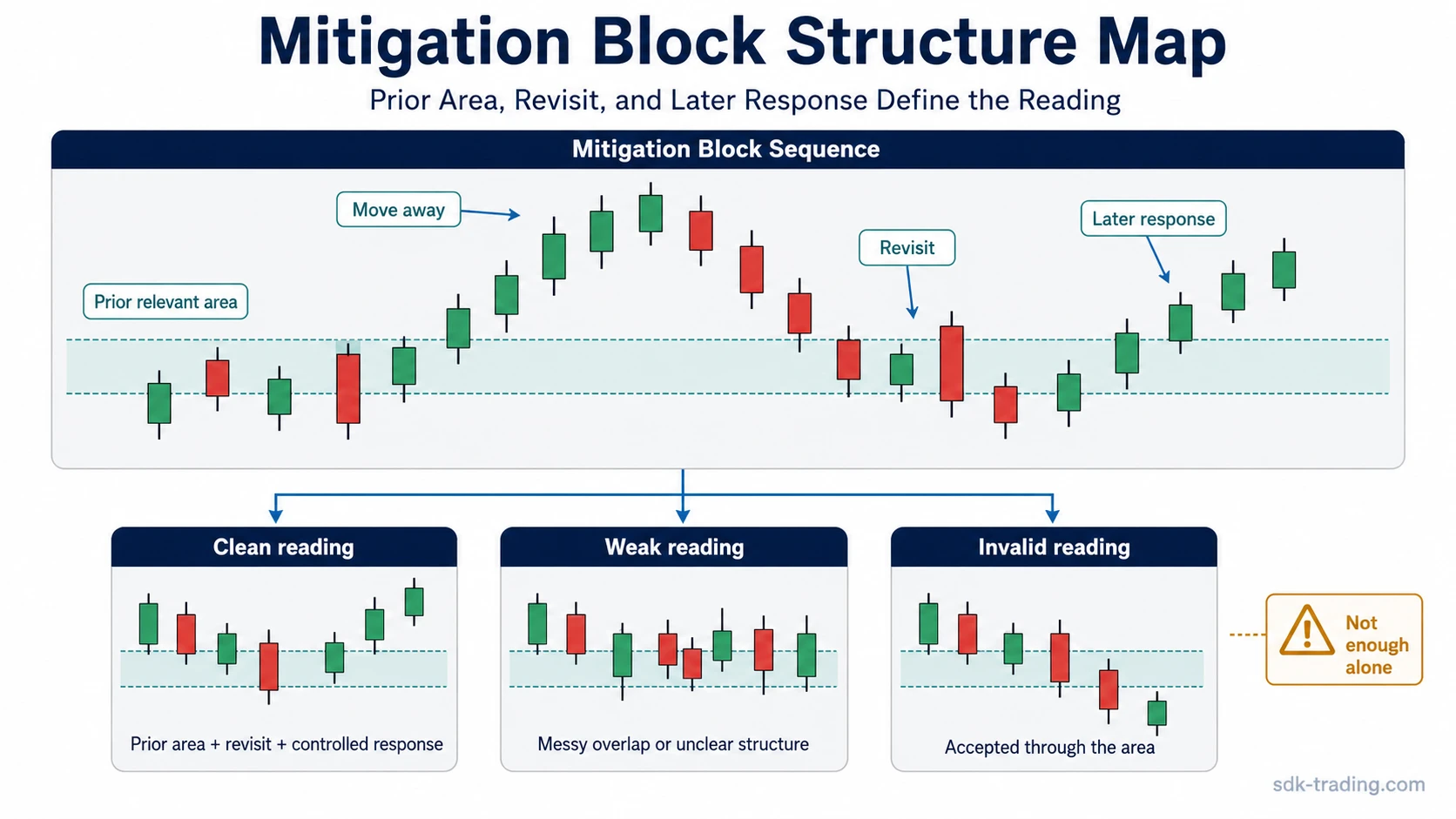
A mitigation block starts with a reference area that has structural relevance. That area may appear before or during a directional expansion, a displacement-style move, or a shift in how price is being accepted. The later revisit is what brings the area back into focus.
The important sequence is simple: price creates a relevant prior area, moves away from it, returns into it, and then shows whether the area still matters. If price reacts, stalls, absorbs, or fails to accept beyond the area, the mitigation block reading becomes more defensible. If price moves through the area cleanly and accepts beyond it, the reading weakens or fails.
Fair value gap or imbalance behavior can support the context, but it should not replace the mitigation block definition. A gap, imbalance, or fast expansion may help explain why the area is being watched, but the mitigation block label still depends on the prior area and the later response around it.
Illustrative scenario: Price moves away from a prior bearish-origin area, later returns into that same area, and then struggles to accept through it. The mitigation block reading becomes stronger if the response shows containment or absorption around the area. If price accepts through it without a meaningful response, the same rectangle should not be treated as a clean mitigation block.
Mitigation Block Identification Criteria
Identification should be based on observable conditions. A zone is not a mitigation block just because it is visually clean, because a candle is large, or because a chart annotation looks precise. The structure before the revisit and the response after the revisit both matter.
A practical identification review can use the following criteria:
- The prior area is identifiable without forcing the chart.
- The area is linked to a meaningful move, structural shift, or imbalance-related sequence.
- Price later revisits the area instead of leaving it untested.
- The later response around the area can be observed clearly.
- Price does not show clean acceptance through the side that would weaken the reading.
- False-positive conditions, such as messy overlap or ordinary consolidation, are not dominating the structure.
The best use of the criteria is classification, not prediction. A mitigation block can describe a structural reading, but it does not say that price must continue, reverse, or react in a specific way.
Bullish and Bearish Mitigation Blocks
A bullish mitigation block is a directional variant where the later revisit is evaluated inside a bullish structural context. The reading depends on whether price returns into the prior area and then shows behavior that supports continued relevance of that area.
A bearish mitigation block applies the same classification logic in a bearish structural context. The bearish label does not come from candle color alone. It comes from the prior area, the surrounding structure, the revisit, and the later response.
Both variants are best treated as classification labels. They help describe how price is behaving around a prior area, but they do not turn the area into an entry model or a guaranteed reaction zone.
Mitigation Block vs Breaker Block
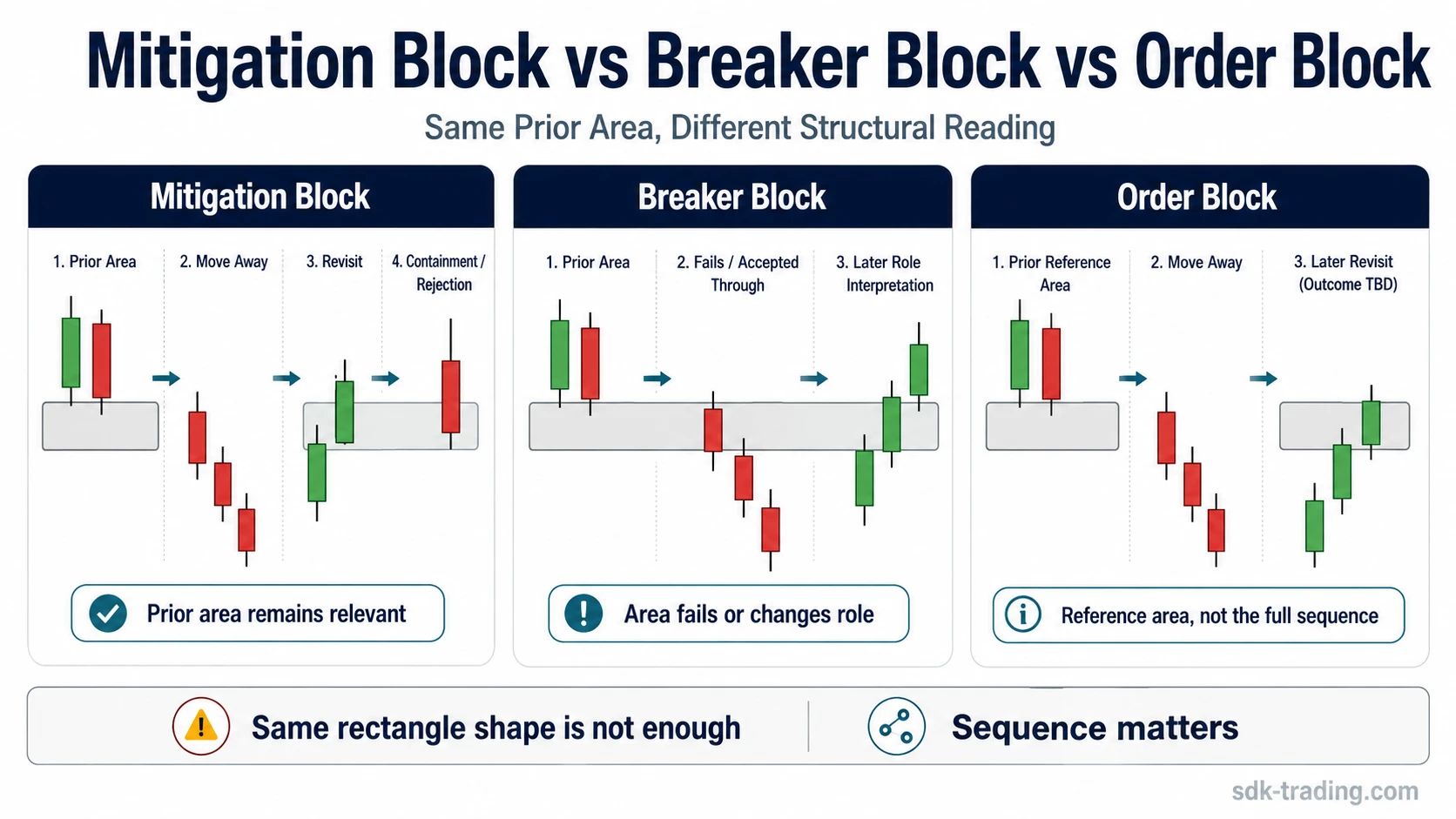
Mitigation block and breaker block logic are often confused because both can involve a return to a prior area. The difference is in how the prior area behaves after price revisits it and whether the area remains respected or is accepted through in a way that changes its role.
| Concept | Main structural idea | What weakens the label |
|---|---|---|
| Mitigation block | A prior area is revisited and remains relevant through containment, absorption, rejection, or lack of clear acceptance through the area. | Clean acceptance through the area or no meaningful response around the revisit. |
| Breaker block | A prior area fails or is accepted through, then may be interpreted differently after that failure or role change. | No clear failure, no accepted break, or no later behavior that supports a changed role. |
| Shared confusion point | Both can use similar rectangles and both may appear near prior structural areas. | Drawing the same zone and changing the label without checking sequence and acceptance. |
The cleaner distinction is sequence. A mitigation block reading depends on the prior area still behaving as relevant during the revisit. Breaker logic requires a clearer failure or acceptance-through condition before the later role of the area can be interpreted differently.
Mitigation Block vs Order Block
A mitigation block can overlap with an order block, but the two labels do not mean the same thing. An order block usually describes the prior area being referenced. A mitigation block reading depends on how price later revisits and responds to that area.
The practical boundary is that order block analysis focuses on the origin or reference area, while mitigation block analysis focuses on the revisit and the later classification of behavior around that area. The same prior zone may be discussed in both contexts, but the label should not be assigned until the sequence supports it.
Boundary note: A prior order-block-like area may become part of a mitigation block reading, but a retest of any prior block is not automatically a mitigation block. The revisit and later behavior must still support the classification.
Clean, Weak, and Invalid Mitigation Block Readings
The strongest part of mitigation block analysis is not the label itself. It is the ability to separate cleaner readings from weak or invalid ones. This prevents a common mistake: treating every prior candle or zone as meaningful after price returns to it.
| Reading quality | What it looks like | Interpretation limit |
|---|---|---|
| Cleaner reading | Prior area, structural context, revisit, and no clear acceptance through the area. | Still a classification, not a prediction. |
| Weak reading | Messy overlap, unclear structure, late reaction, or noisy candles around the area. | The label should be used cautiously or left unresolved. |
| Invalid / false-positive reading | The area is accepted through, reclaimed against the reading, or lacks prior structural relevance. | The zone should not be treated as a mitigation block. |
A clean reading does not require perfect candles. It requires enough sequence clarity to separate the area from ordinary chop. A weak reading may still be worth observing, but the wording should remain conditional. An invalid reading should be discarded instead of re-labeled to fit the original idea.
Common Mitigation Block Mistakes
Several mistakes make mitigation block analysis less useful. The most common is relying on the rectangle instead of the sequence. A rectangle can be drawn around almost any candle cluster, but the label only becomes meaningful if the prior area, revisit, and later response are all visible.
- Calling every prior candle a mitigation block: A candle needs context before it can act as a meaningful reference area.
- Confusing mitigation block with support and resistance: Broad reaction areas are not the same as a sequence-based mitigation block reading.
- Treating every order block retest as mitigation: A prior block can be involved, but the later revisit still has to support the label.
- Ignoring acceptance through the area: Clean acceptance through the zone can weaken or invalidate the reading.
- Using imbalance as proof: Fair value gap or imbalance context can support the review, but it does not prove the mitigation block by itself.
- Assuming institutional intent: Chart structure can be observed, but hidden intent should not be stated as fact.
- Turning classification into execution: A mitigation block label does not define a complete trading decision or prove setup quality.
Limitations of Mitigation Block Analysis
Mitigation block analysis becomes less reliable when the market is overlapping, slow, or structurally unclear. In heavy chop, many prior areas can appear relevant for a few candles and then lose meaning. That makes the label easy to overuse.
Time also changes the usefulness of a prior area. A zone that mattered immediately after a structural move may become less informative after repeated revisits, broad overlap, or a long delay. The older and more reworked the area becomes, the more cautious the classification should be.
The safest interpretation is that a mitigation block is a structural reading, not a standalone trading method. It can help organize chart context, but it should not be presented as proof of future direction or as a complete decision model.
FAQ
What is a mitigation block in trading?
A mitigation block is a prior price-action area that price later revisits after a structural move or shift. The reading depends on how price behaves around the area after the revisit.
How do you identify a mitigation block?
Identify the prior area, check that it has structural relevance, observe the later revisit, and evaluate whether price is contained, absorbed, rejected, or accepted through the area.
What is the difference between a mitigation block and a breaker block?
A mitigation block reading depends on a prior area remaining relevant after the revisit. Breaker logic requires clearer failure or acceptance through the prior area before its later role is interpreted differently.
Is a mitigation block the same as an order block?
No. An order block can be the prior area being referenced, but a mitigation block reading depends on the later revisit and response around that area.
Can a mitigation block fail?
Yes. A mitigation block reading can fail when price accepts through the area, when the structure is unclear, or when the zone lacks meaningful prior relevance.