A bullish mitigation block is a prior bearish-origin area that becomes relevant inside bullish price structure after price revisits it and the response supports a mitigation reading. The label is not created by drawing a rectangle around an old candle area. It depends on the prior area, the later bullish context, the revisit, and whether price behavior confirms, weakens, or invalidates the role of that area.
A bullish mitigation block is best treated as a chart-reading label, not as a prediction or standalone trading instruction. The area only becomes useful for classification when the response after the revisit supports the mitigation reading inside the changed structure.
Key Points
- A bullish mitigation block is a structural label, not a trade signal.
- It depends on a prior bearish-origin area, bullish context, and later revisit behavior.
- The reading becomes stronger when price respects, contains, or absorbs the area after the revisit.
- The reading weakens or fails when price accepts through the area against the expected role.
What Is a Bullish Mitigation Block?
A bullish mitigation block is a former bearish-origin area that is reviewed again after the market has shifted into a bullish structural context. The area often comes from a bearish candle group, supply-side reaction, or earlier downside attempt that later becomes relevant when price returns to it from above or after a bullish displacement.
A broader mitigation block reading focuses on how an earlier area is revisited and processed by later price behavior. The bullish version narrows that idea to a context where the later structure is bullish and the old bearish-origin area is being tested for absorption, containment, or structural respect.
The important boundary is behavioral. A rectangle around a prior bearish candle does not automatically qualify. A bullish mitigation block requires a sequence: prior area, bullish context, revisit, and a response that supports the role of the area. Without that sequence, the label is usually premature.
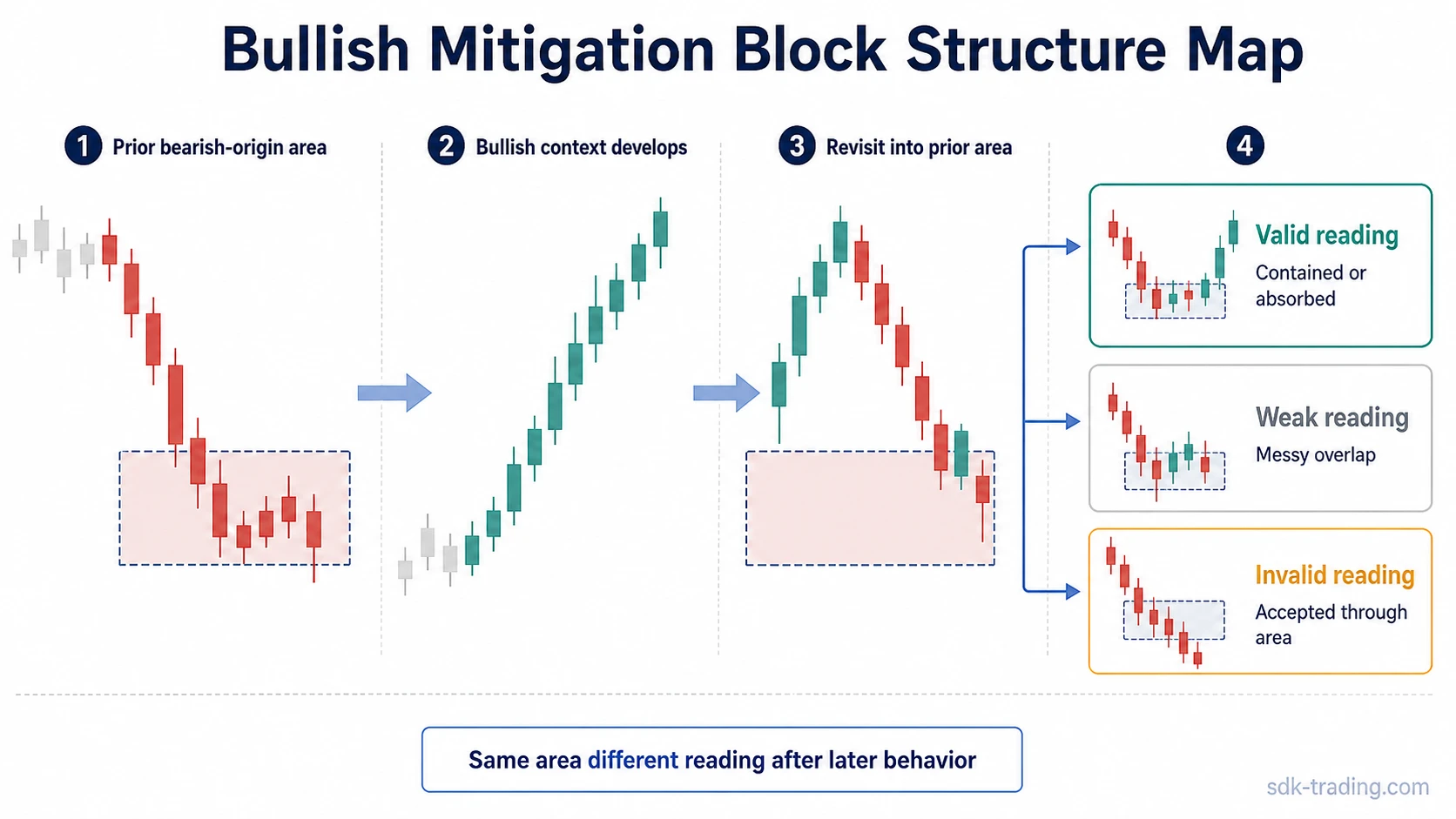
How a Bullish Mitigation Block Forms
The structure usually begins with a bearish-origin area. That area may appear during a downside reaction, a supply-side push, or a bearish candle group before the market later challenges that earlier pressure.
The next requirement is a bullish structural context. This can appear through upward displacement, a break of nearby structure, a stronger upside reaction, or another visible change showing that the old bearish area is no longer being read in isolation. Displacement can support the context, but displacement is not the block itself.
After that, price revisits the prior area. The revisit is the diagnostic moment. If price enters the area and then holds, absorbs the test, or treats the zone as structurally relevant, the bullish mitigation block reading becomes more defensible. If price cuts through the area and accepts beyond it, the reading weakens or fails.
Working definition: a bullish mitigation block is a prior bearish-origin area that becomes relevant inside bullish structure when a later revisit shows containment, absorption, or respect around that area.
How to Identify a Bullish Mitigation Block
Identification should start with observable conditions, not with a preferred market direction. The area must have a clear origin, the later context must support a bullish structural reading, and the revisit must produce behavior that can be classified.
| Diagnostic question | What to check | Why it matters |
|---|---|---|
| Where did the area originate? | Look for a prior bearish-origin candle group, supply-side reaction, or downside attempt. | The block needs a clear prior area before the later revisit can be interpreted. |
| Has the context shifted? | Check for bullish structure, upward displacement, or a meaningful challenge of prior bearish control. | The same area has a different meaning if the broader context has not changed. |
| How does price revisit the area? | Review whether price returns into the area, overlaps it, rejects deeper acceptance, or cuts through it. | The revisit separates a valid reading from a rectangle-only assumption. |
| Is behavior contained or absorbed? | Look for price holding around the area rather than accepting cleanly through it. | Containment or absorption makes the mitigation reading more defensible. |
| What would invalidate it? | Watch whether price accepts through the area in a way that contradicts the expected role. | Invalidation prevents the label from becoming a fixed belief after evidence changes. |
This checklist does not turn the area into an action point. It keeps the label tied to observable chart behavior.
Valid, Weak, and Invalid Bullish Mitigation Block Readings
The same prior area can produce different readings depending on what happens after the revisit. A valid reading, a weak reading, and an invalid reading may begin from a similar-looking rectangle.
| Reading | Observable condition | What it means | What it does not prove |
|---|---|---|---|
| Valid reading | Price revisits the prior bearish-origin area inside bullish structure and later behavior remains contained, absorbed, or respected around the area. | The area can reasonably be classified as a bullish mitigation block under the observed sequence. | It does not prove continuation, reversal, profit potential, or a required trade action. |
| Weak reading | The prior area is visible, but bullish context is unclear, revisit behavior is messy, or price overlaps the area without a clean structural response. | The area may be under review, but the evidence is not strong enough for a clean label. | It does not prove that the area is invalid, but it also does not justify a confident classification. |
| Invalid or false-positive reading | Price accepts through the area in a way that contradicts the expected role, or the area was labeled before any meaningful revisit behavior appeared. | The bullish mitigation block label should be rejected or downgraded. | It does not prove the opposite direction by itself. It only means the original label failed its own conditions. |
Practical Scenario: Same Area, Different Reading
A common diagnostic scenario begins with a bearish-origin area formed during a downside push. Later, the market challenges that earlier pressure, shifts into a bullish structural context, and returns to the same old area. If the revisit holds around the area and the response supports absorption rather than clean acceptance through it, a bullish mitigation block reading may be defensible.
If the same revisit produces only noisy overlap, the reading is weaker. If price accepts through the area and the old zone no longer acts as a respected area, the bullish mitigation label fails. The rectangle did not change, but the later behavior changed the classification.
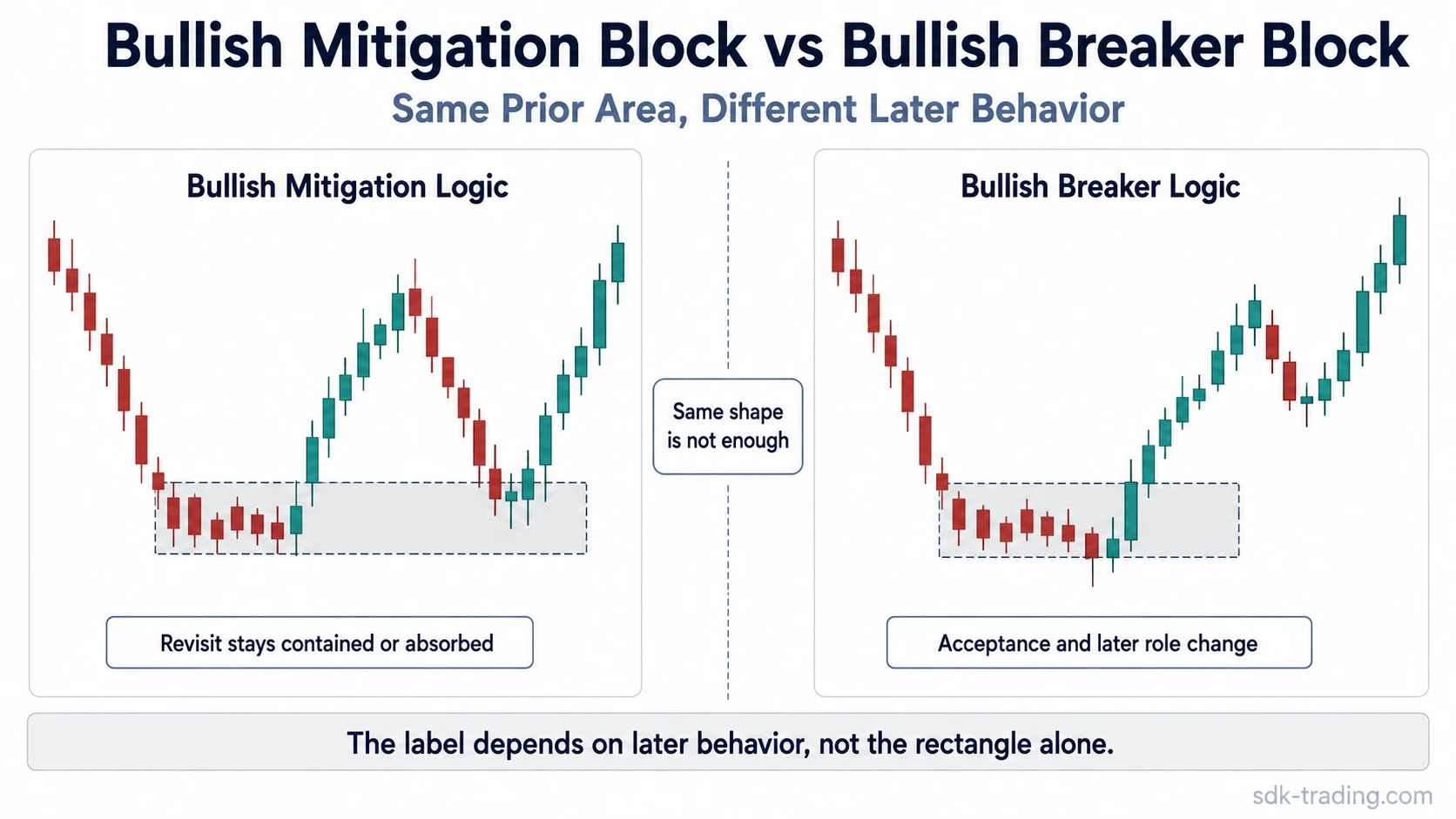
Bullish Mitigation Block vs Bullish Breaker Block
A bullish mitigation block and a bullish breaker block can look similar because both may involve an old area being revisited after structure changes. The difference is the role assigned to the area after later behavior develops.
Mitigation logic focuses on a prior area being revisited, contained, or absorbed within a bullish context. Breaker logic usually requires a clearer failure or role flip of a prior area after price accepts through it and later treats it differently. The distinction depends on sequence and acceptance, not on the rectangle shape alone.
Bullish vs Bearish Mitigation Block
A bullish mitigation block is read through bullish structural context after a prior bearish-origin area becomes relevant again. A bearish mitigation block reading applies the opposite directional logic, where a prior bullish-origin area becomes relevant inside bearish structure.
The directional label should follow the structure and revisit behavior. It should not be assigned only because an old candle area is visible.
Bullish Mitigation Block vs Order Block and Displacement
An order block is usually discussed as a candle or candle group connected to an earlier impulse, supply area, or demand area. A bullish mitigation block is narrower because the label depends on the old area being revisited and processed inside later bullish structure.
Displacement can help show that context has changed, but it is not the same thing as the mitigation block. The displacement may create the structural background. The block reading comes from how price later behaves around the prior area.
Classification rule: origin area plus bullish context plus revisit behavior is the minimum structure. A rectangle without later behavior remains an area under review, not a confirmed bullish mitigation block reading.
Common Mistakes When Reading Bullish Mitigation Blocks
| Mistake | Cleaner reading |
|---|---|
| Labeling any old bearish candle as a bullish mitigation block. | Require bullish context and later revisit behavior before assigning the label. |
| Treating the block as a prediction. | Use it as a conditional structural reading that can strengthen, weaken, or fail. |
| Confusing mitigation logic with breaker logic. | Check whether the later behavior shows containment, absorption, acceptance, or role flip. |
| Ignoring invalidation once price behavior changes. | Downgrade the label when price accepts through the area against the expected role. |
FAQ
Is a bullish mitigation block the same as an order block?
No. An order block usually refers to a candle or candle group connected to an earlier impulse or reaction. A bullish mitigation block requires later bullish context, a revisit into a prior bearish-origin area, and behavior that supports containment, absorption, or structural respect around that area.
Is a bullish mitigation block the same as a bullish breaker block?
No. The two can involve similar-looking prior areas, but breaker logic usually depends on a clearer failure or role flip after acceptance through an area. Mitigation logic focuses more on how the prior area is revisited and processed inside the later structure.
What invalidates a bullish mitigation block?
The reading weakens or fails when price accepts through the prior area in a way that contradicts the expected role of the zone. A label assigned before the revisit is also premature.
Does a bullish mitigation block predict price movement?
No. It is a structural classification based on prior area, context, revisit, and later behavior. It does not prove reversal, continuation, trade quality, or outcome.
Does a bullish mitigation block require displacement?
Displacement can help show that the surrounding structure has changed, but the block reading still depends on the prior area and later revisit behavior. Displacement alone is not enough.