Displacement in trading is a strong price-action move marked by directional expansion, large candle bodies, imbalance or fair value gap behavior, and market-structure context. A large candle alone is not enough. The reading becomes more meaningful only when the move changes how price is being accepted, rejected, or repriced around a specific structure.
In ICT and SMC language, displacement usually describes the quality of movement rather than a fixed candle pattern. It can appear after liquidity has been taken, during a shift in market structure, or inside a fast repricing move that leaves inefficient price action behind. The same visual move can be weak if it is only a volatility spike with no clear imbalance, no follow-through, and no relevant structure around it.
Key Points
- Displacement is a movement-quality concept, not a standalone trading signal.
- A displacement candle usually has a strong directional body, but candle size alone does not confirm the reading.
- Fair value gap, imbalance, liquidity context, and market-structure behavior can make the label more defensible.
- Weak displacement often appears as a large candle with poor follow-through, noisy wicks, or unclear structural relevance.
- Bullish and bearish displacement describe direction only; they do not define entry, exit, stop, target, or trade quality.
What Displacement Means in Trading
Displacement means price moves away from an area with enough force to suggest that one side of the market is repricing value quickly. In a bullish displacement, price expands upward with strong candle bodies and limited immediate rejection. In a bearish displacement, price expands downward with similar force in the opposite direction.
The useful part is not the speed by itself. The useful part is the relationship between speed, candle structure, imbalance, and the surrounding market context. A fast move that breaks structure, leaves a fair value gap, or follows a liquidity event can carry a different interpretation from a random wide candle inside noisy range conditions.
Displacement is often discussed near imbalance because a forceful move may leave an area where price traded inefficiently. That does not mean every imbalance confirms displacement, and it does not mean every displacement must create a clean fair value gap. The terms overlap, but they are not identical.
What Separates Displacement From a Large Candle
A large candle can attract attention without carrying much structural meaning. It may appear during news, thin liquidity, range expansion, or temporary volatility. A displacement reading needs more than size. It needs directional commitment, a context where the move changes the chart reading, and later behavior that does not immediately erase the expansion.
Simple distinction: a large candle is a visual fact; displacement is an interpretation of movement quality in context.
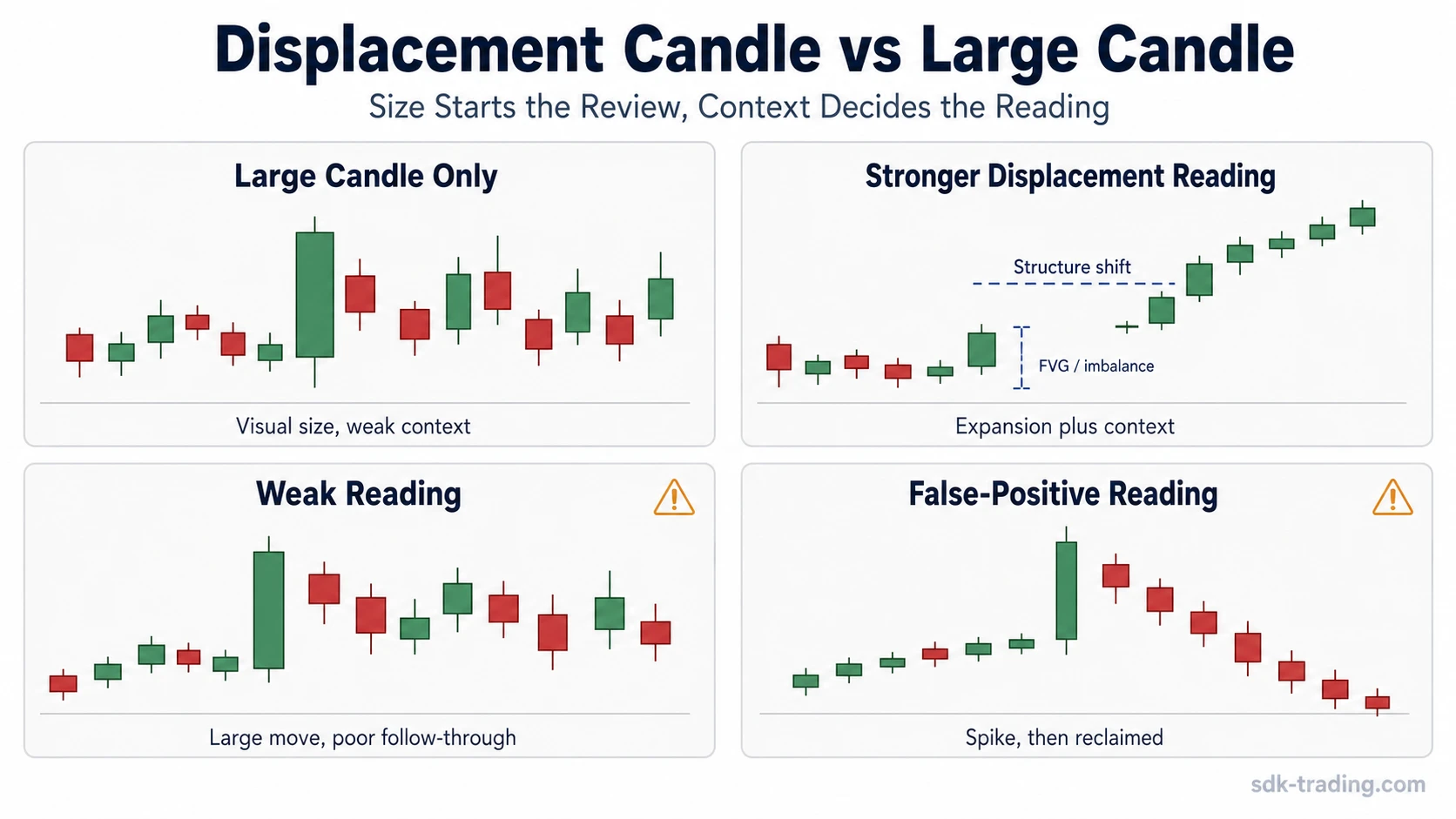
Cleaner displacement usually has several observable features working together: a decisive directional body, relatively controlled rejection for the direction being read, a possible fair value gap or imbalance, and a location that matters within market structure. If those features are missing, the candle may still be large, but the label carries less weight.
Structure matters because candle appearance is secondary to where the candle appears and what changes after it forms. A strong candle in the middle of unresolved chop is less informative than a strong candle that follows a liquidity event, breaks a prior swing, or shifts acceptance away from a contested area.
Clean, Weak, and Invalid Displacement Readings
Displacement is best treated as a graded reading, not a mechanical yes-or-no label. The same candle shape can carry different meaning depending on imbalance, follow-through, structure, and later acceptance.
| Reading | Observable behavior | What it may indicate | Why it can fail |
|---|---|---|---|
| Clean displacement | Strong directional candle bodies, possible FVG or imbalance, and a clear structural location. | Price may be repricing away from a prior area with meaningful directional pressure. | Later price can still reclaim the move, fill the inefficiency, or reject the structural shift. |
| Weak displacement | Large candle or fast movement, but poor follow-through, noisy wicks, or unclear imbalance. | The move may show temporary momentum rather than a durable change in acceptance. | The candle can become only a volatility burst if later behavior does not support it. |
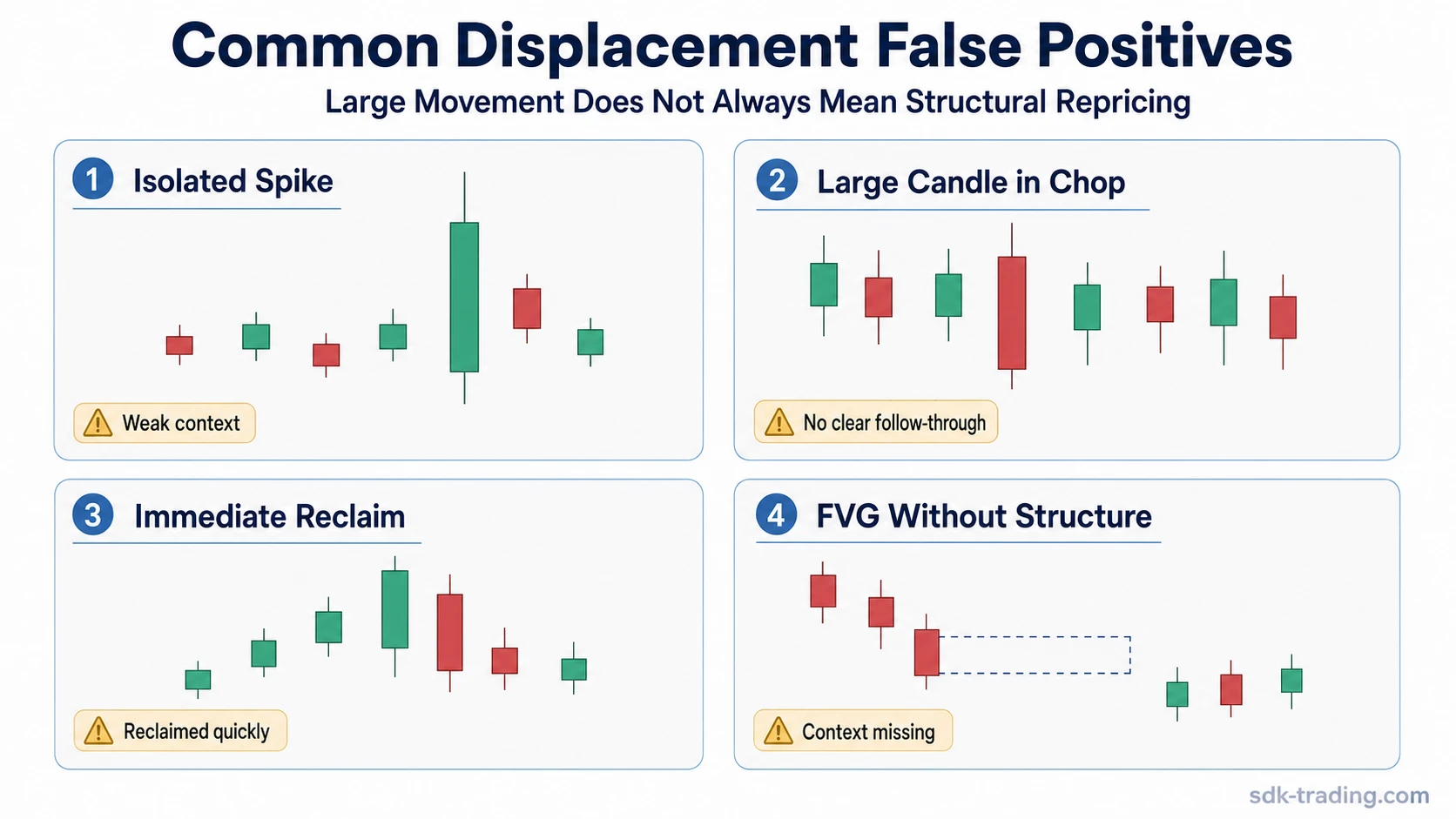
| Invalid or false-positive reading | Isolated spike, immediate reversal, no useful structure, or no clear relationship to imbalance. | The move may be random expansion, news-driven volatility, or range noise. | The label fails when the chart gives no later structural reason to treat the move as meaningful. |
Limitation: displacement does not prove institutional activity, predict continuation, or confirm a trade. It only describes a possible change in movement quality when the surrounding evidence supports that reading.
How Displacement Relates to Imbalance, FVG, and Market Structure
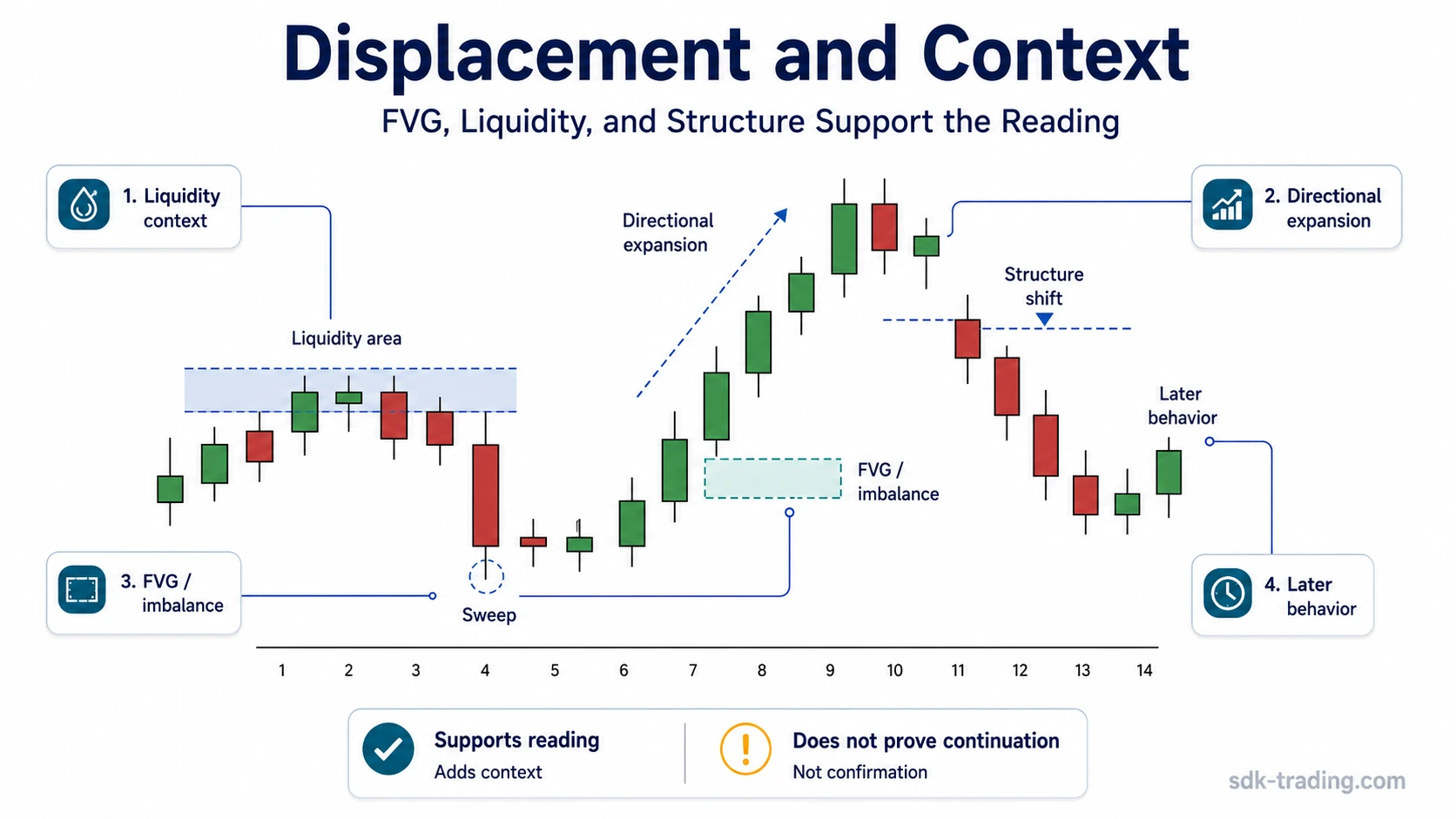
Displacement and imbalance are closely related because forceful movement can leave inefficient price action behind. A fair value gap is one way traders describe that inefficiency when the candle sequence leaves a visible gap-like area between surrounding candles. In that sense, FVG can be evidence that a move expanded quickly, but it is still context, not proof.
Market structure gives displacement a reason to matter. A forceful move through a prior swing, away from a liquidity area, or out of a compressed range can change how the chart is read. Without that structural relationship, the same candle may only show temporary speed.
Liquidity sweep context can also matter. Price may first move through a visible high or low, then expand in the opposite direction. The displacement label becomes more defensible when that expansion is not immediately rejected and when the later structure supports a change in acceptance.
Bullish and Bearish Displacement
Bullish displacement is upward directional expansion with strong buying-side movement quality. It may appear after a downside liquidity sweep, after a break in bearish structure, or during a fast repricing move that leaves imbalance behind. The label describes the direction and quality of the move, not a complete bullish trade idea.
Bearish displacement is downward directional expansion with strong selling-side movement quality. It may appear after an upside liquidity sweep, after a break in bullish structure, or during a fast repricing move lower. The same limitations apply: direction does not equal certainty, and a bearish displacement reading can weaken if price quickly reclaims the move.
The direction matters less than the sequence. A more defensible reading asks what price did before the move, what the move changed, whether imbalance was created, and how price behaved afterward.
Displacement vs Order Blocks and Mitigation Blocks
Displacement is the movement away from an area. An order block is usually treated as a prior candle or area that traders later evaluate as a possible origin point for movement. Confusing the two can blur the difference between a movement event and a price area.
A bullish mitigation block depends on revisit behavior into a prior bearish-origin area and the later response around that area. Displacement may appear before or after related block logic, but it does not create the mitigation label by itself.
Breaker blocks and inducement are also separate ideas. A breaker reading depends on failed prior-area behavior and a later role change. Inducement relates to liquidity attraction before a larger move. Displacement can interact with those concepts, but it remains the movement-quality part of the sequence.
Displacement in Trading Example in Context
Consider a market that has been moving sideways around a visible short-term low. Price briefly pushes below that low, then quickly expands upward with two strong bullish candles. The move leaves a small fair value gap and breaks above the most recent lower high.
That sequence may support a bullish displacement reading because the expansion appears after a liquidity event, creates imbalance, and changes short-term structure. The reading would weaken if price immediately dropped back through the same candles, filled the gap without response, and accepted below the prior low.
The example is not a trade instruction. It only shows how displacement is evaluated through sequence: prior condition, expansion, imbalance, structure, and later behavior.
Why Displacement Can Become a False Positive
False positives usually appear when candle size is treated as enough evidence. A single large candle can look impressive while still forming inside a range. If the move does not break meaningful structure, does not leave useful imbalance, or is immediately reclaimed, the displacement label becomes weak.
Another false positive appears when a fair value gap is read without structure. A gap-like inefficiency can form during a fast candle sequence, but that does not automatically mean the market has repriced in a useful way. The surrounding location and later behavior still matter.
A third false positive appears when a candle reacts to news or temporary volatility and then returns to the prior range. If the candle has a long upper wick, leaves no clear imbalance, and is fully retraced by the next candles, the displacement label is less reliable. The candle was large, but the later behavior did not support the idea that price was being repriced with lasting force.
Size starts the review. Sequence, structure, imbalance, and later behavior decide whether the displacement label still carries weight.
Common Mistakes When Reading Displacement
A common mistake is treating every wide candle as displacement. Wide candles can appear for many reasons, including temporary volatility, thin liquidity, or news-driven expansion. Without structural relevance, a large candle may add noise rather than clarity.
Another mistake is treating FVG as automatic confirmation. A fair value gap can strengthen the reading, but it does not remove the need for context. If price immediately fills the gap and rejects the move, the displacement label becomes less useful.
A third mistake is turning displacement into a signal. Displacement can help describe how price moved, but it does not define a complete decision process. A disciplined reading separates observation, context, and later confirmation instead of forcing the candle into a trade conclusion.
Displacement Trading FAQ
What is displacement in trading?
Displacement in trading is a strong directional price-action move that may show rapid repricing through large candles, imbalance or FVG behavior, and market-structure context. It describes movement quality, not a standalone signal.
Is every large candle a displacement candle?
No. A large candle can be only a volatility spike if it lacks imbalance, structural relevance, or later follow-through. Candle size starts the review, but context decides whether the displacement reading is useful.
How is displacement related to FVG or imbalance?
Displacement can create or accompany imbalance because price may move too quickly to trade efficiently through an area. A fair value gap can support the reading, but it does not prove displacement by itself.
Can displacement be bullish or bearish?
Yes. Bullish displacement describes strong upward expansion, while bearish displacement describes strong downward expansion. The direction only classifies the move; it does not define a trade plan.
Is displacement the same as an order block?
No. Displacement is the movement quality away from or through an area. An order block is usually treated as a prior candle or area that traders evaluate separately within price-action structure.