Breaker block vs mitigation block is a price-action distinction between two ways of reading later behavior around a prior price area. A breaker block reading depends on a prior area losing its earlier role after structural failure or acceptance beyond it. A mitigation block reading depends on a revisit into a prior area where the reaction is absorbed or contained without the same role-flip behavior.
Both labels can be drawn around zones, which is why they are often confused. The important difference is not the rectangle itself. The label depends on sequence: what the area represented first, how price returned to it, whether the area failed, and what later behavior confirmed or weakened the reading.
Core distinction: breaker logic is about a prior area failing and changing role, while mitigation logic is about a revisit into a prior area where the market works through that area without the same structural flip.
Breaker Block vs Mitigation Block: Direct Difference
A breaker block is more defensible when a prior order-flow area loses its earlier function and later becomes part of a role-reversal reading. The earlier zone is no longer simply being revisited. It has been challenged, failed, and then reconsidered after the market accepts beyond it or uses it differently.
A mitigation block is more defensible when price returns into a prior area and the later reaction looks like absorption, mitigation, or contained interaction rather than a clean structural flip. The market is revisiting a prior area, but the evidence does not yet support calling that area failed and converted into a breaker.
For bearish examples, the distinction can be studied through a bearish breaker block when the prior area loses its role and later acts differently after failure.
A bearish mitigation block focuses instead on the revisit into the prior area before that same role-change logic is justified.
Criteria Table: How to Tell Which Label Fits
| Criterion | Breaker block lens | Mitigation block lens | Misread to avoid |
|---|---|---|---|
| What the label depends on | A prior area fails, loses its earlier role, and later becomes relevant through role-reversal logic. | Price revisits a prior area and the interaction is read as mitigation or absorption. | Choosing the label from zone shape alone. |
| Prior area behavior | The earlier area is challenged and no longer behaves as it did before. | The earlier area is revisited, but not necessarily broken and converted into a new role. | Calling every old zone a breaker after one return. |
| Structural failure or containment | Structural failure or acceptance beyond the area matters more than the first touch. | Contained response around the area matters more than a full role shift. | Treating a contained revisit as proof of failure. |
| Liquidity sweep relevance | A sweep can support breaker logic only when later behavior shows failure and role change. | A sweep can occur near a mitigation reading, but the label still depends on the later response. | Using a liquidity sweep as an automatic label. |
| Revisit or retest behavior | The retest matters after the area has lost its prior role. | The revisit matters because price is working through a prior area without the same role conversion. | Assuming every retest is mitigation. |
| Continuation vs shift reading | May support a shift reading when the prior area fails and later behavior accepts that change. | May support a continuation or absorption reading when the prior area is revisited but not converted. | Turning either label into a directional prediction. |
| What makes the label premature | The area has not clearly failed or changed role yet. | The revisit has not shown enough contained behavior around the prior area yet. | Labeling the first touch before later behavior is visible. |
| What the label does not prove | It does not prove a reversal, continuation, entry, target, or outcome. | It does not prove a reversal, continuation, entry, target, or outcome. | Reading either concept as a complete trading model. |
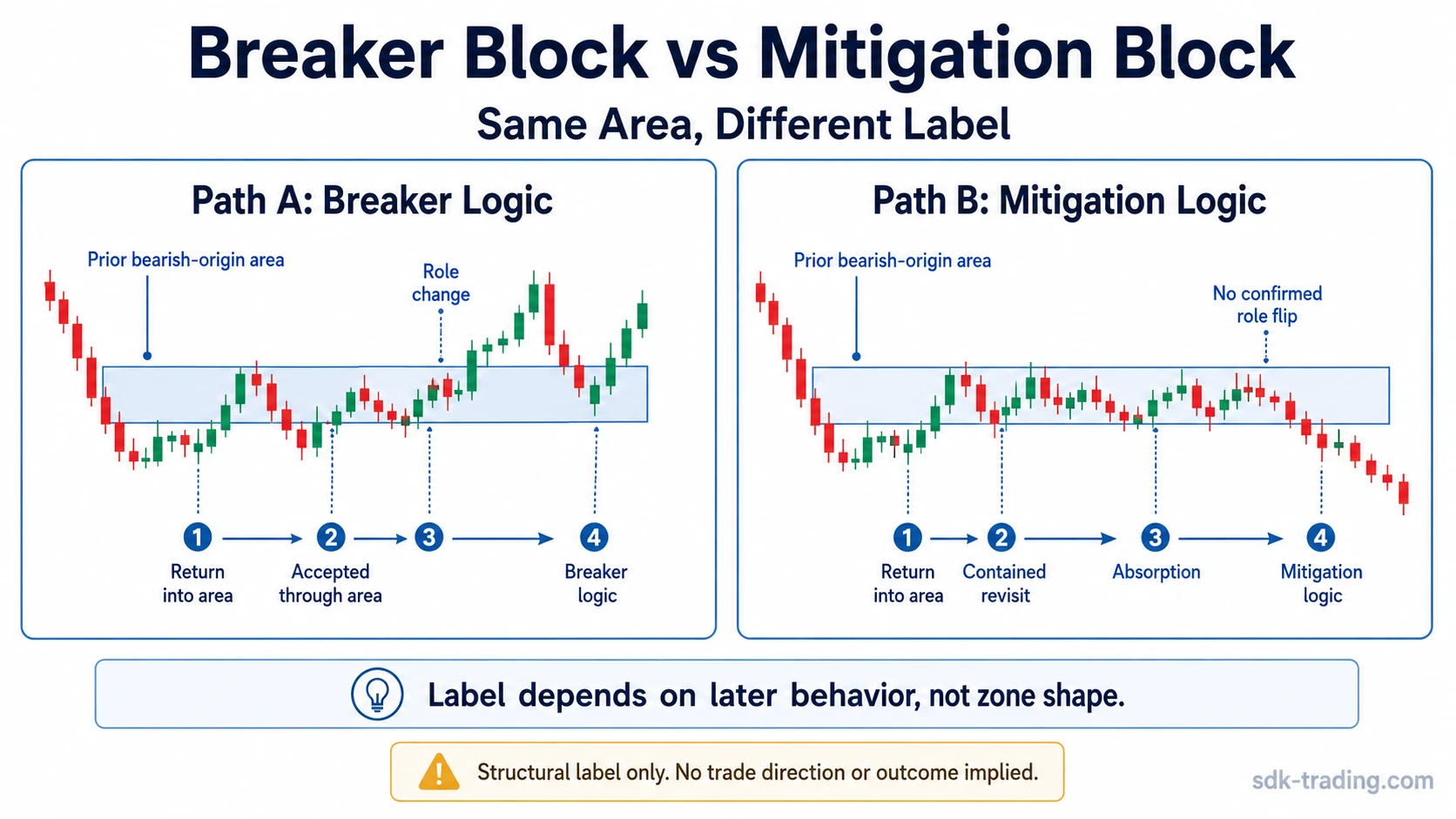
Same Area, Different Label
Consider a prior bearish-origin area that price later revisits. At first, the area may look similar in both readings because the chart still contains a marked zone, a return into that zone, and later reaction around it.
Path A: Price returns to the prior bearish-origin area, accepts through it, and the area loses its earlier role. Later interaction with that area supports breaker logic because the old function has failed and the market is treating the area differently.
Path B: Price returns to the prior bearish-origin area, reacts inside or around it, and remains contained without the same accepted role change. That supports mitigation logic because the area is being revisited and worked through, but not yet converted into breaker behavior.
The same drawn rectangle can therefore produce different labels. The distinction comes from the sequence after the revisit, not from the fact that the zone exists.
Use the Breaker Lens When the Prior Area Fails
The breaker lens fits better when the earlier area no longer performs its prior function. A prior bearish-origin area, for example, may stop behaving like a supply-side reference after price accepts beyond it. Later interaction can then be read through a role-reversal framework rather than a simple revisit.
The key condition is not that price touched the area. The key condition is that the prior meaning of the area has been damaged or replaced by later structure. Without that failure or role change, breaker language is usually too early.
Limitation: A failed reaction near a prior zone is not automatically a breaker block. The stronger reading needs evidence that the area lost its earlier role and that later behavior accepted that change.
Use the Mitigation Lens When the Revisit Is Contained
The mitigation lens fits better when price returns into a prior area and the later behavior looks like a contained revisit, absorption, or working-through process. The area is still relevant, but the evidence does not yet show the same structural failure that would justify breaker logic.
This is why mitigation block readings often remain more conditional at first. The zone can be meaningful, but the label becomes stronger only when the revisit and the following behavior stay consistent with mitigation rather than role reversal.
Important distinction: mitigation is not the same as a guaranteed reaction. It is a diagnostic label for how price interacts with a prior area. Later behavior can still weaken or change the reading.
Why Breaker and Mitigation Blocks Look Similar
The labels are confused because both can begin with a prior zone, both can involve a revisit, and both can appear near order-block or imbalance language. On a chart, the early drawings may look almost identical.
The difference appears when the sequence is tested. A breaker reading needs prior-area failure and role change. A mitigation reading needs a revisit or absorption process without the same confirmed role flip. That is why the decision boundary should come from later behavior around the area rather than from the initial candle group or zone width.
Fair value gap language can appear nearby when the chart also contains displacement or an inefficient price area, but a fair value gap is not the same classification problem. Breaker and mitigation labels are about how a prior area is later treated.
Common Misreads
| Misread | Why it is weak | Cleaner interpretation |
|---|---|---|
| The rectangle shape decides the label. | Both readings can begin with similar-looking zones. | Use later behavior around the area as the decision point. |
| Any sweep confirms a breaker block. | A sweep alone does not prove role change. | Look for failure of the prior role and accepted behavior after that failure. |
| Any revisit confirms mitigation. | A revisit only shows that price returned to the area. | Mitigation needs contained interaction, absorption, or working-through behavior. |
| A breaker block is automatically stronger than mitigation. | The labels describe different structural readings, not quality rankings. | Judge whether the later sequence supports role change or contained revisit. |
| The label predicts the next move. | Neither label proves direction, continuation, reversal, or outcome. | Treat both as diagnostic structure labels, not complete trading instructions. |
Decision Boundary Checklist
Before choosing between breaker block and mitigation block language, check the sequence rather than the drawing:
- What was the prior area before price returned to it?
- Did the area clearly fail or lose its earlier role?
- Did price accept beyond the area or only react around it?
- Was the later interaction a role change or a contained revisit?
- Is the label being chosen from evidence, or only from the fact that a zone can be drawn?
If the prior role failed and later behavior accepts that change, breaker logic becomes more defensible. If price is still working through the prior area without a confirmed role flip, mitigation logic is usually the cleaner label.
FAQ
What is the main difference between a breaker block and a mitigation block?
A breaker block reading depends on a prior area failing and changing role. A mitigation block reading depends on price revisiting a prior area and being absorbed or contained without the same confirmed role flip.
Is every failed zone a breaker block?
No. A failed zone supports breaker logic only when later behavior shows that the area lost its earlier role and became relevant through a new structural relationship.
Is every revisit into a prior area a mitigation block?
No. A revisit is only the starting condition. A mitigation reading becomes more defensible when the later reaction shows absorption or containment around the prior area.
Can a mitigation reading later become breaker logic?
Yes. If the area later fails, price accepts beyond it, and the prior role changes, the same area may become better described through breaker logic.
Do breaker blocks or mitigation blocks predict market direction?
No. They are structural labels for reading behavior around prior areas. They do not prove a reversal, continuation, entry, exit, target, or outcome.