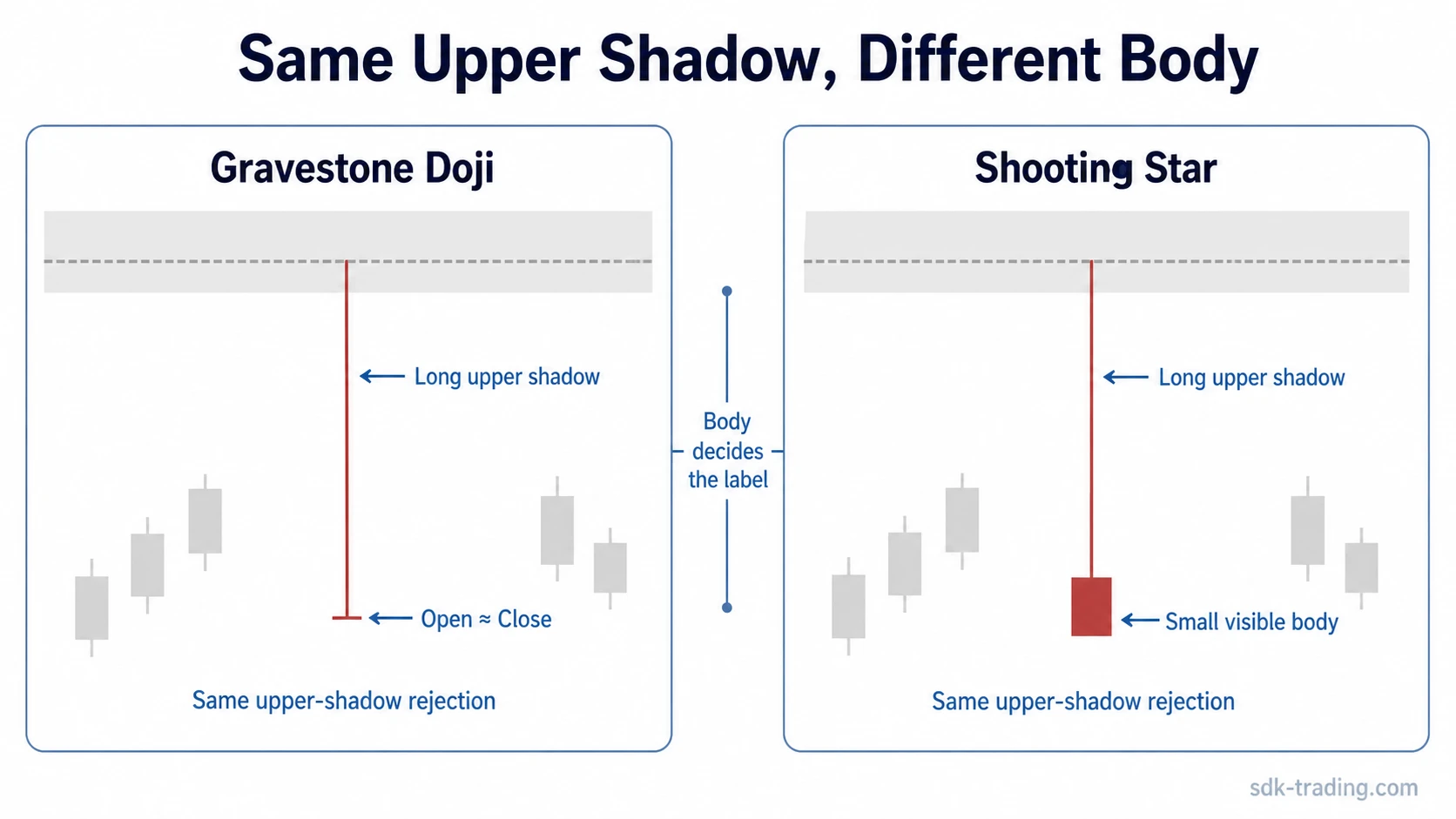
A long upper shadow after an upside probe can make these candles look almost identical. The difference is the body: a gravestone doji has a near-equal open and close near the session low, while a shooting star keeps a small but visible real body near the low.
- Both candles can have a long upper shadow after an upside probe.
- A gravestone doji has a near-equal open and close near the low.
- A shooting star keeps a small visible real body near the low.
- Confirmation affects the rejection reading, not the candle name.
Gravestone Doji vs Shooting Star: Quick Distinction
A gravestone doji belongs to the doji family because the open and close are nearly equal near the low.
A shooting star can share the same upper-shadow rejection, but a small real body remains visible near the low.
The wick creates the overlap; the body decides the classification. A long upper shadow alone does not make a candle a gravestone doji.
Same Upper-Shadow Scenario, Different Classification
Price advances into a prior resistance area, briefly trades higher, then closes back near the session low. Both candles can record that failed upside attempt. The classification turns on the body: near-equal open and close favors a gravestone doji, while a small visible real body favors a shooting star.
| Criterion | Gravestone Doji | Shooting Star |
|---|---|---|
| Upside attempt | Price probes higher and retreats. | Price probes higher and retreats. |
| Body relationship | Open and close are nearly equal. | Open and close are separated enough to form a visible body. |
| Body location | Body sits near the session low. | Body sits near the session low. |
| Upper shadow | Long upper shadow dominates the candle range. | Long upper shadow dominates the candle range. |
| Lower shadow | Usually little or none. | Usually little or none. |
| Candle family | Doji-family upper-shadow candle. | Small-body upper-shadow candle. |
| Resistance context | Can make the failed upside attempt more relevant. | Can make the failed upside attempt more relevant. |
| Later confirmation | Changes the rejection reading, not the candle name. | Changes the rejection reading, not the candle name. |
How to Classify the Candle
Start with the open-close relationship before judging the wick. The upper shadow may be the most visible feature, but it is not the naming rule.
- Check body compression. If the open and close are nearly equal, the candle is closer to a gravestone doji. If the body remains visible, it is closer to a shooting star.
- Check body location. Both candles place the body near the low of the session.
- Check upper-shadow dominance. Both candles need a long upper shadow that records an upside attempt and retreat.
- Check the lower shadow. A large lower shadow weakens the clean classification for both patterns.
- Add market context. A candle near resistance, after an advance, or near an overextended area can make the rejection reading more relevant.
- Use confirmation for interpretation. Later candles can strengthen or weaken the rejection reading, but they do not rename the original candle.
Where Traders Misread the Difference
The most common mistake is treating the long upper wick as the whole pattern. That works visually, but it fails as a classification rule because both candles can have the same dominant upper shadow.
| Misread | Safer Check |
|---|---|
| The upper wick is long, so it must be a gravestone doji. | Check whether the open and close are nearly equal. |
| The body is tiny, so the candle name does not matter. | A tiny visible body can still separate a shooting star from a doji-family candle. |
| The candle closed near the low, so both names are interchangeable. | Close location matters, but open-close structure decides the label. |
| Later bearish candles turn the candle into a different pattern. | Later candles affect confirmation, not the original candle identity. |
| Chart scaling makes the body look invisible. | Assess the body relative to the full candle range, not only the zoomed visual impression. |
Context and Confirmation
Context can make either candle more meaningful, especially when the upper shadow forms after an advance, near resistance, or around an area where buying pressure has already started to weaken. Even then, the candle remains only one piece of evidence.
If later candles fail to reclaim the upper-shadow area and price continues to accept lower levels, the rejection remains active. If price quickly trades back above that area and holds there, the failed-upside interpretation loses priority.
Confirmation changes the reading, not the candle name. A gravestone doji stays a gravestone doji if the open and close were nearly equal. A shooting star stays a shooting star if a visible real body remained near the low.
Use This Lens When the Body Is Hard to Judge
Some candles sit near the boundary between the two labels. A small chart, compressed price scale, or thin candle body can make the difference look less obvious. The cleaner approach is to classify the candle by proportion first, then interpret it through context.
| Condition | Likely Reading | Limitation |
|---|---|---|
| Open and close are almost identical near the low. | Gravestone doji is the cleaner label. | Confirmation is still needed before treating the rejection as active. |
| Small but visible body remains near the low. | Shooting star is the cleaner label. | The body must be judged against the full candle range. |
| Upper wick dominates, but body detail is unclear. | Upper-shadow rejection is visible, but classification is less certain. | Zoom level and data source can affect the visual reading. |
| Later candles fail to reclaim the upper-shadow area. | Upper-shadow rejection remains active. | The later move does not change the original candle structure. |
| Later candles reclaim and hold above the upper-shadow area. | Failed-upside interpretation loses priority. | The candle name still comes from the original open-close structure. |
FAQ
Can a shooting star look like a gravestone doji?
Yes. A shooting star can look like a gravestone doji when the real body is very small. The deciding check is whether the open and close are nearly equal or whether a visible real body remains.
Does a long upper wick make it a gravestone doji?
No. A long upper wick can appear in both candles. A gravestone doji needs near-equal open and close near the low, while a shooting star keeps a small visible real body near the low.
Does confirmation change the candle name?
No. Confirmation can keep the failed-upside interpretation active or push it aside, but it does not rename the original candle. The candle name comes from its own open, close, body, and shadow structure.
Which candle is more bearish?
Neither candle is automatically more bearish by name alone. The rejection reading depends on where the candle forms, how the body is structured, and whether later candles confirm or invalidate the failed upside attempt.