A Shooting Star candlestick pattern is a single-candle structure where price pushes higher after prior upward pressure, fails to hold the upper area, and closes back near the lower part of the candle range. The long upper wick records the higher-price probe, while the small lower-range body shows that the probe was not accepted by the close.
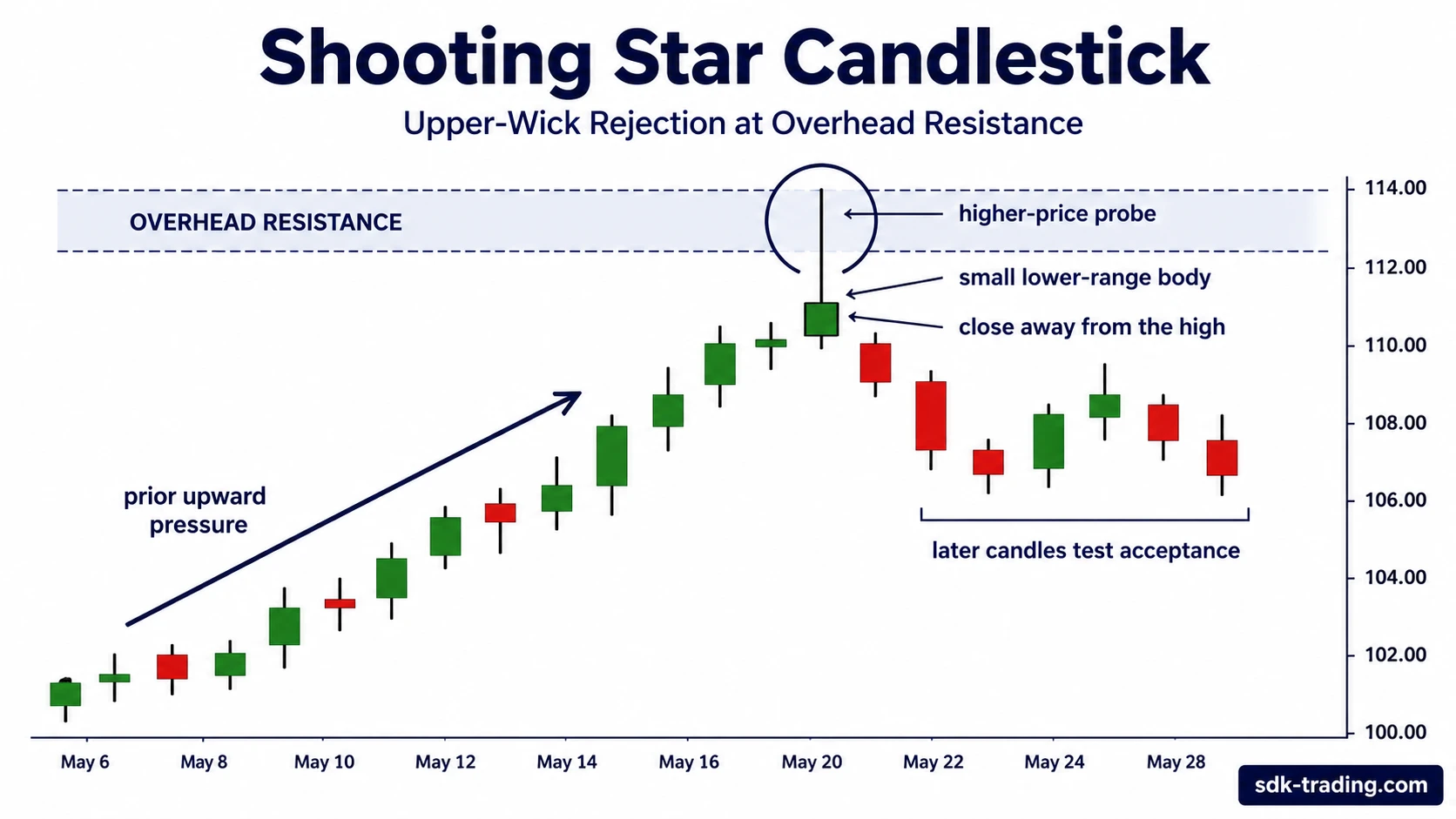
Safe interpretation: a Shooting Star is not a reversal signal by itself. The reading depends on prior upward pressure, the upper-wick structure, close location, and whether later candles accept or reject the tested high.
Shooting Star Checklist
- Appears after prior upward pressure, a rally, or a recovery attempt.
- Has a dominant long upper wick that records a higher-price probe.
- Has a small real body near the lower part of the candle range.
- Has little or no lower wick, so the candle is not visually balanced.
- Needs later candles to test whether the upper probe was rejected or accepted.
Shooting Star Candlestick Anatomy
The anatomy of a Shooting Star starts with the relationship between the upper wick, real body, lower wick, high, low, open, and close. The candle can be red or green, but the cleaner structure has a small body near the low of the range and a close away from the high.
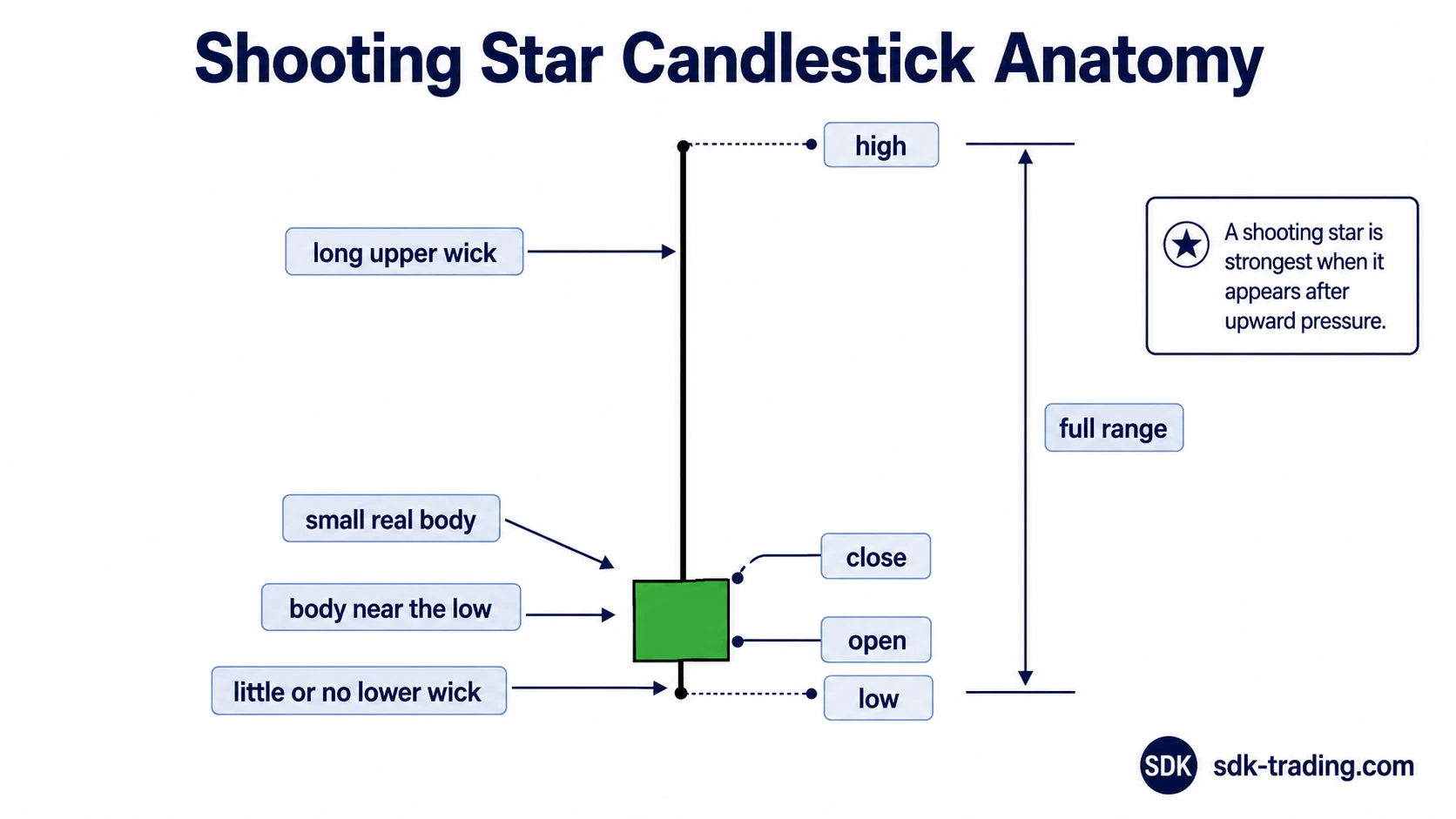
| Candle part | Cleaner Shooting Star reading | What weakens it |
|---|---|---|
| Upper wick | Dominates the candle and marks a clear higher-price probe. | The upper wick exists but does not dominate the full structure. |
| Real body | Small and positioned near the lower part of the range. | The body is large, centered, or too close to the high. |
| Lower wick | Small or absent. | Large enough to make the candle look balanced or indecisive. |
| Close location | Finishes away from the high, near the lower part of the range. | Closes too close to the high, reducing the failed-probe reading. |
| Prior context | Appears after upward pressure or a test of an overhead area. | Appears in the middle of a noisy range with no clear prior push. |
How to Identify a Shooting Star Candlestick
The first check is location. A Shooting Star needs some form of upward pressure before it forms. That can be a short rally, an extended advance, a recovery into supply, or a test near resistance.
The second check is structure. The upper wick should dominate the candle, the body should sit near the lower part of the range, and the close should show that price did not finish near the tested high. A small lower wick is acceptable, but a large lower wick makes the candle less clean.
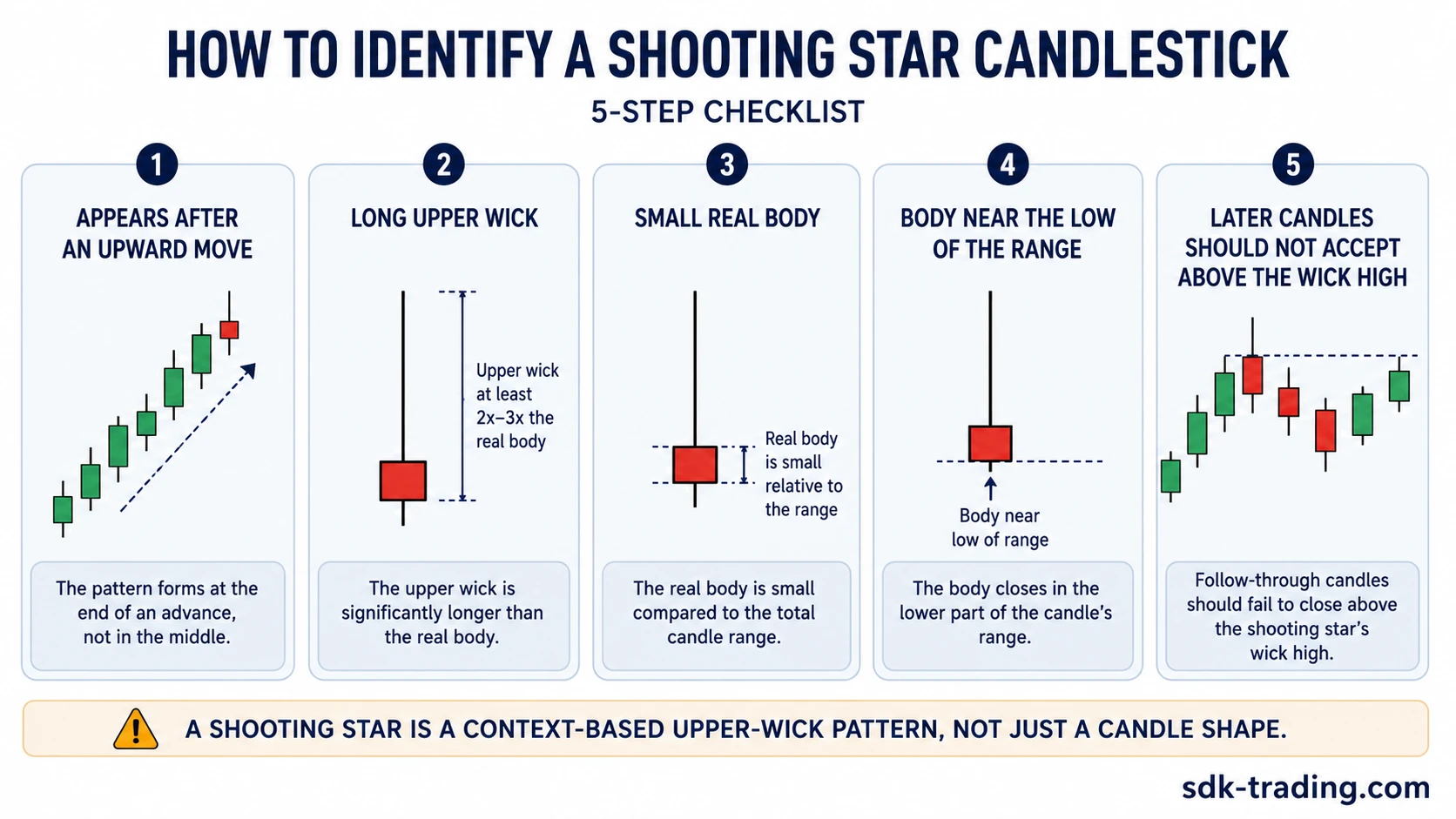
| Identification check | Cleaner reading | Weaker reading |
|---|---|---|
| Prior movement | Appears after upward pressure, a rally, or a recovery attempt. | Forms without a meaningful prior push. |
| Upper wick | Clearly shows a higher-price probe. | Only slightly longer than the body or not visually dominant. |
| Body placement | Small body near the lower part of the candle range. | Body is large, centered, or too close to the high. |
| Lower wick | Little or no lower wick. | Lower wick is large enough to create a balanced candle. |
| Later candles | Do not accept above the upper wick high. | Close and hold above the tested high. |
What a Shooting Star Shows Mechanically
A Shooting Star shows a failed upper-price probe. Buyers push price higher during the candle, but the upper area does not hold into the close. The final candle shape records the difference between the intraperiod test and the area where price actually settled.
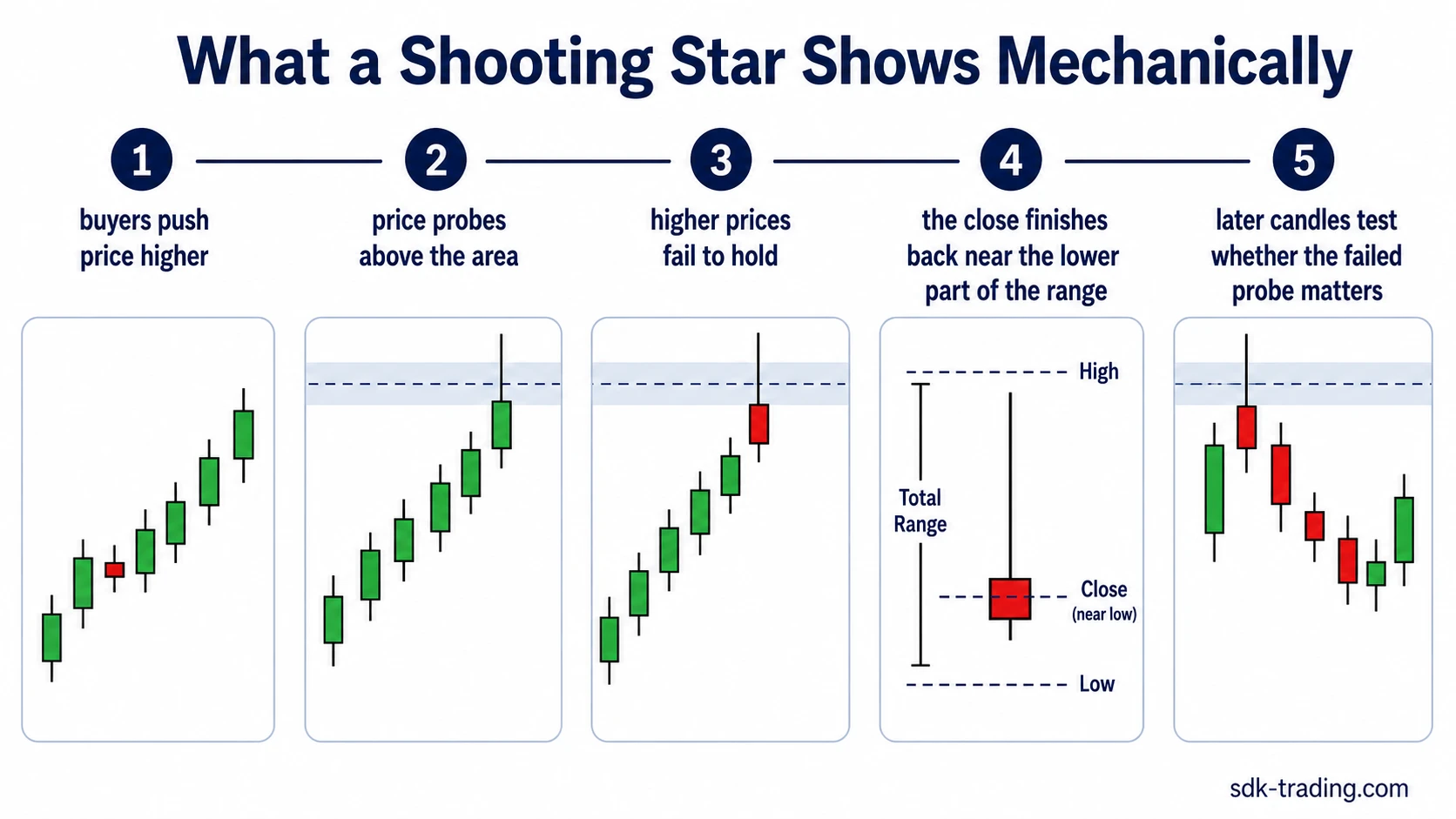
That is why the candle should not be treated as a standalone bearish command. It is a warning that the upper probe failed during that candle. The reading becomes more useful when it appears where an upper test already matters, such as after a rally, near a prior high, or around an area where supply has appeared before.
Resistance-specific context changes the reading because a failed upper probe carries more weight when it occurs near a prior reaction area. The concept of shooting star at resistance narrows the interpretation to that location-specific case.
Clean, Weak, and Invalid Shooting Star Readings
The useful question is not whether the candle has a long upper wick. The useful question is whether the full structure supports a failed upper-price probe after upward pressure. A clean reading, a weak reading, and an invalid reading can look similar at first glance.
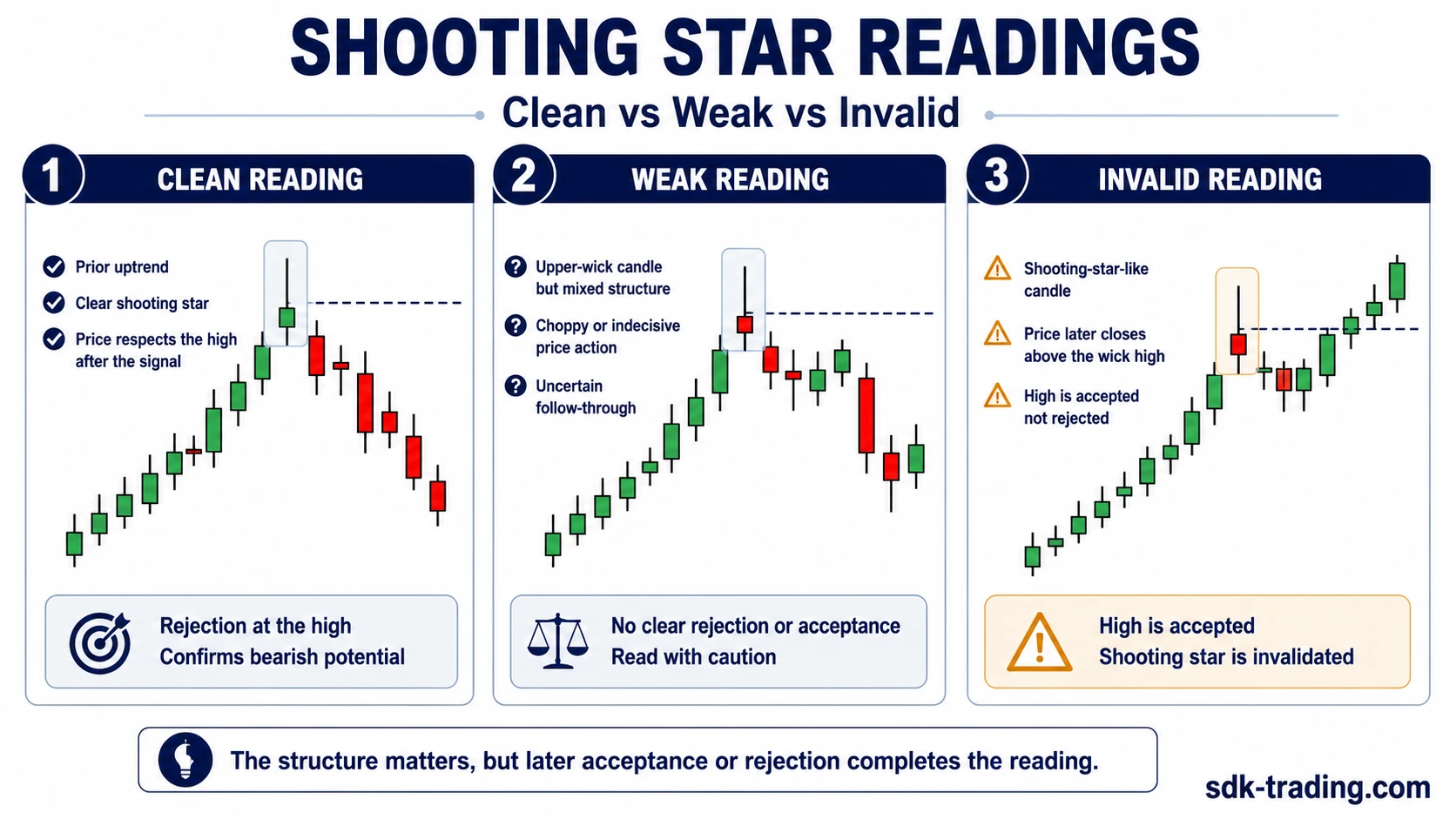
| Reading quality | What it looks like | Interpretation boundary |
|---|---|---|
| Cleaner Shooting Star | Prior upward pressure, dominant upper wick, small lower-range body, and close away from the high. | Supports a failed upper-probe warning, but still needs later price response. |
| Weaker Shooting Star | Upper wick exists, but body size, lower wick, close location, or context is unclear. | The candle may show rejection, but the Shooting Star label carries less weight. |
| Invalid Shooting Star reading | Later candles close and hold above the wick high, or the shape appears without prior upward pressure. | The failed-probe interpretation has broken down. |
Acceptance vs Failed Acceptance After a Shooting Star
A Shooting Star records failure inside one candle, but later candles show whether that failure remains meaningful. If later candles stay below the tested upper area and struggle to recover it, the failed-probe reading remains more defensible. If later candles reclaim and accept above that upper area, the candle loses much of its diagnostic value.
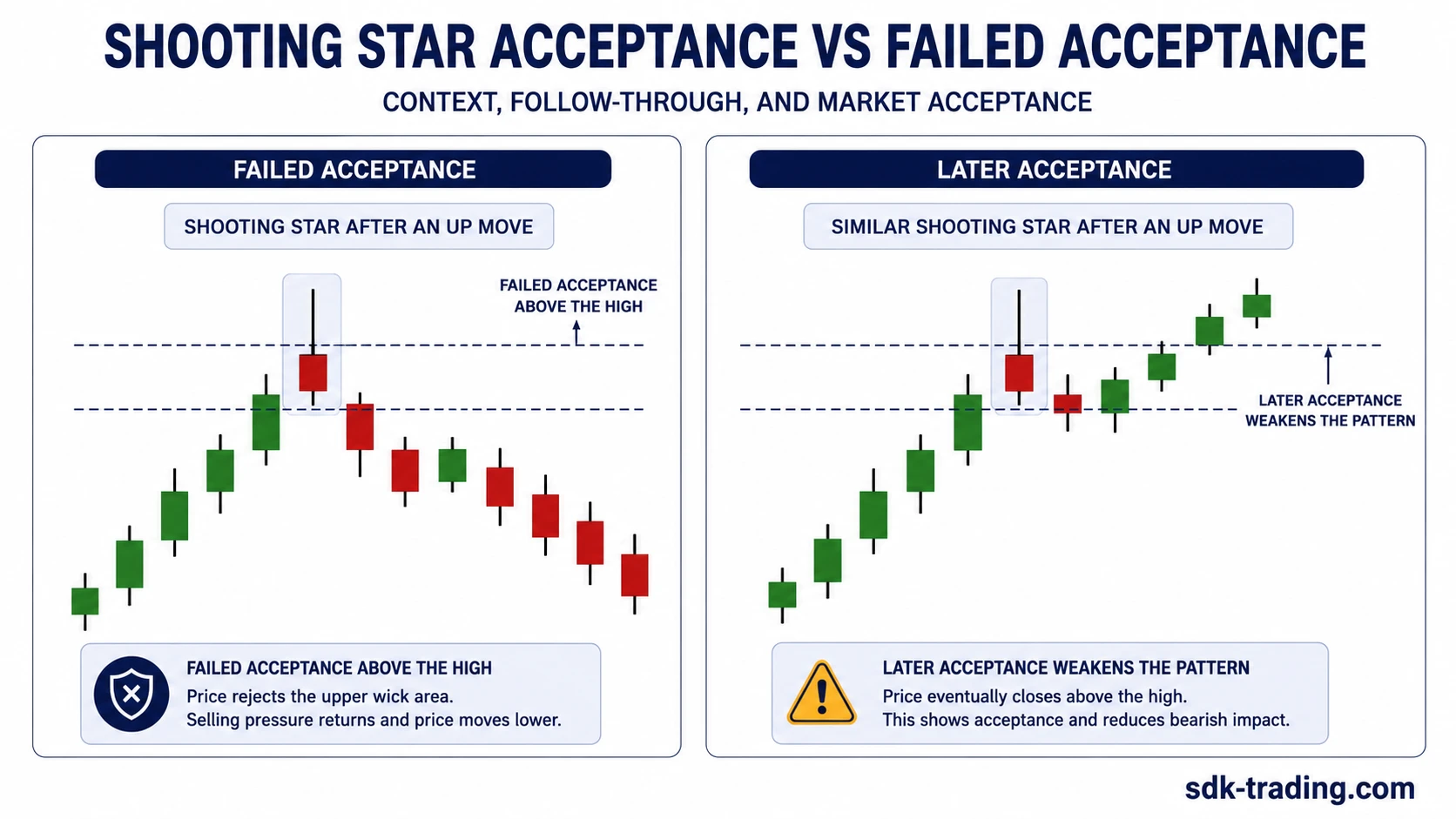
Follow-through is the main boundary between an isolated upper wick and a more meaningful rejection attempt. The concept of shooting star confirmation focuses on whether later candles reject, reclaim, or accept above the tested upper area. A Shooting Star only starts the diagnostic question.
What a Shooting Star Can and Cannot Confirm
A Shooting Star can show that price tested higher levels during one candle and failed to finish near that upper extreme. It can also identify the area where the upper probe failed after prior upward pressure.
It cannot confirm a complete bearish reversal by itself. The reading becomes stronger only if later candles continue to reject the tested upper area, and it weakens if price accepts back above that area.
| Question | Interpretation boundary |
|---|---|
| What can the candle show? | A failed upper-price probe during that candle. |
| What does it need? | Prior upward pressure and later behavior that does not accept above the tested high. |
| What should stay separate from the candle? | Trade planning, risk placement, and outcome assumptions should not come from the candle alone. |
| What weakens the reading? | Unclear prior context, a large or centered body, balanced shadows, or later acceptance above the upper probe. |
Why a Long Upper Wick Is Not Always a Shooting Star
A long upper wick can appear in many candles. It can belong to a rejection candle, a spinning top, a pin bar, an inverted hammer, or a random volatile bar. The Shooting Star label becomes useful only when the candle combines shape, location, and a failed upper close after upward pressure.
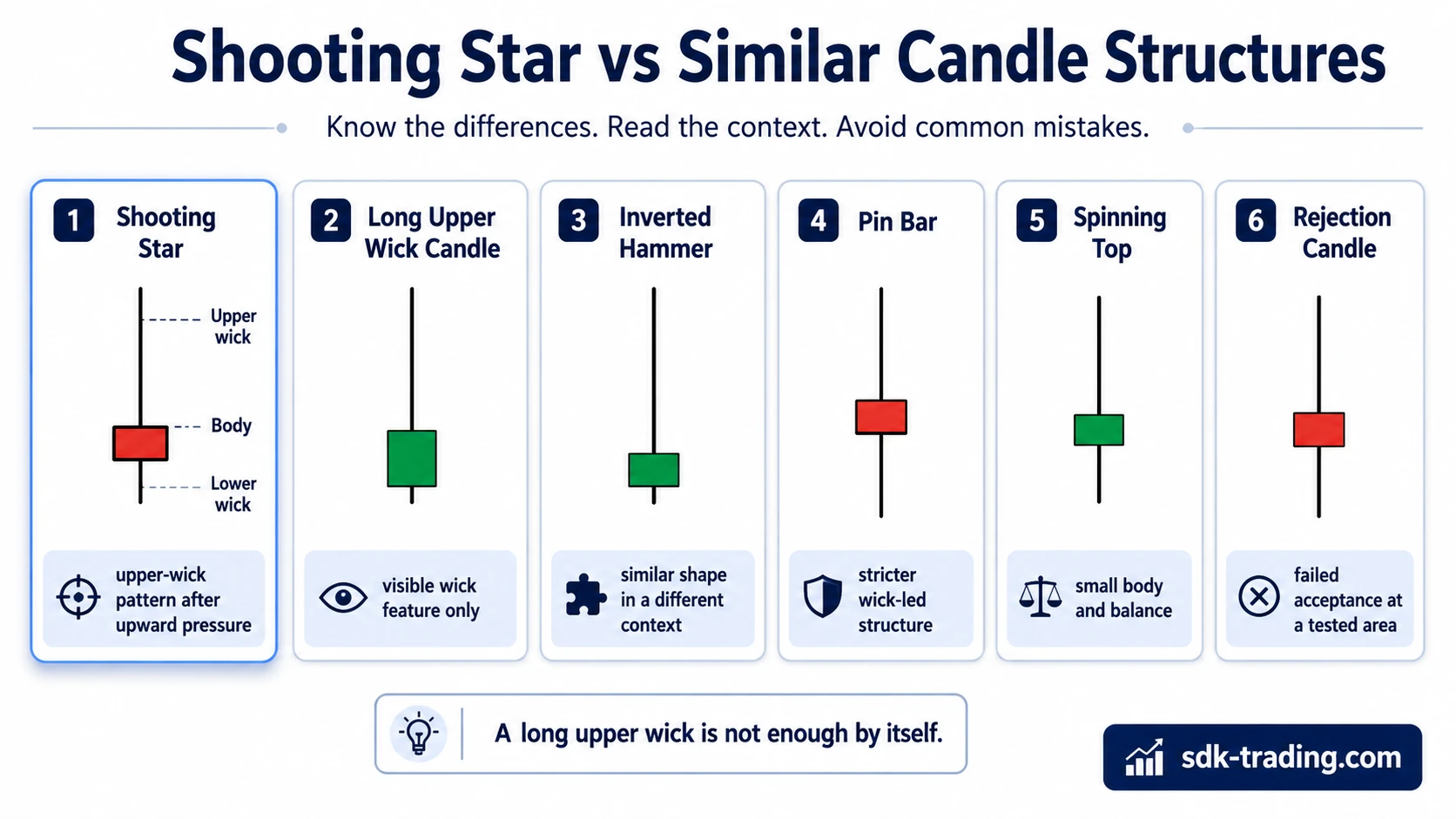
A broader rejection candle can reject either side of the range and does not require the same specific prior context. A spinning top usually has a small body with more balanced shadows, so it often shows two-sided uncertainty rather than a cleaner upper-probe failure.
| Similar structure | Why it can be confused | Main boundary |
|---|---|---|
| Shooting Star | Long upper wick and small lower-range body. | Needs prior upward pressure and a failed upper-price probe. |
| Long upper wick candle | Shows a visible upper shadow. | Wick length alone does not create the Shooting Star context. |
| Inverted hammer | Can look almost identical in candle shape. | Usually appears after downside pressure, not after an advance. |
| Pin bar | Also uses a dominant wick as part of the reading. | Uses stricter wick-led structure and can appear in broader contexts. |
| Spinning top | Can have a small body and visible shadows. | Shadows are more balanced, so the candle is less one-sided. |
| Rejection candle | Also records failed acceptance at a tested area. | Can be upper or lower and does not require Shooting Star-specific prior context. |
Shooting Star in an Uptrend
A Shooting Star is most commonly discussed after an uptrend because that is where a failed upper-price probe can warn that demand is no longer holding higher prices cleanly. The candle does not prove that the uptrend has ended. It only shows that the tested upper area failed during that candle.
In a trend context, shooting star in uptrend depends on the same candle anatomy but puts more weight on the preceding advance, the location of the upper probe, and whether later candles continue to reject the tested area.
Shooting Star Chart Example: Clean, Weak, and Invalid Candidates
A chart can contain several upper-wick candles that look similar at first. The safer reading is to classify each candidate by context, structure, and later response instead of naming every long upper wick as a Shooting Star.
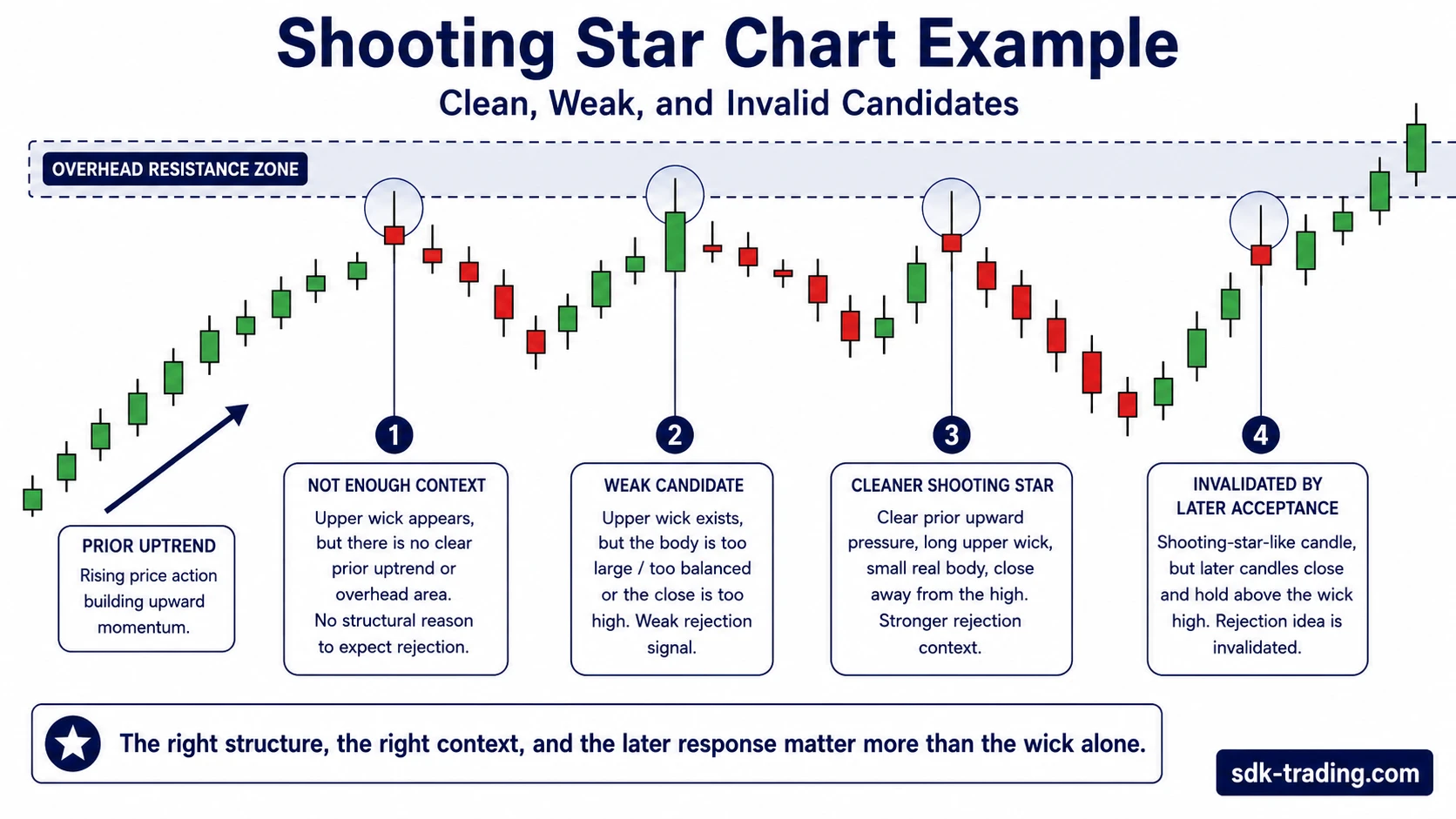
In the first candidate, the candle has an upper wick, but the surrounding chart does not give enough prior upward pressure or overhead context. In the second candidate, the upper wick exists, but the body or close location weakens the Shooting Star reading. In the cleaner candidate, the candle appears after upward pressure, probes higher, and closes away from the high. In the invalid example, later candles accept above the wick high, so the earlier failed-probe reading should not be forced.
How to Read a Shooting Star Without Overreading It
A practical reading starts with the candle, but it should not stop there. First, check whether price had been moving upward before the candle. Second, check whether the upper wick clearly dominates the body and lower shadow. Third, check whether the close failed to hold the upper part of the range. Fourth, watch whether later candles reject or accept the tested upper area.
If those pieces align, the Shooting Star becomes a cleaner warning that the upward test did not hold. If one or more pieces are missing, the candle becomes weaker. If later price accepts above the tested upper area, the original failed-probe interpretation should be treated as invalid rather than forced into the chart.
FAQ
What does a Shooting Star candlestick mean?
A Shooting Star candlestick means price tested higher levels during the candle but closed back near the lower part of the range. It is usually read as a warning that the upper probe was not accepted, especially after prior upward pressure.
What makes a Shooting Star reading stronger?
A Shooting Star reading becomes stronger when it appears after prior upward pressure, tests a meaningful upper area, closes away from the high, and later candles fail to accept back above the upper probe.
Can a Shooting Star have a lower wick?
Yes. A small lower wick can exist. The reading becomes weaker if the lower wick becomes large enough to make the candle look balanced, because the structure then looks less like a clean upper-price rejection.
What invalidates a Shooting Star reading?
The reading weakens or becomes invalid when later candles accept above the upper probe area, when the candle forms without prior upward pressure, or when the body and shadows do not match the Shooting Star structure.
How is a Shooting Star different from a spinning top?
A Shooting Star has a dominant upper wick and a small body near the lower part of the range. A spinning top usually has a small body with more balanced upper and lower shadows, so it shows broader indecision rather than a clearer failed upper-price probe.