A Spinning Top candlestick pattern in trading is a single-candle formation with a small but visible real body, upper and lower shadows, and a close near the open or body area. It reflects two-sided movement during the candle period: price pushed in both directions, but neither side produced strong net progress by the close.
Key Points
- A Spinning Top candlestick has a small visible body, not a nearly bodyless structure.
- Both upper and lower shadows matter because they show movement above and below the body area.
- The close near the open shows that neither side controlled the final result of the candle period.
- Body color can add nuance, but it does not decide the reading by itself.
- The candle is diagnostic, not predictive. Later candles matter most when they accept or reject the Spinning Top range.
What Is a Spinning Top Candlestick?
Definition: A Spinning Top candlestick is a small-bodied candle with visible upper and lower shadows. Unlike a doji, it keeps a real body; unlike a one-sided rejection candle, it shows probing on both sides of the body area.
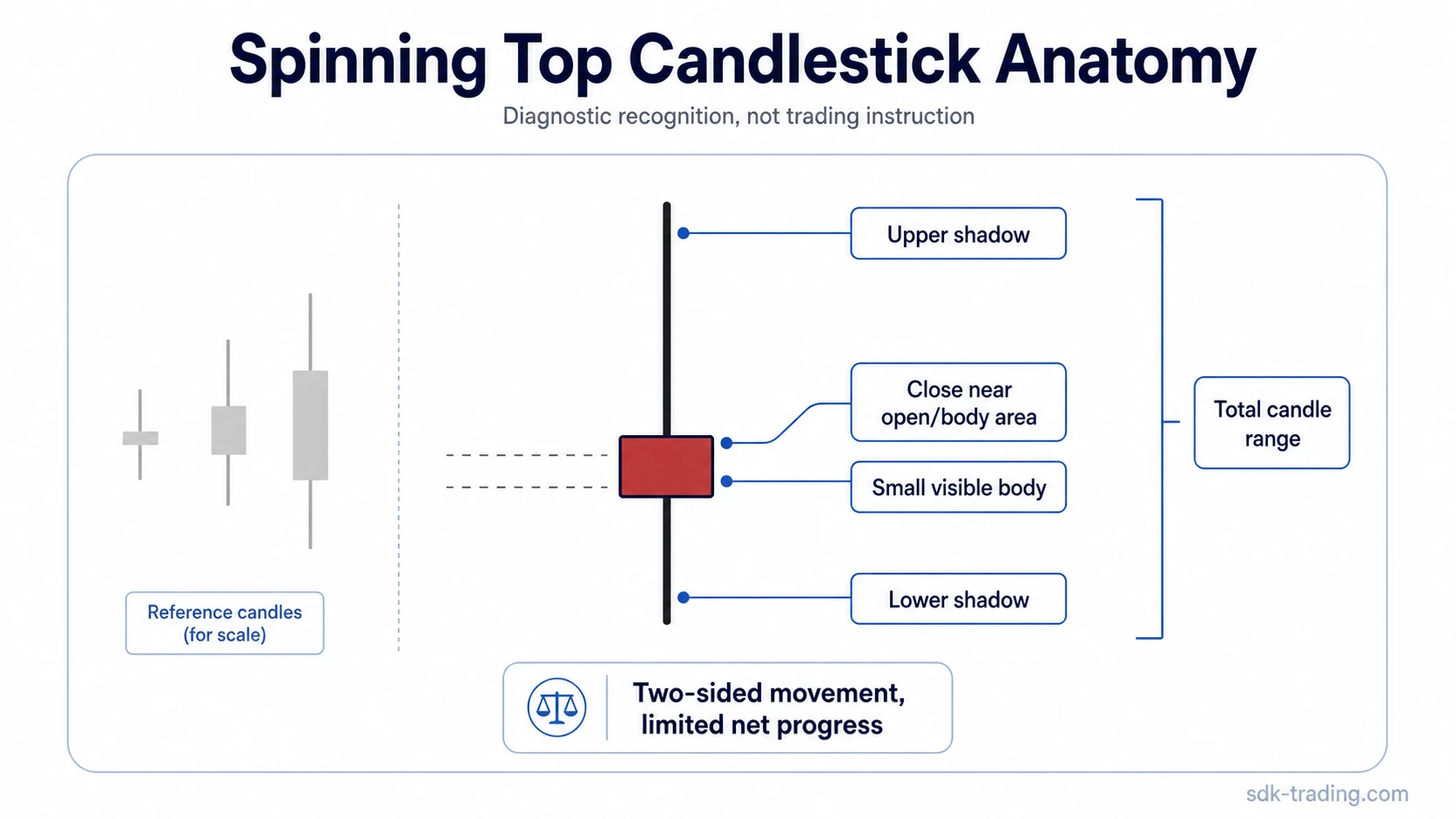
The body is the important boundary. A Spinning Top is not defined only by long shadows or only by a small body. The candle needs a visible body and two-sided shadow activity, so the final shape shows hesitation rather than clean directional control.
A bullish body and a bearish body can both qualify. A close slightly above the open may show a small upward result, while a close slightly below the open may show a small downward result. In both cases, the main reading comes from the relationship between the body, shadows, and close location.
Spinning Top Candlestick Anatomy
The anatomy of a Spinning Top candlestick is best read as a relationship between parts, not as a single measurement. The small body, two shadows, and close location work together to show movement without decisive control.
| Component | What to look for | Why it matters |
|---|---|---|
| Real body | Small but visible distance between open and close | Shows that the candle did make some net movement, unlike a near-bodyless doji reading. |
| Upper shadow | Price moved above the body area before closing lower than the high | Shows that upside movement was attempted but not fully held into the close. |
| Lower shadow | Price moved below the body area before closing above the low | Shows that downside movement was attempted but not fully held into the close. |
| Close location | Close remains near the open or body area | Shows limited net progress after movement in both directions. |
| Shadow balance | Upper and lower shadows are both visible, but exact equality is not required | Separates a two-sided hesitation candle from a one-sided rejection structure. |
| Context | Position after a directional move, near a range boundary, or around a prior reaction area | Shows whether the candle marks ordinary rotation or a more important hesitation point that needs later follow-through. |
Spinning Top Candlestick Example on a Chart
A Spinning Top is easier to read when it appears inside a short price sequence. Price may move upward first, then form a small-bodied candle with upper and lower shadows near a prior reaction area. The candle does not confirm a reversal by itself. It shows that the latest candle period produced movement in both directions without clean continuation.
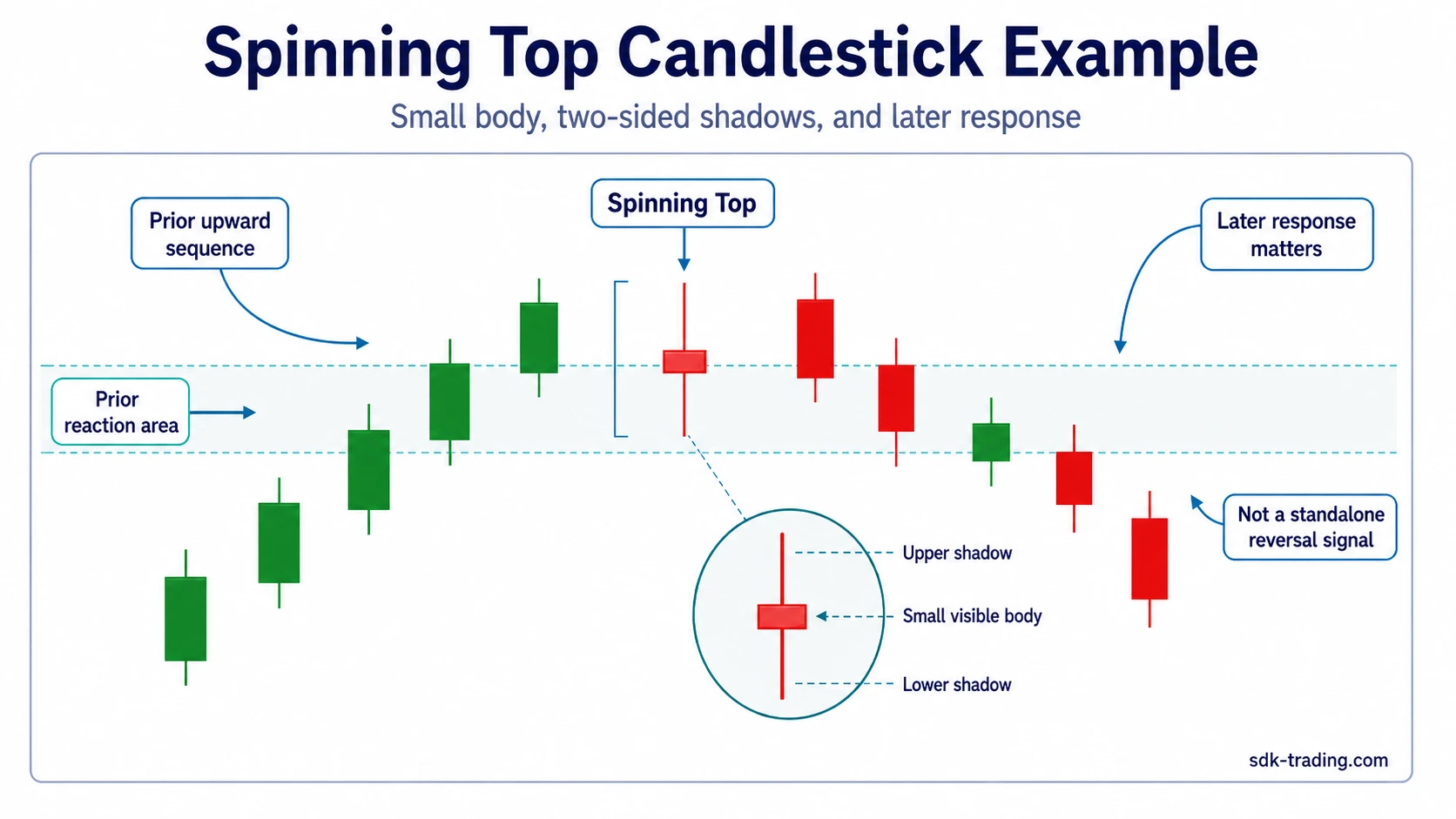
Example: After a short upward sequence, price forms a Spinning Top near a prior reaction area. The upper shadow shows that buyers tried to extend the move, while the lower shadow shows that sellers also pushed price back during the same candle period. Because the close remains near the body area, the candle shows hesitation rather than a completed directional signal.
The next candles decide the reading. If price accepts above the Spinning Top range, the candle may have been only a pause. If price fails to hold above the range and accepts lower, the hesitation becomes more meaningful. The example is diagnostic: it explains what to observe, not where to enter or exit.
Bullish, Bearish, and Black Spinning Top Candles
A bullish Spinning Top closes slightly above its open, while a bearish or black Spinning Top closes slightly below its open. Both versions still belong to the same candlestick structure: a small visible body, upper and lower shadows, and limited net progress by the close.
The body color adds nuance, but it does not override the main reading. A green or white body may show a small upward result, while a red or black body may show a small downward result. In both cases, the candle remains a hesitation structure until later candles show whether price accepts one side of the range.
What a Spinning Top Shows About Price Movement
A Spinning Top candlestick shows that price traveled away from the open in both directions, but the final close returned near the body area. That structure often reflects hesitation, balance, or temporary disagreement between buyers and sellers.
A simple example is a candle that first pushes above the open, then drops below it, and finally closes near the opening area. The upper shadow records the failed upside extension, the lower shadow records the failed downside extension, and the small body records the limited final result.
The candle does not decide direction by itself. It can warn that directional control is weaker than the prior movement suggested, but later candles are needed to clarify whether price accepts one side of the range or continues to rotate around the same area.
Spinning Top Candlestick in an Uptrend, Downtrend, or Range
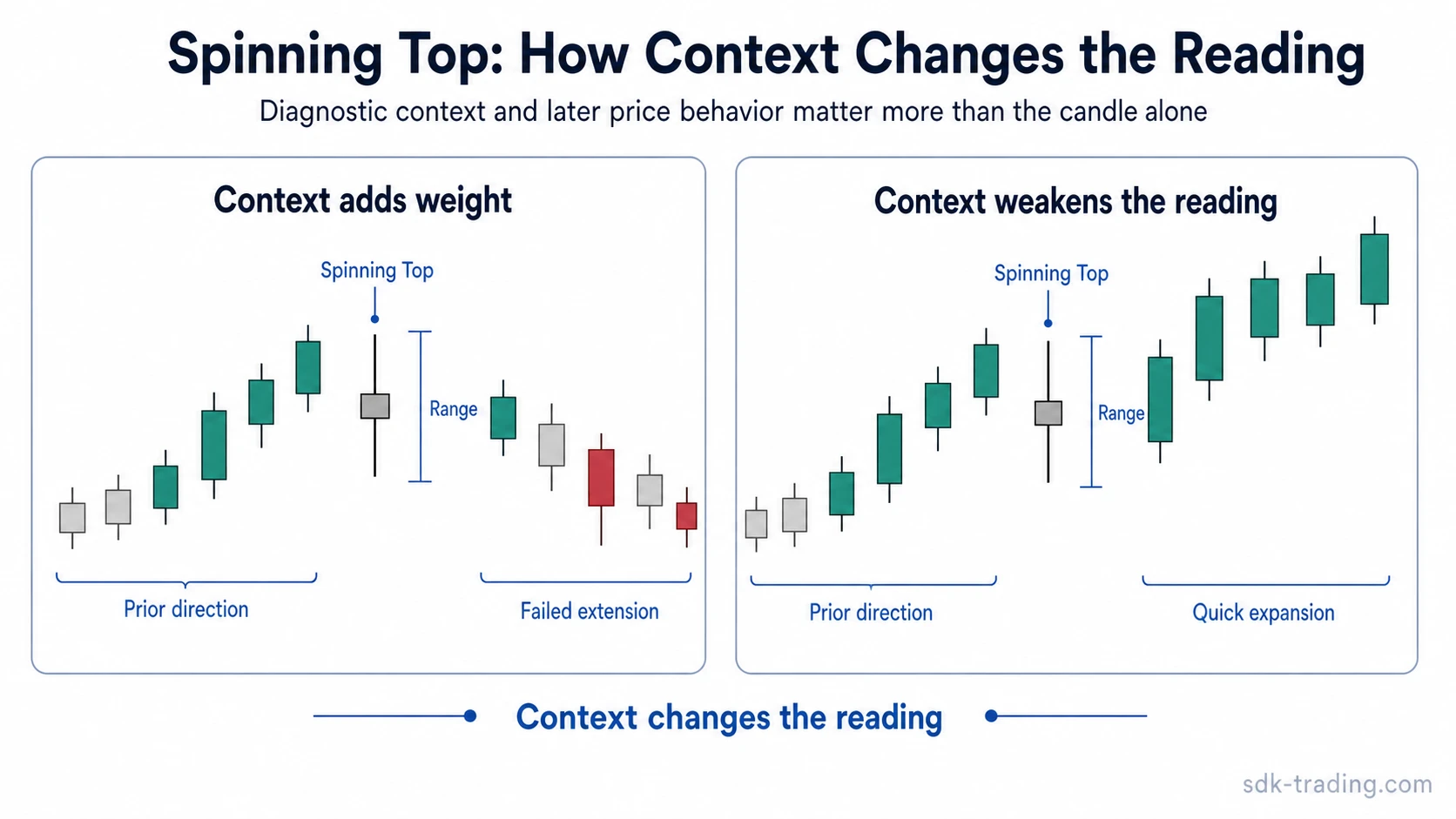
The location of a Spinning Top changes how it should be read. The same candle can mean ordinary rotation in one chart area and a more important loss of control in another.
| Context | What the Spinning Top can show | What matters next |
|---|---|---|
| Uptrend | Buyers controlled the prior move, but the Spinning Top shows weaker final control during the candle period. | Later candles need to show whether price accepts above the range or fails to extend the prior move. |
| Downtrend | Sellers controlled the prior move, but the candle shows two-sided activity and less clean downside progress. | The next candles decide whether the move continues lower or whether hesitation turns into a reversal attempt. |
| Range or sideways market | The candle may simply show normal indecision inside a balanced area. | The reading is weaker unless price later breaks and holds beyond the range or reaction area. |
How Traders Confirm a Spinning Top Candlestick
A Spinning Top is confirmed by later price behavior, not by the candle shape alone. The candle creates a range to watch. Confirmation depends on whether later candles accept above it, reject below it, or continue rotating around the same area.
- Check whether the next candles hold above or below the Spinning Top range.
- Compare the candle with the prior move: a hesitation candle after a strong move matters more than the same candle inside random noise.
- Use nearby support, resistance, swing areas, or range boundaries as context.
- Avoid treating the candle as a standalone reversal signal.
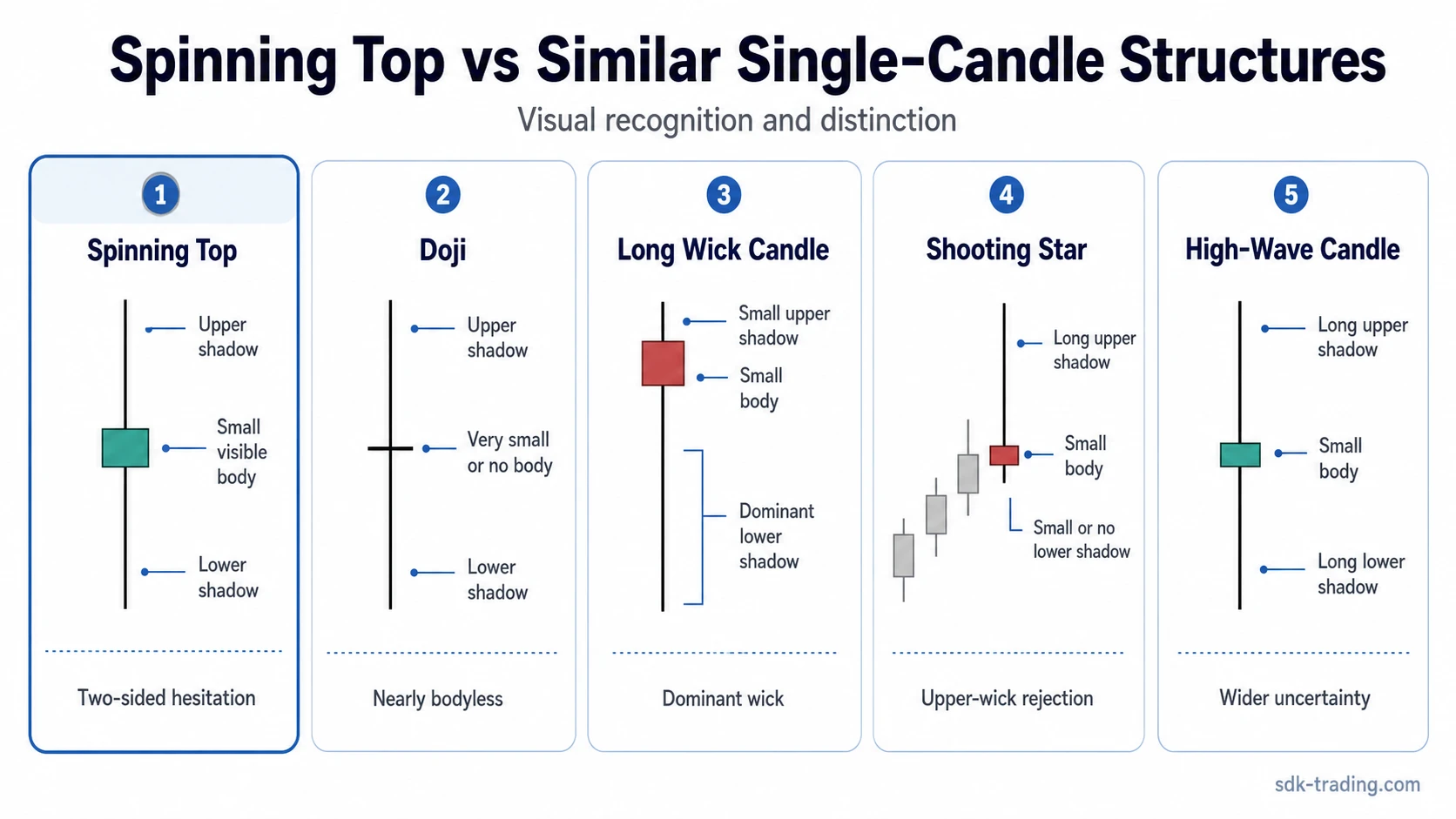
Spinning Top vs Doji, Long Wick Candle, and Shooting Star
Several single-candle patterns can look similar at first glance, but the difference comes from body size, shadow balance, and directional emphasis.
| Candle type | Main structure | Key difference from a Spinning Top candlestick |
|---|---|---|
| Doji | Open and close are nearly the same | A Spinning Top has a small but visible body, while a doji is closer to bodyless. |
| Long wick candle | One or more shadows dominate the candle | Long shadows alone are not enough. A Spinning Top needs a visible small body and two-sided probing. |
| Shooting star | Dominant upper shadow after upside pressure | A shooting star emphasizes one-sided upper-wick rejection, while a Spinning Top emphasizes two-sided hesitation. |
| Rejection candle or pin bar | One side of the candle dominates the interpretation | A Spinning Top is less directional because both upper and lower movement are part of the reading. |
| High-wave candle | Large range with stronger uncertainty | A high-wave candle emphasizes broad range uncertainty, while a Spinning Top is defined more narrowly by a small visible body and two-sided shadows. |
Common Misreadings of Spinning Top Candles
Most Spinning Top mistakes come from reading one candle feature in isolation. The candle should be judged by body size, shadow activity, close location, and later price response together.
| Common mistake | Why it is wrong | Better reading |
|---|---|---|
| Treating any small-bodied candle as a Spinning Top | A small body is required, but it is not enough by itself. | Look for a small visible body plus upper and lower shadows that show movement on both sides of the body area. |
| Demanding perfect shadow symmetry | The upper and lower shadows do not need to match exactly. | Check whether both sides of the candle show meaningful probing without a strong final close away from the body area. |
| Assigning too much meaning to body color | A bullish body only shows a small positive close, while a bearish or black body only shows a small negative close. | Use body color as nuance, not as the main directional reading. |
| Treating the candle as a reversal call | A Spinning Top can appear before a pause, continuation, range rotation, or reversal attempt. | Read it as hesitation first. Later candles decide whether the hesitation becomes meaningful. |
FAQ
What does a Spinning Top candlestick mean in trading?
A Spinning Top candlestick usually means price moved in both directions during the candle period but closed near the open or body area. It reflects hesitation or limited net progress, not a confirmed reversal by itself.
Is a Spinning Top candlestick bullish or bearish?
A Spinning Top candlestick can have a bullish or bearish body. The body color adds nuance, but the main reading comes from the small visible body, upper and lower shadows, and close location.
What is a black Spinning Top candlestick?
A black Spinning Top candlestick is a Spinning Top with a close slightly below the open. The black or bearish body shows a small negative close, but the main structure still comes from the small body and two-sided shadows.
How is a Spinning Top candlestick different from a doji?
A doji has an open and close that are nearly the same, creating little or no real body. A Spinning Top candlestick has a small but visible real body with shadows on both sides.
How do traders confirm a Spinning Top candlestick?
Traders confirm a Spinning Top by watching later candles around the Spinning Top range. Acceptance above or below that range matters more than the candle color by itself.
Is a Spinning Top a reversal or continuation pattern?
A Spinning Top can appear before a reversal, continuation, pause, or range rotation. Its meaning depends on the prior trend, location, and later price behavior.
What makes a Spinning Top reading weak?
A Spinning Top reading is weak when the candle appears in random range noise, has no meaningful location, or later candles ignore the range that made the hesitation visible.
Does a Spinning Top candlestick predict a reversal?
No. A Spinning Top candlestick can warn that directional control is weakening, but it does not predict a reversal. Later price behavior is needed to clarify whether the hesitation matters.