A long wick candlestick is a trading candle with an upper shadow, lower shadow, or both that extends far beyond the real body. The wick shows that price reached that part of the high-low range but did not fully hold it by the close.
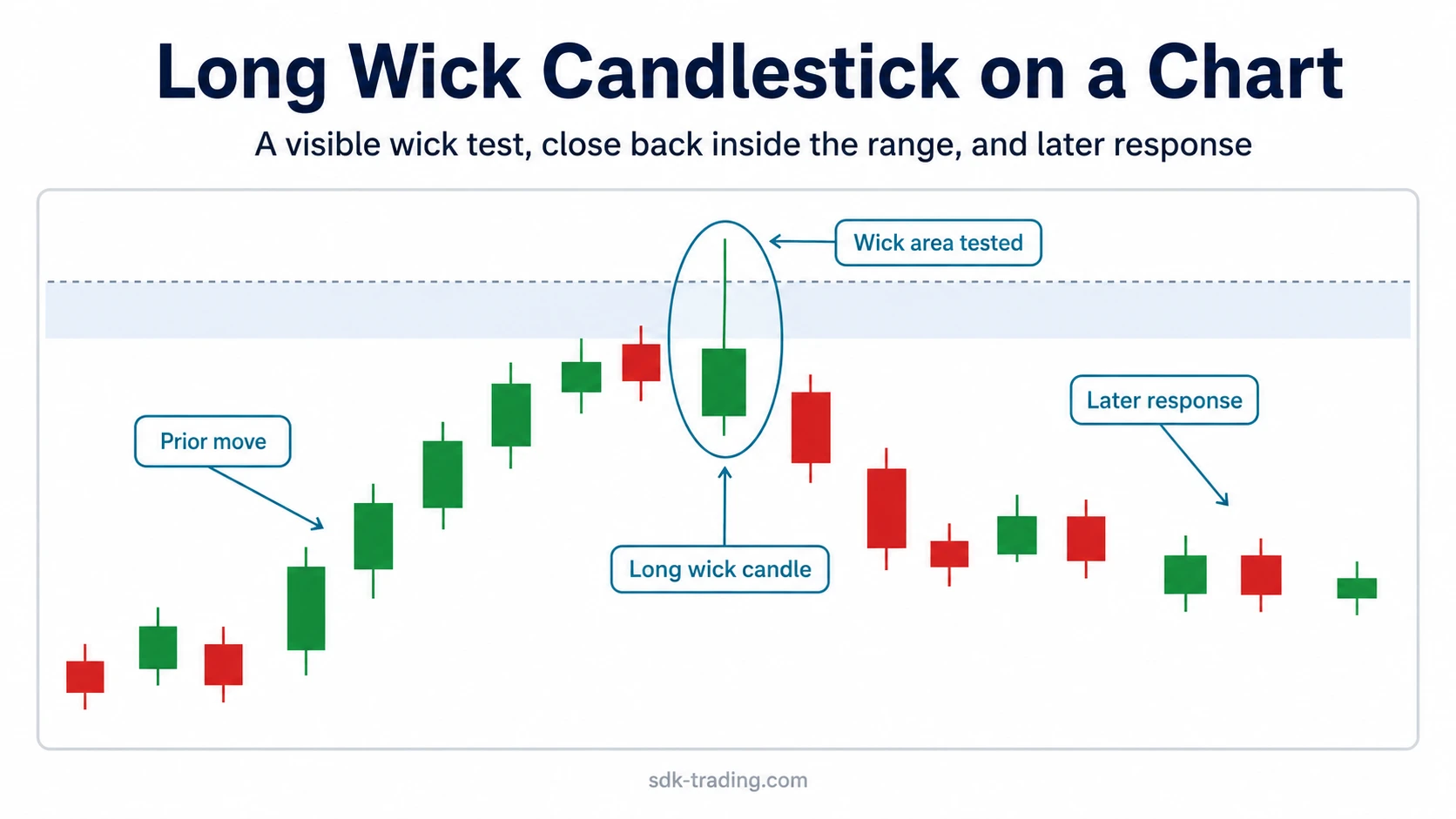
The wick alone does not prove direction, reversal, or rejection. Its meaning depends on the body location, the surrounding chart structure, and the way later candles respond to the area that price tested.
Safe interpretation: a long wick records price travel that was not fully held by the close. It becomes more meaningful only when structure and later price response support the same reading.
Key Points
- A long wick candlestick shows price movement away from the candle body, not a complete trading signal by itself.
- A long upper wick records an upside test that did not fully hold into the close.
- A long lower wick records a downside test that did not fully hold into the close.
- Long wicks on both sides show wide two-sided movement and need extra context before interpretation.
- Body position, nearby structure, and later acceptance or rejection decide whether the wick matters.
Long Wick Candlestick Anatomy
A long wick is easier to read when the candle parts are separated clearly. The structure is built from the open, close, high, low, real body, wick, and full candle range.
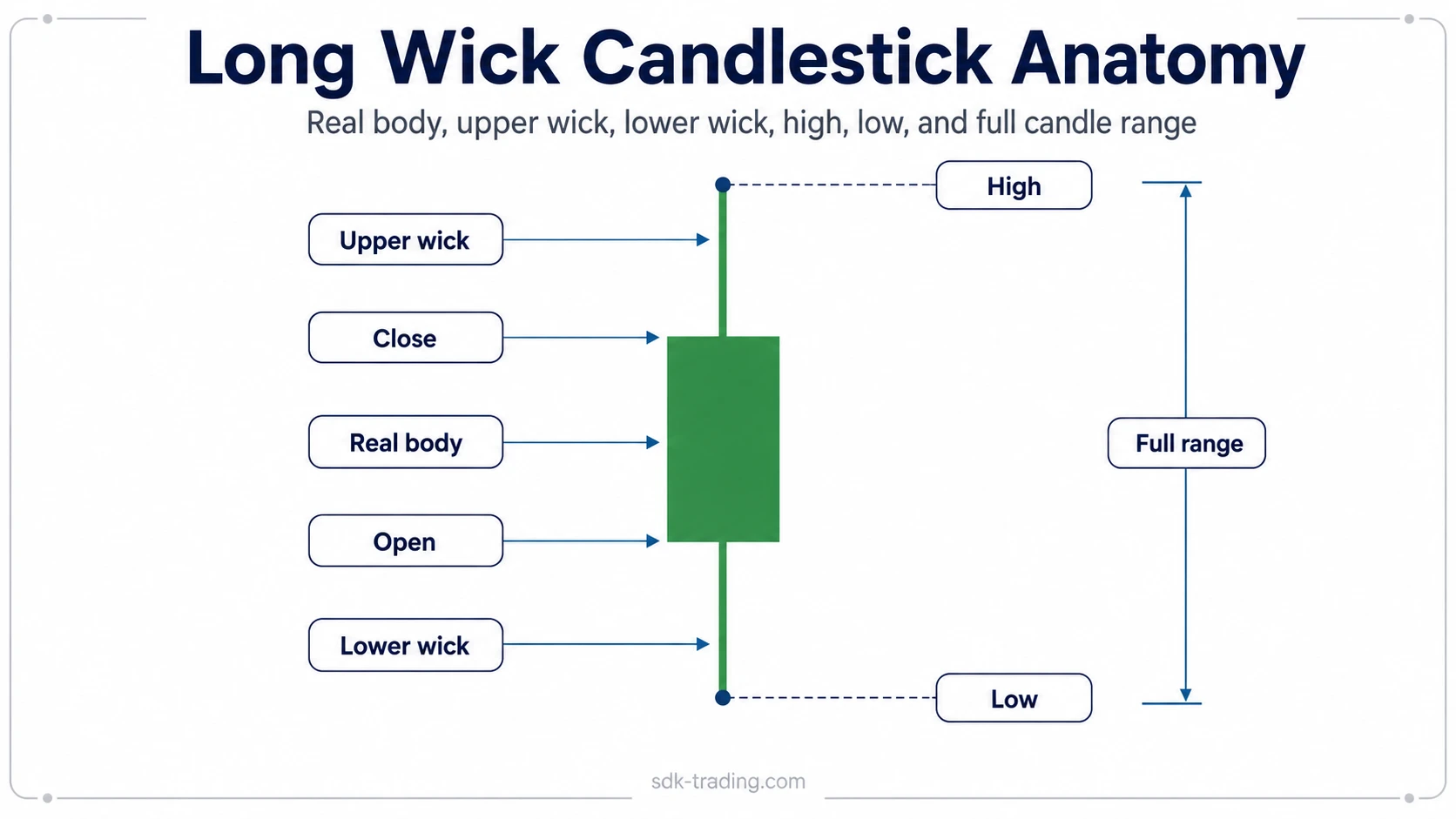
| Candle part | What it means |
|---|---|
| Real body | The distance between the open and the close. |
| Upper wick / upper shadow | The distance between the top of the body and the high. |
| Lower wick / lower shadow | The distance between the bottom of the body and the low. |
| High | The highest traded point during the candle period. |
| Low | The lowest traded point during the candle period. |
| Range | The full distance between the high and the low. |
| Open | The price where the candle period began. |
| Close | The price where the candle period ended. |
A wick becomes “long” by comparison. A shadow that looks extended on a quiet chart may be normal inside a volatile range. Relative size matters more than a fixed measurement.
Long Upper Wick, Long Lower Wick, and Long Wicks on Both Sides
A long upper wick, a long lower wick, and long wicks on both sides record different kinds of price movement. The shape gives the first observation, but the surrounding chart decides how much weight that observation deserves.
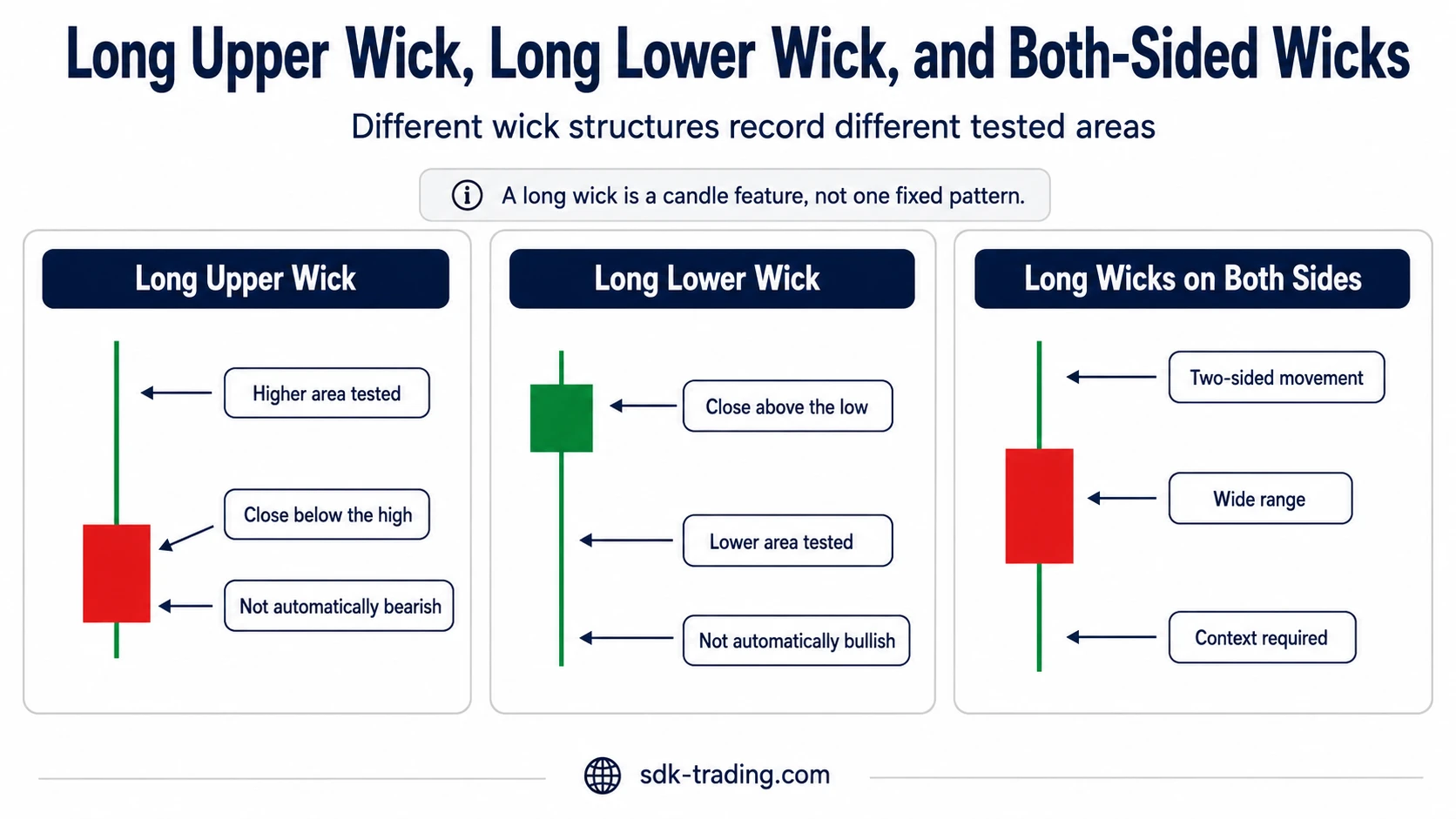
| Wick structure | What it records | What it does not prove |
|---|---|---|
| Long upper wick | Price tested higher levels but closed back below the high. | It does not automatically prove bearish control or a reversal. |
| Long lower wick | Price tested lower levels but closed back above the low. | It does not automatically prove bullish control or a reversal. |
| Long wicks on both sides | Price moved widely in both directions before settling near the body area. | It does not automatically prove a high wave candle, long-legged doji, or balanced market. |
A long upper wick can carry more weight when it forms after price tests a meaningful supply area and then fails to hold above it. A long lower wick can carry more weight when it forms after price tests a meaningful demand area and then fails to hold below it. Without that structure, the wick is only evidence of movement away from the body.
Why a Long Wick Is Not a Complete Pattern by Itself
A long wick is a visible candle feature. It is not automatically a full candlestick pattern because named patterns usually require stricter shape, location, or follow-through conditions.
A long lower wick may resemble a hammer only when the candle structure and surrounding context fit the hammer pattern. A long upper wick may resemble a shooting star only when the broader setup supports that reading. A long wick can also appear inside ordinary volatility where no meaningful change in control has taken place.
Important distinction: candles can warn, but structure decides whether the warning deserves attention. A wick gains meaning when the tested area matters and later candles confirm that the market could not hold that part of the range.
What Gives a Long Wick Candlestick Meaning?
The strongest long wick readings come from a combination of wick structure, body location, surrounding levels, volatility context, and later response. Wick length alone is not enough.
| Diagnostic question | Useful reading |
|---|---|
| What is it? | A candle with an extended wick or shadow relative to the body, nearby candles, or recent range. |
| What is it not? | It is not automatically a reversal, rejection candle, pin bar, hammer, shooting star, high wave candle, or long-legged doji. |
| What gives it meaning? | Location, body position, surrounding structure, volatility context, and later price response. |
| What weakens the reading? | Later acceptance through the tested area or a close that removes the failed-hold interpretation. |
Long Wick Candlestick vs Related Candle Patterns
Several candlestick patterns can include long wicks, but the wick alone does not name the pattern. The difference comes from shape, body position, location, and later response.
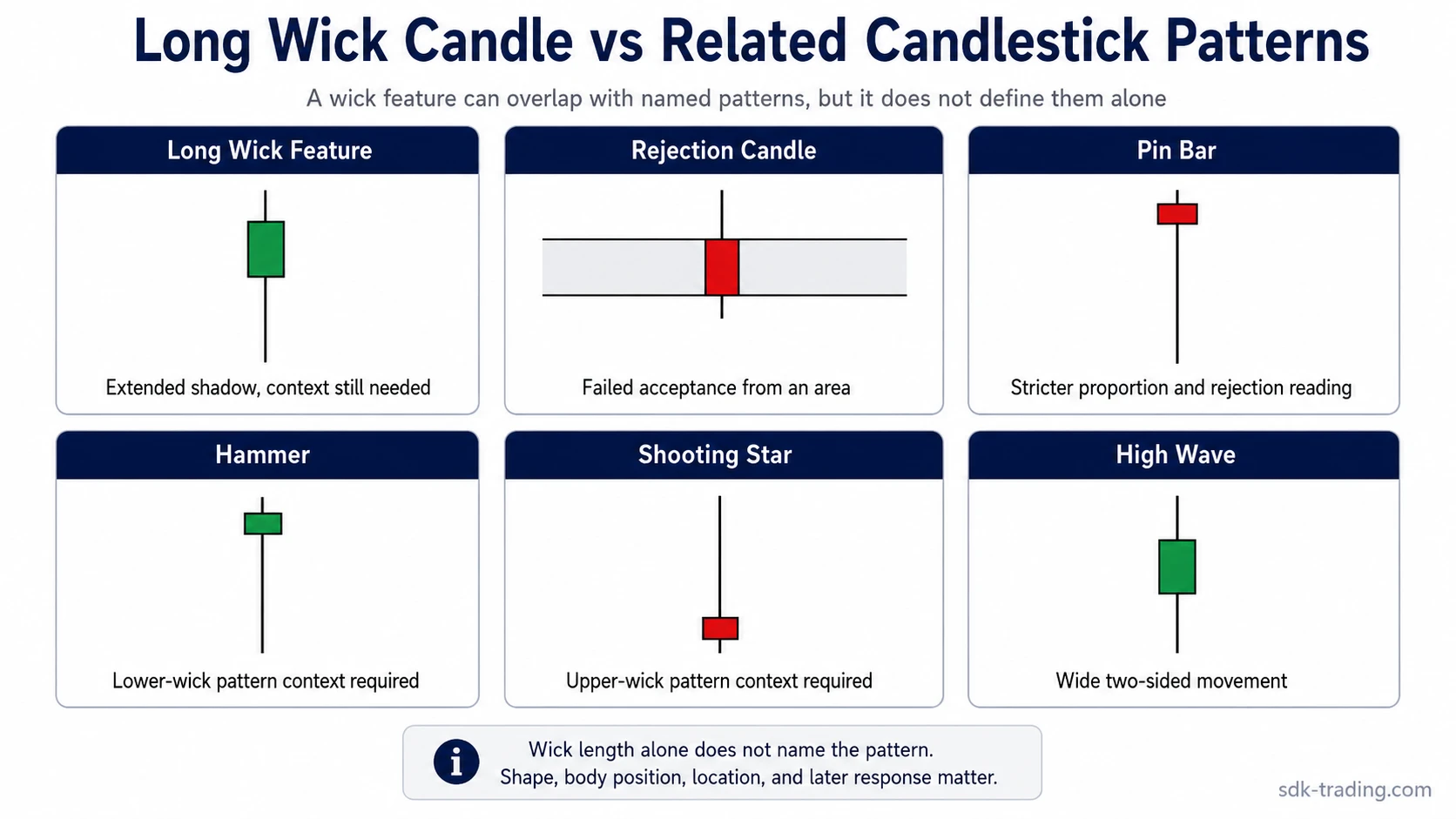
| Related structure | Main distinction |
|---|---|
| Rejection candle | A rejection candle needs failed acceptance from a meaningful area; a long wick only shows the visible wick structure. |
| Pin bar | A pin bar has stricter proportions and usually a clearer directional rejection reading. |
| High wave candle | A high wave candle usually has long shadows on both sides and emphasizes wide two-sided movement. |
| Spinning top | A spinning top emphasizes a small body and hesitation; a long wick emphasizes extended travel away from the body. |
| Hammer | A hammer requires lower-wick pattern context; a long lower wick alone is not enough. |
| Shooting star | A shooting star requires upper-wick pattern context; a long upper wick alone is not enough. |
| Long-legged doji | A long-legged doji requires a near-equal open and close with wide shadows. |
| Climax candle | A climax candle focuses on extreme effort or range behavior; a long wick may appear inside that behavior but does not define it alone. |
| Exhaustion candle | An exhaustion candle needs evidence that the prior push is losing force; a long wick can support that idea only with context. |
When the Long Wick Reading Weakens
The long wick reading weakens when later price accepts through the area that the wick originally tested. If an upper wick forms after a move above a prior area, the failed-hold reading loses strength when later candles close and hold above that same area.
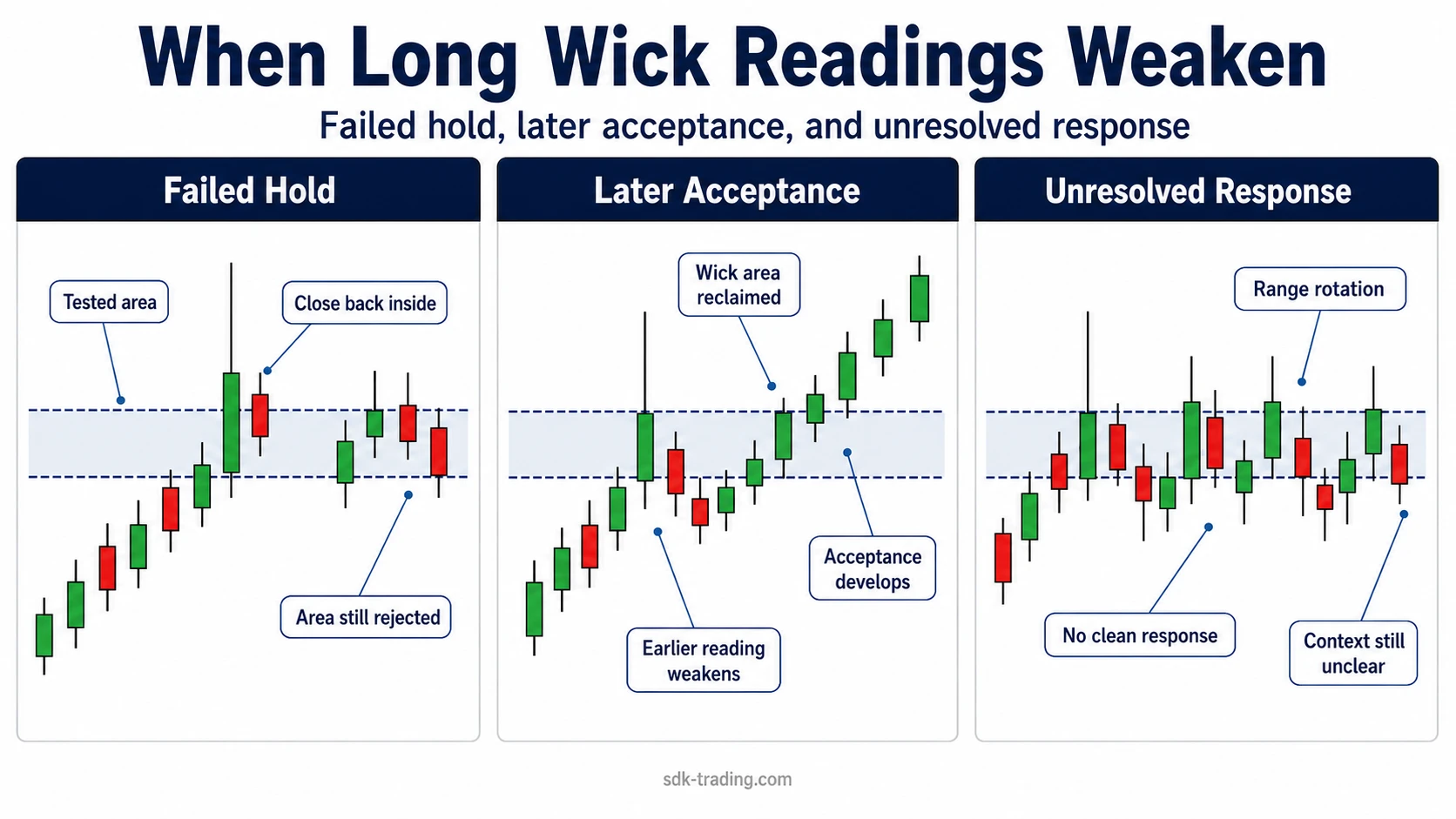
The same logic applies to a lower wick. If price briefly trades below an area, leaves a long lower shadow, and then later accepts below that tested zone, the earlier failed-hold reading no longer carries the same weight.
The wick can also become less useful inside a wide, messy range where long shadows are common. In that environment, a single wick may reflect normal volatility rather than a meaningful change in control.
Failed movement versus accepted movement: a breakout candle becomes more relevant when price moves beyond a prior area and holds there. A long wick often raises the opposite question: price moved beyond an area, but did it stay there?
Common Mistakes When Reading Long Wicks
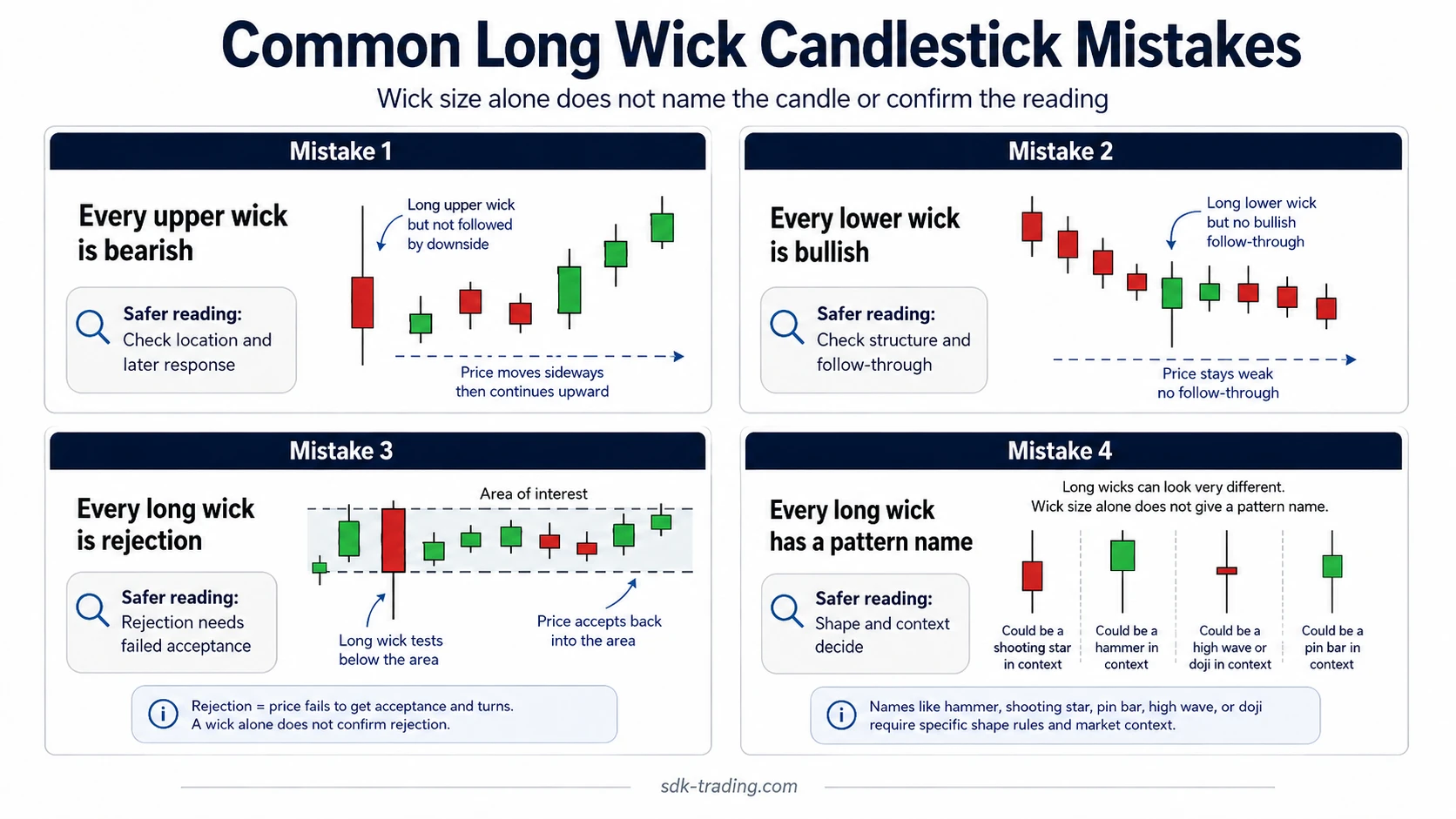
Most long wick mistakes come from treating a visible candle feature as a complete market conclusion. The safer approach is to separate what the wick records from what later price behavior confirms.
| Mistake | Safer reading |
|---|---|
| Treating every long upper wick as bearish | A long upper wick shows an upside test that did not fully hold; later acceptance or failure decides the meaning. |
| Treating every long lower wick as bullish | A long lower wick shows a downside test that did not fully hold; structure and follow-through still matter. |
| Calling every long wick a rejection candle | Rejection needs a failed acceptance reading from a meaningful area, not just wick length. |
| Ignoring the body | The close location affects whether the candle looks like failed movement, wide volatility, or unresolved pressure. |
| Reading the wick without later candles | Later candles show whether the tested area was rejected, accepted, or still unresolved. |
FAQ
What does a long wick candlestick mean?
A long wick candlestick means price moved far away from the candle body and then closed back inside the range. The wick records price travel that was not fully held by the close. It does not prove direction by itself.
Is a long upper wick always bearish?
A long upper wick is not always bearish. It shows that price tested higher levels and closed below the high, but the meaning depends on location, body position, surrounding structure, and later price behavior.
Is a long lower wick always bullish?
A long lower wick is not always bullish. It shows that price tested lower levels and closed above the low, but the candle still needs context before it can support a stronger reading.
Is a long wick candlestick the same as a rejection candle?
A long wick candlestick is not automatically the same as a rejection candle. A rejection reading needs failed acceptance from a meaningful area. A long wick only shows the visible wick structure until context confirms more.
Can a long wick candlestick be a pin bar or high wave candle?
A long wick candlestick can overlap with a pin bar or high wave candle, but only when the stricter shape and context requirements fit. Wick length alone is not enough to name the candle as either pattern.