An exhaustion candle is a candlestick where price travels aggressively but fails to retain enough directional progress into the close. The diagnostic issue is not candle size alone. It is whether strong movement produced a weak retained result.
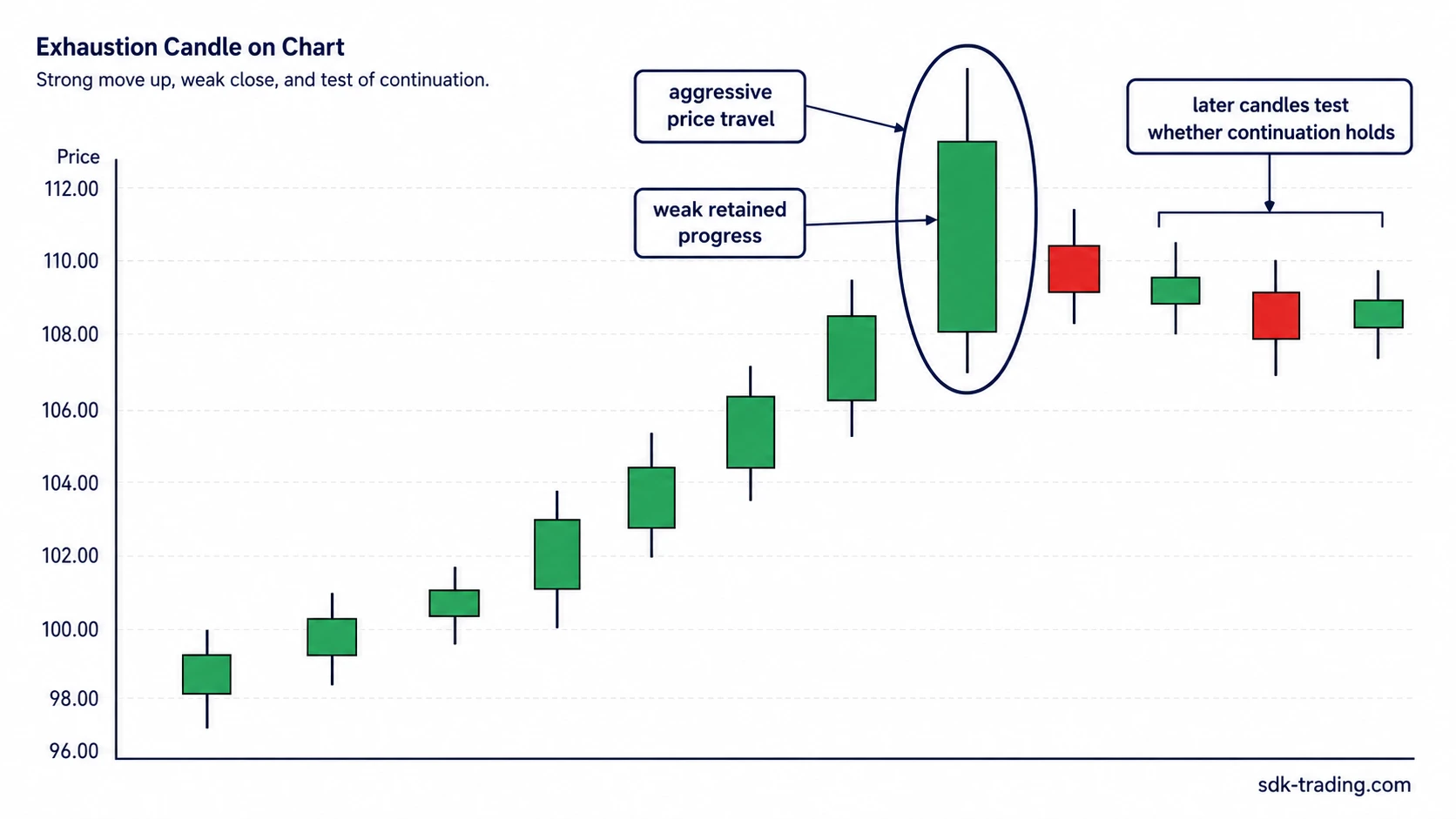
Safe interpretation: an exhaustion candle is not just a large candle and does not prove a completed reversal by itself. The reading depends on retained range, close location, effort versus result, and later price response.
Key Points
- An exhaustion candle shows aggressive movement with weak retained directional progress.
- A large candle is not enough if price holds most of the move into the close.
- The strongest reading comes from a mismatch between traveled range and retained range.
- Volume can support the reading when effort produces weak result, but volume alone is not proof.
- Later candles decide whether the exhaustion candidate is accepted, rejected, or still unresolved.
What Makes an Exhaustion Candle Look Exhausted?
An exhaustion reading starts with the relationship between movement and result. Price may expand quickly, cover a wide range, or attract visible participation, but the close fails to preserve the directional advantage. That difference between range traveled and range retained is the main diagnostic feature.
| Feature | What to check | Why it matters |
|---|---|---|
| Traveled range | How far price moved from low to high during the candle. | A large traveled range shows effort or aggressive movement. |
| Retained range | How much of the directional move remained by the close. | Weak retention shows that the move did not hold efficiently. |
| Close location | Whether the close holds near the directional extreme or gives back much of the move. | The close shows whether aggressive movement became durable progress. |
| Wick behavior | Whether the candle leaves a visible rejection from the extreme. | A wick can support the reading, but wick size alone does not define exhaustion. |
| Later response | Whether following candles accept the extension or rotate back inside the prior area. | Later candles test whether the exhaustion warning still matters. |
Traveled Range vs Retained Range
The useful distinction is how far price traveled versus how much of that movement remained at the close. A candle can cover a large range and still retain most of the move. That is not the same as exhaustion. The exhaustion reading becomes stronger when the traveled range is large but the retained result is weak.
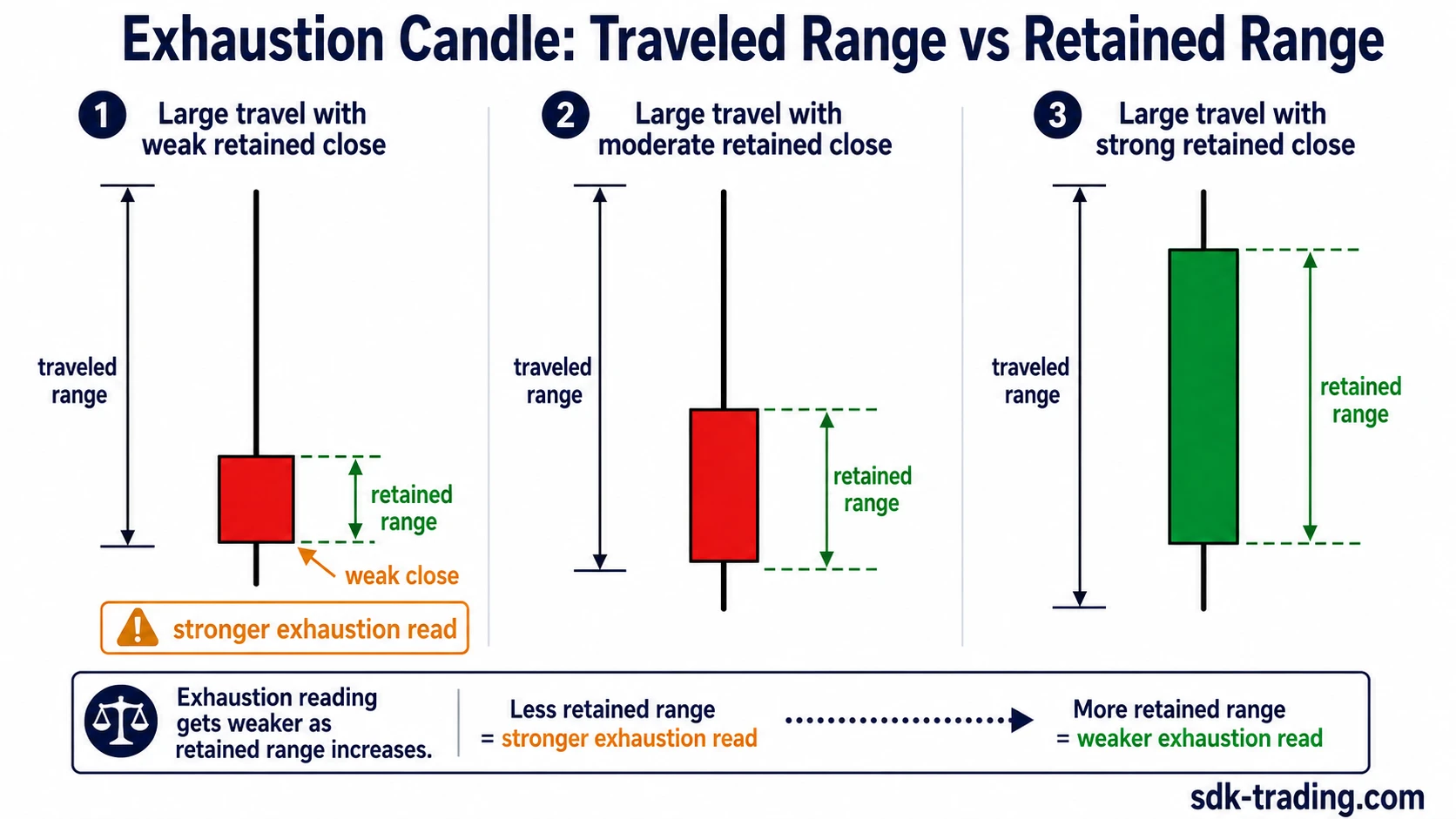
Core distinction: traveled range shows movement. Retained range shows result. Exhaustion is more defensible when large movement produces a weak retained result.
Exhaustion Candle Diagnostic Boundary
The strongest exhaustion reading comes from a mismatch between effort and result. A candle can be large, volatile, or high volume without being exhausted if price still closes with clean control in the direction of the move.
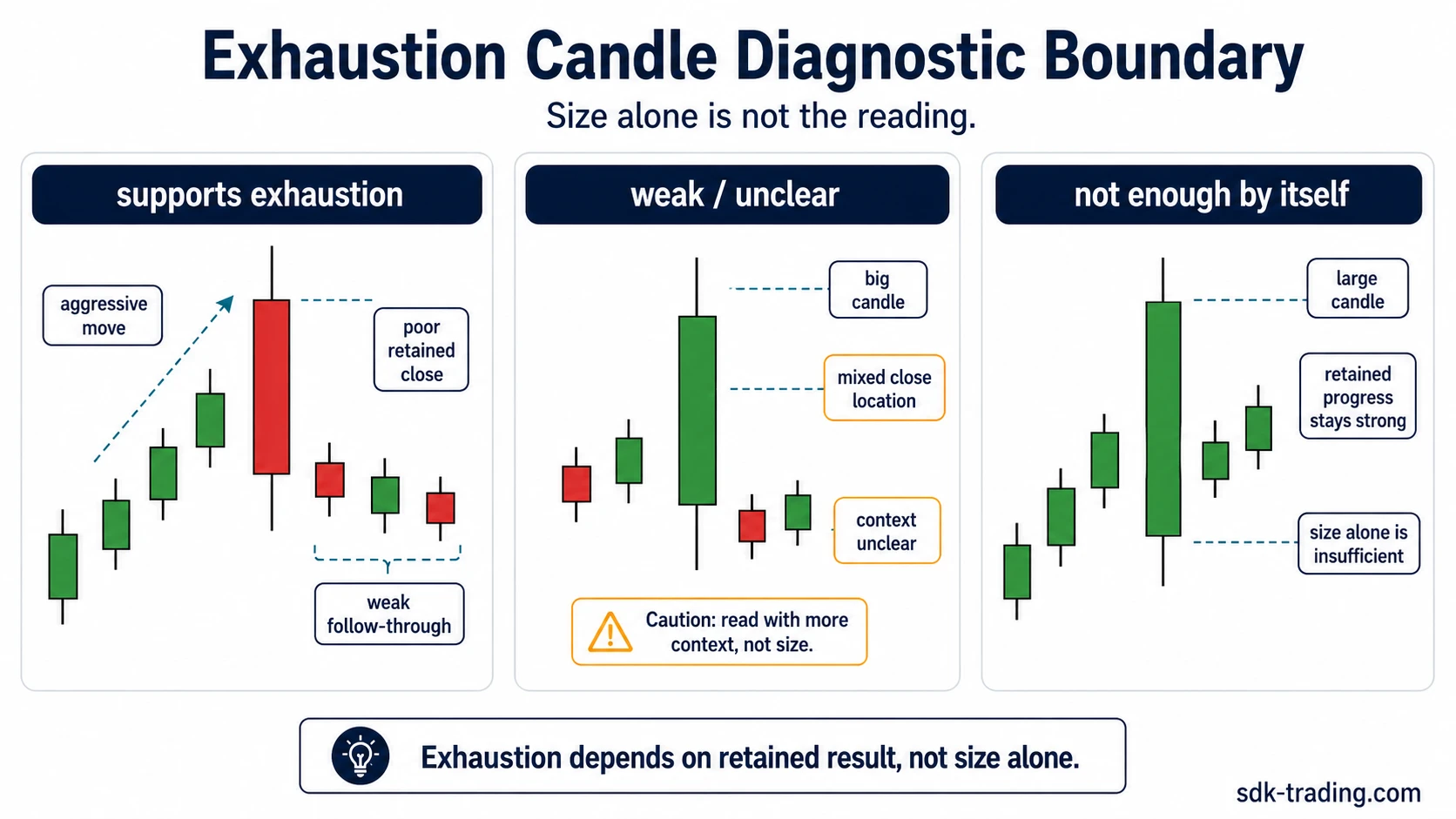
| Diagnostic question | Exhaustion reading becomes stronger when… | Exhaustion reading weakens when… |
|---|---|---|
| Was the move retained? | Price travels far but closes poorly relative to the range. | Price closes near the directional extreme and keeps most of the move. |
| Did effort produce clean result? | Expanded range or volume produces little retained progress. | Strong participation produces efficient continuation. |
| Is the wick doing all the work? | The wick aligns with weak close location and failed retained movement. | The wick is long, but the candle does not show broader effort/result failure. |
| Is later behavior confirming failure? | Following candles fail to accept the directional extension or rotate back inside the prior area. | Following candles accept the extension and continue away from the prior range. |
Volume, Range, and Failed Result
Volume is useful when it helps compare effort with result. If participation expands but price cannot retain the directional move, the candle may show inefficient displacement. That is different from treating high volume as a mechanical exhaustion rule.
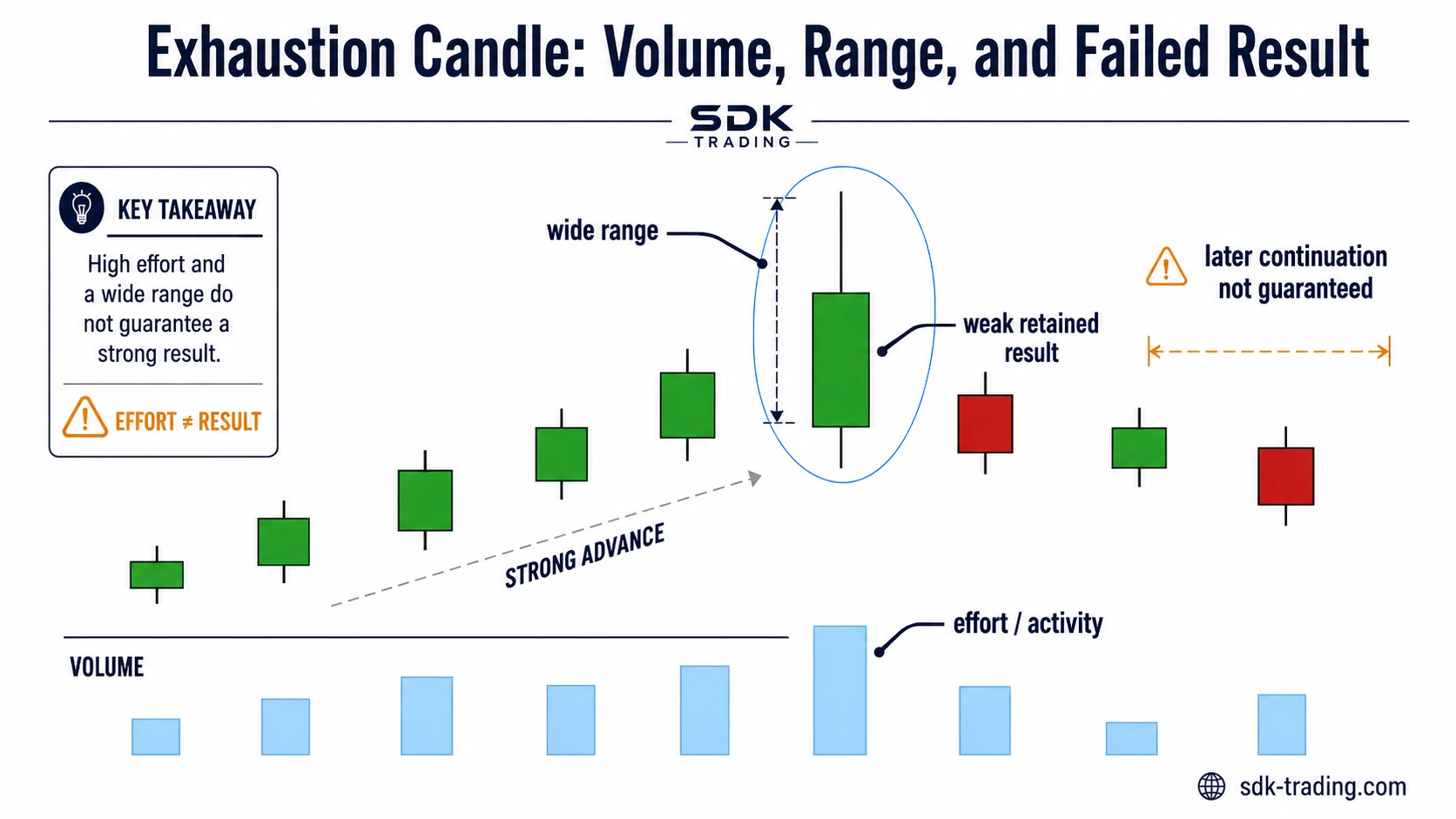
A wide breakout candle with strong close location can show continuation rather than exhaustion. A high-volume candle can also be efficient if it breaks away and holds the move. The exhaustion reading becomes more defensible when expanded effort produces a weak close, poor retained range, or later failure to accept the extension.
How an Exhaustion Candle Can Form
An exhaustion candle often forms after price is already moving directionally. The move expands, the candle covers a wide traveled range, but the close retains less of the move than expected. That creates an exhaustion candidate, not a completed conclusion.
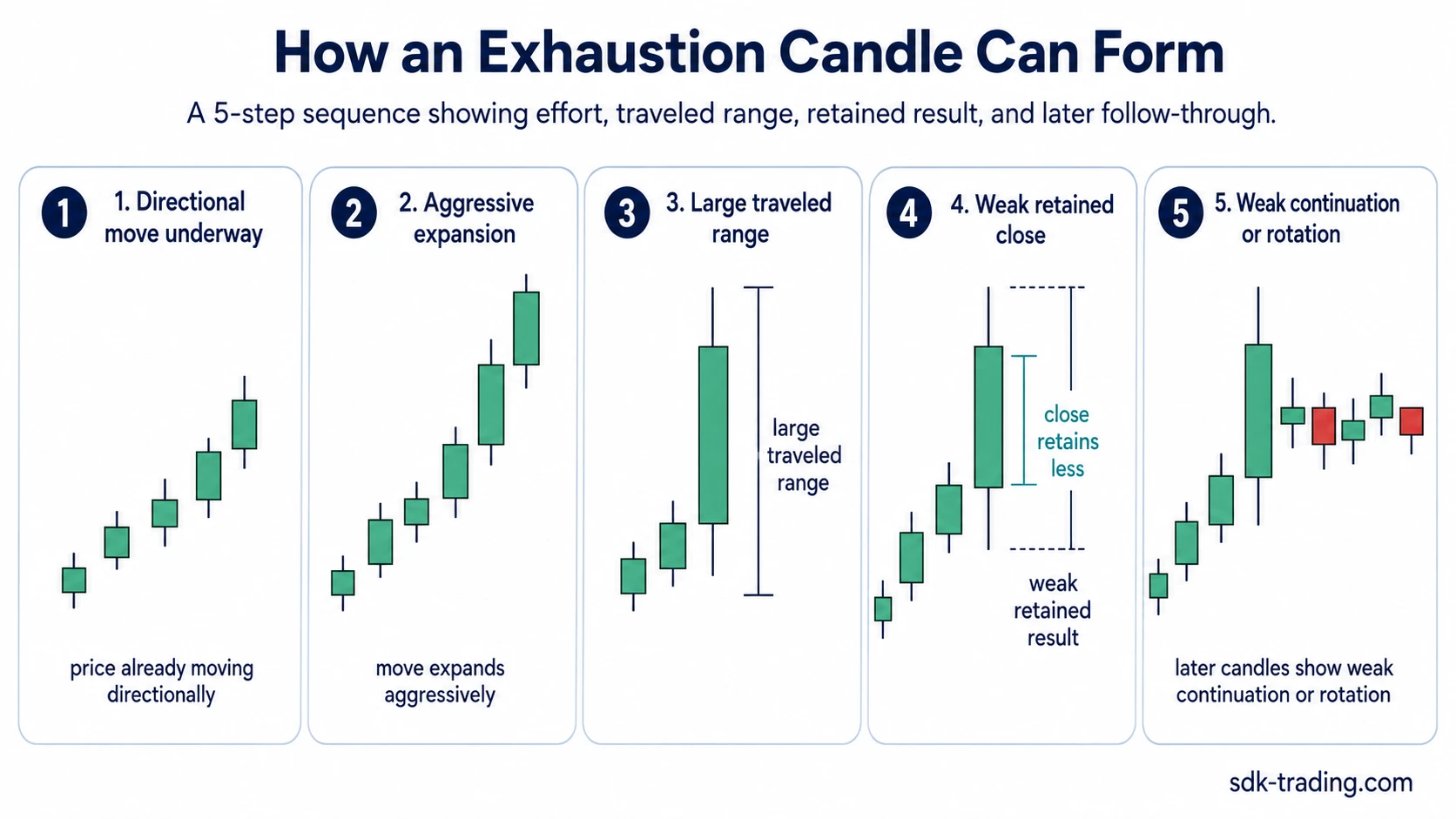
The reading becomes stronger if later candles fail to continue beyond the exhaustion candle, rotate back inside the prior area, or show that the attempted extension was not accepted. It weakens if later candles hold beyond the expansion area and continue with clean closes.
Exhaustion Candle vs Nearby Candle Types
An exhaustion candle often gets confused with nearby single-candle ideas because all of them can involve large range, visible wicks, or expanded participation. The difference is the diagnostic focus.
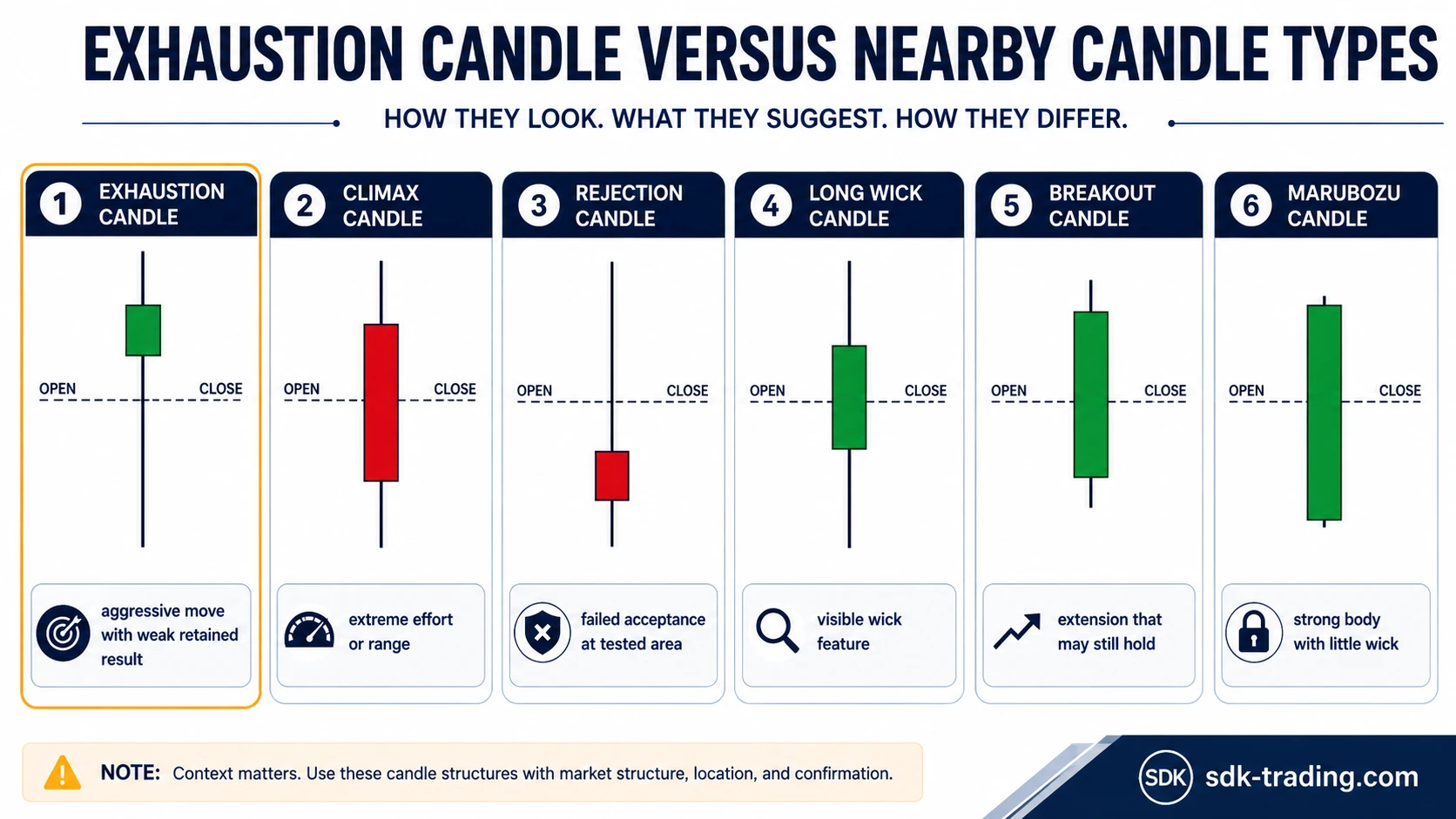
| Nearby concept | Main focus | Boundary against exhaustion |
|---|---|---|
| Climax candle | Extreme participation and directional intensity. | Exhaustion focuses on whether that effort fails to retain efficient result into the close. |
| Rejection candle | Failed acceptance at a tested area. | Exhaustion can include rejection, but its main feature is failed movement after aggressive participation. |
| Long wick candle | Visible wick feature. | A long wick is a shape feature. Exhaustion requires range traveled, retained close, and later response. |
| Breakout candle | Extension beyond a prior area. | A breakout can hold and continue; exhaustion asks whether the extension failed to retain progress. |
| Marubozu | Strong body with little wick. | A marubozu often emphasizes clean directional control, while exhaustion emphasizes weak retained result. |
Later Price Response
An exhaustion candle is only an early warning until later candles respond. If the next candles fail to accept the extension, rotate back inside the prior range, or close weakly after the same push, the exhaustion reading becomes stronger.
If later candles accept the extension and continue away from the prior range with clean closes, the exhaustion reading weakens. In that case, the large candle may represent efficient continuation rather than failed movement.
Useful test: exhaustion is not proven by the first candle. The next response shows whether the aggressive move was rejected, accepted, or still unresolved.
Common Exhaustion Candle Mistakes
Most exhaustion candle mistakes come from treating size, volume, or wick length as proof by itself. The safer approach is to compare effort with retained result and then check whether later candles confirm or weaken the reading.
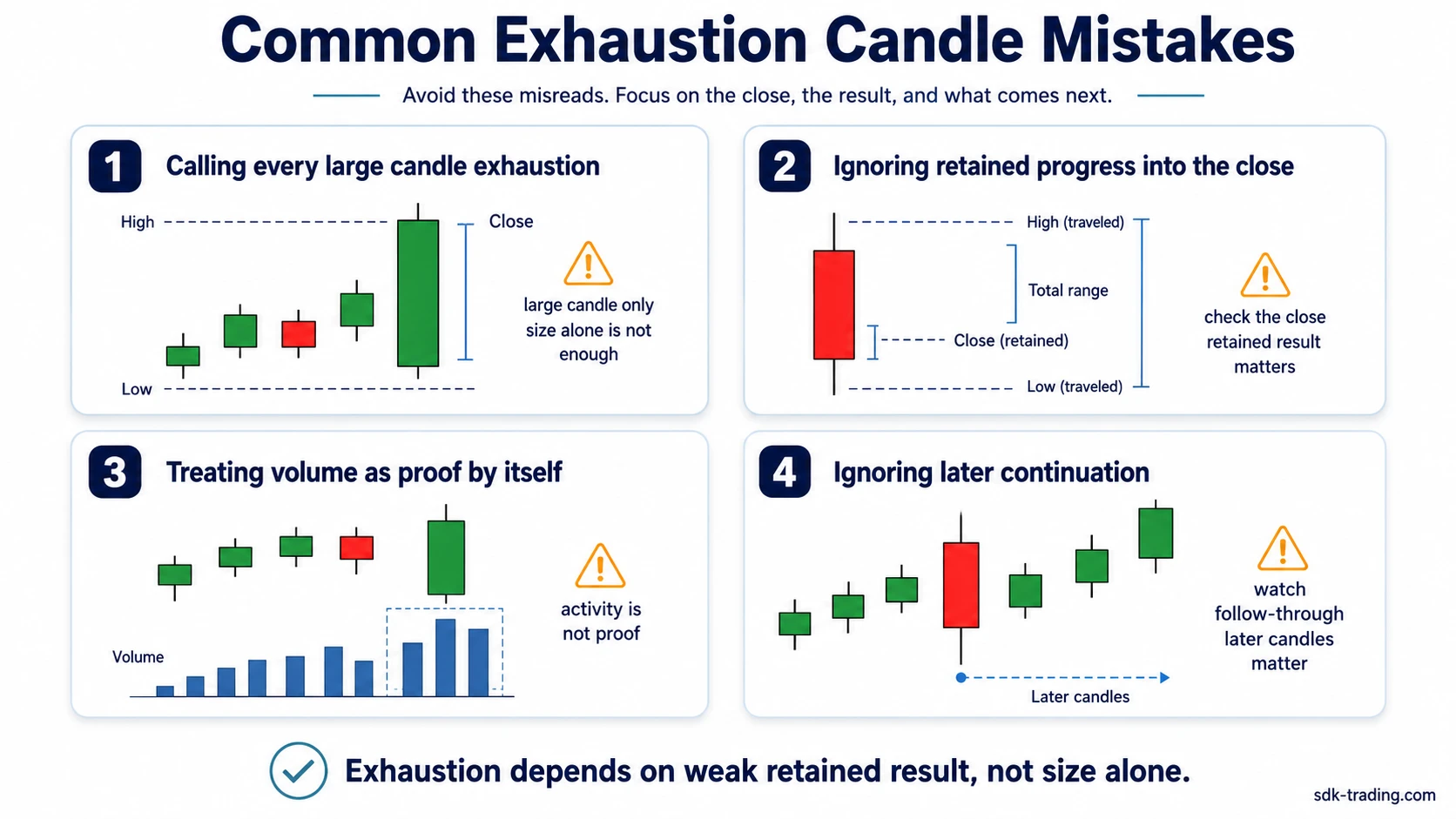
| Mistake | Safer interpretation |
|---|---|
| Calling every large candle exhaustion | Large range matters only when the close fails to retain enough of the move. |
| Ignoring retained progress into the close | The close location shows whether aggressive movement became efficient directional progress. |
| Treating high volume as automatic exhaustion | Volume supports the reading only when effort produces a weak or inefficient result. |
| Reading a long wick as exhaustion by itself | The wick needs support from close location, retained range, and later behavior. |
| Assuming the candle proves a turn | The candle warns of possible failed continuation, but later acceptance or rejection decides the reading. |
FAQ
What does an exhaustion candle mean in trading?
An exhaustion candle means price moved aggressively but failed to retain clean directional progress into the close. It can warn that participation is no longer producing efficient continuation, but it does not prove a completed turn by itself.
When does an exhaustion candle reading become stronger?
The reading becomes stronger when aggressive price travel is not retained into the close and later candles fail to accept the directional extension. The useful test is effort versus retained result, not reversal expectation.
Does an exhaustion candle require high volume?
No. High volume can support the reading when it shows strong effort with weak result, but exhaustion is not defined by volume alone. Close location, retained range, wick behavior, and later price response remain important.
Can a long wick candle be an exhaustion candle?
It can, but only when the wick appears with failed retained movement and a weak close relative to the traveled range. A long wick by itself is not enough to define exhaustion.
What invalidates an exhaustion candle reading?
The reading weakens when later candles accept the directional extension and continue away from the prior range with clean closes. In that case, the large candle may represent efficient continuation rather than exhaustion.