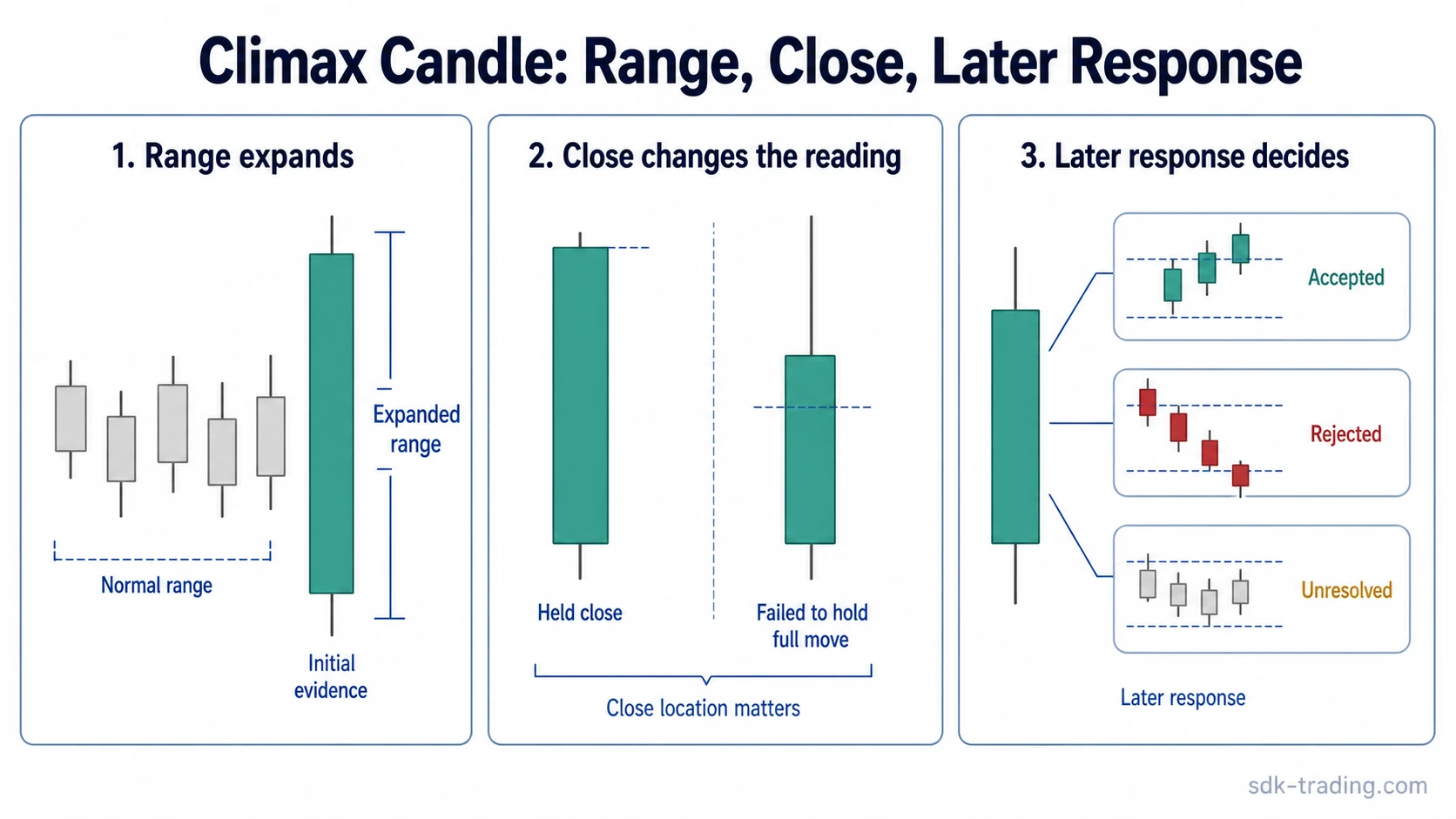
A climax candle in trading is a candlestick with an unusually wide high-low range compared with nearby candles. The wide range shows expanded activity during one candle period, but it does not by itself prove reversal, continuation, rejection, or exhaustion.
The useful distinction is simple: climax describes unusually expanded range, exhaustion describes possible pressure failure, rejection describes failed acceptance, and breakout describes a close beyond a boundary. A climax candle can overlap with those readings, but range expansion is the starting evidence.
Key Points
- A climax candle is defined by unusually expanded high-low range, not by body size alone.
- The candle can appear in bullish or bearish contexts, but the shape itself does not decide direction.
- Close location helps separate held pressure from movement that failed before the candle ended.
- Follow-through around the expanded range separates continuation, exhaustion, rejection, and unresolved activity.
What a Climax Candle Shows in Trading
A climax candle shows that price traveled through an unusually wide range during one candle period. The market may have expanded because of aggressive participation, forced activity, late participation, or a sharp reaction around an important area.
The defining feature is the full high-low range. The real body can be large, moderate, or small. Wicks can appear on one side, both sides, or barely at all. A wide body may show one-sided pressure, while a wide candle with long wicks may show that both sides were active inside the same period.
Close location changes the reading. A candle that expands upward and closes near its high shows that much of the upward progress held into the close. A candle that expands upward but closes near the middle or low shows that the market traveled far but failed to hold the full move.
Climax Candle Misread vs Safer Reading
| Misread | Safer reading |
|---|---|
| Large candle means reversal | Expanded range shows unusual activity; reversal requires later failure, rejection, or pressure-loss evidence. |
| Large body defines the pattern | The full high-low range matters more than body size alone. |
| Buying climax and selling climax are separate candle shapes | They are directional contexts around the same range-expansion idea. |
| Long wick equals climax | A wick can appear inside a climax candle, but wick dominance belongs more directly to a long-wick or rejection reading. |
The safer reading separates observation from conclusion. The candle records expanded activity. The conclusion depends on prior movement, close location, nearby structure, and later price response.
Buying Climax and Selling Climax Contexts
A buying climax context appears when a wide-range candle forms after a strong upward push. It can reflect heavy upside participation, late buying, or aggressive continuation pressure, but the candle alone does not prove that the advance is finished.
A selling climax context appears when a wide-range candle forms after a strong downward push. It can reflect heavy downside participation, forced selling, or capitulation-style pressure, but the candle alone does not confirm that a durable low has formed.
Volume can strengthen the reading when available, especially if activity expands sharply together with candle range. Volume still acts as context, not as mandatory proof. The basic candle reading starts with range, close location, and later behavior.
How a Climax Candle Differs From Nearby Candle Readings
A climax candle differs from an exhaustion candle because climax describes expanded range, while exhaustion adds pressure failure. A climax candle can support an exhaustion reading only when later behavior shows that the prior pressure failed to continue.
A climax candle also differs from a long-wick candle. Long-wick behavior is dominated by failure to hold one side of the range, while a climax candle is defined first by unusual total high-low expansion.
A climax candle also differs from a failed-acceptance or rejection candle reading. Rejection depends on price testing an area and failing to hold it. A climax candle can include rejection, but rejection comes from failed acceptance, not from large range alone.
A breakout candle reading focuses on a close beyond a clear boundary. A climax candle can overlap with that behavior when the expanded range closes outside a range or level, but the question then becomes whether later candles accept that boundary break.
Climax Candle Example in Context
Price advances into a prior resistance area and produces a wide upward candle that briefly stretches beyond the area. The candle closes near the middle of its range instead of holding near the high. The expanded range shows active participation, but the close leaves the move unfinished.
If following candles hold above the upper part of that range, acceptance becomes more defensible. If price falls back below the tested area and cannot reclaim it, the same candle leans closer to failed acceptance or an exhaustion move. If price stays inside the expanded range without a clear answer, the candle remains unresolved evidence.
What Makes a Climax Candle Reading Stronger or Weaker
The reading becomes stronger when the wide range appears after an extended directional push, closes in a meaningful part of its range, and receives a clear later response. It becomes weaker when the candle appears inside ordinary sideways noise or when later candles leave the range unresolved.
- Is the candle range unusually wide compared with nearby candles?
- Where did the candle close inside its full high-low range?
- Did the move appear after an extended directional push?
- Did later candles accept the range or fail back through it?
- Is the candle better described as exhaustion, rejection, breakout, or unresolved expansion?
FAQ
What does a climax candle mean in trading?
A climax candle in trading means one candle period had unusually expanded high-low range compared with nearby candles. It shows increased activity, but the reading depends on close location, prior movement, and later response.
When does a climax candle become more than range expansion?
A climax candle becomes more meaningful when the expanded range is followed by clear acceptance, rejection, exhaustion, or failure behavior. The wide range is the observation; the later response decides what the observation supports.
Is a climax candle the same as an exhaustion candle?
No. A climax candle describes range expansion. An exhaustion candle adds the idea that prior pressure may be failing. The same candle can support an exhaustion reading only when later price behavior shows pressure loss.
Can a climax candle have a long wick?
Yes. A climax candle can have a long wick, but the wick is not the defining feature. If the main message is failed acceptance shown by the wick, a long-wick or rejection reading may be more precise.
Is volume required for a climax candle reading?
No. Volume can strengthen the interpretation when it expands with the candle range, but the basic candle reading starts with unusual high-low range, close location, and later price response.