A breakout candle is a candle whose body closes beyond a meaningful prior level, range, or containment area. The reading becomes stronger when the close is supported by range expansion, participation, and later acceptance outside the old boundary, but one candle does not guarantee continuation.
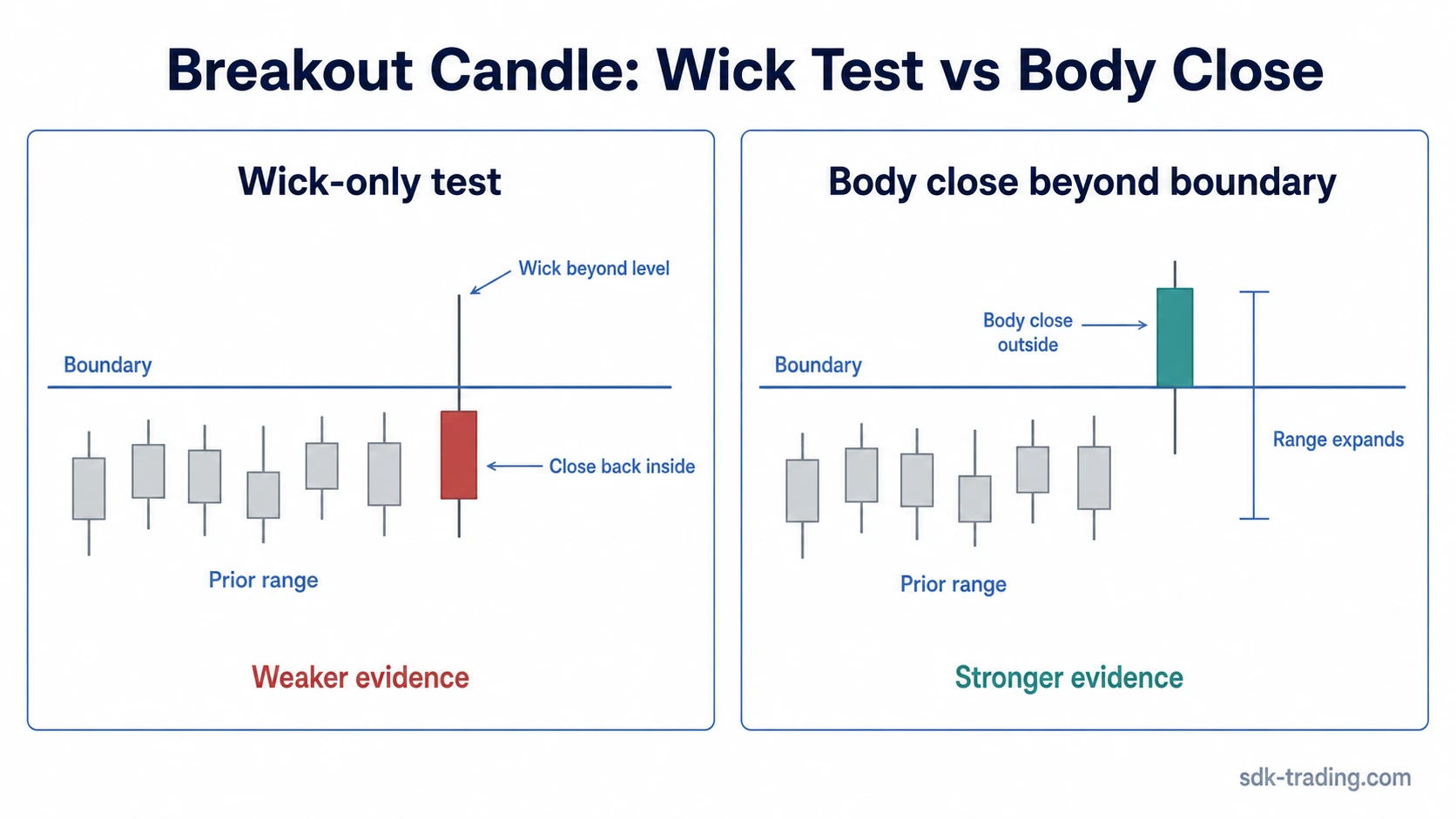
Candle size alone does not define a breakout candle. The boundary must already matter, the candle must produce a meaningful result relative to that boundary, and later price behavior must show whether the attempted break is accepted, rejected, or still unresolved.
Key Points
- A breakout candle needs a meaningful prior boundary before the candle forms.
- A body close beyond the boundary provides stronger evidence than a wick-only test.
- Range expansion and higher volume can strengthen the reading when they accompany a real price result.
- A gap can add evidence when price relocates beyond the old structure, but the gap itself does not confirm continuation.
- Later acceptance, rejection, overlap, or retest behavior determines whether the breakout candle gains or loses weight.
See a Bullish Breakout Candle With a Gap on a Real Chart
This short example shows a bullish candle breaking a prior high while a gap and stronger participation add additional evidence to the move.
The combination shown in the video can represent strong bullish evidence when the boundary, close, gap, volume, and later price behavior support the same reading. It should not be treated as a universal rule or as proof that the breakout must continue.
How a Breakout Candle Forms
A breakout candle develops when price moves from an established area of containment into a test beyond a visible boundary. The structure before the candle matters because without a meaningful boundary there is nothing important to break.
| Stage | What to Observe | Why It Matters |
|---|---|---|
| 1. Prior boundary | Price has repeatedly reacted around a range edge, prior high, prior low, support, resistance, or another visible containment area. | The existing structure gives the breakout candle a reference point. |
| 2. Boundary test | Price begins trading through or beyond the reference area. | The market is testing whether it can leave the previous structure. |
| 3. Candle close | The candle body finishes beyond the boundary rather than only leaving a wick outside. | The close shows that the attempt persisted through the candle period. |
| 4. Range and participation | The candle may expand in range while volume or other participation measures increase. | Additional activity can strengthen the evidence behind the price result. |
| 5. Later response | Subsequent candles hold outside, retest, overlap, or return through the boundary. | Later behavior shows whether the attempted breakout is accepted or rejected. |
What Makes a Breakout Candle Stronger, Weaker, or Unresolved?
The quality of the reading comes from agreement between the boundary, candle close, range, participation, and later price behavior. No single feature is enough on its own.
| Reading | Typical Evidence | Interpretation |
|---|---|---|
| Stronger breakout candle | Clear boundary, body close outside, range expansion, meaningful participation, and limited immediate rejection. | Several pieces of evidence support attempted acceptance beyond the previous structure. |
| Weaker breakout candle | Small body, wick-heavy break, weak participation, marginal close, or immediate return toward the old area. | The boundary was tested, but the evidence of acceptance remains limited. |
| Unresolved breakout candle | The candle closes outside, but later candles overlap, stall, or repeatedly cross the boundary. | The initial breakout remains possible, but the market has not yet established a clean new structure. |
| Failed breakout | Price moves back inside the previous structure and fails to regain the outside area. | The initial breakout interpretation loses weight and may need to be reclassified. |
Why the Candle Close Matters
A candle can trade through a resistance or support area during the period and still finish back inside the old structure. That wick shows that price reached beyond the boundary, but it also shows that the market did not maintain that outside position through the close.
A body close beyond the boundary provides stronger evidence because more of the candle’s final price structure remains outside the previous area. The close still does not prove continuation, but it creates a more developed breakout attempt than a wick-only breach.
| Candle Behavior | What It Shows | What Remains Unknown |
|---|---|---|
| Wick beyond the boundary | Price temporarily traded outside the prior area. | Whether any durable acceptance can develop beyond the level. |
| Small close beyond the boundary | The candle finished outside, but the result is relatively limited. | Whether later candles can expand and hold the new area. |
| Strong body close beyond the boundary | The candle produced a larger directional result outside the old structure. | Whether the apparent momentum becomes sustained acceptance or later fails. |
Gap, Volume, and a Strong Bullish Breakout Candle
A bullish breakout can become more interesting when several independent observations occur together: price clears a meaningful prior high, the breakout candle closes strongly, a gap separates the new trading area from the old structure, and participation expands.
These observations are complementary rather than interchangeable. The candle describes the price result during the period. The gap describes relocation between trading areas. Volume describes activity. The prior high defines the structural boundary.
| Evidence | What It Adds | What It Does Not Prove |
|---|---|---|
| Break of prior high | Price has challenged a visible structural boundary. | That price will remain above the high. |
| Strong bullish candle | Buyers produced a meaningful positive price result during the candle period. | That the move cannot reverse on later candles. |
| Gap | Price relocated away from the previous accepted area. | That the gap is automatically a breakaway gap or that it must remain open. |
| Expanded volume | More participation accompanied the price movement. | That all of the activity represented durable buying or future continuation. |
| Later acceptance | Price remains outside the old structure after the initial breakout. | Certainty about the final size or duration of the move. |
Breakout Candle vs Breakaway Gap
A breakout candle and a breakaway gap can occur together, but they describe different parts of the chart. Keeping the two concepts separate prevents one dramatic candle from being given several labels without checking the required structure.
| Concept | Primary Question | Key Requirement |
|---|---|---|
| Breakout candle | Did the candle close beyond a meaningful prior boundary? | Close location relative to the boundary, supported by range, participation, and later response. |
| Breakaway gap | Did price gap away from a prior accepted range, base, or major boundary? | A prior accepted area, visible separation, and later acceptance outside that structure. |
| Stock market gap | Did price relocate from one traded area to another without trading through every intermediate price on the chart interval? | Visible separation between the earlier and later trading areas. |
How Volume Changes the Breakout Candle Reading
Volume becomes useful when it is compared with the price result. A candle that closes cleanly beyond a boundary while participation expands provides more combined evidence than the same price movement on unusually weak activity.
Heavy volume is not automatically bullish or bearish. Large activity can also appear during absorption, exhaustion, or two-sided trading. If volume expands but price cannot maintain progress beyond the boundary, the high activity may describe conflict rather than clean continuation.
Volume rule: use volume to evaluate participation behind the breakout, not as proof that the breakout must continue.
Later Response After the Breakout Candle
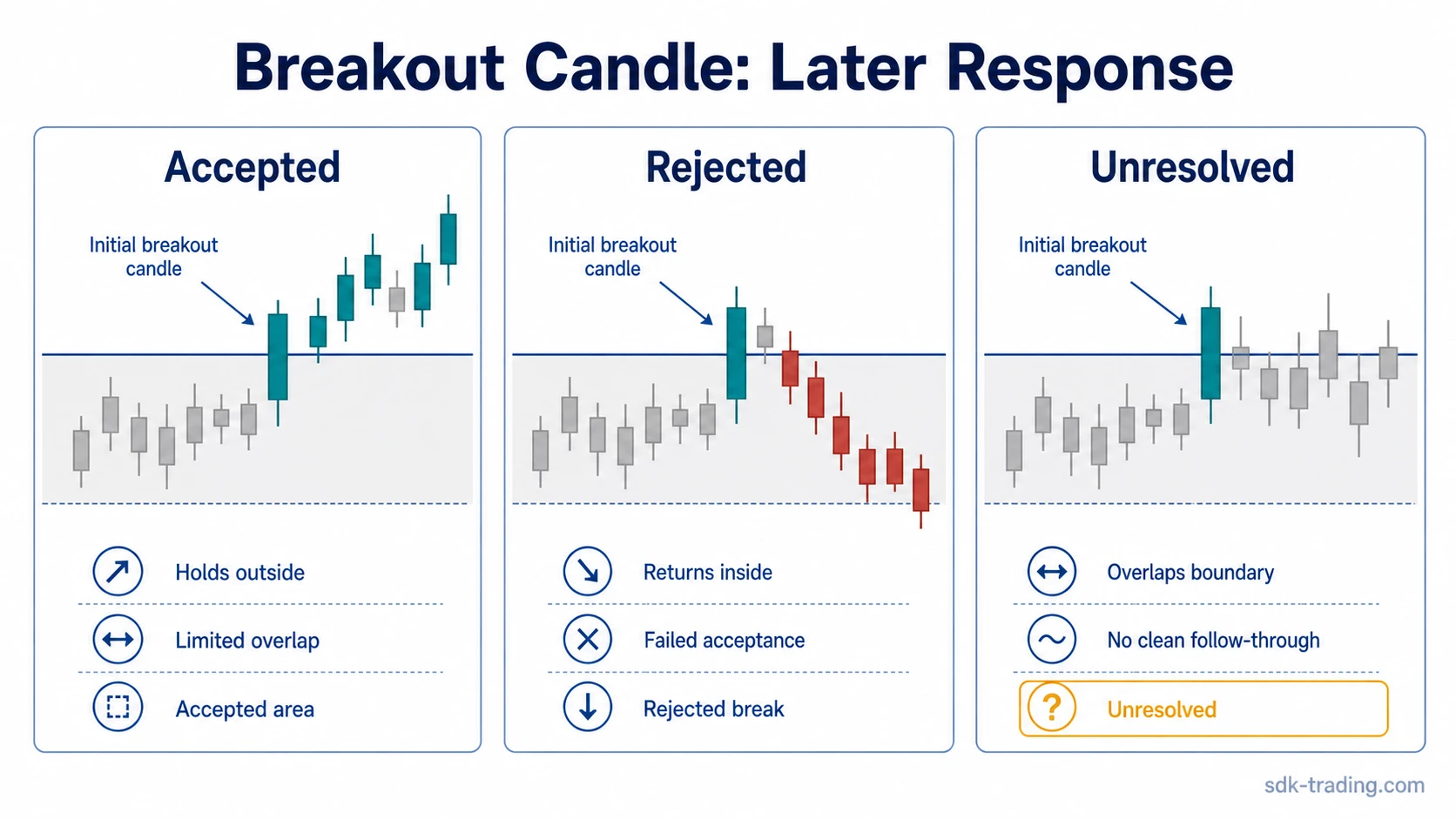
The first breakout candle creates evidence. The candles that follow determine whether that evidence gains or loses structural weight.
| Later Response | Typical Behavior | Effect on the Initial Reading |
|---|---|---|
| Accepted | Price remains outside the boundary with limited overlap and continues building structure there. | The breakout candle gains weight as part of a broader accepted move. |
| Retested and held | Price returns toward the old boundary and remains on the new side. | The former boundary may be developing a new structural role. |
| Rejected | Price quickly returns inside the old structure and cannot regain the outside area. | The breakout candle loses weight and the move may become a false breakout . |
| Unresolved | Price repeatedly overlaps the boundary without clean continuation or rejection. | The first candle remains insufficient for a strong classification. |
Breakout Candle vs Similar Candle Ideas
| Candle Idea | Main Focus | Difference From a Breakout Candle |
|---|---|---|
| Breakout candle | Body closes beyond a meaningful prior boundary. | The relationship to the boundary defines the reading. |
| Marubozu | Large body with little or no wick. | The body-and-wick shape defines the candle, even if no structural boundary is being broken. |
| Rejection candle | Price tests an area but closes away from the tested extreme. | The focus is failed acceptance rather than successful closing evidence beyond the boundary. |
| Climax candle | Extreme range or activity that may indicate a late-stage burst. | The focus is possible exhaustion, not simply whether price closed beyond a level. |
Related Candle Readings
When price breaks a boundary but quickly closes back inside the prior structure, rejection candle behavior can help describe the failed acceptance. The important distinction is whether price held beyond the boundary or only tested it before returning.
Very large range combined with unusually heavy activity can create a different question: momentum versus exhaustion. A climax candle reading focuses on extreme activity and possible exhaustion, while a breakout candle focuses on acceptance beyond a meaningful boundary.
Common Breakout Candle Mistakes
| Common Mistake | Why It Weakens the Reading | Better Check |
|---|---|---|
| Calling every large candle a breakout candle | A large body can form without breaking any meaningful structure. | Define the prior boundary before evaluating the candle. |
| Calling a wick through the level a confirmed breakout | The candle may finish back inside the previous structure. | Compare the body close with the boundary. |
| Treating high volume as proof | High activity can accompany momentum, absorption, or exhaustion. | Compare volume with the actual price result and later response. |
| Assuming a gap guarantees continuation | A gap can be rejected, filled, or belong to another structural context. | Check where the gap occurred and whether the new area is accepted. |
| Assuming bullish breakout evidence means price should never be shorted | A strong bullish setup describes current evidence, not a permanent property of the chart. | Reassess the structure if later acceptance fails or the breakout is rejected. |
| Ignoring later candles | The initial breakout can look strong and still fail immediately afterward. | Watch for acceptance, retest, rejection, or unresolved overlap. |
| Turning the candle into a complete trading decision | The breakout candle does not define risk, position size, invalidation, or reward/risk by itself. | Keep candle evidence inside the larger technical and risk framework. |
Limitations of Breakout Candle Analysis
Breakout candle classification depends on the quality of the underlying boundary. A candle breaking a clean multi-test range can carry more structural information than an equally large candle moving through a minor level inside noisy price action.
The reading is also incomplete when the candle closes. Later price can validate the outside area, reject it, or turn the initial break into prolonged overlap. This makes real-time breakout analysis inherently conditional.
A breakout candle is therefore best used as one layer of evidence inside a broader structure. It can show a meaningful attempt to leave a prior area, especially when range, gap, and participation support the move, but it cannot guarantee continuation or replace confirmation and risk analysis.