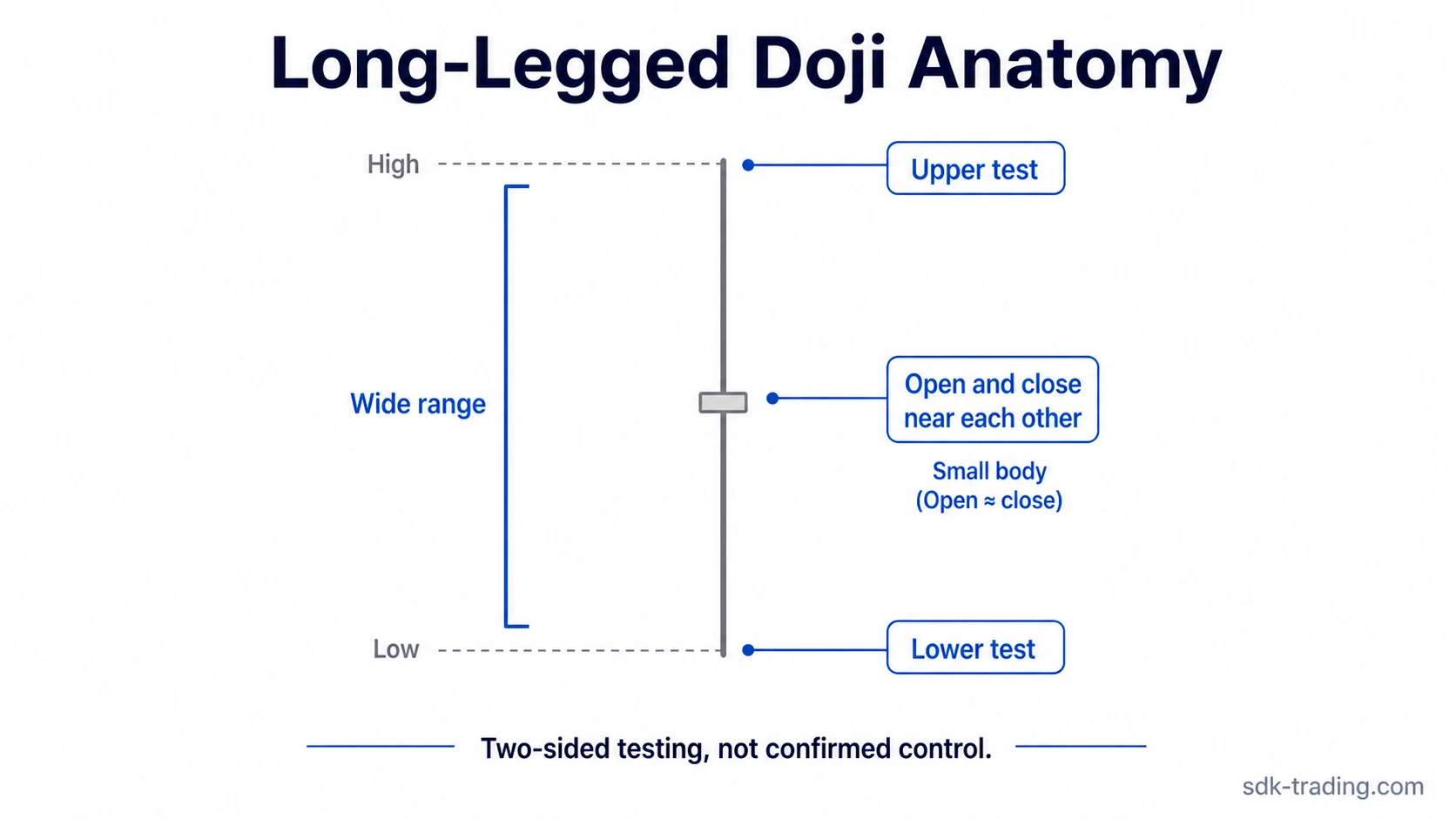
A long-legged doji candlestick pattern is a single candle with long upper and lower shadows and a small real body near the middle of the candle’s range. The open and close sit close to each other, while price has tested meaningfully higher and lower levels during the same candle.
The long shadows make the candle different from a small, quiet doji. They show wide two-sided range exploration: buyers pushed price upward, sellers pushed price downward, and neither side held clear control into the close. That creates market indecision, but not a completed bullish or bearish conclusion. The candle becomes useful only when later price behavior shows whether either side of that wide range is accepted or rejected.
Key Points
- A long-legged doji has long upper and lower shadows.
- The real body is small because the open and close are near each other.
- The candle records wide two-sided testing inside one candle range.
- The candle alone does not prove bullish or bearish control.
- Later price behavior decides whether the reading strengthens, weakens, or remains unresolved.
What Is a Long-Legged Doji?
Definition: A long-legged doji is a doji candlestick with an unusually wide high-to-low range, long shadows on both sides, and a small real body formed by a near-equal open and close.
The defining feature is the distance price traveled above and below the opening area before closing near that same area. That structure shows that both sides had a chance to press the market, but neither side finished the candle with clear control.
A long-legged doji can appear after an advance, after a decline, or inside a sideways range. Its location changes the question being asked, but the candle itself still starts with the same observation: price explored both directions and closed without a decisive body.
How to Identify a Long-Legged Doji
The pattern is identified by visible candle structure. It does not require a prediction about what price should do next.
| Feature | What to look for | Why it matters |
|---|---|---|
| Upper shadow | A long wick above the body | Shows that buyers tested higher prices during the candle. |
| Lower shadow | A long wick below the body | Shows that sellers tested lower prices during the candle. |
| Real body | Small body compared with the full candle range | Shows that the open and close stayed close together. |
| Open and close | Near the same level | Creates the doji structure rather than a directional candle body. |
| Total range | Wider than a typical quiet doji | Separates a long-legged doji from a small indecision candle. |
The shadows do not need to be perfectly symmetrical. The important point is that both sides of the candle show meaningful range extension while the body remains small.
What the Long-Legged Doji Shows
A long-legged doji shows tension between price exploration and closing control. The upper shadow shows an upside test that was not fully held. The lower shadow shows a downside test that was not fully held. The small body shows that the close returned near the opening area instead of settling strongly at one side of the range.
The candle can mark uncertainty, a pause after directional movement, a volatility expansion, or the start of a consolidation area where both buyers and sellers tested the market without producing a clean close.
Important distinction: the long-legged doji records two-sided activity. It does not, by itself, prove that a reversal has started or that continuation has failed.
Long-Legged Doji Confirmation: Stronger, Weaker, or Unresolved
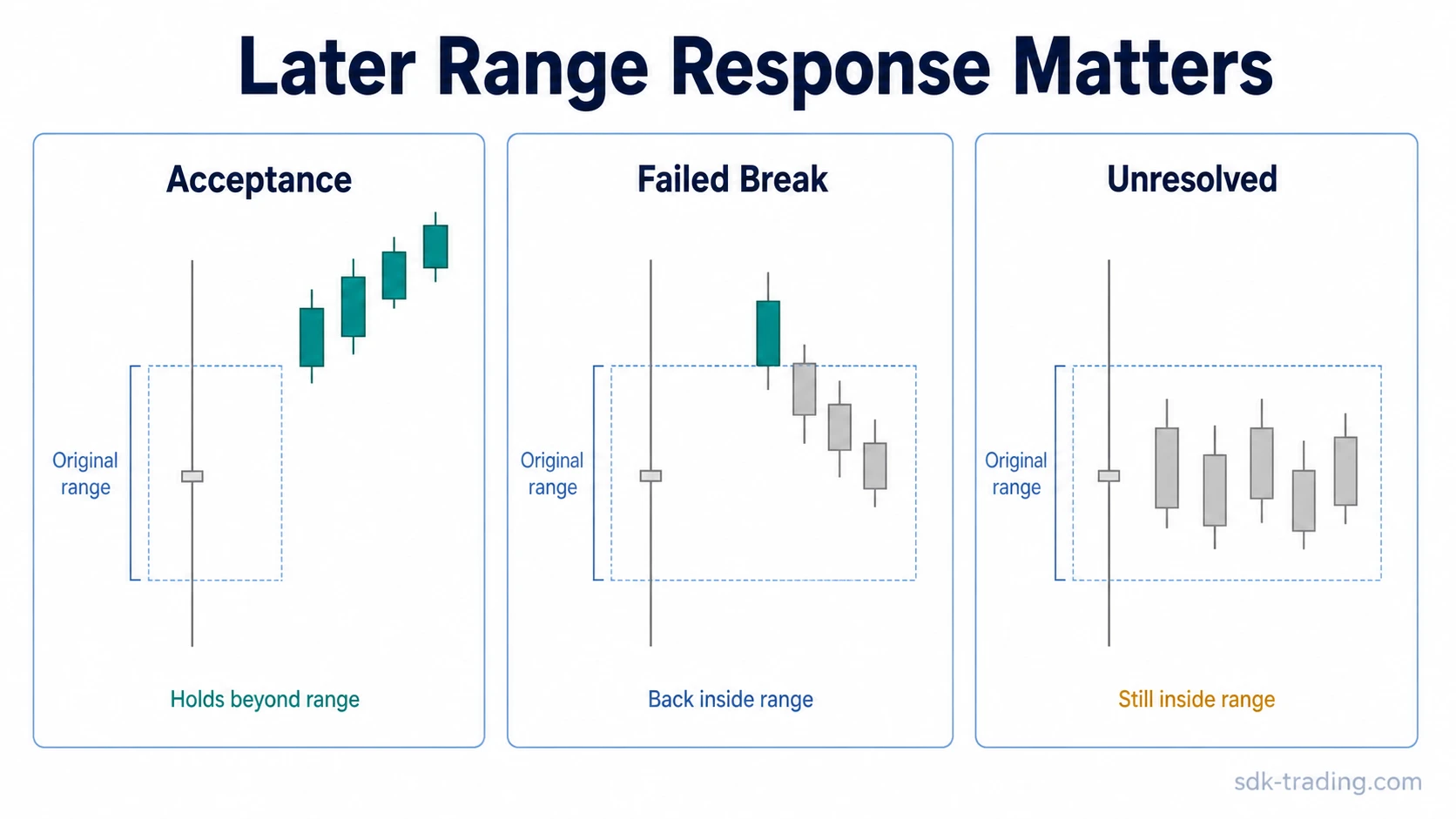
The long-legged doji range creates a useful boundary for later interpretation. The high, low, and closing area become reference points for judging whether later candles accept one side of the range or return back inside it.
| Diagnostic question | Range behavior | Reading |
|---|---|---|
| What does the candle record? | Price tested above and below the opening area, then closed near the open. | Two-sided range exploration without clear closing control. |
| What does it not prove? | The candle does not show that either side has accepted control beyond the range. | No standalone bullish, bearish, reversal, or continuation proof. |
| What strengthens the reading? | Later candles accept beyond one side of the long-legged doji range. | The market begins resolving the two-sided test in one direction. |
| What weakens the reading? | An attempted move beyond the range quickly fails back inside it. | The break lacks acceptance and the doji range remains the active reference. |
| What keeps it unresolved? | Price continues trading inside the long-legged doji range. | The candle remains a volatility and uncertainty marker rather than a directional signal. |
Long-Legged Doji vs Other Doji Candles
The long-legged doji belongs to the doji family, but its meaning is shaped by the size and balance of its shadows. It is not the same as a one-sided rejection candle.
| Candle | Main structure | Practical distinction |
|---|---|---|
| Long-legged doji | Long upper shadow, long lower shadow, small body | Records wide testing in both directions. |
| Standard doji | Open and close near each other | May show indecision, but the range may be much smaller. |
| Dragonfly doji | Long lower shadow with little or no upper shadow | Emphasizes a downside test and recovery more than two-sided range expansion. |
| Gravestone doji | Long upper shadow with little or no lower shadow | Emphasizes an upside test and failure more than balanced two-sided testing. |
| Rickshaw man doji | Long upper and lower shadows with the body near the middle | Often treated as a closely related long-legged doji form, especially when the small body sits near the center of the range. |
Trend location also changes interpretation. A long-legged doji after a strong move can raise a different question from one inside a range, which is why trend location changes the doji reading.
Common Mistakes When Reading a Long-Legged Doji
Mistake: calling the candle a reversal as soon as it appears.
Better reading: treat the candle as evidence of two-sided testing first. A reversal reading becomes more defensible only if later price behavior rejects one side of the range and begins accepting the other.
- Ignoring location: the same candle can mean different things after a trend, near a prior level, or inside a choppy range.
- Treating volatility as control: a wide range shows movement, not necessarily dominance.
- Over-reading the small body: the body confirms the doji structure, but the long shadows explain why the candle deserves separate attention.
- Using one candle without later response: the range needs follow-up before a stronger directional interpretation forms.
Long-Legged Doji Example in Context
Price has been moving upward and begins trading around a prior supply area. During one candle, it pushes above the recent high, fails to hold there, sells down through the opening area, and then recovers enough to close near where it opened. The finished candle has a long upper shadow, a long lower shadow, and a small real body.
The tempting read is to call the candle a reversal because the upper test failed. That read is incomplete because the lower test also failed. The candle has not shown clean control by either side; it has shown that both sides tested the range.
The reading gains more weight if later candles accept below the long-legged doji low or reclaim and hold above the high. It weakens if price briefly breaks one side and then returns back into the candle’s range. If price stays inside the range, the candle remains unresolved context rather than a finished directional message.
FAQ
What does a long-legged doji mean in trading?
A long-legged doji means price tested meaningfully higher and lower levels during the candle but closed near the open. It shows two-sided activity and uncertainty, not confirmed directional control.
Is a long-legged doji bullish or bearish?
A long-legged doji is not automatically bullish or bearish. The later response to the candle’s range matters more than the candle label alone.
How is a long-legged doji confirmed?
A stronger interpretation forms when later candles accept beyond one side of the long-legged doji range. A quick move back inside the range weakens the attempted directional reading.
What makes a long-legged doji unreliable?
The reading becomes weaker when price remains trapped inside the candle’s range, when a breakout quickly fails, or when the candle is read without considering trend location and surrounding structure.